
Publication - Research and analysis
Scottish economic bulletin: October 2025
Provides a summary of latest key economic statistics, forecasts and analysis on the Scottish economy.
Business Conditions
Business activity remains subdued in the third quarter though optimism is more stable.
Business Activity
- Business surveys for the third quarter of the year indicate that business activity in Scotland has remained subdued and businesses continue to face challenging demand conditions and economic uncertainty.
- The RBS Growth Tracker business survey indicates that business activity in the private sector contracted moderately in September, with the index falling to 49.2 (a reading below 50 indicates contracting business activity).[5] Ongoing challenging demand conditions were reflected by a sharp fall in new work orders (46.9), which fell for a twelfth consecutive month, and at its fastest rate since March.
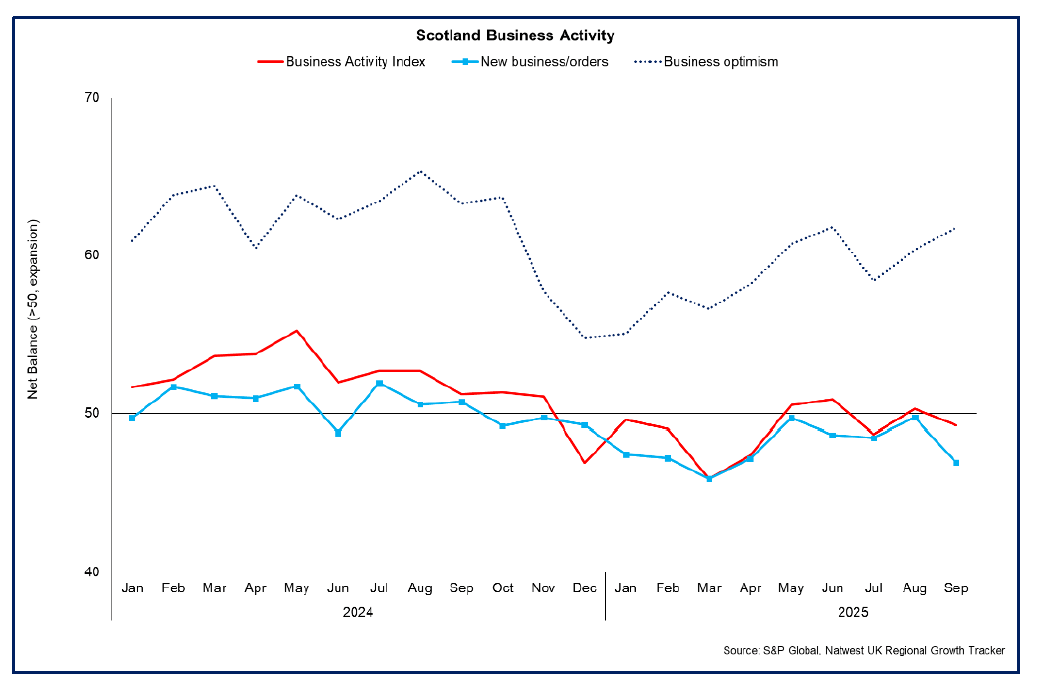
- This pattern of weak activity is echoed in the Scottish Business Monitor for Q3 2025 in which Scottish businesses, on balance, reported reduced activity (-12.3), albeit to a lesser degree than in the first half of the year. Businesses also continued to report reduced new business activity (-16.0), and to a greater degree than in the previous quarter, while Business Insights and Conditions Survey (BICS) data for August also showed a decrease in the share of businesses reporting increased domestic demand over the month (15.6%, down from 19.9% in July), further highlighting the challenging demand landscape.[6],[7]
Business Concerns
- Key business concerns over 2025 have been falling demand and taxation, alongside ongoing cost pressures. BICS data for October shows that falling demand for goods and services continues to be the most commonly cited main concern by businesses in Scotland (15.6% of businesses), albeit to a lesser degree than in September (18.8%).
- The second most reported main concern was competition with other UK businesses, which rose from 7.3% in September to 11.5% in October. Taxation as a main concern fell from 10.4% in September to 9.7% in October, and continued to ease from its recent peak of 18.0% in April when the increase in employer National Insurance Contributions (NICs) was implemented.
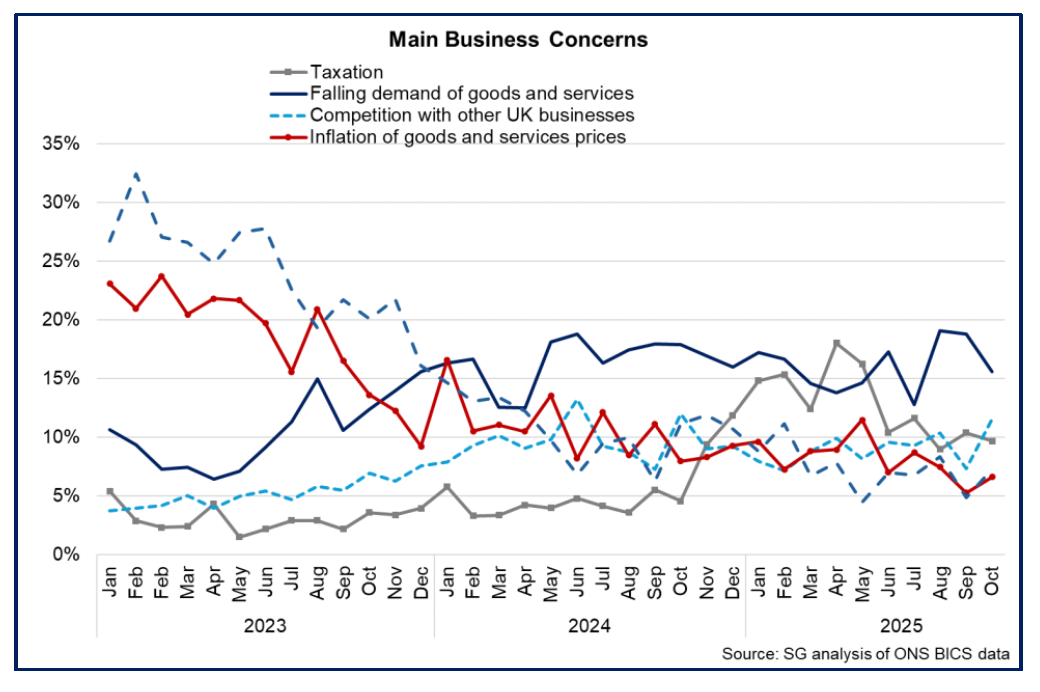
- The Scottish Business Monitor also reported that economic/business and political uncertainty remain the top concerns for businesses going into the fourth quarter of the year, which likely reflects in part the uncertainty leading up to the UK government’s autumn budget.
Business Costs
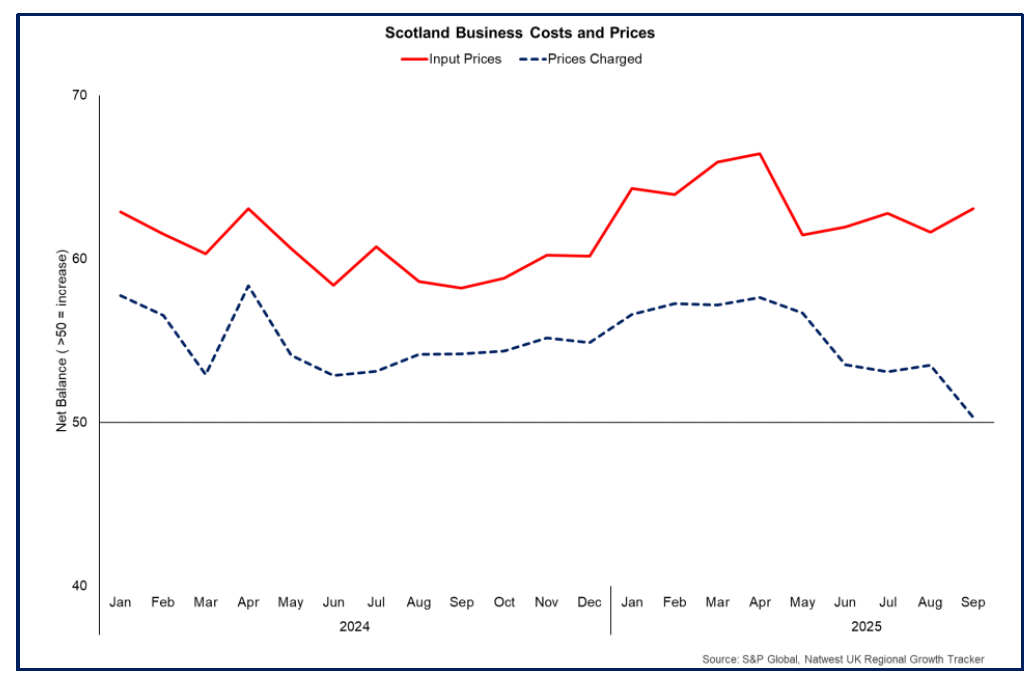
- The RBS Growth Tracker business survey indicated that business input price inflation picked up in September, with the indicator rising to a five-month high and continuing an upward trend over the past year. Increased labour costs were reported by businesses as a key driver for the rise, in part due to increased employer NICs and efforts to retain staff.
- However, output prices rose only marginally in September, and at their slowest rate since October 2020. This highlights that some businesses are not passing costs on to clients, further emphasising the challenging demand conditions facing businesses amid strong competition.[8]
- This pattern is consistent with BICS indicators showing that the proportion of businesses considering price increases has fallen in recent months from its recent peak of 40.3% in May, following the increase in employer NICs, to 12.6% in October. Labour costs continue to be the most frequently mentioned driver of businesses considering raising prices (33.8%), followed by energy costs (19.4%).
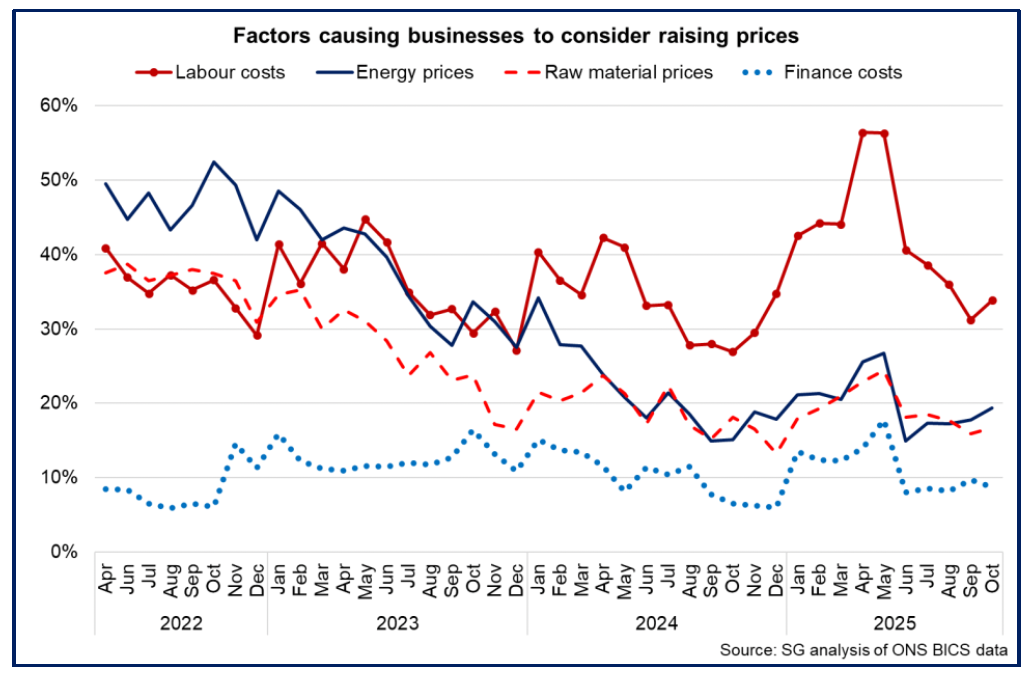
- The Scottish Business Monitor also reported that total labour costs and energy costs are key components contributing to business cost pressures in Q3, with energy costs likely to be a growing concern over the next two quarters. The survey reported that while cost pressures have eased, they remain a key issue with 78.4% of businesses reporting increased total business costs in Q3.
Business Optimism
- Despite these trends in business activity and cost pressures, the RBS Growth Tracker reported that business optimism improved in September to a three-month high with businesses seeking to improve performance and generate new work. Businesses also increased staffing for the first time in four months, albeit marginally, potentially reflecting expectations of improved activity over the coming year.
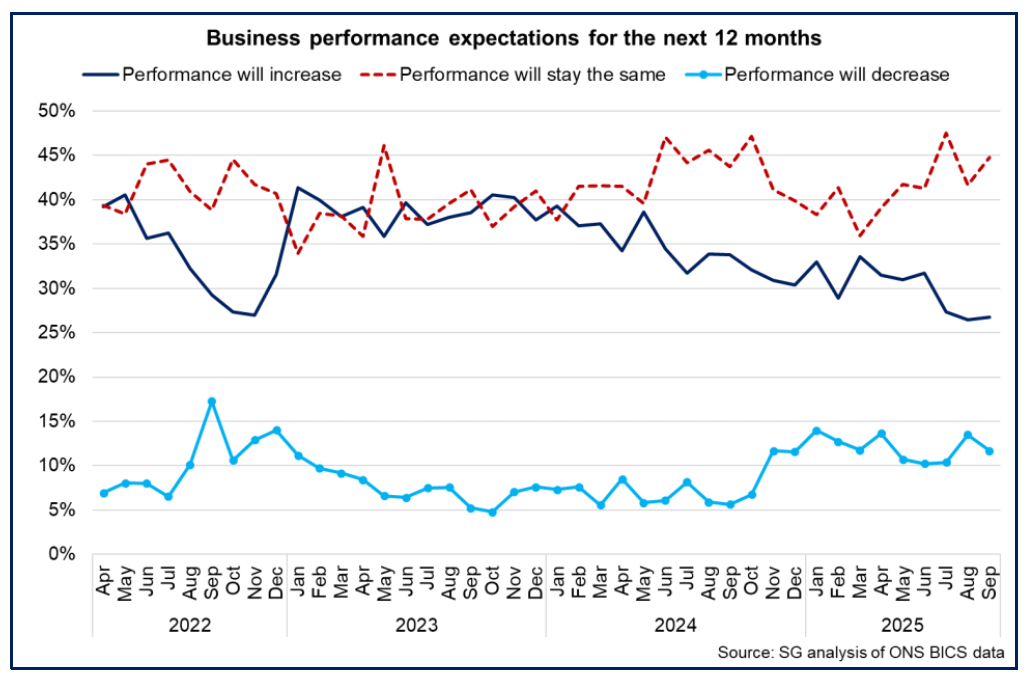
- Despite the recent improvement in optimism, the indicator remains below its level during the middle of 2024. The Scottish Business Monitor also reflects this weakness in business optimism albeit that the recent downward trend in sentiment from the second half of 2024 had stabilised in Q3.
- Similarly, BICS data shows that a decreasing share of businesses over the past year expect business performance to increase (26.8% in September), however there has been an increasing share of businesses expecting business performance to stay the same (44.8% in September).
Contact
Email: economic.statistics@gov.scot