
Scottish Child Payment and the labour market: 2026 update
This publication presents Scottish Government analysis of how Scottish Child Payment interacts with the labour market in Scotland.
Labour market indicators – update
Our previous 2024 publication considered Universal Credit conditionality and award data to investigate whether SCP could be affecting clients’ labour market decisions. This section updates those indicators using the latest available data. The methodology and limitations set out in the July 2024 publication continue to apply.
Universal Credit conditionality
SCP is most likely to affect labour market decisions among parents of young children whose entitlement depends on continued receipt of Universal Credit. The Planning for Work conditionality regime predominantly covers lone parents or lead carers of young children who are expected to move towards work in future as their children grow older, and are therefore a group likely to be exposed to labour market incentives. If SCP was leading parents to reduce work participation in order to maintain benefit eligibility, this might be reflected in lower rates of employment among this group compared with other parts of the UK.
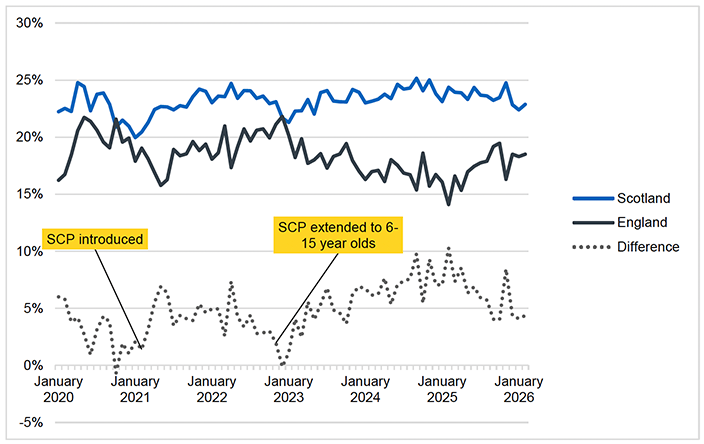
Source: DWP, Stat Xplore, People on Universal Credit
There has been a persistent, though variable, gap between Scotland and England, with claimants in this conditionality group consistently more likely to be in employment in Scotland. There is no clear evidence of a labour market impact associated with SCP; indeed employment rose relative to England in the period following the extension to 6-15 year olds. However, this indicator cannot capture changes in working hours or earnings among claimants who remain in employment.
Universal Credit award size
Eligibility for SCP is lost when entitlement to Universal Credit ends. Households receiving low Universal Credit awards are typically closer to the point at which entitlement may cease because of an increase in their earnings. Examining trends in the proportion of households receiving low awards therefore provides an indication of whether SCP is associated with more households holding themselves close to the Universal Credit eligibility boundary. However, award amounts are also influenced by household circumstances and other elements of Universal Credit entitlement.
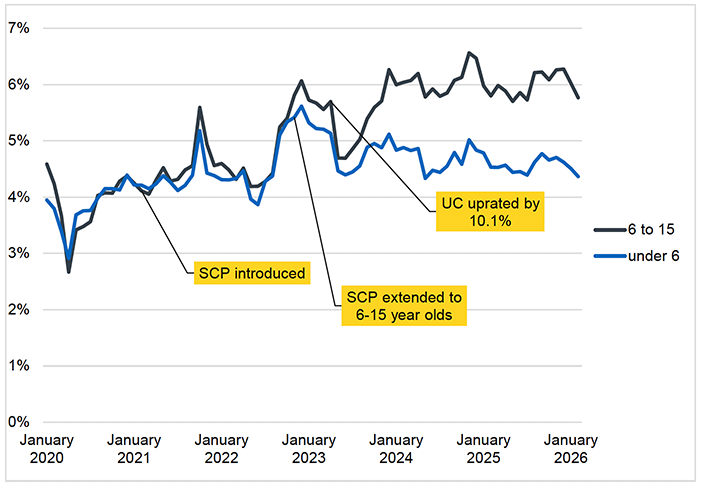
Source: DWP, Stat Xplore, Universal Credit Household Data
The proportion of households with children aged under 6 receiving low awards has remained at similar levels. For those aged 6-15, there has been a noticeable rise from 2023 onward. However, as demonstrated in figure 3, this increase is similar to that in England for this age group, suggesting that this change cannot be attributed to the extension to SCP.
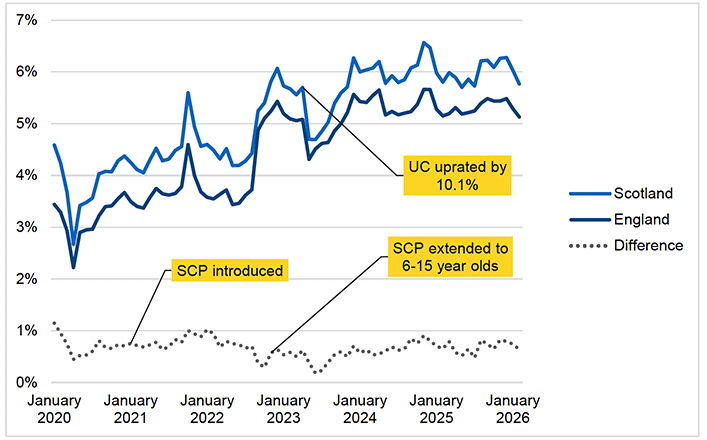
Source: DWP, Stat Xplore, Universal Credit Household Data
The difference in low awards as a proportion of caseload between Scotland and England is consistently at around 1 percentage point. In both countries, there has been a similar divergence between age groups, with those aged 6-15 having a larger proportion of claimants in the below £200 bracket.
Overall, this updated analysis continues to suggest that SCP is not leading to particular increases in low UC award amounts in Scotland relative to England. As would be expected, trends in low award amounts seem more closely linked to changes to UC rates and are similar for comparable households in England.
New Universal Credit claims
Examining the proportion of new Universal Credit claims with low awards provides an indication of whether the introduction of SCP, and increases to its value and coverage, influenced behaviour around entry to the Universal Credit system among households that are close to the earnings threshold for entitlement. Changes in this measure may reflect labour market decisions, increased benefit take-up among already eligible households, or other changes in the composition of new claims
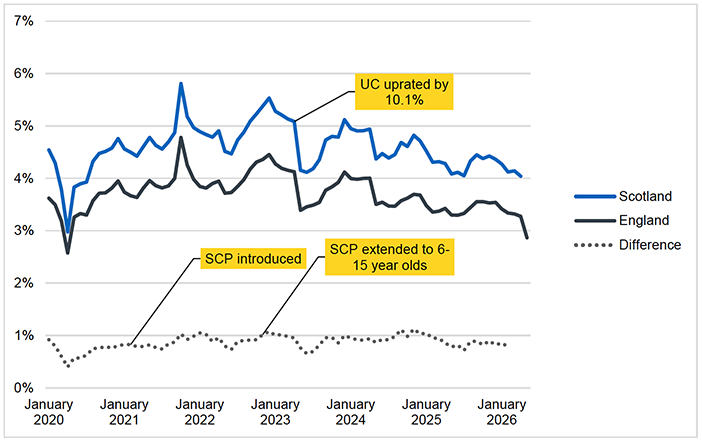
Source: DWP, Stat Xplore, Universal Credit Household Data
There is no indication from this data that the introduction of SCP, the extension of eligibility to children aged 6 to 15, or subsequent uprating has led to an increase in the proportion of new claims receiving very small awards in Scotland relative to England.
Assessment
The updated indicators provide no suggestion that Scottish Child Payment has affected labour market behaviour at a population level. Across the indicators examined, trends in Scotland have generally been similar to those observed in England following the introduction and expansion of Scottish Child Payment.
Taken together, these findings are consistent with the conclusions of the 2024 publication. While the indicators cannot identify all possible behavioural responses, they do not suggest that Scottish Child Payment has led to substantial population-wide changes in employment or earnings behaviour.
Contact
Email: ceu@gov.scot