
Scottish Budget 2026 to 2027: integrated public sector pay and workforce policy
Outlines Scotland’s integrated approach to public sector pay and workforce planning for 2026–27. It states an intention to set pay parameters, workforce reform measures, and a governance framework to deliver fiscal sustainability while supporting service redesign and protecting front line delivery.
Annex: Pay and Workforce Factsheet
This annex provides an overview of the size of Scotland’s devolved public sector workforce, and the estimated costs associated with it. This builds upon and updates the information first published in Annex D of the 2025 Medium Term Financial Strategy (MTFS).
Public sector workforce
Every quarter, the Scottish Government publishes statistics on the number of people employed in the public sector. This is based on administrative records and surveys of individual public sector bodies carried out by the Scottish Government and the Office for National Statistics (ONS)[1].
The latest available data[2] shows that in September 2025, there were 548,500 people employed in the devolved public sector in Scotland, see Figure 1.
The devolved public sector workforce headcount increased by 0.4 per cent over the year to September 2025. This increase is largely due to an increase in NHS employment of 1,730[3] (0.9 per cent).
The Fiscal Sustainability Delivery Plan published in June 2025 set out a public sector workforce reduction target of 0.5% per annum on average over the next five years, to 2029-30.
Progress towards meeting the reduction target will be assessed once full data is available for the financial year 2025-26, with the first meaningful comparison possible from data published in June 2026.
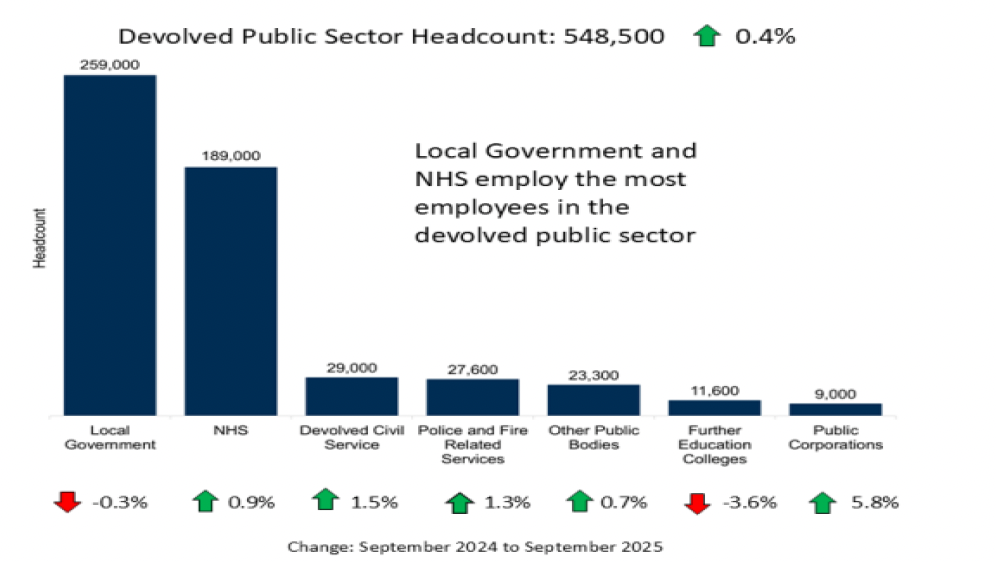
Source: Infographic taken from Public Sector Employment in Scotland Statistics for Quarter 3 2025.[4] Numbers rounded to the nearest 100.
On a full time equivalent (FTE) basis[5], there were 468,600 people employed in the devolved public sector in September 2025.[6]
Local Government and the NHS account for 45.5 per cent and 34.5 per cent of the devolved public sector on an FTE basis, see Table D.1 below.
Public sector paybill
There is currently no statistical publication setting out the financial costs of Scotland’s devolved public sector workforce.
Based on internal data collected in the middle of 2025, the public sector paybill including Local Government is estimated to have been around £27.3 billion in the financial year 2024 to 2025, see Table D.02 below. This is around £100 million lower than the estimate published in June 2025, largely due to downward revisions in the paybill for Further Education colleges upon review of the existing data.
Excluding Local Government and teachers, the paybill for the financial year 2024 to 2025 is estimated to have been around £16.5 billion.
As expected, the NHS makes up the largest part of the paybill for the financial year 2024 to 2025, accounting for an estimated £11.6 billion of spending. This estimate remains unchanged compared to the last publication.
In 2024 to 2025, pay deals were around £600 million greater than planned under the public sector pay metric, recognising the Scottish Government’s principles of fair, affordable and sustainable pay for the devolved public sector workforce in Scotland.
Multi-year pay deals provide certainty for the public sector workforce and an opportunity for the Scottish Government, employers and Trade Unions to plan for and transform our public services to improve outcomes for the people of Scotland.
Since the publication of the MTFS, the majority of public sector pay deals have now been agreed for 2025-26, and most deals agreed also cover 2026-27. At the time of the MTFS, it was estimated that where pay deals had been agreed, the costs could be around £122 million higher, compared to the costs expected under the Public Sector Pay Policy published in December 2024. Accounting for pay deals and offers made since then, this estimate has now increased to £280 million (including Local Government) for 2025-26.
It is expected that portfolios agreeing pay deals that exceed the pay metrics will deliver efficiencies through reform to ensure the paybill remains sustainable in the medium term and all deals are based on fairness and affordability. The paybill for the financial year 2025 to 2026 is now estimated to be around £29.0 billion. This takes into account the latest pay deals and offers; the Government’s commitment to reduce the workforce by 0.5 per cent on average each year, and an assumption of 0.5 per cent pay drift across all public sector workforces.[7]
Sources and Limitations
The data was primarily collected in August 2025 from Scottish Government departments, reflecting a “point in time”’ and will not therefore reflect subsequent changes. Paybill estimates include on-costs, such as employer National Insurance Contributions. The data can also not be considered as ‘outturn’ because the data was collected before final audited accounts of all public bodies were available for the financial year 2024 to 2025.
There is also a degree of uncertainty about this cost estimate, given it covers a diverse range of workforces with different pay policies and a variety of public bodies. This might result in differences in how organisations estimate and report their full-time equivalent staffing and the associated staff costs.
Information on the Local Government estimate is presented separately. Councils operate independently of central government and are accountable to their electorates for the services they provide. The most recently available Local Government Finance Statistics publication lists employee costs at £10.3 billion in the financial year 2023 to 2024.[8] Local Government Finance Statistics for 2024 to 2025 will be published in February 2026.
The figures presented in the table below are therefore estimated by applying average pay increases for the financial year 2024 to 2025 to the published outturn for the previous year.
The paybill data presented here remain subject to testing of quality, volatility and ability to meet user needs. Improving the data collection and the robustness of paybill estimates and publishing this in a transparent way is an ongoing programme of analytical activity.
Detailed Tables
| Workforce | Devolved public sector full-time equivalent staff |
|---|---|
| Local Government | 213,000 |
| NHS | 161,900 |
| Police & Fire Services | 26,900 |
| Devolved Civil Service (includes Scottish Government and some public bodies) | 27,600 |
| Other Public Bodies | 21,500 |
| Public Corporations | 9000 |
| Further Education | 9,100 |
| Total Devolved | 468,600 |
Source: Public Sector Employment in Scotland Statistics for Quarter 3 2025, table 5.
Numbers are rounded to the nearest 100 and may not sum due to rounding.
| Workforce | Paybill in £ million for financial year 2024 to 2025 |
|---|---|
| Local Government: excluding teachers* | 6,800 |
| Local Government: teachers* | 3,900 |
| NHS** | 11,600 |
| Police and Fire related services | 1,500 |
| Scottish Government | 700 |
| Other public sector workforces | 2,200 |
| Further education | 600 |
| Total (excluding Local Government) | 16,500 |
| Total (including Local Government) | 27,300 |
Numbers are rounded to the nearest 100 and may not sum due to rounding.
Source: Internal Scottish Government data. * These are estimates based on Scottish Government modelling. **It should be noted that this estimate includes spending on both staff employed by the NHS and contract staff which in the National Accounts would be classified as procurement spending. However, for the purposes of paybill modelling, it is included as it more accurately reflects pressures associated with staffing in the NHS and public sector pay.