
Scotland's future catching policy: strategic environmental assessment report 2026
Strategic environmental assessment and sustainability appraisal report for Scotland’s future catching policy: selectivity proposals consultation 2026.
Appendix D – Scottish Demersal Fish Bycatch Report
2024
Scottish demersal fish bycatch report
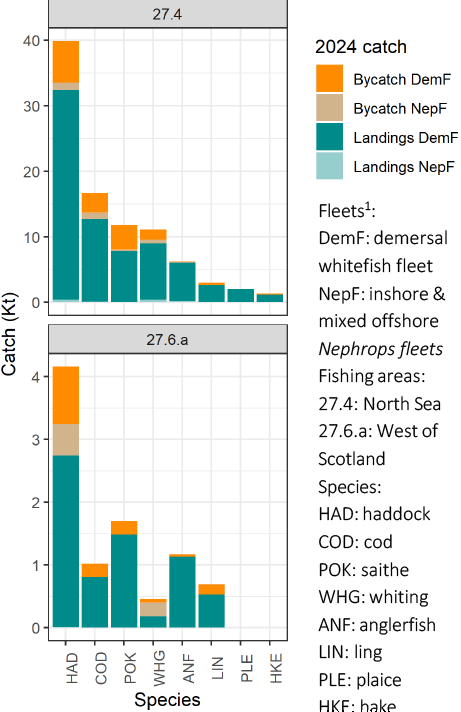
Scotland’s demersal otter trawler fleets target whitefish, inshore Nephrops and offshore mixed Nephrops/whitefish. Sampling programmes are used to make annual assessments of the quantity and composition of the demersal catch. The catch is divided into the landings and bycatch (unwanted catch) components. Figure 1 shows the total 2024 Scottish landings and bycatch of demersal fish species with the greatest catch weights.
The Scottish Demersal Observer Programme, operated jointly by the Marine Directorate of the Scottish Government and the Scottish Fisherman's Federation, collects biological data from the bycatch of these trawler fleets targeting demersal species in the North Sea and the West of Scotland. Data collected through this programme are used to estimate the quantity and composition of the bycatch of these fleets, as well as Nephrops landings.
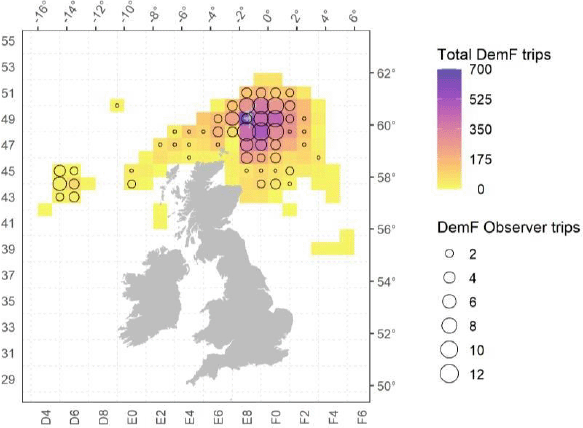
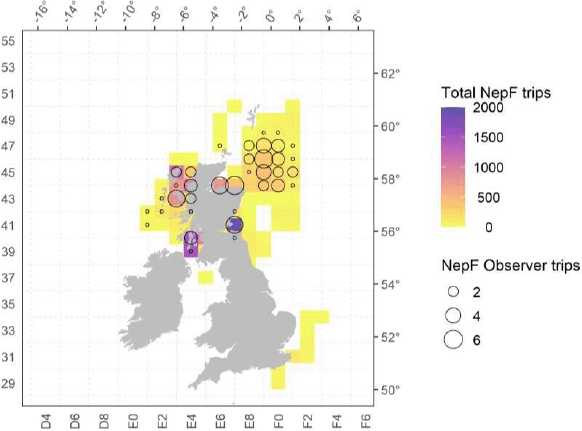
The sampling design groups vessels into sampling strata, based on vessel characteristics, main fishing areas and the composition of their catch. There are three strata for the demersal whitefish fleet: North Sea, West of Scotland and Rockall. The inshore Nephrops fleet is divided into five strata: functional units (FU): Clyde, South Minch, North Minch, Moray Firth, Firth of Forth; and the offshore mixed Nephrops fleet which operates mainly in the Fladen FU. Table 1 shows the number of trips carried out in 2024. Sampling effort of the fleets is mapped in figure 2.
At-sea, the bycatch is sampled to identify species present and record length frequencies by haul. Length stratified collection of otoliths is undertaken for predetermined species, to determine age. On trips targeting Nephrops, the sampling of Nephrops landings and fish bycatch is carried out by alternate days. Incidental bycatch of endangered, threatened, and protected (ETP) species is recorded for each haul as encountered.
Ratio estimation is used to estimate the bycatch quantity by species, using the landed weight of the species combined with the haul landing weight of cod, haddock, saithe, whiting and Nephrops to raise the bycatch weight to haul and trip level. The Horvitz-Thompson estimator is used to estimate numbers-at-age or length and bootstrapping used to estimate corresponding standard errors and confidence intervals for these estimates. Data are stored in a national database. At each stage rigorous quality checking procedures are followed.
| Fleet/Area | 27.4 | 27.5.b | 27.6.a | 27.6.b |
|---|---|---|---|---|
| DemF | 44 | 1 | 6 | 4 |
| NepF | 24 | 14 | ||
| DemF COS* | 4 | |||
| NepF COS* | 3 |
*Trial co-sampling schemes (COS), where fishers provide catch samples for processing by scientists
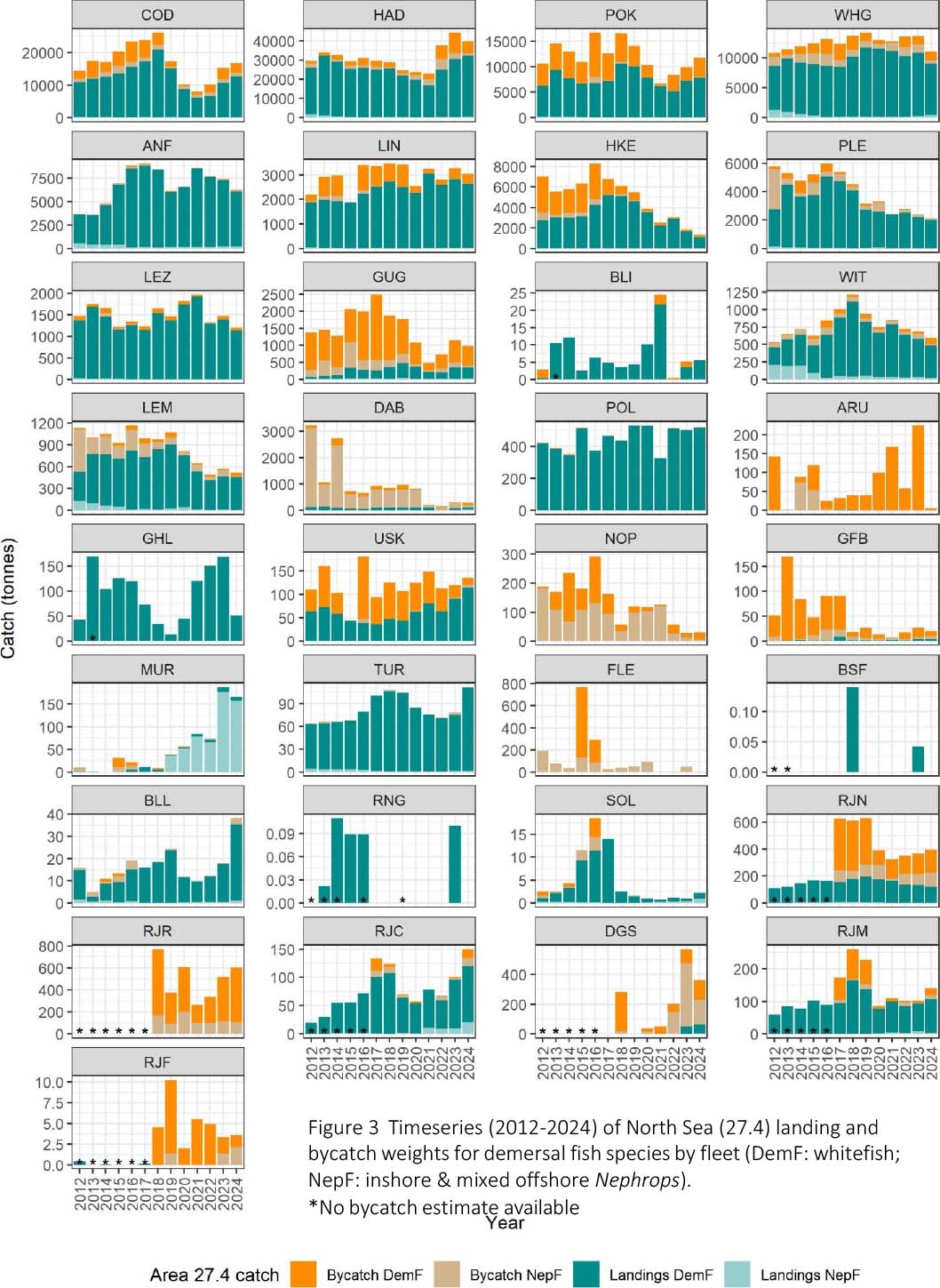
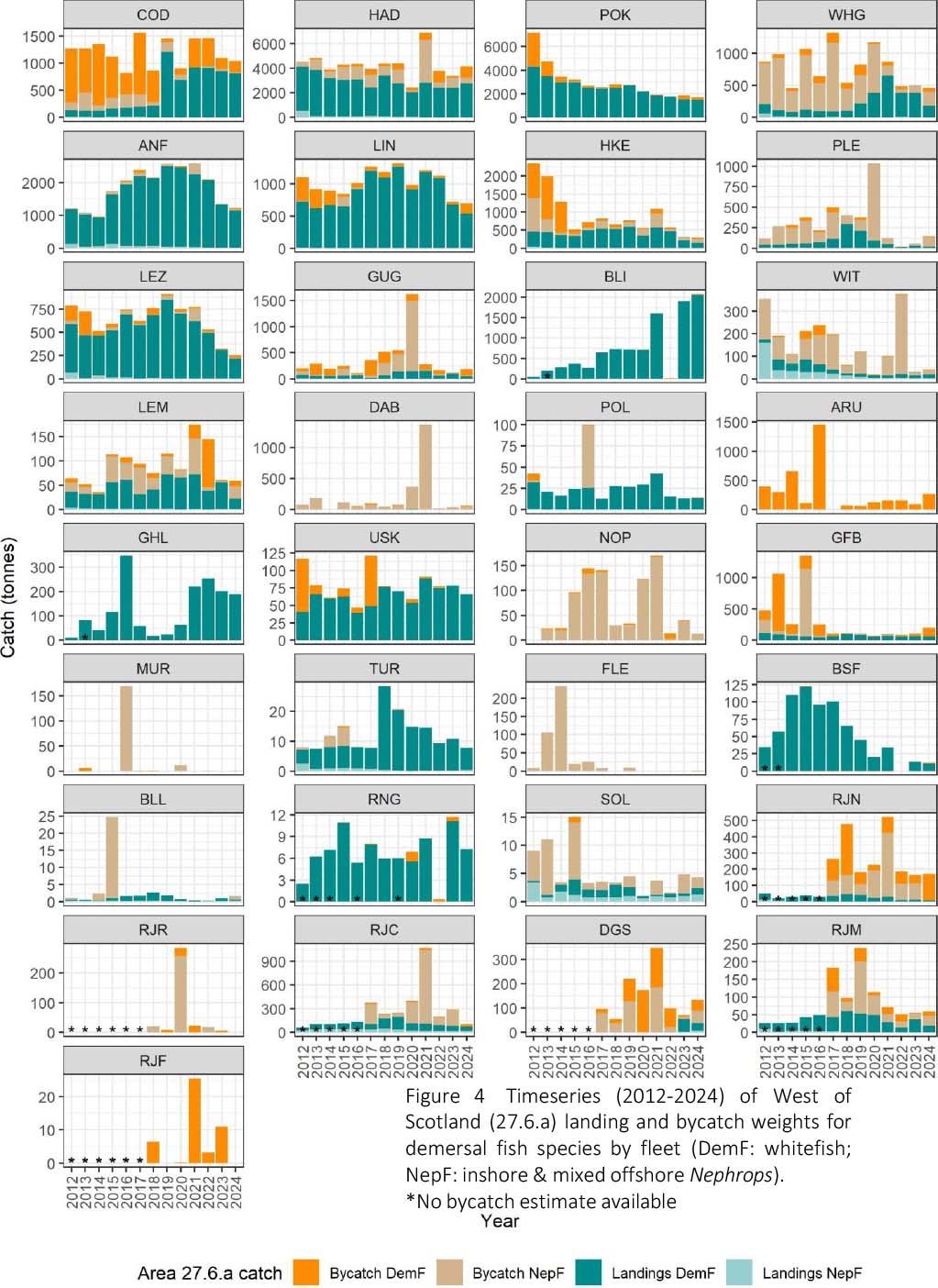
Estimates of the quantity and composition of the demersal catch are made in the spring of the year following sampling. These data are submitted to the International Council for the Exploration of the Sea (ICES) for inclusion in stock assessments. Timeseries of the landings and bycatch weight of all 33 fish species listed in table 2, by fleet and area are shown in figures 3 and 4.
A table providing the 2024 total landed weight, the estimated bycatch weight (with confidence intervals), bycatch rate and percentage of bycatch over minimum size (OMS) of all sampled fish species can be found in the spreadsheet: ‘Scottish demersal bycatch summary table 2024’.
Figure 2 Total number of fleet trips (colour scale) and total number of observer trips (open circles) by fleet (DemF: whitefish; NepF: inshore & mixed offshore Nephrops) and rectangle in 2024.
NB: for data protection, rectangles containing data from fewer than 5 vessels have been removed from view.
| Code | Common | Scientific |
|---|---|---|
| ANF | Anglerfishes nei | Lophiidae |
| ARU | Greater Argentine | Argentina silus |
| BLI | Blue ling | Molva dypterygia |
| BLL | Brill | Scophthalmus rhombus |
| BSF | Black scabbardfish | Aphanopus carbo |
| COD | Atlantic cod | Gadus morhua |
| DAB | Common dab | Limanda limanda |
| DGS | Spurdog | Squalus acanthias |
| FLE | European flounder | Platichthys flesus |
| GFB | Greater forkbeard | Phycis blennoides |
| GHL | Greenland halibut | Reinhardtius hippoglossoides |
| GUG | Grey gurnard | Eutrigla gurnardus |
| HAD | Haddock | Melanogrammus aeglefinus |
| HKE | European hake | Merluccius merluccius |
| LEM | Lemon sole | Microstomus kitt |
| LEZ | Megrims nei | Lepidorhombus spp. |
| LIN | Ling | Molva molva |
| MUR | Surmullet | Mullus surmuletus |
| NOP | Norway pout | Trisopterus esmarkii |
| PLE | European plaice | Pleuronectes platessa |
| POK | Saithe(=Pollock) | Pollachius virens |
| POL | Pollack | Pollachius pollachius |
| RJC | Thornback ray | Raja clavata |
| RJF | Shagreen ray | Leucoraja fullonica |
| RJM | Spotted ray | Raja montagui |
| RJN | Cuckoo ray | Leucoraja naevus |
| RJR | Starry ray | Amblyraja radiata |
| RNG | Roundnose grenadier | Coryphaenoides rupestris |
| SOL | Common sole | Solea solea |
| TUR | Turbot | Psetta maxima |
| USK | Tusk(=Cusk) | Brosme brosme |
| WHG | Whiting | Merlangius merlangus |
| WIT | Witch flounder | Glyptocephalus cynoglossus |
Contact
Email: fcpconsultation@gov.scot