
Scotland's Future Catching Policy: Selectivity Proposals Consultation 2026
As a result of FCP technical workshops and stakeholder engagement, and following on from our review of current technical measures, innovations, and best practises, the Scottish Government are proposing a number of changes to technical and management measures across Scottish waters.
Closed
This consultation closed 11 May 2026.
View this consultation on consult.gov.scot, including responses once published.
Annex A - Introduction to Fishing Nets
The content of this consultation is very technical in nature, and so this section should provide some clarity and reference when discussing such things as mesh sizes and square mesh panels. The majority of the technical measures in legislation relate to demersal bottom trawls, which are funnel-shaped nets towed along the seabed. The diagram below gives a breakdown of their components and operation:
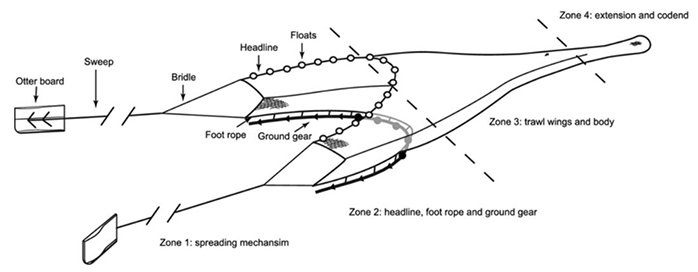
- Otter boards (trawl doors): Act as hydroplanes that spread the net horizontally.
- Foot rope: Weighted underside rope that drags across the bottom, stirring fish upward into the net.
- Headline with floats: Keeps the net mouth open vertically.
- Body and wings: Funnels fish toward the rear; mesh size may taper from larger front meshes to smaller back meshes.
- Extension piece and Codend: The terminal section where fish are collected— this is where most technical measures and legislation are focused - the mesh size here determines the minimum fish size retained. The larger the mesh, the fewer juveniles retained.
These nets may include additional selectivity devices such as:
- Square mesh panels (SMPs): Panels of square instead of diamond mesh, inserted in the upper side of the extension piece to allow fish to escape.
Mesh Sizes in Scottish Demersal Trawling
There are typically two enforced shapes of mesh within Scottish fisheries, diamond mesh (most commonly found in the extension piece and codend) and square mesh, (most commonly found in selectivity panels).
Most fishing gear is made of netting with diamond shaped meshes, this gives the gear flexibility and a certain amount of stretch. Increasing the mesh size is one of the easiest ways to improve the size selectivity of any gear and reduce by-catch of immature fish.
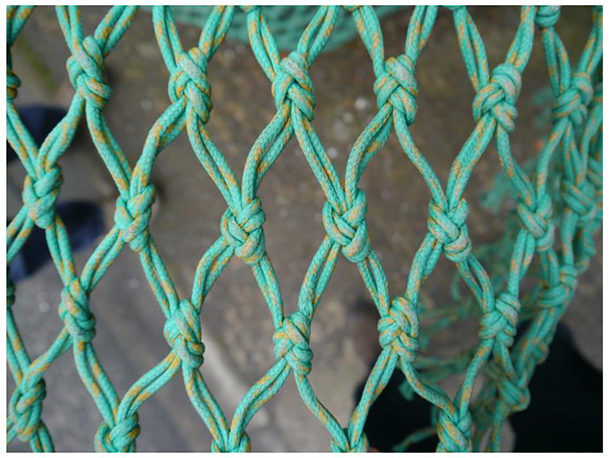
Square mesh panels are required when fishing in directed fisheries, usually when there is a need to use a smaller codend mesh size, in order to create a panel from which fish can escape from. The square mesh panel is one of the most commonly used and well-known selective devices. In this, the diamond mesh is turned 45 degrees or crafted in a knotless fashion to create a square shape which holds open upon tension throughout the fishing operation, allowing for the release of small fish.
Measuring Mesh Size
When measuring mesh size, fisheries enforcement officers will use a calibrated Omega gauge and take a series of measurements between the knots (vertically – or towards the codend when measuring diamond, and corner to corner, when measuring square mesh). Using an omega gauge was introduced by the EU in order to establish a standard for measuring nets that could be unified and replicated across all enforcement bodies. The Omega gauge uses a set strength standard, measured in newtons, and requires multiple measurements before it will give an average.
Contact
Email: fcpconsultation@gov.scot