
A review of interventions to build community cohesion and respond to anti-immigration protests
The review brings together the most relevant available evidence on short- and longer-term responses to asylum-related protests and considers evidence of their effectiveness, to inform policy and practice.
5 Findings - Responding to emerging community tensions
This section examines interventions to address emerging anti-immigration and asylum-related tensions and reduce the risk of harmful escalation. It considers three areas, covering approaches to asylum accommodation and engagement with receiving communities; communication approaches that address misinformation and support community cohesion; and responses to organised mobilisation.
5.1 Asylum accommodation and receiving communities
Evidence evaluating interventions to support community cohesion around asylum accommodation is limited. However, recent research and inquiry-based evidence provide insights into the factors contributing to tensions and identify lessons for policy and practice. In particular, Mort & Morris (2026) examine community cohesion and experiences of asylum accommodation across six English areas, while the Home Affairs Committee's (2025b) report following its inquiry into asylum accommodation draws specific conclusions relevant to community cohesion.19,88 While asylum accommodation is a reserved matter and many of the recommendations are directed at the Home Office or wider UK Government, this review draws out findings and lessons that may also be relevant to policy and practice at devolved and local levels.
5.1.1 Local pressures and responses
Mort & Morris (2026) found that hostile responses to asylum were often ascribed to wider experiences and perceived unfairness of housing scarcity, overcrowding, homelessness and rising living costs, alongside perceptions that the system was failing people already struggling locally.88 Gardenier & Pilkington (2026) report similar findings around anti-migrant mobilisation interacting with pre-existing local grievances.89 In Dover, concerns around small-boat arrivals intersected with longstanding frustrations around pollution, traffic, rubbish and sanitation.
The Home Affairs Committee (2025b) reached similar conclusions, finding that the disproportionate distribution and clustering of asylum accommodation can place additional pressure on local authorities and services and exacerbate tensions and risk damaging community cohesion, especially where services are already struggling.19 The inquiry also found that local authorities and voluntary organisations often provided unfunded support to meet needs not covered by accommodation contracts, with evidence indicating that this support has been particularly important in alleviating tensions in contingency hotels.
Research from Glasgow highlights that the pressures associated with temporary asylum accommodation are not limited to receiving communities. Drawing on a 14-month collaborative ethnography with people seeking asylum, Guma et al. (2024) found that relocation to temporary accommodation during the COVID-19 pandemic imposed additional restrictions beyond those experiences during the wider pandemic, including the loss of cash payments, curfews and reduced control over everyday life, with negative consequences for health and well-being.3 The authors analyse these experiences as processes of racialisation, reproduced through both accommodation policies and everyday interactions with private provider staff. The study also highlights a disconnect between these lived experiences and public narratives portraying people seeking asylum as living in ‘luxury’ hotels, which is linked to wider stigmatisation and hostility towards people seeking asylum.
Further, the project points to the role of collaborative research in bringing the experiences of people seeking asylum into public and policy discussions, including through a co-produced documentary aimed at communicating their everyday experiences.The documentary was subsequently used for public engagement through screenings and discussions in different areas of Scotland, including Falkirk, which was specifically chosen after asylum dispersal was extended beyond Glasgow to other areas of Scotland. Feedback from the Falkirk screening highlighted limited public awareness of the experiences of people seeking asylum living in hotel accommodation.90 Such approaches may therefore provide opportunities to challenge misconceptions and support wider community understanding.
In terms of strengthening community cohesion, Mort & Morris (2026) recommend housing acquisition that addresses local housing needs alongside asylum accommodation, as well as flexible funding for areas experiencing rapid migration-related change and a retrospective ‘community dividend’ for areas that have hosted asylum hotels.88 This would allow local authorities to respond to local pressures while investing in service capacity, cohesion and integration. Darling (2025) similarly highlights the importance of supporting sustained local capacity, drawing on Glasgow’s experience of locally funded integration networks and partnerships between local authorities and civil society to support community engagement and coordinate responses to dispersal.91
Evidence from other migration contexts suggests that the ways receiving communities experience the effects of migration may also shape attitudes. Wu et al. (2026), examining internal migration in China, found that migrant inflows generated economic benefits for local residents and that resulting increases in household wealth were associated with reduced discrimination towards migrants.92 Although the context differs substantially from asylum accommodation in Scotland, the findings suggest that whether receiving communities experience tangible benefits from migration may be relevant to intergroup attitudes.
5.1.2 A transparent and locally informed model
Evidence also consistently emphasises the importance of local consultation, communication and preparation.19,88,89,91 Darling (2025) argues for a transparent accommodation allocation model, especially as asylum full dispersal is implemented across all UK regions.91 The lack of consultation with local authorities has created concerns among local authorities over the distributional fairness of dispersal and the use of hotels. Similarly, Gardenier & Pilkington (2026) found that a lack of transparency around arrivals, such as the central government decision to repurpose Napier Barracks, was a key factor in polarising attitudes within communities and attracting anti-migrant activists to the area.89 Their research further found that local authorities and frontline organisations had developed operational knowledge through managing tensions, but that this local knowledge was often absent from national asylum policy design.
The Home Affairs Committee (2025b) inquiry provides evidence of the consequences of inadequate engagement.19 It found that opening hotels with little or no notice undermined local authorities’ ability to communicate effectively with residents and that failures to genuinely engage communities had damaged cohesion. The inquiry also heard that gaps in communication could create a vacuum that far right activists could exploit to foster tensions and anti-immigrant sentiment, as Section 5.2 illustrates. The evidence points towards practical measures including assessing impacts on local services before accommodation is procured, providing local authorities with at least 28 days’ notice of new contingency accommodation and establishing clearer data-sharing arrangements. It also highlights the value of involving local authorities and Strategic Migration Partnerships in accommodation planning, given their knowledge of local housing markets. The Home Affairs Committee (2025b) suggests that this knowledge could inform how accommodation funding is used to house people seeking asylum, while also benefiting communities by renovating housing, repurposing appropriate buildings, bringing void properties back into use, or developing housing that could later enter the social housing stock.19
Evidence also points towards greater local involvement in the governance and delivery of asylum accommodation. In oral evidence provided during the inquiry, Mort and Darling highlighted the 2026 break clause [c] in the current asylum accommodation private contracts as an opportunity to reconsider the existing model of provision.21 Mort proposed using the break clause to pilot a more decentralised model, giving regional and local bodies greater responsibility for commissioning and managing accommodation. Darling similarly highlighted the expertise held by local authorities and argued that directing resources through locally led provision could provide wider benefits for communities. Similar proposals for greater local involvement are also developed in Mort & Morris' (2024) research and Darling's (2025) written evidence to the inquiry.91,11
In its report following the inquiry, the Home Affairs Committee's (2025b) concluded that a decentralised model could provide a viable alternative to the current system and called for a future system that is more locally led but better centrally coordinated, with the Home Office working in partnership with local stakeholders while retaining ultimate responsibility and oversight.19 The Committee identified the 2026 break clause and the end of the current contracts in 2029 as opportunities to reform the current model. While responsibility for asylum accommodation remains reserved to the UK Government, these findings point to the potential for greater devolved and local involvement in accommodation planning and delivery.
5.1.3 Including the voices of people seeking asylum
The literature also highlights the importance of involving people seeking asylum themselves rather than focusing solely on receiving communities. Mort & Morris (2024) argue that the design and delivery of accommodation and support should be informed by their lived experiences through meaningful dialogue with providers and policymakers.11 In relation to community cohesion specifically, they argue that strategies should engage both local residents and people seeking asylum, identifying initiatives such as Welcome Hubs as a means of facilitating interaction, promoting positive relationships and reducing tensions. Darling (2025) similarly recommends regular collective feedback opportunities for people living in asylum accommodation.91
The Home Affairs Committee (2025b) also demonstrates how the conditions experienced by people seeking asylum can intersect with wider community tensions.19 The inquiry found that long stays in unsuitable hotels can harm residents while increasing pressures on local services and concluded that closing the least suitable hotels could help ease local tensions. It also identified shared rooms, inability to work and limited opportunities for meaningful activity as features of hotel accommodation that can contribute to tensions around accommodation sites by increasing isolation and frustration among people seeking asylum, while prolonged hotel use and pressures on local services can contribute to concerns within receiving communities. This illustrates how conditions within asylum accommodation and pressures experienced by communities can interact in ways that affect community cohesion.
5.2 Communication and misinformation
Misinformation and disinformation can fuel hostility, deepen divisions and undermine trust, creating risks for community cohesion.93 While misinformation refers to false information spread without intent to mislead and disinformation involves deliberate deception with the intention to cause harm , they are considered together here because both can contribute to the circulation and amplification of misleading claims.94 These risks are especially relevant to immigration and asylum, with recent evidence from Ireland showing widespread misperceptions about migration, which in turn predicted more negative attitudes toward immigration.95 The role of misinformation was visible during the disorder following the Southport attack in 2024, but misleading claims have also featured in more recent anti-asylum mobilisation in Scotland, including around allegations of sexual offending.34
However, the evidence highlights that negative attitudes should not be understood simply as the result of inaccurate or insufficient information. European research shows that misinformation about migration often draws on existing concerns, portraying migrants as threats to health, wealth, and identity.96 Perceived material and symbolic threats can also intersect with wider prejudice and racialised assumptions, with particular ethnic, religious and migrant groups constructed as more threatening than others.95 This wider context is important for interpreting the intervention evidence, as it suggests that correcting inaccurate information alone may not address the wider concerns and attitudes associated with hostility towards immigration and asylum. A detailed examination of racism and racialisation is beyond the scope of this review and sits within Scotland's wider anti-racism policy framework.
5.2.1 Strengthening resilience to misinformation
A recent policy paper, ‘Understanding and Addressing Misinformation in Scotland’ (2025), submitted to the Scottish Government, identifies a range of evidence-led approaches to strengthening resilience to misinformation.97 Drawing on research across psychology, behavioural science, education and digital governance, the paper identifies digital and media literacy, behavioural approaches such as cognitive reflection and ‘prebunking’[d], technological interventions including warning labels and content provenance, and improvements to platform governance. The paper therefore recommends a combination of educational, behavioural, technological and regulatory responses rather than reliance on any single intervention. It argues that people are not universally susceptible to misinformation and that resilience can be built through interventions to strengthen their ability to assess and question misleading information.
As discussed in Section 4.2, this review has found evidence that educational interventions which develop critical thinking can help address attitudes towards immigration among young people. Similarly, Howarth et al. (2025) highlight critical digital and media literacy as an important means of reducing susceptibility to misinformation.97 The paper recommends developing these skills from an early age and sustaining them into adulthood. It argues that, rather than relying on one-off awareness activities, what is needed is a “systemic, embedded approach that integrates research-informed digital resilience education throughout the curriculum and equips educators to deliver it effectively".97(p18) ‘Project Real’ provides an evaluated example of this approach. Co-created with young people, teachers, psychologists, influencers and Police Scotland, the programme combines structured misinformation and media-literacy activities with online safety and cybersecurity education. Early evaluations found increased confidence among young people in evaluating online content, although the reported outcomes relate primarily to confidence, awareness, and knowledge rather than to longer-term effects on susceptibility to misinformation or behaviour.97 While much of this evidence focuses on young people, critical thinking is also considered important for evaluating the credibility of online information more broadly .98 However, research has focused mostly on students, highlighting a need for greater attention to the wider adult population.
Beyond school interventions, prebunking is identified as a public educational tool to build people’s cognitive resistance to misinformation.96,97 An example of a prebunking intervention to address misinformation about migrants and refugees was a campaign launched by Google in partnership with academic researchers.99 The campaign used 90-second videos to expose people to manipulation techniques commonly used in misinformation, including scapegoating, emotional manipulation and false dichotomies. The videos were experimentally evaluated and found to improve people’s ability to recognise manipulation techniques, distinguish trustworthy from untrustworthy content and make better sharing decisions. Following testing, the campaign was rolled out through social media platforms in Poland, Slovakia and Czechia, where misinformation about displaced Ukrainians was prevalent. Evaluation found that the campaign improved recognition of manipulation techniques in Poland and Czechia, although effects were limited in Slovakia .100 However, these outcomes concern people's ability to identify and respond to misinformation, rather than whether their underlying attitudes towards migration changed. Wider evidence similarly cautions that correcting misinformation does not necessarily translate into changes in attitudes towards refugees.101 This distinction is important when considering evidence on how migration itself is communicated, discussed next.
5.2.2 Communicating effectively about migration
Evidence on migration attitudes suggests that communication may be more likely to lead to positive attitudes when it addresses the perceived effects of migration on society, economic or otherwise, rather than simply providing more information about migration itself. An international review of 68 experimental studies by Dennison (2022) found that communication was generally more effective when it emphasised benefits for society as a whole, similarities and common ground between migrants and receiving communities, and empathy.102 Correcting misconceptions about the effects of migration could also improve attitudes, whereas simply correcting perceptions of the number of migrants was generally less effective. These perceived effects can be broadly clustered into material threats, concerning resources, employment and welfare, and symbolic threats, concerning identity, values and culture.103
There is relatively consistent evidence that communicating the material effects of migration can influence attitudes. A large-scale experiment in Japan presented participants with information about the social and economic problems that immigration could help address, such as labour shortages for caring for the elderly.104 Exposure to this information increased support for more open migration policy. Similarly, in the US, Abascal et al. (2021) found that factual information correcting misconceptions about immigrants’ effects on crime, employment and public finances increased support for immigration.105 However, effects on policy preferences diminished rapidly over time, suggesting the need for continual reinforcement. The experimental study also challenges the ability to translate experimental findings into practice; survey respondents had to engage with the provided information, while in everyday settings people tend to avoid information that conflicts with their existing views. This raises questions about how such messages can reach those who are most sceptical of migration in the first place.
Evidence addressing symbolic and social concerns is less straightforward. Neureiter (2022) found that informing UK respondents that prospective Syrian arrivals would undertake language and civic-education courses increased support for their admission, with strong effects among respondents expected to perceive greater symbolic threat.103 However, Abascal et al. (2021) found no comparable effect from providing factual information about immigrants’ English acquisition in the US, leading the authors to suggest that cultural concerns may either be relatively resistant to factual intervention or encompass concerns extending beyond language.105 Narrative approaches provide another route. Bandiera et al. (2026) similarly found across three experiments in Colombia that migrant narratives improved attitudes towards immigrants, but increased support for more open immigration policies was associated with narratives addressing economic concerns.106 This suggests that positive feelings towards migrants do not necessarily translate into support for more inclusive migration policy.
Although these studies come from substantially different migration contexts, together they suggest that communication which engages with the perceived social and economic consequences of migration can influence attitudes. This is especially relevant to asylum, given evidence that asylum seeking people can be perceived as a greater fiscal ‘burden’ than other migrant groups.103 In the UK, Neureiter (2022) found that support for admitting people from Syria increased when UK respondents were informed that they would have limited access to welfare, particularly among groups expected to perceive greater material threat (i.e. those with conservative political beliefs and individuals with low socioeconomic status).103 While this demonstrates the importance attributed to material concerns, Neureiter cautions against translating the finding into policy, highlighting the ethical implications of restricting welfare provision. The study therefore illustrates an important limitation when interpreting intervention effectiveness, as a message may increase public support without necessarily providing an appropriate basis for policy.
The ‘Together, We are Scotland’ (2025) campaign is an example illustrating how cohesion messaging can be combined with communication addressing wider material concerns.53 In response to ongoing community tensions, the Scottish Government brought together Scotland’s Highlights 2025 and We Are Scotland, which promoted messages around kindness, inclusion and shared responsibility, with its Cost-of-Living campaign providing information about available financial support.53 An internal evaluation found positive effects from running the campaigns together, with those exposed to both responding more positively to messages about Scotland as a supportive and inclusive place to live and reporting greater awareness and use of financial support.
Finally, the wider literature cautions against assuming that any positive narrative will work equally across audiences. Banulescu-Bogdan (2022) highlights the importance of considering who communication is intended to reach, including the risk that campaigns primarily reach those who are already sympathetic towards refugees.101 Overall, the evidence suggests that effective communication depends not simply on providing accurate information, but on what is communicated, which concerns are addressed and whether messages reach the audiences they are intended to influence. This is important given that, as discussed in the following section, those mobilising around immigration and asylum are not a homogeneous group, and different concerns and motivations may require different forms of engagement.
5.3 Responding to organised mobilisation
Research suggests that anti-asylum and anti-immigration protest crowds are diverse, with people taking part for different reasons and with different levels of commitment to far right views.107,108,109 These differences are relevant when considering interventions.
Drawing together findings across this literature, this review groups participants into three broad categories: core far right activists, mobilised participants and peripheral participants (Figure 1). Core far right activists encompass committed far right activists and organisers who organise protests, shape agendas, travel between locations and mobilise others.28,108 Mobilised participants encompass those drawn into anti-immigration or anti-asylum mobilisation primarily around local concerns surrounding immigration or asylum accommodation, rather than through strong ideological commitment to the far right. While they may reject far right or racist labels, they reflect the claims and narratives about migrants promoted by the far right.108,109 Peripheral participants include those drawn in more through anti-establishment sentiment, peer influence, excitement or opportunities for disorder.23,110,111
Figure 1: Anti-immigration protest participants according to ideological commitment and motivations for participation
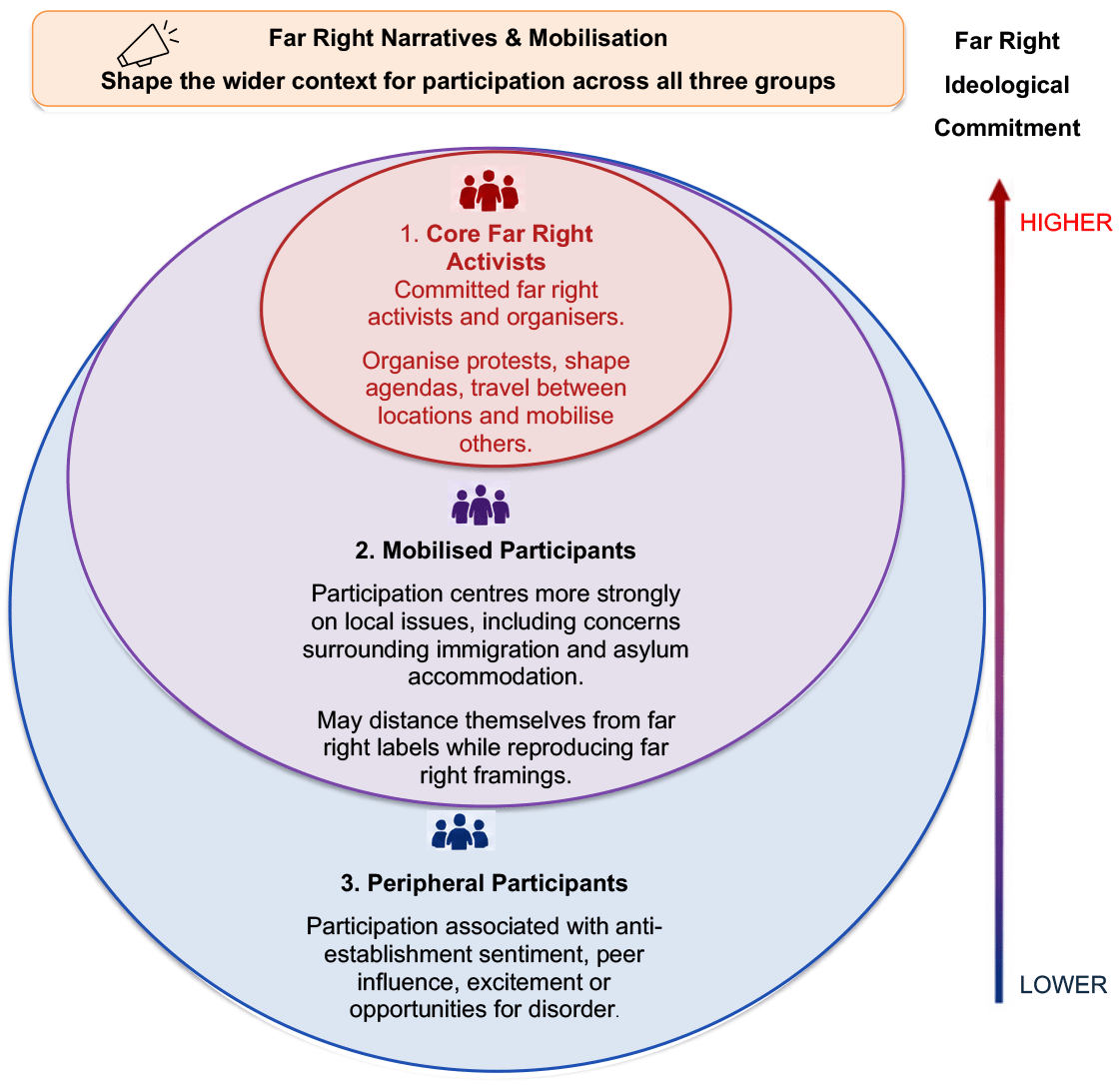
Far Right Narratives & Mobilisation Shape the wider context for participation across all three groups
Far Right Ideological Commitment
Higher
1. Core Far Right Activists Committed far right activists and organisers.
Organise protests, shape agendas, travel between locations and mobilise others.
2. Mobilised Participants
Participation centres more strongly on local issues, including concerns surrounding immigration and asylum accommodation.
May distance themselves from far right labels while reproducing far right framings.
3. Peripheral Participants
Participation associated with anti-establishment sentiment, peer influence, excitement or opportunities for disorder.
Lower
The three forms of participation point to different areas of the intervention evidence. Many of the approaches discussed so far focus on building community cohesion and are most relevant to the concerns and local tensions associated with mobilised participation (e.g., shared participation, community capacity, communications). Peripheral participation raises different issues around peer influence and opportunities for disorder, which relate more closely to public-order and policing responses and are beyond the scope of this review. The review therefore moves next to evidence from extremism and far right research, examining interventions targeting committed activists, groups and organised campaigns.
5.3.1 Intervening in far right activism
Interventions targeting far right activism operate at different levels, from interventions with individuals involved in or at risk of supporting terrorism, extremist activity to measures aimed at disrupting organised groups and campaigns.
5.3.1.1 Individual interventions
The review did not identify evaluated individual level interventions specifically addressing anti-immigration mobilisation below the threshold for radicalisation to terrorism. This points to a gap between established approaches for intervening where individuals are at risk of radicalisation to terrorism and approaches for addressing wider extremist activity below this threshold. This is consistent with wider evidence identifying a gap in responses to harmful extremist activity that falls below criminal and counter-terrorism thresholds.112
Where individuals are considered at risk of becoming terrorists or supporting terrorism, multi-agency interventions can instead provide early support. These involve collaboration between two or more agencies or organisations, including police and other public sector bodies such as education, immigration and health services, alongside non-governmental organisations and other service providers, to identify individuals considered at risk of radicalisation, becoming terrorists or supporting terrorism, coordinate referrals and provide support.113 The UK Government’s Prevent strategy provides one example of this approach, with Channel operating as its multi-agency support programme in England and Wales and the equivalent Prevent Multi-Agency Panels (PMAP) operating in Scotland.114,55
However, as mentioned above, these approaches are intended to support those at risk of becoming terrorists or supporting terrorism, rather than providing an equivalent intervention for wider extremist activism or anti-immigration mobilisation below this level of concern. As such, there are limitations to the extent to which these interventions can contribute to addressing anti-immigration mobilisation more broadly.
Further, there is limited evidence on the effectiveness of these approaches with challenges in assessing and attributing longer-term impacts to preventative interventions. Scottish research with stakeholders and public sector practitioners showed perceived benefits of multi-agency working, particularly its capacity to provide holistic and tailored support, while also finding considerable uncertainty about the effectiveness of Prevent and difficulties in attributing individual disengagement to the intervention.114 A systematic review by Mazerolle et al. (2021) searched international evidence published between 2002 and 2018 on police-involved multi-agency interventions addressing terrorism, violent extremism and radicalisation to violence, a broader outcome than radicalisation to terrorism alone.113 It found only five studies assessing effectiveness. These had a high risk of bias and/or methodological limitations, leaving insufficient evidence to determine whether multi-agency programmes reduce radicalisation to violence. An independent evaluation of Channel and PMAP, is currently underway.115
5.3.1.2 Interventions targeting organised groups and campaigns
A different strand of evidence examines responses to organised far right activity. This includes interventions on demobilising far right campaigns,6,116,117 as well as approaches to de-escalating violence within protests118,119. As public-order responses fall outside the scope of this review, the focus here is on the former. Zeller (2026) examined 40 large far right demonstration campaigns across Germany, England and Austria between 1990 and 2020, identifying different routes through which campaigns demobilised, including restricting opportunities and resources, state restrictions, civil counter-mobilisation and anti-far right militancy.6 No single condition was necessary or sufficient on its own, but different combinations of pressures contributed to demobilisation across campaigns.
State and legal responses can also affect the trajectory of far right mobilisation where relevant legal thresholds are met. Zeller (2026) identifies restrictions on demonstrations, arrests and prosecutions among factors associated with campaign demobilisation, alongside measures that reduced the resources and opportunities available to campaigns.6 In Austria, for example, the withdrawal of military participation and transport from the Ulrichsberg Celebration, followed by the withdrawal of state funding, led to the campaign's demobilisation. Where organisations are believed to be concerned in terrorism, under the Terrorism Act 2000, they can be proscribed or banned if it is proportionate to do so. In 2016, National Action became the first extreme right wing organisation to be proscribed under UK terrorism legislation.120 Macklin (2018) found that proscription was effective in physically degrading and dismantling the group, despite attempts by a minority to continue, but less successful in eliminating their online propaganda (one of the aims of banning the group in the first place).117 Zeller (2026) similarly cautions against equating the decline of a particular organisation or campaign with the decline of the wider movement.6 More generally, it has been argued that proscription can also discourage lawful political and civic activity among among communities who may be associated with but not part of proscribed groups, for example in the context of communities pursuing goals around self-determination, and concerns have been raised about how decisions to proscribe organisations are made, scrutinised and reviewed.121
Zeller (2026) also identifies civil counter-mobilisation, such as counterprotests, as particularly important in campaign demobilisation, both by directly opposing far right activity and by contributing to subsequent action by authorities.6 Similar findings are reported by Hoerst & Drury (2023), whose experiment found that counterprotests can reduce people's willingness to support far right movements by making these movements appear less legitimate and less likely to succeed.116 Zeller (2026) illustrates that anti-far right militancy involving more disruptive opposition, particularly blockades and event disruptions, was also associated with demobilisation. In the English case of the BNP's Red, White and Blue festival, anti-far right militancy increased the costs and reduced the benefits of continuing the campaign, contributing to its end.6
However, caution is needed when applying these findings to contemporary anti-immigration mobilisation. Zeller’s analysis focuses specifically on large far right demonstration campaigns involving at least 1000 participants, rather than anti-immigration mobilisation more broadly. Contemporary anti-immigration mobilisation may be less clearly bounded, involving overlapping organisations, networks and individuals whose relationship to organised far right activity and motivations for participation may vary. These differences in context and the complexities of contemporary mobilisation are considered further in Section 10.2 and are also reflected in the different levels of ideological commitment and motivations for participation examined at the beginning of this section.
Contact
Email: Fran.Warren@gov.scot