
A review of interventions to build community cohesion and respond to anti-immigration protests
The review brings together the most relevant available evidence on short- and longer-term responses to asylum-related protests and considers evidence of their effectiveness, to inform policy and practice.
10 Appendix 2: Conceptualising anti-immigration and asylum-related mobilisation
This appendix provides further detail on the conceptual and legal distinctions used in the review to understand anti-immigration and asylum-related mobilisation in Scotland. Drawing on social movement literature, it distinguishes between three interconnected levels of mobilisation including (i) individual demonstrations at the micro level, (ii) demonstration campaigns and the organisations, networks and actors that sustain them at the meso level, and (iii) the wider social movement at the macro level. These distinctions help differentiate between forms of activity that may require different policy responses and provide additional context for the interventions examined in the main report.
Figure 2. Conceptual and legal framework for understanding anti-immigration mobilisation in Scotland.
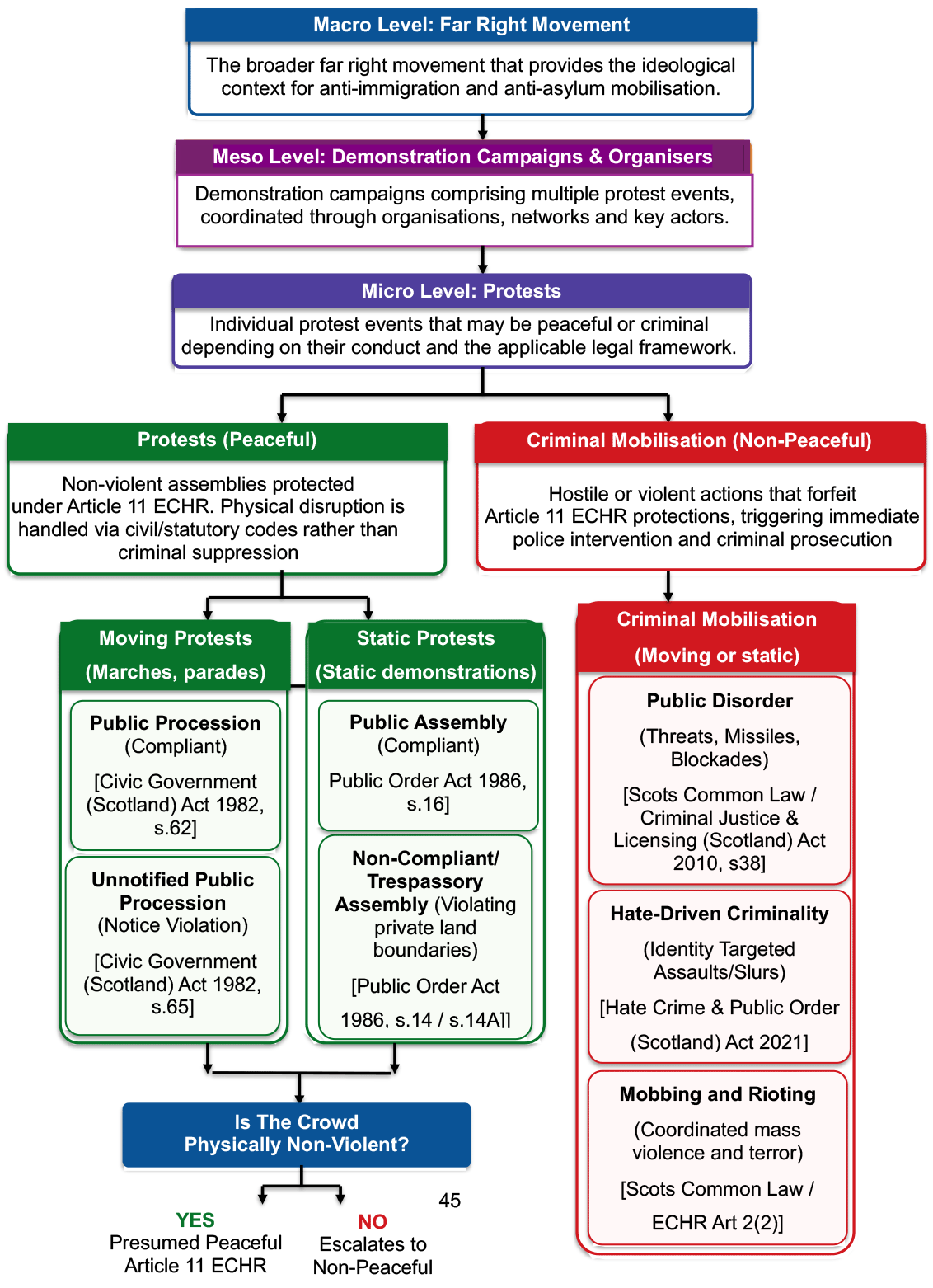
The framework presents anti-immigration mobilisation in Scotland as operating across three interconnected levels. At the macro level, the wider far-right movement provides the ideological context for anti-immigration and anti-asylum mobilisation. At the meso level, organisations, networks and key actors coordinate demonstration campaigns comprising multiple protest events. At the micro level, mobilisation takes the form of individual protest events, which are distinguished according to their conduct and the applicable legal framework.
Peaceful protests are treated as non-violent assemblies protected by Article 11 of the European Convention on Human Rights (ECHR), with physical disruption addressed through relevant civil or statutory provisions rather than criminal suppression. These can include moving protests, such as compliant or unnotified public processions, and static protests, including compliant public assemblies and non-compliant or trespassory assemblies. In contrast, criminal mobilisation involves hostile or violent conduct that forfeits Article 11 protection and may result in police intervention and criminal prosecution. The framework identifies public disorder, hate-driven criminality, and mobbing and rioting as forms of criminal mobilisation.
10.1 Micro-level: protests
At the micro level, mobilisation takes the form of individual protests and demonstrations. The rights to freedom of expression and assembly are protected by Articles 10 and 11 of the European Convention on Human Rights (ECHR), incorporated into Scots law through the Human Rights Act 1998. However, these rights apply to peaceful assembly and are not unlimited. Scottish Government (2024) guidance states that Article 11 does not apply where “participants are intent on violence or otherwise reject the foundations of a democratic society”.
As shown in Figure 2, the ‘Marches, Parades and Static Demonstrations Guidance’ distinguishes between marches, parades and processions, which require organisers to give at least 28 days’ notice to public authorities, and static demonstrations, which do not require prior notification.134 Moving and static protests may become non-compliant if they breach notice requirements or trespass on private property, under the Civic Government (Scotland) Act 1982, s.65, and the Public Order Act 1986, s.14/s.14A, respectively. However, non-compliance does not in itself make a demonstration non-peaceful.
10.1.1 Protesting: from human right to public safety concern
While peaceful protest is protected under Articles 10 and 11 of the ECHR, protests involving violence, hate crime, or other criminal behaviour pose public safety concerns and are highly likely to require a policing intervention. Research on the summer 2024 riots illustrates the difficulty of categorising mobilisation. Drury et al. (2025) argue that describing assemblies involving collective attacks simply as protests can obscure the criminality involved.107 At the same time, not all demonstrations involving criminal behaviour meet the threshold for rioting. The term ‘criminal mobilisation’ is used in this review to distinguish non-peaceful demonstrations involving criminal offences from peaceful forms of protest. These can take different forms, including public disorder, hate-driven criminality, and mobbing and rioting (Figure 2).
‘Public disorder’ includes behaviour that breaches the peace, causes serious disruption or threatens members of the public. Relevant offences include common-law breach of the peace and threatening or abusive behaviour under the Criminal Justice & Licensing (Scotland) Act 2010 s.38. Damage to property may also result in charges of vandalism or common-law malicious mischief.
‘Hate-driven criminality’ refers to criminal behaviour targeting particular groups. Where an offence is motivated by ill will towards a protected group or involves an intention to stir up hatred against a protected characteristic, the Hate Crime & Public Order (Scotland) Act 2021 may apply. Protected characteristics include age, disability, race (including nationality, citizenship, ethnic or national origins), religion, sexual orientation, transgender identity and variation in sex characteristics.
‘Mobbing and rioting’ involves collective rather than individual criminal behaviour. The Scottish Law Commision (1984) describes this as a crowd “acting together for a common illegal purpose (…) [who] act violently or behave in a noisy, violent and disorderly manner to the disturbance of the peace”.135(p4) It activates the Article 2(2)(c) ECHR exception, which legally authorises Police Scotland to deploy full public order tactical gear and use necessary physical force to stop.136
Recent events in Scotland illustrate how these categories can apply in practice and how a demonstration may move between them as events escalate. A recent example is the referred to ‘Glasgow’s summer of unrest’, characterised by multiple anti-immigration protests and counter-protests during June and July 2026.137 During the June 2026 Glasgow anti-immigration protest following the Belfast riots, an unnotified public procession escalated into public disorder. Three men were arrested and charged with various offences, while three members of the public and two police officers were injured.32 Although the specific charges were not detailed, Police Scotland reported that “members of the public were attacked because of the colour of their skin”.
A further escalation occurred at the Glasgow Green mobilisation organised by Unite the Clans at the end of July, where a number of people were arrested for offences including assault, possession of offensive weapons, breach of the peace, obstruction and resisting arrest.32 In both cases, criminal responsibility was attributed to particular individuals rather than to the wider crowd. This illustrates why criminal behaviour within a protest does not necessarily characterise the wider mobilisation as criminal, or mean that the event as a whole constitutes mobbing and rioting.
The Glasgow Green mobilisation also illustrates how interventions may target not only behaviour at individual protests, but also the organisations and campaigns that organise and sustain mobilisation. These events also form part of a broader pattern of anti-immigration demonstrations across Scotland, alongside disruptive but largely peaceful protests in Edinburgh, Perth, Ayr and Paisley.32 Looking beyond individual protests, therefore, shifts attention to how demonstrations are connected, organised and sustained over time. The meso level next considers how these protests connect through wider campaigns, organisations and networks.
10.2 Meso-level: Demonstration campaigns and movement organisations
Beyond individual protests, the meso level considers how anti-immigration demonstrations connect through wider campaigns, organisations and networks. To understand these connections, this review draws on Zeller's (2026) conceptualisation of demonstration campaigns as a series of demonstrations organised around shared claims, concerns or objectives.6 Demonstration campaigns provide a link between individual protest events and the wider social movements of which they may form part, with organisations and networks helping to organise and sustain mobilisation across events. Zeller (2026) Identifies four characteristics of demonstration campaigns.6 First, they have consistent organising actors; second, they are temporally bounded; third, they consist of strategically linked actions; and fourth, they seek to advance wider movement goals. These characteristics are considered below while tracing far right mobilisation in Scotland, recognising that contemporary anti-immigration mobilisation may not always correspond neatly to this understanding of demonstration campaigns.
1. Campaigns have a consistent organising actor, either solely or in coordination with others. Although a comprehensive mapping of the organisations and influential actors involved in anti-immigration campaigning is beyond the scope of this review, existing research identifies a range of far right organisations operating through locally rooted networks in Scotland.28 Verma et al. (2025) find that contemporary far right mobilisation is also supported by decentralised but interconnected online networks linking local and national actors to wider transnational networks.138 These networks can connect locally rooted grievances with wider extremist narratives and facilitate mobilisation across otherwise geographically disconnected locations. This underscores the complexity of identifying consistent organising actors within contemporary mobilisation, where influence and coordination can operate across overlapping organisations, networks and online communities. This is consistent with evidence from the summer 2024 riots finding that social media contributed to the rapid spread of disorder across otherwise unconnected towns and cities.27 However, Cannon & Murphy (2024) note that far right myths predate social media and argue that responses need to consider the interaction between online mobilisation and offline community dynamics.108
Anti-immigration campaigning also extends beyond protests to activities such as social gatherings, community initiatives, organisational meetings, leafleting and street posting. Sijstermans (2025) identifies a range of organisations involved in far right activity in Scotland between July 2024 and August 2025, including registered political parties and other organisations. Many of these organisations originated in England before extending their activity into Scotland while more recent mobilisation has also included the emergence of Scottish-led organisations. Sijstermans (2025) and Ellis (2026) describe an emerging Scottish dimension to far right mobilisation alongside these wider British traditions.139,28 This is also reflected in the emergence of Scottish-led organisations such as Unite the Clans Scotland in 2026.28 Formerly known as Aberdeen Against Illegal Migration, the group combines anti-immigration messaging with Scottish nationalist imagery and has attracted more than 50,000 Facebook followers.137
2. Campaigns are temporally bounded. While wider movements may continue over time, individual campaigns tend to form around particular issues or events and can lose momentum or collapse when these change.6 This distinction in relevant to the summer 2024 riots, which ended following large anti-racist counter-demonstrations across the UK, although the extent to which the counter-protests contributed to their end remains unclear, necessitating further research .107 Far right organisations and networks have continued to mobilise around new issues and events. The end of a particular campaign therefore does not necessarily entail the demobilisation of the organisations or wider movement involved. Zeller (2026) similarly distinguishes between campaign, organisational and movement demobilisation.6
3. Campaigns consist of strategically linked actions Zeller (2026) distinguishes demonstration campaigns from isolated protest events through the strategic connection between their actions.6 The concentration of anti-immigration demonstrations seen during Scotland's ‘summer of unrest’ points to the importance of considering whether recurrent protests form part of wider coordinated campaigning, rather than treating each event separately.
4. Campaigns are intended to advance movement goals. Demonstration campaigns can contribute to goals that extend beyond the immediate issue around which individual protests are organised.6 In the case of anti-immigration mobilisation, this connects individual protests and campaigns to the wider far right movement considered below.
10.3 Macro-level: the wider far right movement
At the macro level, the focus shifts from individual demonstration campaigns and the organisations that sustain them to the wider social movement within which anti-immigration mobilisation takes place. Unlike individual campaigns, social movements are broader and more enduring, bringing together different organisations, networks and actors around shared political or social goals. A growing body of literature places recent anti-immigration and anti-asylum mobilisation within the wider rise of the far right in the UK.23,24,26,107,110,138,139,140
The far right encompasses two main ideological forms: the (populist) radical right and the extreme right . While terminology can vary, there has been increasing consistency over the past two decades in distinguishing between these two forms, particularly in their relationship to democracy.7 The populist radical right is associated with nativism, authoritarianism and populism, while the extreme right is associated with intense nationalism, racism and xenophobia.6 A key distinction concerns their relationship with democracy, as the radical right challenges the liberal foundations of democracy while operating within democratic rules, whereas the extreme right rejects the democratic system itself.7
However, Pirro (2023) argues that this distinction is increasingly difficult to apply in practice because of growing links between radical right parties and extreme right movements and groups.7 He therefore calls for greater attention to what far right actors do, rather than relying only on their stated ideological positions, and advocates the systematic use of ‘far right’ as an umbrella term. For these reasons, far right is used in this review in this broader sense.
Locating anti-immigration mobilisation within the wider far right movement does not mean that everyone who participates in anti-immigration protests belongs to a far right organisation or shares the same ideological commitments. As Section 5.3 demonstrates, participants can have different motivations and levels of commitment, while far right actors, organisations and networks can enable and sustain wider anti-immigration mobilisation, including among people outside established far right groups.
10.3.1 On far right and Scottish exceptionalism
In Scotland, the far right can also draw on wider social and local grievances. Ellis (2026) describes how far right actors can capitalise on nostalgia and concerns about urban change, reframing these through narratives that attribute decline to external forces.139 This includes presenting “‘mass-migration’ and incompetent, ideologically-driven local councils” as responsible for perceived socio-structural and urban decline.139(p353)
Far right organisations in Scotland have traditionally drawn on British unionist symbols, while more recent anti-immigration mobilisation has also used Scottish nationalist imagery, including the widespread display of Saltires during protests in summer 2025.141,142 This challenges longstanding assumptions of Scottish exceptionalism, whereby Scotland has been viewed as having a distinctively social-democratic political culture that is relatively resistant to far right politics .139 Ellis (2026) argues that the discursive elements on which the far right can draw are “already well-established in Scottish political culture”.139(p368) The visibility of far right activity is reflected not only in the campaigning discussed at the meso level, but also in recent electoral developments.143 Nonetheless, recent evidence on public attitudes presents a more mixed picture: while 45% of people in Scotland thought immigration should be reduced in 2025, only 17% disagreed (while 39% agreed or strongly agreed) that people from outside Britain who come to live in Scotland make the country a better place.1 Key drivers of disagreement with the latter included having no qualifications or qualifications below degree level, experiencing financial difficulties, belonging to a White ethnic group, and not knowing anyone from a different racial or ethnic background. This reinforces the importance of considering the wider social and local contexts in which attitudes towards immigration develop.
Viewing anti-immigration mobilisation at the macro level therefore draws attention to a wider movement that extends beyond any individual protest, campaign or organisation. It also highlights the relationship between anti-immigration mobilisation, wider far right narratives and challenges to democratic institutions. The interventions reviewed in the main report operate across these different levels, from strengthening community cohesion and responding to local tensions to addressing organised mobilisation and supporting demobilisation.
Contact
Email: Fran.Warren@gov.scot