
Public procurement: survey of suppliers 2024
This is the report for the Survey of Suppliers to the Scottish Public Sector, held between 10 September and 19 November 2024. The survey aimed to help us better understand the Scottish public procurement process from the perspective of suppliers.
3. Profile of respondents
This section presents an overview of the 344 respondents to the survey. We asked the following questions to understand the characteristics of organisations who have responded to the survey.
Q2. Which of the following statements best describes your organisation? (i.e. seeking to make a profit, charity or voluntary sector, or other).
Q3. Do you consider your organisation to be a supported business?
Q4. Approximately how many people work in your organisation?
Q5. What sector does your business operate in?
Q6. In which local authority is your organisation located?
The questions in this section cover respondents’ organisation type, business sector, size and location.
3.1 Organisation type
We asked respondents how they would describe their organisation. The majority of respondents (84%, or 271 in total) stated that their organisation was mainly seeking to make a profit (e.g. for owners or shareholders). A further 14% of respondents (44 in total, n=324) responded that they were a charity or voluntary sector organisation or social enterprise. Other respondents categorised themselves as local government or central government financed bodies.[3]
Of 342 respondents, 35 respondents identified themselves as a supported business (10%).[4]
Figure 1 shows the breakdown of respondents by business size, measured by the number of people who work in their organisations.
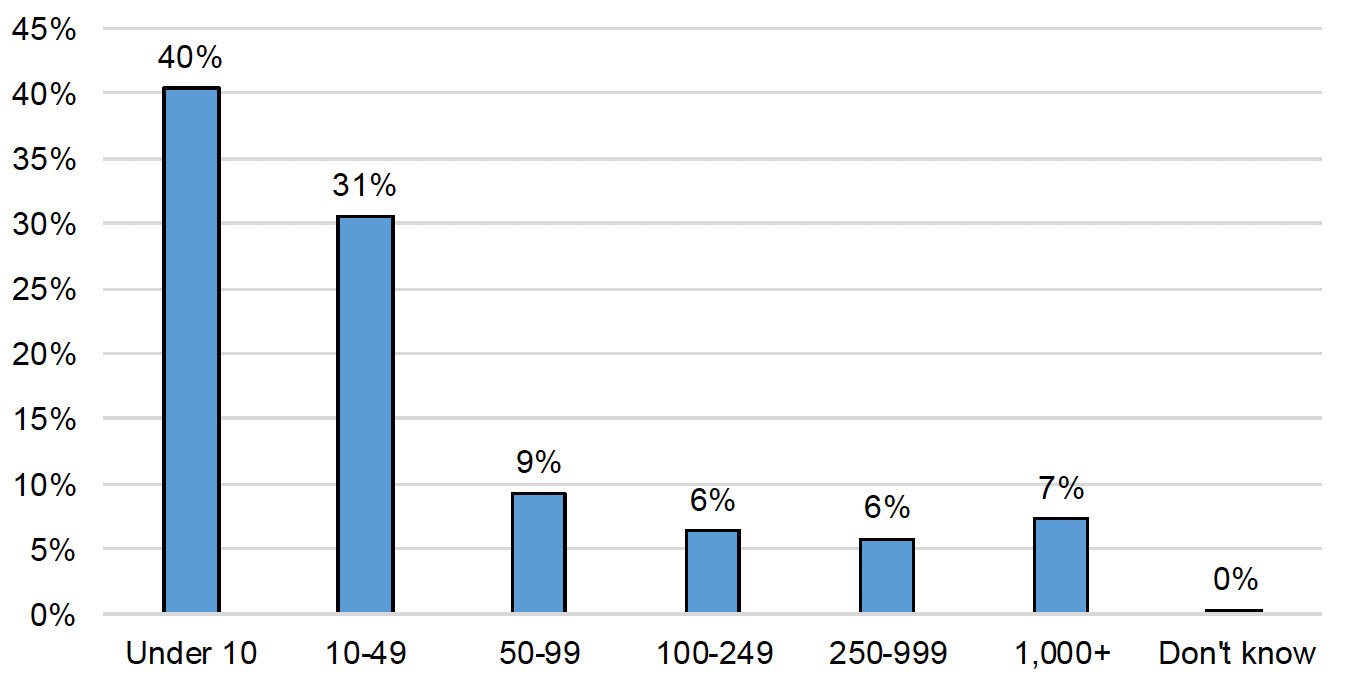
When taking staff numbers as a measure of business size, we see that SMEs made up the majority of responses to the survey. In total, 298 identified themselves as SMEs (87%, n=344).
The largest share of all respondents (40%, 139 respondents, n=344) were micro businesses (i.e. organisations with fewer than 10 members of staff), 105 respondents (31%) were small businesses (i.e. organisations with fewer than 50 members of staff), 54 respondents (16%) were medium-sized businesses (with 50-249 members of staff) and 45 respondents (13%) were large businesses (with at least 250 members of staff).
3.2 Supplier Business Sector and Location
A wide range of suppliers responded to the survey, representing diverse business sectors[5] and locations both within Scotland and the UK, and further abroad.
Table 1 shows respondents’ business sector. If respondents operated in more than one business sector, we asked them to select the sector of their principal business activity.
Table 1: What sector does your business operate in?
Business Sectors
Accommodation and food services
Respondents (n=319)
2%
Business Sectors
Administrative and support service activities
Respondents (n=319)
7%
Business Sectors
Agriculture, forestry and fishingRespondents (n=319)
2%
Business Sectors
Arts, entertainment and recreation
Respondents (n=319)
3%
Business Sectors
Construction
Respondents (n=319)
14%
Business Sectors
Education
Respondents (n=319)
7%
Business Sectors
Electricity, gas, steam and air conditioning supply
Respondents (n=319)
4%
Business Sectors
Human health and social work activities
Respondents (n=319)
10%
Business Sectors
Information and communication
Respondents (n=319)
15%
Business Sectors
Manufacturing
Respondents (n=319)
8%
Business Sectors
Professional, scientific and technical activities (including social and scientific research)
Respondents (n=319)
16%
Business Sectors
Public administration and defence, compulsory social security
Respondents (n=319)
2%
Business Sectors
Real estate activities
Respondents (n=319)
2%
Business Sectors
Transportation and storage
Respondents (n=319)
2%
Business Sectors
Voluntary Sector
Respondents (n=319)
2%
Business Sectors
Water supply, sewerage, waste management and remediation activities
Respondents (n=319)
2%
Business Sectors
Wholesale and retail trade, repair of motor vehicles and motorcycles
Respondents (n=319)
3%
The largest share of respondents operated in professional, scientific and technical activities sectors (16%, 50 respondents, n=319) followed by businesses classed as information and communication (15%, 48 respondents), and construction (14%, 46 respondents). However, almost all business sectors were represented by at least five respondents.[6]
We then asked respondents to select the local authority in which they were located. These answers were aggregated to local authority regions for this analysis.[7] If their organisation operated across multiple sites, we asked them to select the local authority in which their head office was located. The Local Authority Regions include the following groupings of local authorities areas:
- Aberdeen and North East: Aberdeen City, Aberdeenshire, Moray.
- Highland and Islands: Argyll and Bute, Eilean Siar (Western Isles), Highland, Orkney, Shetland.
- Tayside, Central and Fife: Angus, Clackmannanshire, Dundee City, Falkirk, Fife, Perth and Kinross, Stirling.
- Edinburgh and Lothians: City of Edinburgh, East Lothian, Midlothian, West Lothian.
- Glasgow and Strathclyde: East Ayrshire, East Dunbartonshire, East Renfrewshire, Glasgow City, Inverclyde, North Ayrshire, North Lanarkshire, Renfrewshire, South Ayrshire, South Lanarkshire, West Dunbartonshire.
- Scotland South: Dumfries and Galloway, Scottish Borders.
The survey received responses from suppliers located in each Local Authority Region across Scotland, as well as responses from elsewhere in the UK and from further abroad.
Figure 2 shows the breakdown of the local authority regions where respondents reported they were located.
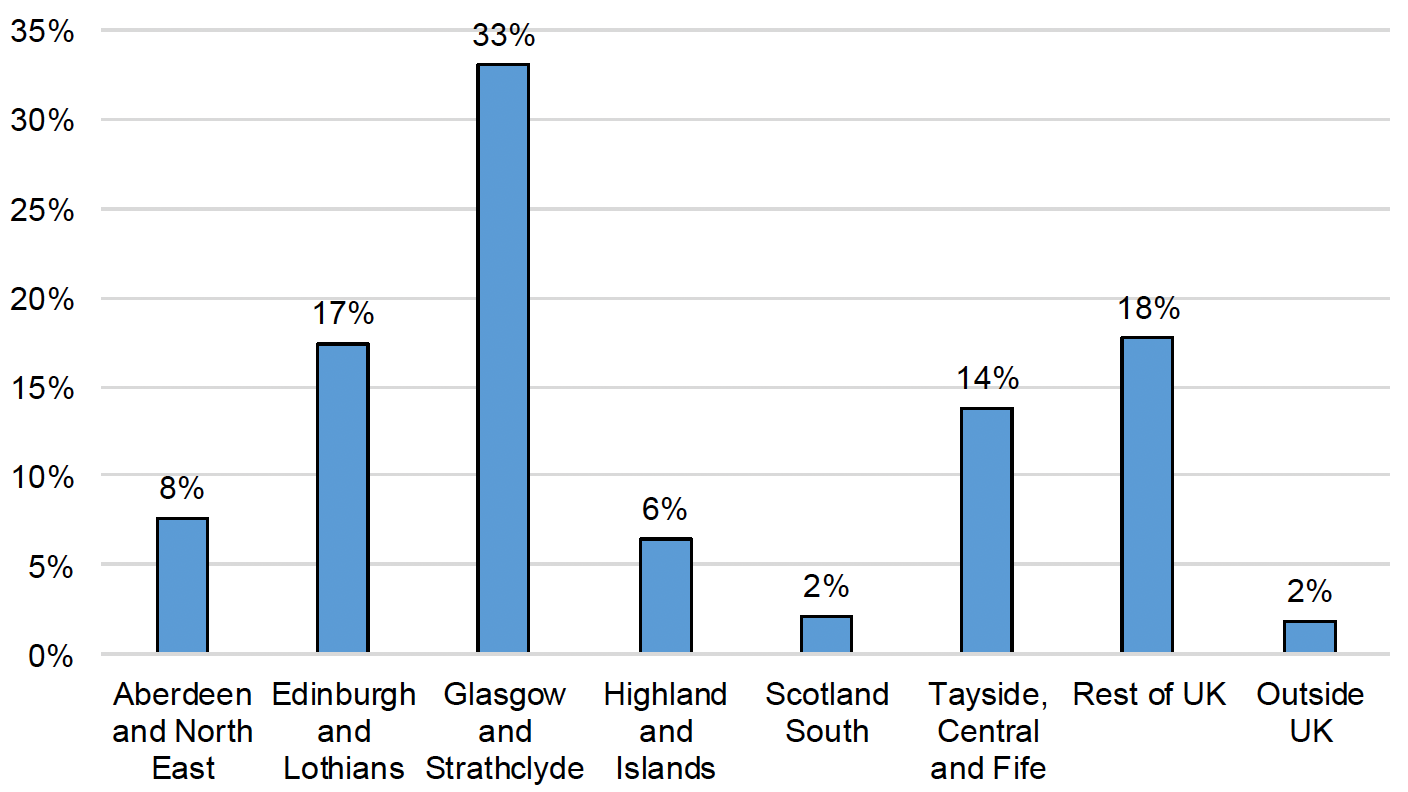
The largest share of respondents from Scotland came from the region of Glasgow and Strathclyde, with 33% (108 respondents, n=327), followed by Edinburgh and Lothians with 17% (57 respondents). Suppliers from outside Scotland comprised 20% (64 respondents) of the total responses to the survey.