
Preventing human trafficking and exploitation: evidence review
This evidence review aims to explore current understanding of approaches to preventing human trafficking and exploitation in the UK. It is part of a series of four evidence reviews. This paper provides insight on the potential merits of a public health approach.
Introduction
Human trafficking and exploitation are complex, harmful and often hidden crimes, as well as abuses of human rights and dignity. These offences can take a variety of forms. The Home Office’s 2017 typology of modern slavery identified 17 types of modern slavery offences in the UK across criminal, sexual, and labour exploitation and domestic servitude (Cooper et al., 2017). Victim/survivors may experience multiple forms of exploitation and this may take place outside of the UK, in the UK or in multiple locations (NRM, 2023).
The offence of human trafficking is defined in section 1 of the Human Trafficking and Exploitation (Scotland) Act 2015 Act as ‘the recruitment, transportation or transfer, harbouring or receiving or exchange or transfer of control of another person for the purposes of exploiting them’. The 2015 Act also introduced the section 4 offence of slavery, servitude and forced or compulsory labour. A person commits an offence where they know or ought to know that they are holding another person in slavery or servitude. A person also commits an offence where the person knows or ought to know that they are requiring another person to perform forced or compulsory labour. In addition to the legislative measures introduced by the Human Trafficking and Exploitation (Scotland) Act, the Scottish Government’s first Trafficking and Exploitation Strategy for Scotland was published in May 2017. The 2017 Strategy centres on three action areas:
1. Action Area 1 – identify victims and support them to safety and recovery
2. Action Area 2 – identify perpetrators and disrupt their activity
3. Action Area 3 – Address the conditions that foster trafficking and exploitation.
The three Action Areas were underpinned by a Child Trafficking Strategy Group, focused on issues as they related to children. The refreshed 2025 Strategy has adopted a Public Health approach to human trafficking and centers on the following four outcomes:
1. Child and adult victims are identified, protected and supported to safety and long-term recovery
2. Perpetrators are identified, their activities are disrupted and they are prosecuted
3. Improved use of data, evidence and research informs strategy implementation
4. Conditions that expose children, adults and communities in Scotland to increased risks of trafficking and re-trafficking are addressed
The prevalence of human trafficking (globally as well as in the UK and Scotland) has been the subject of much debate and remains a contentious issue (UNODC (2018) in Rigby et al., 2020). In the UK, the National Referral Mechanism (NRM) is the UK-wide framework for identifying victims of human trafficking and ensuring they receive the appropriate support. It is the primary data source for statistics on human trafficking and exploitation in the UK. However, due to the hidden nature of exploitation, NRM statistics are very likely to be an under representation of the true prevalence of exploitation in the UK (ONS, 2020).[3]
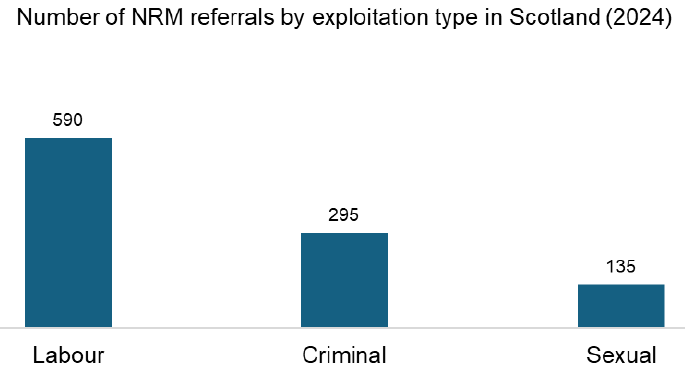
Annual NRM statistics show that there were 920 referrals for victims of trafficking and exploitation in Scotland in 2024, which is an increase of 20% on 2023 (765 referrals). There were 664 referrals for adults (aged 18 or above), and 256 referrals for children (aged 17 or under). A summary of NRM statistics by type of exploitation, gender and adult/child is provided in Table 1 and in Figures 1 and 2.
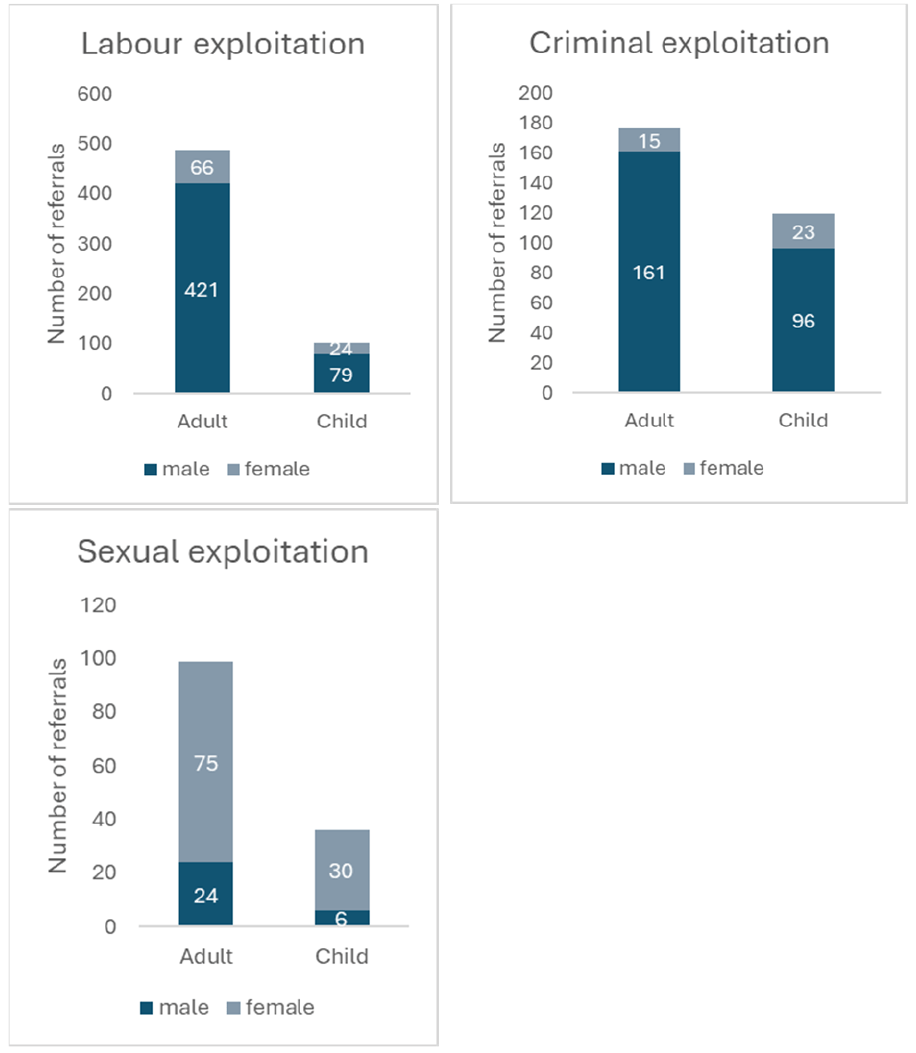
Of the 664 adult[4] referrals there were 537 males and 127 females. The most common form of exploitation was labour exploitation, with 487 adult cases involving some form of labour exploitation, followed by 176 cases for criminal exploitation, 99 cases for sexual exploitation. and 92 cases for domestic servitude[5] (see Figure 2). In a number of cases, there were more than one type of exploitation involved[6].
In 2024, Vietnamese nationals made up the largest nationality cohort across all adult referrals (227 cases), followed by Albanian (102), Eritrean (61) and Sudanese (35).
Of the 256 child referrals there were 177 males and 79 females. The most commonly reported form of exploitation for children was criminal exploitation, with 119 cases involving some form of criminal exploitation, followed by 103 referrals for labour exploitation and 36 referrals for sexual exploitation (see Figure 2).
UK nationals (82 cases) made up the largest cohort of child referrals, followed by Vietnamese (79) and Sudanese (17). Exploitation that occurred overseas (i.e. not in the UK) accounted for almost 43% of all NRM referrals (children and adults) recorded in Scotland in 2024.
Adult Female |
Adult Male |
Total (adults) |
Child Female |
Child Male |
Total (children) |
Total (all) |
|
Labour (all types that include labour) |
66 |
421 |
487 |
24 |
79 |
103 |
590 |
Criminal (all types that include criminal) |
15 |
161 |
176 |
23 |
96 |
119 |
295 |
Sexual (all types that include sexual) |
75 |
24 |
99 |
30 |
6 |
36 |
135 |
Source: Modern Slavery: National Referral Mechanism and Duty to Notify statistics UK, end of year summary 2024: data tables (Table 4)
Aims and research questions
The Scottish Government began a refresh of the Trafficking and Exploitation Strategy in 2023. Justice Analytical Services were asked to undertake a series of evidence reviews to inform and underpin the approach to prevention in the revised strategy. This includes a general overview of human trafficking prevention literature (this paper) and three smaller, focused reviews on sexual exploitation, labour exploitation and criminal publication[7]. This evidence review aimed to investigate what is currently understood about prevention strategies and interventions UK and if there are any known interventions or strategies found to be effective for preventing human trafficking of adults and children. The review was guided by the following research questions:
- What is the current understanding of prevention strategies and interventions aimed at addressing human trafficking and exploitation in the UK?
- Which interventions are known to be effective in preventing human trafficking and exploitation in the UK?
Due to a paucity of published evidence and time constraints, we were unable to evaluate the impact and effectiveness of specific interventions which limited our ability to answer question two comprehensively. The findings instead focus primarily on research question one, highlighting recommendations, promising practices and key policy principles for preventing human trafficking and exploitation.
Methodology, scope and limitations
The literature review explored the current UK literature on prevention of human trafficking and exploitation of adults and children. It was conducted over one month in 2024 and draws on 43 papers. Given the time constraints, this summary does not include an exhaustive coverage of all the available literature but instead summarises the key findings from the evidence sourced in the time available. In line with literature review methodology, the review did not include a critical appraisal of the evidence.[8] This means that there may be variations in the relevancy and robustness of included studies that have not been considered. The findings should therefore be treated as indicative.
Key word searches (Table 1, Annex A) for academic and grey literature written in English were made through the Scottish Government’s Knowledge and Evidence library and the Government Social Research EBSCO databases, alongside key websites (Tables 2 and 3, Annex A). The review included literature published since 2017, when the first Scottish Government Human Trafficking and Exploitation Strategy was published. Whilst it focused on UK based literature, it does include evidence where human trafficking is discussed in an international or global context or covers the UK alongside other countries (e.g. literature by WHO, UNODC, GRETA). Moreover, the review includes literature on all levels of prevention – primary, secondary, and tertiary – in line with a public health approach. Finally, input was sought from external academic experts to identify relevant literature, including engagement with the Modern Slavery & Human Rights Policy and Evidence Centre. Annex A provides further details on the search strategy.
A note on terminology
Language and terminology in this field is contested (Balch and Hesketh, 2024). Whilst this report adopts the terms human trafficking and exploitation in line with Scottish Government legislation and strategy, related terms such as “Modern Slavery”[9] may be used when reporting on specific evidence. The terms “victim” and “survivor” are used interchangeably to refer to people who have lived experience of trafficking and exploitation.
Contact
Email: justice_analysts@gov.scot