
Preventing criminal exploitation: evidence summary
This paper is part of series of evidence reviews which aim to explore current understanding of prevention strategies and interventions in relation to human trafficking and exploitation in the UK. This paper focuses on the prevention of criminal exploitation of adults and children.
Findings
Prevalence
The prevalence of human trafficking (globally as well in the UK and Scotland) has been the subject of much debate (UNODC (2018) in Rigby et al, 2020). In the UK the primary data source is the National Referral Mechanism (NRM) statistics. However, due to the hidden nature of criminal exploitation, NRM statistics are very likely to be an under representation of the true prevalence of criminal exploitation in the UK[6]. Indeed, wider evidence suggests that the NRM process does not represent the true number of child victims of human trafficking and exploitation in Scotland (Rigby et al, 2020). For example, a Glasgow Child Protection Committee study identified that child referrals to the NRM constituted about a third of known cases in the city (Rigby et al, 2020).
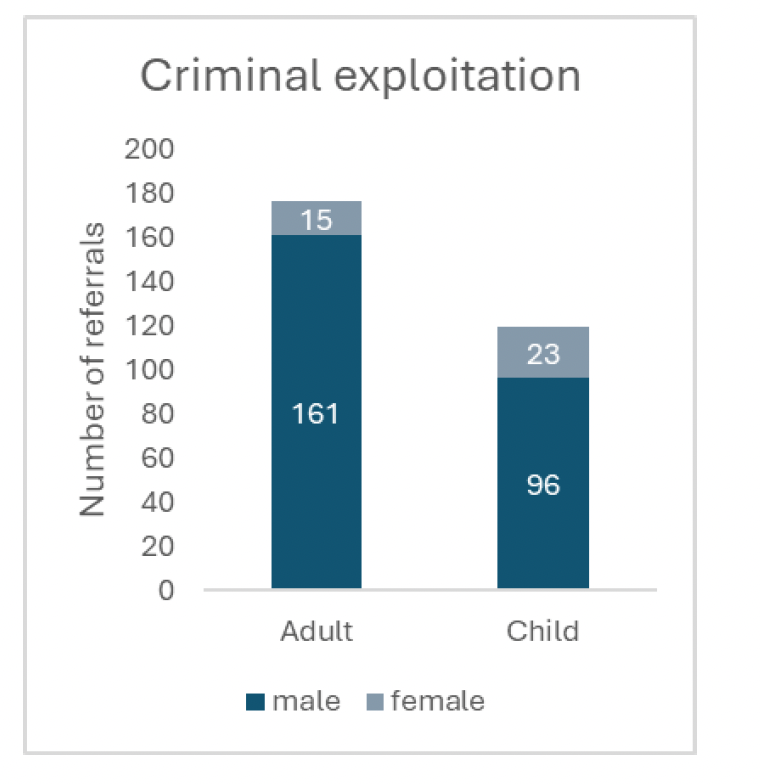
National Referral Mechanism (NRM) statistics for Scotland for 2024 show a total of 920 victim referrals[7] for all forms of human trafficking and exploitation. Criminal exploitation is currently the second most common form of reported human trafficking and exploitation in Scotland, after labour exploitation, accounting for 295 (of 920) NRM referrals in 2024 (see Table 1 below - using the combined figure). In 2024, one quarter of all adult NRM referrals (26% or 176) and nearly half of all child referrals (46% or 119) involved some form of criminal exploitation. In terms of gender, almost all adult victim referrals for criminal exploitation were male (93% or 161); this was also the case for the majority of child referrals (81% or 96) (see Figure 1).
| Adult Female | Adult Male | Total (adults) | Child Female | Child Male | Total (children) | Total (all) | |
|---|---|---|---|---|---|---|---|
| Criminal Exploitation (only) | 4 | 72 | 76 | 14 | 70 | 84 | 160 |
| Criminal Exploitation Combined (all types that inc. criminal) | 15 | 161 | 176 | 23 | 96 | 119 | 295 |
Source: Modern Slavery: National Referral Mechanism and Duty to Notify statistics UK, end of year summary 2024: data tables (Table 4)
The majority of adult referrals related to foreign nationals (only 8 referrals for UK nationals), with the most referred nationality being Vietnamese (81). In contrast, the majority of child referrals were for UK nationals (60), followed by Vietnamese (23). The UK Home Affairs Committee Inquiry into Human Trafficking in 2023 notes that county lines exploitation primarily involve UK national victims and in particular, UK national children (HoC,124, 2023). NRM county lines data broken down by region (for Scotland) is not currently available.
Risk factors
Understanding and mitigating the risk factors for exploitation is crucial for building resilience and preventing harm. People from any background can be criminally exploited. However, children and young people and adults with vulnerabilities can be at increased risk of criminal exploitation. Risk factors are wide ranging but can include deprivation or lower economic status, insecure immigration status, mental health issues, homelessness, experience of care or the criminal justice system, and substance or alcohol misuse amongst others. For children and young people, specific risk factors can include experience of adverse childhood experiences (ACEs), not being in mainstream education, going missing, lack of a safe/stable home environment, physical or mental health issues and special educational needs (Home Office, 2023; CSJ, 2024; Oswald et al., 2024; Children’s Society, 2019; National Crime Agency, 2019). That said, some evidence suggests that organised crime groups are also targeting young people without these vulnerabilities and those unknown to authorities (Maxwell, 2023; Dando et al., 2023), particularly as technology has created new means for recruiting/exploiting victims and facilitating crimes (CSJ, 2024; The Children’s Society, 2019; Dixon, 2023).
Ofcom, in relation to the Online Safety Act, highlights ways in which technology and online platforms can be used to target potential victims through fake profiles, fake job offerings and the use of encrypted private messaging services to groom and facilitate travel of migrants. Perpetrators can use social media to gain an insight into people’s lives and then use this information to manipulate and exploit them (Ofcom, 2023). Further investigation is required to better understand the use and impact of technology in human trafficking and exploitation.
The current response to preventing criminal exploitation
Overall, the literature suggests that current responses to addressing and preventing criminal exploitation have tended to focus on criminal justice responses i.e. tertiary prevention. Human trafficking and exploitation cases are complex to investigate and prosecute. The literature highlights the challenging nature of policing, investigating and prosecuting criminal exploitation, particularly where it is not always easy to distinguish the victim from the perpetrator(s) (Olver & Cockbain, 2021; Shaw & Greenhow, 2020; Espeute & Lanskey, 2023).
Barriers to victim-identification identified in the literature include an over-reliance on victim accounts, particularly the lack of disclosure from children (Espeute & Lanskey, 2023); the absence of a shared statutory definition of child criminal exploitation; the lack of information sharing between police and statutory agencies (HMICFRS, 2024); and a lack of understanding of the scale and nature of child exploitation (HMICFRS, 2024).
Whilst there are no official statistics on how many people are criminalised for offences committed as a result of trafficking and exploitation in the UK (EPCAT, 2021) or on the use of the ‘non-punishment principle’[8], the literature consistently flags concerns about failures to apply the principle effectively (Barnardo’s, 2021; CSJ, 2024). The UK Home Affairs Committee inquiry into Human trafficking in 2023 highlighted that victims of criminal exploitation often face arrest and prosecution before consideration of their victimisation, allowing traffickers and organised crime groups to evade justice (HoC,124, 2023).
Wider evidence describes the statutory defence used in England and Wales (which is how the non-punishment principle is applied there) being raised late in the criminal justice process; investigations discontinuing when the defence is raised; and delays whilst awaiting NRM decisions (IASC referenced in EPCAT, 2021; Hestia, 2020; Langhoff et al, 2024). Concerns about the implementation of the non-punishment principle has also been raised in relation to child victims of trafficking and exploitation. UNICEF (2017), in its review of trafficked children and the non-punishment principle in the UK, including Scotland, found very low levels of awareness among prosecutors, police and defence solicitors of the non-punishment protections and little monitoring of its use.[9]
A common theme across a number of reports/research papers concerning child criminal exploitation was the prioritisation of prosecution over safeguarding (Action for Children, 2024; Dixon, 2023), causing further harm and risk of exploitation (Action for Children, 2024). Other areas of concern cited in the literature include a failure to understand the links between missing children and exploitation and a poor understanding of safeguarding/child protection by the police (HMICFRS, 2024). Delays in investigations and NRM decisions, were also highlighted, which sometimes result in a victim only being recognised as such following prosecution (HMICFRS, 2024; Pearson and Cavener, 2024; Marshall, 2023). A report on child trafficking in Scotland highlighted the prioritisation of the NRM over a child protection referral, citing the need for multi-agency child protection responses to take precedence (Rigby et al., 2020).
In terms of prosecutions of perpetrators, some of the literature cites the low number of prosecutions against perpetrators of trafficking and exploitation in England and Wales, and in Scotland (Action for Children, 2024). Other research highlights a lack of understanding and inadequate implementation of legal remedies (Olver and Cockbain, 2021) including Trafficking and Exploitation Prevention Orders (TEPOs) and Trafficking and Exploitation Risk Orders (TEROs) in Scotland (Dixon, 2023).
The absence of a shared statutory definition of criminal exploitation was a recurrent theme across the literature, including child criminal exploitation, and/or the creation of offences for specific types of exploitation such as cuckooing.[10] For example, a recent report by the Centre for Social Justice (CSJ, 2024, pg. 5)
noted that the UK’s overall response to criminal exploitation “is inconsistent, stemming largely from an incomplete and confusing definition in legislation and policy.” This includes inconsistency in terms of both support for victims and prevention of exploitation. Similarly, the recent Jay Review of Criminally Exploited Children (Action for Children, 2024) attributed variation in practice to the absence of a statutory definition of child criminal exploitation.
A public health approach to preventing criminal exploitation: challenges and barriers
The relevance and benefits of a public health approach to preventing human trafficking and exploitation, whereby prevention is addressed on three levels: primary, secondary and tertiary prevention (Such et al., 2017), is covered in a separate evidence review produced as part of this series[11]. Robust evidence on public health approaches to preventing criminal exploitation is lacking. However, some government reports explicitly recommend this approach such as the UK Government briefing on Serious youth violence: county lines drug dealing and the Government response (Home Office, 2022).
Maxwell at al.’s (2019) rapid review of service responses to child criminal exploitation emphasises the need for primary prevention interventions to address the vulnerabilities that place children and young people at increased risk of exploitation (see risk factors listed above).
Though early identification and intervention is considered essential to prevent and respond to child criminal exploitation, the literature reviewed for this paper highlighted concerns about a lack of a contextual safeguarding approach[12] - which assesses risks outside the family/home environment - and a lack of consistency across agency responses (Maxwell et al., 2019; Wroe, 2019; Barlow et al., 2022; Action for Children, 2024). Key issues highlighted in the literature include a poor understanding of the scale and level of risk to children, and how definitions, thresholds and ‘family-focused services’ may not be appropriate for abuse that occurs outside of the family (Ofsted, 2018; Maxwell et al., 2019).
Research with parents with direct experience of child criminal exploitation found that participants felt that the current safeguarding system was ill-equipped to respond to extra-familial abuse (Maxwell, 2023). Parents (in this case mothers) reported feeling judged and struggled to access services (Dando et al., 2023). This was due to perceived systematic or individual professional failures to understand and recognise child criminal exploitation (Dando et al., 2023). The same research highlights the value of parental insights into behavioural changes in children being criminally exploited and potential indicators of grooming and recruitment which could help recognise signs of exploitation early (Dando, 2023; see also Maxwell, 2023).
Evidence-led approach
Defining and monitoring the problem is a key feature of a public health approach (see the WHO 4-step public health approach to reducing violence). The literature reviewed for this paper highlights the lack of accessible, routine and accurate data collection on criminal exploitation, particularly child criminal exploitation (Children’s Society, 2019; Barnardo’s, 2021; HMICFRS, 2024; Rigby et al., 2020) The need for better data on victims (e.g. risk factors and markers) and on prosecutions and convictions is also stressed (CSJ, 2024; Oswald et al., 2024; Hestia, 2020; The Children’s Society, 2019 and 2020; The Centre for Social Justice, 2024). Similarly, Dixon (2023), in their review of child criminal exploitation in Scotland, highlights the need for a better understanding of the nature and scale of the problem Dixon (2023) also calls for more consideration of models of exploitation and patterns of criminal activity, and to ensure evidence informed policy and practice, including prevention efforts.). Rigby et al. (2020) recommend a central Scottish repository to be established to collate information and monitor prevalence and patterns relating to children exploited through trafficking.
Multi-agency working and information sharing
The literature reviewed for this paper highlights the importance of a multi-agency response in preventing criminal exploitation. A ‘whole system approach’ is recommended that includes “policy, prevention, disruption, protection and support across multiple agencies” and interventions at national, community, family and individual child level (Maxwell et al., 2019, pg. 33). Olver and Cockbain (2021) found that consistent frameworks for information sharing could lead to more effective responses. Similarly, Dixon’s (2023) review reported that multi-agency working and consistent information sharing is essential for tackling child criminal exploitation and safeguarding victims. The Jay Review recommends the creation of “a new cross-border protocol for sharing data between the four nations” (Action for Children, 2024, pg. 10).
However, evidence suggests that there remain challenges to achieving this way of working. Barriers include different data operating models, GDPR concerns, lack of resources, and diverse working cultures and priorities (Home Office, 2021; Olver & Cockbain, 2021; Neaverson & Lake, 2023). Evidence suggests that local operational issues are compounded by a lack of data and information sharing on child criminal exploitation at a national level which makes it difficult to identify, prevent and respond to the problem (Action for Children, 2024). The Jay Review also found a lack of coordinated policy and practice at a local and national level, including the absence of consistent, national leadership and strategy on tackling child criminal exploitation (Action for Children, 2024).
Supporting victims and preventing re-exploitation
Access to tailored, specialist support for criminal exploitation is reported to be limited in the UK (HoC, HC 124, 2023). Over one-third of Dixon’s small sample of participants (n=22) who work within child criminal exploitation noted the lack of child criminal exploitation specific services in Scotland (Dixon, 2023). Moreover, a lack of suitable accommodation and placements and appropriate mental health support for children and young people were flagged as key barriers to preventing re-exploitation (Dixon, 2023; Langhoff et al., 2024).
Promising practices for preventing criminal exploitation
Very few anti-trafficking and exploitation interventions and services are evaluated, or evaluated robustly in the UK (Sereni & Baker, 2018; Home Office, 2021). There is therefore a lack of sound ‘what works’ evidence on how to prevent and respond to criminal exploitation effectively. However, a number of promising practices identified in the literature are briefly summarised below. Themes already covered are not listed i.e. the need for more effective multi-agency working and information sharing; better evidence and data; and calls for a statutory definition of criminal exploitation.
Engagement: The evidence reviewed emphasises the importance of relationship driven approaches in responding to child criminal exploitation. Guidance in the form of toolkits[13] and the wider literature stresses the importance of persistence and building trust with young people and their families Dixon (2023). Other key factorsare being “flexible, responsive to the child’s needs and vulnerabilities, and [are] delivered in a way that makes the individual feel safe” (Dixon, 2023 p65) ; ). The value of engaging at “reachable” moments, for example during school exclusion or returning from a missing episode, is also highlighted (Langhoff et al., 2024).
The need for time and investment is identified – time to build trusting relationships and develop trauma-informed services, and investment in services and staff to retain staff and provide support for as long as victims need it (Neaverson & Lake, 2023). Peer mentors/engagement with mentors with lived experience of child criminal exploitation is highlighted as a promising practice (Maxwell et al., 2022; Oswald et al., 2024).
Schools and education: The links between children missing from education and safeguarding risks, including the risk of child criminal exploitation are well documented (CSJ, 2024; Oswald et al., 2024). The literature identifies schools and colleges as a key protective factor – in identifying and safeguarding children at risk of exploitation (Ofcom, 2018; Jay Review (2024). A number of papers suggest that reforming school exclusion policies and/or reducing exclusions may reduce the risk of exploitation (Dixon, 2023; Oswald et al., 2024; Neaverson and Lake, 2023).
Other approaches recommended by the Centre for Social Justice include on-site therapeutic programmes and mental health support, mentoring, additional academic support, and restorative justice sessions (CSJ 2009 cited in Oswald et al., 2024). After school and extra-curricular activities are also highlighted as preventative factors (Dixon, 2023). Other suggestions in the literature reviewed include training of school staff (to identify those at risk) and specialist education in schools on drugs, grooming, child criminal exploitation, financial exploitation, knife crime, and harmful relationships (Maxwell et al., 2022; Oswald et al., 2024).
Training and awareness raising: The literature emphasises that training and awareness raising on criminal exploitation must be prioritised so that those most likely to come into contact with potential victims are able to recognise the signs of exploitation and respond effectively. This includes police officers (particularly first responders); social workers; housing officers; teachers; custody, prison and probation staff; NHS staff including GPs, A&E departments, sexual health and school nurses; landlords and housing associations (CSJ, 2024; CSJ, 2021; Hestia, 2020; Ofsted, 2018; Maxwell et al., 2019; Centre for Social Justice, 2024).
Awareness raising among parents/carers, the general public, communities and local businesses is also recommended, particularly those who frequently encounter children and young people (Dando, 2023; CSJ, 2024). As evidenced in the broader human trafficking and exploitation literature, awareness raising should be tailored to its audience and context (e.g. community) with a clear behaviour change focus in order to promote “deep literacy” and action (Such et al., 2022, pg. 14).
Finally, research also suggests that crime prevention and community safety approaches should be incorporated into prevention efforts in line with contextual safeguarding approaches (Barlow et al., 2022).
Contact
Email: justice_analysts@gov.scot