
Northern Shelf Mackerel: Fisheries Management Plan
This Fisheries Management Plan (FMP) relates to North East Atlantic (NEA) mackerel (Scomber scombrus) and is one of 43 FMPs set out in the Joint Fisheries Statement (JFS).This FMP sets out the policies and actions to manage the North East Atlantic mackerel stocks at sustainable levels.
Background
Stock
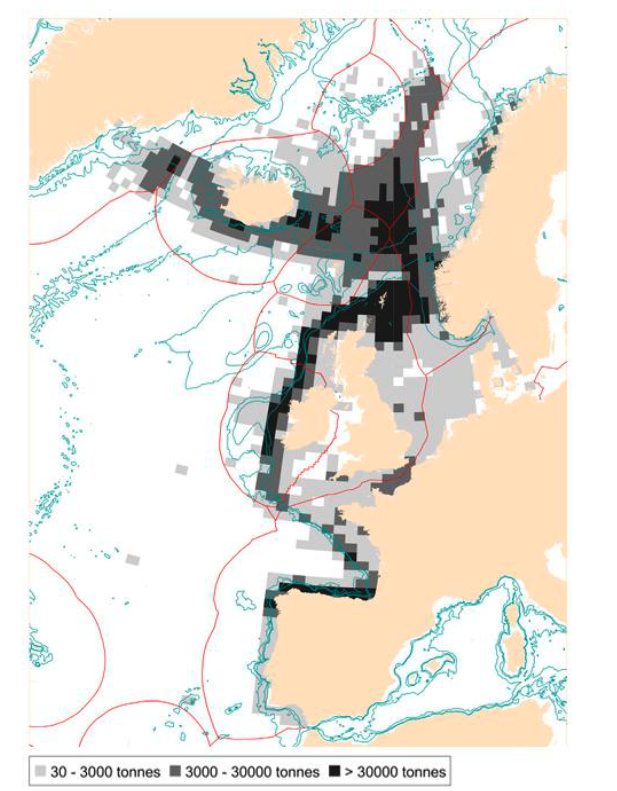
Mackerel is a pelagic, fast-swimming species that forms large schools in the upper water column, primarily as a defensive mechanism against predation. The species is particularly known for their vast annual feeding and spawning migrations. Migratory variations occur but in general terms much of the Northeast Atlantic mackerel stock over-winters in the vicinity of the shelf edge around the northern part of the North Sea (ICES Division 4a) and onto the shelf in the North Sea. The extent of adult fish overwintering along the eastern portion of the Norwegian Trench (along the Norwegian coastline) and to the west of the British Isles (ICES Sub Areas 6 and 7) has not been thoroughly investigated. In February/March, part of the adult stock aggregates prior to commencing its migration south toward spawning grounds in the Celtic Sea, Bay of Biscay and the Cantabrian Sea. Mackerel spawning continues northwards in April and May along West of Ireland and Scotland and as far North as the Faroe Islands and Norwegian coast in June with a large proportion of the adult fish remaining in the higher latitudes to feed during the Summer months. Spawning does occur in the North Sea, and this tends to be later in the season, around June/July. Adult mackerel migrate northward from the spawning areas to the feeding grounds. The principal feeding migration is north and west into Nordic Seas, Iceland Basin and Irminger Sea, and in some years, when the stock was large, as far west into Greenland waters and also as far north into the vicinity of Svalbard. Some fish from the furthest south spawning grounds might move into the North Sea for feeding rather than migrating northward into the Nordic Sea. The drivers of the interannual variations in the location of the feeding grounds are still not properly understood although some research has suggested that this may be partially due to thermal regimes, prey availability and stock size.
Mackerel prey on a variety of zooplankton and small fish (including capelin, sandeel, herring, sprat and Norway pout), although they feed very little during the winter. Herring are the main competitors for prey with mackerel. Mackerel are opportunistic feeders and can change feeding areas accordingly, which may account in part (along with temperature) for observed changes in annual distribution.
The spawning stock biomass (SSB) is estimated to have increased almost continuously from just above 2 million tonnes in the early 2000s to above 12 million tonnes between 2013 and 2015 and subsequently declined to reach a level just above 3.1 million tonnes in 2024. The sum of the unilateral quotas for mackerel resulted in catches that have exceeded the scientific advice by, on average, 39% since 2010. At the time of writing this FMP, the mackerel stock was estimated to be below both MSY Btrigger and Blim in 2025.
The level of recruitment showed a general increase in recruitment at age 2 until 2013, with several particularly large year classes (2005, 2006, 2010 and 2011). However, recruitments since 2014 have been much lower with a decreasing trend is observed in the recent years.
Location
The biological stock is found in ICES subareas 1-8 and 14 and Division 9a (Northeast Atlantic and adjacent waters): that is, the NEA mackerel present in the area extending south to north from Iberian peninsula to the northern Norwegian Sea, and west to east from Iceland to the western Baltic Sea. This FMP only applies to the UK waters of areas 2a, 4, 5b, 6, 7a 7d, 7e, 7f, 7h, 7g, 7j and 12b. In June 2023 the ICES Workshop on the Evaluation of NEA Mackerel stock components (WKEVALMAC) meeting held concluded that the NEA mackerel stock can be considered as one stock and there was no necessity to consider that it constituted a combination of ‘components’. Therefore, NEA mackerel is assessed a single stock unit.
Figure 1: General map of ICES areas.
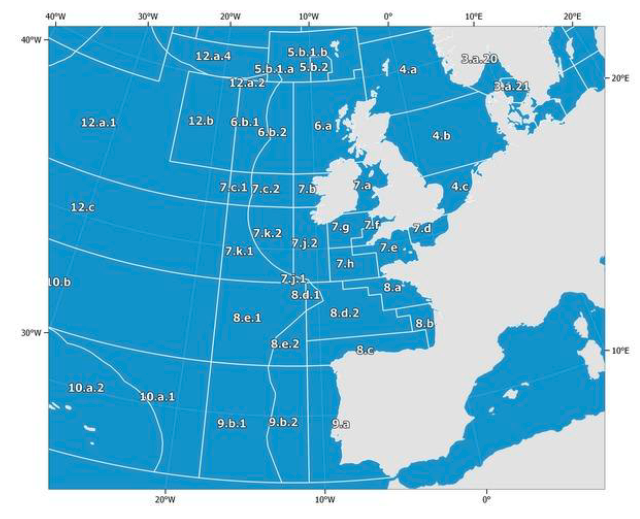
Figure 2: Sum of catches of NEA mackerel for all years between 2006–2024. Curved lines indicate boundaries of national EEZs. Source: Report of the Coastal States Working Group on the Distribution of Northeast Atlantic Mackerel (2025).
Fishery
The international fishery for NEA mackerel extends from the Gulf of Cadiz along the continental shelf edge to the Norwegian Sea, Iceland, and the North Sea, The majority of the UK’s mackerel fishery takes place in UK waters of ICES areas 4a and 6a (North Sea and West of Scotland) in quarters one and four during overwinter and spawning migration. In this section, we analyse all landings by the UK fleet within all ICES areas covered by this FMP.
In the UK, NEA mackerel are largely targeted by approximately 20 large Scottish pelagic vessels which generally utilise pelagic mid water trawls when targeting NEA mackerel. These vessels can catch more than 1,000 tonnes of fish per trip. Given the seasonality of pelagic fisheries, with different species being targeted at different points in the year, vessels targeting NEA mackerel will generally also target other pelagic species at other points in the year, which are themselves subject to separate FMPs. Whilst the pelagic species are different, the method of fishing is generally the same, with many of the same characteristics, and so many of the policies and actions within the FMPs will also be similar. Northern Irish and English (£27,773,113.94 (18,953.43t) from UK waters in 2024[4]) pelagic vessels also target mackerel but on a smaller scale compared to the Scottish fleet.
An additional fishery for NEA mackerel in the North Sea is undertaken in the summer and autumn by numerous under-10 metre vessels, using predominantly handlines. Their combined catch is less than 2,000 tonnes each year.
Although the NEA mackerel caught by Welsh-registered vessels only accounts for a small percentage of the UK catch it is important for some Welsh fishers.
An allocation of 1,750 tonnes of western NEA mackerel is made each year to the MMO for the South West England handline mackerel fishery. This covers landings by vessels targeting NEA mackerel using handline in ICES areas 7e, f, g and h. The fishery operates within the long‑standing “South West mackerel box”, a spatial technical conservation measure covering waters off Cornwall. This measure restricts large‑scale pelagic fishing for NEA mackerel within a defined area while allowing selective methods, including handlining, to continue. The box was established to protect juvenile components of the stock and continues to underpin the small‑scale, inshore character of the fishery.
In the North Sea, adult mackerel appears occasionally as bycatch in the herring fisheries, as well as juveniles in the small-mesh fisheries for sprat. The mackerel fishery is known to take a small bycatch of herring and blue whiting.
Analysis was undertaken of the UK fishing fleet catching NEA mackerel within the ICES subareas this FMP covers. Between 2018 and 2024, 68% of NEA mackerel caught by the UK fishing fleet were caught in ICES area 4.a, with 31% caught in ICES area 6.a. the remaining 1% was predominantly caught in ICES area 7.j, although negligible amounts were attributable to other ICES areas covered by this FMP.
Of the UK-caught NEA mackerel caught in 2024, Scottish-registered vessels accounted for 82% of the total catch by tonnage, whilst English and Northern Irish vessels made up 9% each. Less than 1% was attributable to Welsh-registered vessels.
Analysis of UK fisheries data between 2018 and 2024 shows that almost all (96%) of NEA mackerel caught by the UK fleet is caught using trawls, with 3% caught using purse seine nets and 1% using hooks and lines.
| Gear Type | 2018 | 2019 | 2020 | 2021 | 2022 | 2023 | 2024 |
|---|---|---|---|---|---|---|---|
| Trawls | 94% | 94% | 96% | 96% | 96% | 96% | 98% |
| Purse Seine | 5% | 4% | 3% | 3% | 3% | 3% | 1% |
| Hooks and lines | 1% | 1% | 1% | 1% | 1% | 1% | 1% |
| Other | 0% | 0% | 0% | 0% | 0% | 0% | 0% |
Note: Figures may not sum to 100% due to rounding.
For UK vessels, the landed value of NEA mackerel fluctuated between £201 million and £394 million from 2018 to 2024, excluding 2019 (where a lower TAC was in place). The total value of landings, tonnage, and average value per tonne are shown in Table 2.
| Landings | 2018 | 2019 | 2020 | 2021 | 2022 | 2023 | 2024 |
|---|---|---|---|---|---|---|---|
| Landed Value (£ thousand) | 201,330 | 182,480 | 213,450 | 234,690 | 215,930 | 275,790 | 394,310 |
| Tonnage | 189,700 | 151,711 | 201,979 | 209,800 | 192,557 | 217,657 | 223,987 |
| Price per tonne (£) | 1,061 | 1,203 | 1,057 | 1,119 | 1,121 | 1,267 | 1,760 |
Between 2018 and 2022, the landed value fluctuated between £201 million and £235 million, excluding 2019. Tonnage landed was consistently between 190,000 and 210,000 tonnes, whilst the price per tonne was between £1,060 and £1,120 for the same time period. 2019 saw a significant drop in tonnage to 150,000 tonnes, because of the reduced TAC. This also led to a decrease in the total landed value to £180 million, despite the price per tonne rise to £1,200. Since 2022, the landed value, tonnage, and price per tonne have increased substantially. In 2023, almost 218,000 tonnes of NEA mackerel was landed by the UK fleet, with a value of £276 million, and a price per tonne of almost £1,270. This further increased in 2024, with almost 224,000 tonnes landed at a value of £394 million, and a price per tonne of £1,760.
Between 2015 and 2024, landings of UK-caught NEA mackerel were split between landings into the UK and landings abroad. The main ports within the UK were Peterhead and Shetland who saw, on average, 30% and 11% of NEA mackerel tonnage, respectively. The stock made up a significant proportion of these ports’ total landed value, with Peterhead seeing 38% of its total value coming from the stock, and Shetland seeing 44%. In 2024, £5.6m worth of North-East Atlantic mackerel was landed into ports in England. By value, 84% of this was landed into Dover which accounted for 97% of Dover’s total landed value in 2024. Landings by the handline fleet in South West England are smaller in scale but remain important for coastal communities. For example, 191 tonnes were landed into Newlyn in 2024, with a value of £471,000.[5]
Only a nominal amount (£1k value) of mackerel was landed into Welsh ports in 2024.
The primary landing destination abroad was Norway, which saw an average of 38% of NEA mackerel tonnage, although the Netherlands (9%) and Denmark (6%) saw a not-insignificant amount of tonnage. The landing destinations for the UK fleet changed slightly from 2023. In 2024, Peterhead’s and Shetland’s tonnage received of NEA mackerel increase to 36% and 15%, respectively, whilst Norway’s proportion of the tonnage reduced to 32%. Both the Netherlands and Denmark saw 7% each of the tonnage landed. The change in landing behaviour in 2024 reflects the influence of strengthened Economic Link licence conditions for Scottish vessels introduced on 1 January 2023, which were designed to increase the amount of key Scottish stocks, such as mackerel, landed into Scotland.
For the fleet[6] groups that target NEA mackerel, the species is a stock of significant importance. The pelagic over-40m fleet attribute 75% of their total value to the species, whilst the stock makes up 14% of the total value landed by both the under-10m fleet (using hooks) and the under-10m fleet. The miscellaneous fleet segment derives 12% of their total value from the stock.
Pelagic fisheries are, in the main, classed as a relatively ‘clean’ fishery, meaning that issues with discarding and bycatch are deemed to be minimal. However, given the capability of pelagic trawl vessels to take large tonnage hauls, the impact of any discarding, misreporting or slipping of catch, should it take place, would be considered high. The introduction of Remote Electronic Monitoring (REM) in Scottish waters, where the majority of pelagic fishing takes place in the UK, provides an enhanced level of confidence and ensures that effective tools are in place to deter and detect any illegal activity. Defra is also working towards introducing REM in English waters.
Contact
Email: fmps@gov.scot