
Health and social care - NHS Delivery: consultation analysis
This report presents analysis of the public consultation responses on establishing Public Services Delivery Scotland (NHS Delivery), combining NSS and NES to strengthen national delivery, improving and supporting digital transformation across Scotland's health and social care.
1. About This Report
This report outlines the analysis from the responses to the Scottish Government's consultation on the creation of NHS Delivery – a new national delivery organisation to lead transformation across our health and social care system. The consultation was live from 1 October 2025 to 30 November 2025. The consultation can be accessed at NHS Delivery - a new national delivery organisation: consultation - gov.scot.
1.1 Introduction
Scottish Ministers committed in June 2025 as part of the Service Renewal Framework (SRF) to significantly transform the capability of our National NHS Boards by the creation of a single organisation with the working title formally known as ‘NHS Delivery’.
The new organisation, to be established on 1 April 2026 as ‘Public Services Delivery Scotland’ (PSD Scotland), will bring together the existing functions of NHS National Services Scotland (NSS) and NHS Education for Scotland (NES). It will provide a single point of accountability and delivery for a wide range of support, training and digital services.
The new organisation is expected to lead transformational change and deliver more than its constituent parts, whilst still maintaining delivery of existing statutory and operational responsibilities.
Longer term, and in alignment with the Public Service Reform Strategy (PSRS), it is anticipated that this new organisation will also take on functions and responsibilities that currently exist across the public sector in Scotland including within the Scottish Government Health & Social Care Directorate General.
The consultation sought views on our proposals to reform national support and delivery services for our health and social care system. We believe such reform is necessary if we are to be able to provide continuing high-quality health and social care services to the Scottish public in the years ahead.
Specifically, it sought comments on the intention to combine the functions of NES and NSS from 1 April 2026 as a first step in creating a new national organisation designed to facilitate broader transformation across NHS Scotland and beyond. This builds on previous consolidations in the health system, where the establishment of Public Health Scotland (PHS) has shown the clear merits in having a single public health capability for Scotland – and now we are seeking to create a single delivery and transformation capability.
The full extent of functions to be delivered by the new organisation will be the subject of further stakeholder engagement and formal consultation over the course of 2026 and beyond. In the meantime, it is important that partners and the public can comment on our plans for the operation of PSD Scotland from April 2026 and that was the primary purpose of this consultation, although there was space to offer initial views on its future evolution.
1.1.1 Respondents Profile
A total of 229 consultation responses were received of which 159 (69%) from individuals and 70 (31%) from organisations. A breakdown of the organisation sectors are provided in Annex A.
1.1.2 Methodology
Most responses to the consultation were submitted via the Scottish Government
Citizen Space consultation platform. A total of 223 responses were received with this method. A duplicate response was identified and removed, resulting in a total of 222 responses from Citizen Space being used. An additional seven responses were submitted via email. From the email submissions, two followed the public consultation structure and these have been included in the overall statistics, providing a total of 224 responses for this analysis. The other five email responses did not follow the same structure as those in the consultation, therefore these emails were examined and assessed against the narrative of the consultation response analysis (see figure 1).
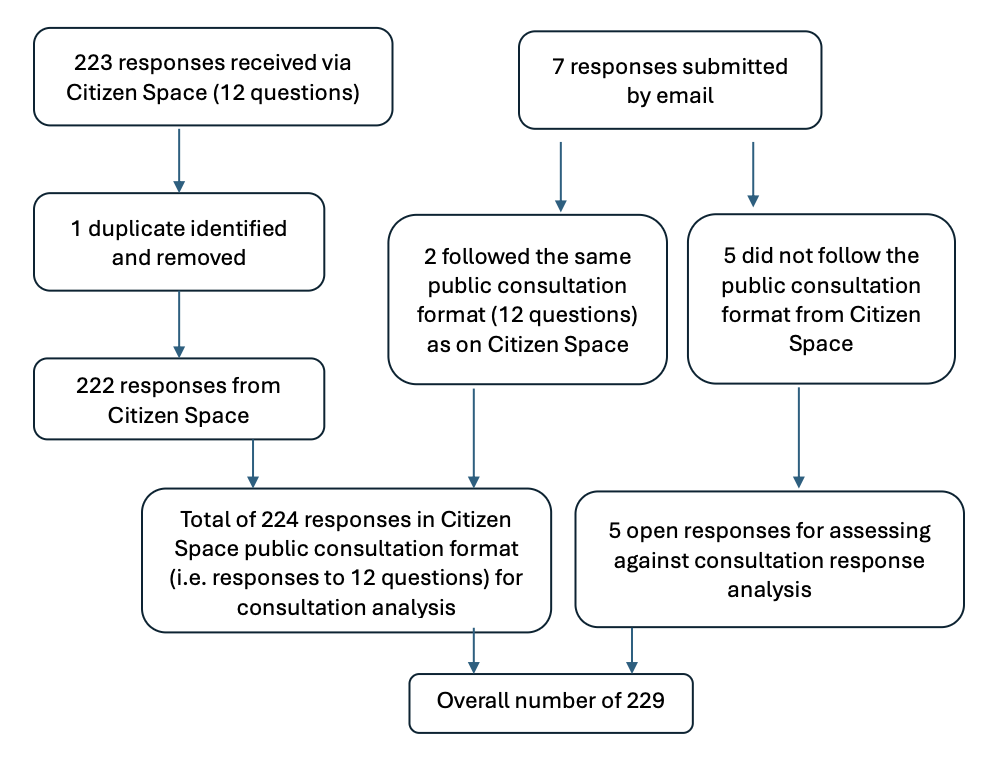
The public consultation on Citizen Space consisted of two sections and included a total of twelve questions.
Section A focused on the case for change and immediate priorities and contained eight closed questions with a free text component.
Section B focused on longer term opportunities and future evolution for the organisation and included three open-ended questions.
With the consultation now closed, responses have been logged, analysed and published where data permission have been granted. Responses that consisted of free text have been grouped into common themes. Excel was used for the initial analysis of the responses. The Scottish Government’s Enterprise version of Microsoft Co-pilot Chat was used to support with coding and high-level reporting, but not for any material analysis.[1] Percentages have been rounded to the nearest whole number and are calculated using the total number of responses from Citizen Space and emails that used the same format (i.e. 224) and are identifiable with a % sign.
Please note that the report indicates the number of respondents who commented on each question. Therefore, the number of responses which mention particular topics or themes for each question does not add up to the overall number of responses received to that question. This is because the same respondent may raise more than one topic or theme in response to a question. It should also be noted that the numbers responding to each question may differ as only some of the respondents answered all of the questions.
1.1.3 Analysis of responses to consultation questions
Section A: Establishing the new organisation to deliver national transformation: the case for change and immediate priorities
Question 1: Do you agree that creating a new national organisation to drive forward digital transformation and system change – beginning with the consolidation of NES and NSS into one organisation – is the right approach to deliver the ambitions set out in Scotland’s Population Health Framework and Service Renewal Framework? Please give reasons for your answer.
| Option | Individuals | Organisation | Total | |||
|---|---|---|---|---|---|---|
| - | number | % | number | % | number | % |
| Agree | 96 | 60% | 40 | 62% | 136 | 61% |
| Disagree | 35 | 22% | 6 | 9% | 41 | 18% |
| Don't know | 28 | 18% | 14 | 22% | 42 | 19% |
| Not Answered | - | - | 5 | 8% | 5 | 2% |
| Total | 159 | 100% | 65 | 100% | 224 | 100% |
Of the 224 respondents, 189 (84%) provided free-text comments.
The majority of the respondents to the consultation (60%) agreed with the above statement (in the box), particularly highlighting benefits such as improving efficiency by reducing duplication, enabling digital transformation in a more streamlined manner, and prospects for better collaboration and integration of expertise. Feedback included:
- “There is a need for change and reduction of waste. The "Once for Scotland" approach is the way to go.” (Individual)
- “There is far too much variation from the silo approach of separate organisation with certain specialisms. Most projects will tend to include both organisations but separate entities do cause inefficiencies and more approvals to seek.” (Individual)
- “Consolidating NES and NSS into NHS Delivery represents a significant and positive step forward in advancing digital initiatives, fostering innovation, and streamlining organisational structures across Scotland’s health landscape.” (Organisation)
However, many respondents who selected ‘Agree’ also expressed caution regarding the creation of NHS Delivery, highlighting topics such as:
Keeping the local context in mind
- “Care needs to be taken however to ensure that particular local needs are not over looked and that NHS Scotland as a whole has clarity about 'who does what' and 'where everyone sits.” (Individual)
Managing the transformation in a clear, supportive and timely manner
- “However it is important to recognise that the ambition for transformation and system change in the services and support provided for NHS Scotland by NHS Delivery, will only be achieved if there is sufficient time, investment in and leadership of the internal transformation that will be needed to bring two very different organisations together to form a united entity” (Individual)
- “It is important that structural change is underpinned by a supportive and well-thought out change management programme that cares for those people in both organisations.” (Individual)
Clarifying the relationship with social care
- “There is a lack of detail as to how this consultation addresses the delivery of social care and that the implementation of this, needs to be better clarified, but we see this new entity as an opportunity to be the bridge between healthcare and social care in particular as the services that are to be delivered in data and in digital will span across both sectors.” (Organisation)
Working in partnership with stakeholders
For the reform to be effective:
- “NHS Delivery should be co-created with the third sector, community and local government organisations” (Organisation), and
- “must engage fully with primary and community care sectors.” (Organisation)
Protecting the essential functions provided by NSS and NES
- “However, whilst NES and NSS will be coming together, it is critically important not to lose or dilute what they both currently offer and the expertise the respective organisations have in their programmes of work.” (Organisation)
- “The training part of the NHS cannot be lost or watered down in any way and should remain a central part of the ambitions for the NHS in Scotland.” (Individual)
Of those respondents who stated they disagreed or didn’t know, there was still some acknowledgment of the need for digital transformation and system change. They covered comparable topics, offering critical considerations and alternative views. Feedback included:
- “I agree that it supports digital transformation – but I'm unclear as to the additional benefits of consolidation.” (individual, don’t know)
- “The joining of these two bodies makes sense in theory in the achievement of these goals. However, [name] does have one reservation; each organisation [NES and NSS] delivers critical functions supporting the viability and effectiveness of the [name] network.” (organisation, disagree)
- “The creation of another national organisation risks over-centralisation, loss of specialist expertise, and political control.” (individual, disagree)
- “Both organisations have very different purposes, ways of working and internal cultures. Bringing them together risks creating conflict and confusion.” (Individual)
Question 2a: Do you agree with the proposed strategic objectives for the new organisation (driving innovation, delivering Once for Scotland services, and streamlining structures)? Please give reasons for your answer.
| Option | Individuals | Organisation | Total | |||
|---|---|---|---|---|---|---|
| - | number | % | number | % | number | % |
| Agree | 115 | 72% | 48 | 74% | 163 | 73% |
| Disagree | 22 | 14% | 2 | 3% | 24 | 11% |
| Don't know | 20 | 13% | 11 | 17% | 31 | 14% |
| Not Answered | 2 | 1% | 4 | 6% | 6 | 3% |
| Total | 159 | 100 | 65 | 100 | 224 | 100% |
Of all respondents to the consultation, 169 (75%) provided free-text comments.
Nearly three-quarters of respondents (73%) agreed with the proposed strategic objectives. Feedback included:
- “Driving innovation is essential to meet future demands.” (Individual)
- “Once for Scotland, designed to focus on digital-first, user-focused, more efficient services for people, aligns with the ambitions of the Service Renewal Framework.” (Organisation)
- “By streamlining the objectives of the organisation, and having a single leadership team and vision to achieve these, it will take away much of the bureaucracy and blockers.” (Individual)
Several respondents, particularly organisations, reported that they needed more clarity on the objectives and process of implementation. As one respondent noted:
- “..... felt that the objectives were somewhat vague and general. They supported delivering Once for Scotland services but again expressed some scepticism relating to how the new organisation would achieve this.” (Organisation)
In addition, many respondents commented on what was missing from the proposed strategic objectives. These points are discussed in the next question.
Question 2b: Should the organisation consider additional strategic objectives? If yes, please specify using the text box below.
| Option | Individuals | Organisation | Total | |||
|---|---|---|---|---|---|---|
| - | number | % | number | % | number | % |
| Yes | 76 | 48% | 45 | 69% | 121 | 54% |
| No | 24 | 15% | 3 | 5% | 27 | 12% |
| Don’t know | 55 | 35% | 12 | 18% | 67 | 30% |
| Not Answered | 4 | 3% | 5 | 8% | 9 | 4% |
| Total | 159 | 100% | 65 | 100% | 224 | 100% |
Of all 224 respondents, 147 (66%) provided free-text comments.
Around half of the respondents to the consultation (54%) indicated that further strategic objectives should be included. Free-text responses showed that while some viewed the current strategic objectives as a good starting point, others found them broad with some calling for more detail. Several respondents also expressed concern that the existing strategic priorities of NES and NSS could be lost in the amalgamation. The proposed additional strategic objectives have been summarised below:
Strategic objective on education and training
Education, training and workforce development were frequently mentioned to remain a core organisational and strategic priority.
- “A dedicated strategic objective on education would provide necessary clarity and assurance, ensuring that workforce development, educational research capacity and innovation in learning remain central to the success of Scotland’s future health and care system”. (Organisation)
Strategic objective on the integration of Health and Social Care
Several organisations and individuals stressed the need for a stronger focus on social care.
- “Ensure that social work and social care services are not sidelined but are instead prioritised and protected within the new structure, as called for by both the SRF and recent Audit Scotland findings.” (Organisation)
- “The organisation should include explicit support for social care integration and a focus on population health equity.” (Organisation)
Strategic objective on wellbeing support for staff
Several respondents called for more focus on the wellbeing of the (future) workforce, particularly during and after the merging of NES and NSS.
- “Address and deliver on employee wellbeing and longer-term recruitment and retention in posts.” (Organisation)
Strategic objective on equity and inclusion
Respondents emphasised the importance of objectives that focus on equity and inclusion to ensure that national transformation benefits all parts of Scotland, will address health inequalities, as well as being preventive and promote digital inclusion. To achieve this service users and staff will need to be included in decision making to ensure that services are designed around people’s needs.
- “Additional strategic objectives on lived experience, digital inclusion, human rights and prevention are required.” (Organisation)
Strategic objective on digital transformation and decision-making
Respondents suggested an objective on data governance and ethical use of AI, while keeping in mind that the workforce needs to develop digital skills and requires support.
- “It is vital that any AI tool used clinically has human oversight to protect the public from being disadvantaged by ethical, safety, personal, and cyber security issues.” (Organisation)
Question 3: Are there services or functions currently delivered by other organisations (in addition to what NES and NSS already do) that should be delivered only by NHS Delivery to improve consistency and reduce duplication? This includes consideration of capabilities that are perhaps fragmented across multiple bodies, where a clear lead organisation should be identified. If yes, please specify using the text box below.
| Option | Individuals | Organisation | Total | |||
|---|---|---|---|---|---|---|
| - | number | % | number | % | number | % |
| Yes | 104 | 65% | 36 | 55% | 140 | 63% |
| No | 39 | 25% | 9 | 14% | 48 | 21% |
| Not Answered | 16 | 10% | 20 | 31% | 36 | 16% |
| Total | 159 | 100% | 65 | 100% | 224 | 100% |
Of all 224 respondents to the consultation, 178 (79%) provided free-text comments.
In total 140 (63%) responded that there are other services and/or functions that could be transferred to NHS Delivery. However, many stressed that moving functions should not be done lightly. As one organisation noted:
- “the expansion of NHS Delivery’s remit must be grounded in a clear understanding of its role and a robust case for added value.” (Organisation)
Another stated:
- “Consolidation should not centralise decision-making to the extent that local responsiveness or specialist input is weakened.” (Organisation)
The suggested functions and services have been broadly categorised as follows:
Coordinating digital transformation and interoperability
Respondents from a range of organisations as well as many individuals highlighted functions that related to national digital platforms and data. They also highlighted the importance of inclusion, taking a stakeholder-driven approach and building on existing work in this area. For example:
- “Digital inclusion: Digital transformation must be equitable, ensuring all NHS-contracted providers and care partners can access and benefit from national digital systems.” (Organisation)
- “ In particular, national digital health data services should be consolidated to enable consistent collection, analysis, and sharing of information on long-term conditions... A single national body should host and manage condition-specific registries…integrating data from primary, secondary and tertiary care across Scotland.” (Organisation).
Integrating Cross Cutting Services under NHS Delivery
Many comments focussed on functions currently seen as fragmented across national and professional bodies. Examples include:
- Procurement of IT and other large contracts
- Facilities and maintenance
- Workforce planning
- Quality improvements
- Some HR functions.
Workforce Education and Training
Protecting and expanding the functions around education and training of the current and future workforce was a recurring topic. Some respondents also welcomed opportunities to coordinate research and streamline pathways for knowledge sharing and evaluation, for example:
- “Education should be protected and ring-fenced for all grades.” (Organisation)
- “We recommend that NHS Delivery works with universities and NHS Boards to develop and protect career pathways for clinical academics, ensuring Scotland remains competitive in attracting and retaining talent.” (Organisation)
Question 4: What areas of national delivery could be improved by NHS Delivery to make services more efficient or better joined-up?
| Option (multiple answers) |
Individuals Total = 159 |
Organisation Total = 65 |
Total | |||
|---|---|---|---|---|---|---|
| - | number | % | number | % | number | % |
| Redesigning how services could be planned or improved | 94 | 59% | 33 | 51% | 127 | 57% |
| Making better use of data and digital tools | 120 | 75% | 51 | 78% | 171 | 76% |
| Improving supply chains or procurement | 89 | 56% | 33 | 51% | 122 | 54% |
| Supporting shared back-office services like HR or finance | 97 | 61% | 30 | 46% | 127 | 57% |
| Strengthening workforce development and training | 110 | 69% | 49 | 75% | 159 | 71% |
| Other (please indicate below) | 29 | 18% | 26 | 40% | 55 | 25% |
| Not Answered | 4 | 3% | 3 | 5% | 7 | 3% |
The option Making better use of data and digital tools, received the highest proportion of responses for improving efficiency and integration (76%), followed by Strengthening workforce development and training (71%).
One quarter (25%) selected Other, though overall 139 (62%) provided comments in the free-text section of this option. Many of the comments expanded on the above multiple-choice options, mostly going into further detail on how these areas could be improved. For example:
- “NHS Delivery will create a unique opportunity to improve how national support services are coordinated and integrated, managing the linkage between digital, workforce and strategic planning. This could provide a universal analytical capability (drawing on NSS and Public Health Scotland data strengths) to support local leaders in executing the Population Principle based on evidence-based needs assessments.” (Organisation)
- “Employment and education opportunities for refugees and asylum seekers.” (Organisation)
- “Charities, like [name], are ready and willing to work with NHS Scotland to design new services which will improve patient outcomes. Direct referral from the NHS to the third sector is one example of this.” (Organisation)
- “NHS Delivery could potentially help strengthen the following areas: Integrated national workforce pathways enabling flexible, carer-friendly training and development; Shared digital records and shared intranet systems to reduce repeated assessments and improve continuity, particularly for maternity, mental health, and social care users; National procurement and shared services that improve reliability and reduce stark variations across Scotland; Leadership, improvement, and change management support which is designed with specific working patterns in mind and which would benefit a majority female working team.” (Individual)
- More can be done to tackle the flow in secondary care by addressing the unchallenged flow from social care. (Individual)
- “Build on the extensive presence of other partners within health & social care that have stronger and more benign links to communities throughout Scotland”. (Individual)
Some respondents also expressed their disagreement with NHS Delivery or asked for further detail on the five proposed areas.
Question 5: Are there any existing services, programmes, or functions currently delivered by NES or NSS that you believe could be stopped, scaled back, or redesigned (or handed over to another organisation) to better align with current priorities and system-wide impact? If yes, please explain in the text box below.
| Option | Individuals | Organisation | Total | |||
|---|---|---|---|---|---|---|
| - | number | % | number | % | number | % |
| Yes | 51 | 32% | 27 | 42% | 78 | 35% |
| No | 91 | 57% | 18 | 28% | 109 | 49% |
| Not Answered | 17 | 11% | 20 | 31% | 37 | 17% |
| Total | 159 | 100% | 65 | 100% | 224 | 100% |
A total of 122 free-text responses were recorded, representing 54% of the 224 responses.
Almost half of the respondents to the consultation (49%) indicated that no current services, programmes, or functions needed to change to better align with current priorities, for example:
- “All services currently delivered by NES should not be scaled back. As stated earlier, the educational services, including training must be a key function of the new organisation.” (Organisation)
- “From my understanding of both organisations I would say they are both doing essential, high priority work that has a significant impact on NHS service provision.” (Individual)
Around a third (35%) responded Yes, and provided further feedback on their agreement, including:
- “Stop using private sector consultancy and technology platforms and outsourcing. Stop getting locked into contracts that will not deliver for Scotland.” (Organisation)
- “Legacy training programmes or digital projects developed for specific professional groups could be streamlined or consolidated where similar provision now exists elsewhere. Equally, multiple digital platforms and data systems serving overlapping purposes could be rationalised to reduce fragmentation and user burden”. (Individual)
- “Clarifying the respective roles and responsibilities of national organisations is a key enabler for reducing duplication and ensuring each body operates within its intended scope. For example, current support for Estates and Facilities Education is not currently provided by NES, which highlights a gap that could be addressed through re-alignment rather than service reduction”. (Organisation)
- “Training programmes frequently overlap across health and social care and a centralised system could improve this and offer better career pathways particularly to social care staff.” (Organisation)
These, as well as other examples, were often accompanied by the caveat that any redesign should be driven by a review and evidence of impact. Many of those who did not answer the closed question, also suggested further considerations before making any changes. For example:
- “Any consideration of changes to existing services would require a detailed mapping exercise and engagement with those directly affected.” (Organisation)
- “Rather than eliminating services outright, the focus should be on reducing duplication and clarifying leadership across overlapping areas.” (Individual)
Furthermore, comments indicated that this question was challenging for some respondents to the consultation, primarily due to a lack of familiarity with existing services, programmes, and their impact on the work.
- “I don't know enough of the specific granular detail of what is currently delivered to comment.” (Individual)
Question 6: Do you agree that NHS Delivery should lead the development of national digital capabilities (e.g. Electronic Health Records, digital inclusion, data architecture) for Scotland’s health and social care system? Please explain your response.
| Option | Individuals | Organisation | Total | |||
|---|---|---|---|---|---|---|
| - | number | % | number | % | number | % |
| Yes | 129 | 81% | 49 | 75% | 178 | 79% |
| No | 13 | 8% | 2 | 3% | 15 | 7% |
| Don’t know | 14 | 9% | 9 | 14% | 23 | 10% |
| Not Answered | 3 | 2% | 5 | 8% | 8 | 4% |
| Total | 159 | 100% | 65 | 100% | 224 | 100% |
A substantial majority (79%) to the consultation agreed that NHS Delivery should lead the development of national digital capabilities. Out of all the respondents, 156 (70%) provided free text explanations, which have been broadly summarised as follows:
Consistency and Interoperability
Echoing previous question feedback respondents highlighted that NHS Delivery as the national lead could reduce fragmentation, establish consistent standards and interoperable systems across health and social care. Which could enhance health and social care delivery; strengthen patient safety and medical education. Some comments included:
- “It would make a real difference to have one record system for health and social care which would support sub national clinical boards and a Once for Scotland Approach.” (Organisation)
- “It makes sense for NHS Delivery to take national leadership… bringing them together under one organisation offers the potential to achieve the ‘Once for Scotland’ ambition.” (Individual)
- “The development of a single, secure Electronic Health Record (EHR) will be a key element of this work. It is essential that the EHR connects all parts of health and social care, including primary and community care providers, to support continuity of information and safe, effective care.” (Organisation)
While this view was widely shared, some respondents added that a central lead could overshadow smaller boards and local contexts, potentially compromising digital inclusion. Others raised concerns about cyber security risks, whilst others emphasised the need for robust oversight. Feedback included:
“This approach may not be beneficial to smaller Boards who may struggle to have an equal voice as part of a centralised one size fits all mechanism.” (Organisation)
“Maintaining mechanisms for local adaptation and co-design, particularly in remote, rural, and island areas where digital inclusion challenges and service models differ markedly.” (Individual)
Several respondents also highlighted that health and social care systems differ significantly and require distinct approaches and governance.
Capitalising on existing expertise
Respondents noted the strengths of both NES and NSS in digital capabilities and assets, stressing the importance and benefits of combining these under a clear governance structure to improve accountability and financial efficiency.
- “NES has deep experience in delivering national digital learning, workforce, and data solutions, while NSS has a proven track record in implementing and supporting national systems, digital infrastructure, and data platforms. Together, these capabilities provide a solid foundation for NHS Delivery to take on a national leadership role in digital transformation.” (Organisation)
Some respondents commented that they felt NHS Delivery leading on the development of national digital capabilities merger was too ambitious, or they questioned whether the necessary expertise, particularly in clinical systems, was available. Feedback included:
“Replacing existing systems is hugely costly and disruptive, and history shows that large-scale IT projects frequently fail to deliver promised benefits.” (Organisation)
“Neither NSS nor NES have the necessary clinical digital subject matter expertise or clinical resources to lead the delivery and implementation of core clinical systems, such as secondary care electronic health records… Clinical subject matter expertise primarily sits within territorial health boards rather than national organisations and leadership for major digital transformation programmes that impact on delivery of care should come from clinicians within these health boards.” (Organisation)
Question 7: Should NHS Delivery be tasked with improving data sharing, data access and interoperability across health and social care? Please explain your response.
| Option | Individuals | Organisation | Total | |||
|---|---|---|---|---|---|---|
| - | number | % | number | % | number | % |
| Yes | 128 | 81% | 55 | 85% | 183 | 82% |
| No | 10 | 6% | 1 | 2% | 11 | 5% |
| Don’t know | 19 | 12% | 4 | 6% | 23 | 10% |
| Not Answered | 2 | 1% | 5 | 8% | 7 | 3% |
| Total | 159 | 100% | 65 | 100% | 224 | 100% |
There was strong agreement among respondents to the consultation (82%) that NHS Delivery should take responsibility for improving data sharing, data access and interoperability.
Of all respondents, 162 (72%) provided free text comments, many of which reinforced this view. Feedback included:
“If this is all under the Digital umbrella then yes, it would make sense for digital data to be managed by NHS Delivery.” (Individual)
“A national approach to data would offer significant benefits, particularly in reducing duplication of effort and streamlining processes that currently vary across Boards and organisations.” (Organisation)
“Yes, absolutely. If we want a ‘Once for Scotland’ approach to work, improving data sharing, access, and interoperability is essential. Right now, boards using different systems that don’t connect creates barriers for care and for learning.” (Individual)
Respondents recognised that responsibilities for data architecture and governance are fragmented, creating inefficiencies and barriers to interoperability. Several comments from respondents shared the same thoughts on the on the current inability of data sharing, for example:
“Our members frequently raise frustrations with current recording systems in the NHS, which vary across and within health boards, where some are having to use multiple systems, with different clinicians on different systems. This means, for example, that AHP and psychologist colleagues cannot see each other’s notes where appropriate, to provide a more joined up service for patients.” (colleagues)
“having a "once for Scotland" approach for data sharing/information governance is essential - the current position is preventing effective research and innovation.” (Individual)
“The interface between primary and secondary care represents one of the greatest areas of risk for patients, as poor communication and lack of IT system interoperability can lead to information being lost.” (Organisation)
Several free-text responses emphasised the need for the organisation to play an active role in improving data sharing, data access and interoperability across health and social care. Feedback included:
- “NHS Delivery should have the resources to ensure that they can really support organisations in data sharing, access and interoperability. It should not just be setting standards and targets but really helping to implement change.” (Organisation)
- “NHS Delivery should provide the foundation for a national Electronic Patient Record, harmonised data architecture, and secure, real-time access to information for clinicians, planners, and patients. By consolidating leadership for data sharing and interoperability, NHS Delivery should be actively tasked with reducing unwarranted variation, improve equity, and build public trust in how sensitive health and care data is managed.” (Individual)
- “The remit of NHS Delivery should not just be technical implementation, but also to define and enforce data standards, governance, and user-centric workflows that ensure data is accessible, trustworthy, and presented in a way that is usable for the staff delivering care. Improved interoperability is the essential foundation for delivering the strategic objectives of 'Once for Scotland' services and streamlining structures.” (Individual)
While many welcomed a consistent, pro-active approach to data sharing, a number of considerations and potential risks were identified. These included concerns about patient choice, misuse of power, cyber security, the impact on NHS and local services and the role of third sector organisations, social care integration, governance and legal requirements (including GPDR) or reliance on commercial suppliers. Some comments provided:
Patient choice and confidentiality
- “We welcome more consistent data sharing to improve access to and standards of care. However, we would also urge caution when sharing data on mental ill health, and suggest further workforce training to guard against mental health stigma.” (Organisation)
Social care
- “In defining NHS Delivery’s remit, it will be important to respect social care’s distinct systems and priorities.” (Organisation)
- “This is important, as we all need access to health data. But again, if this is for health and social care, a lot of integration work is still to be done.” (Individual)
Governance
- “NHS Delivery should lead efforts to improve data sharing, data access, and interoperability across health and social care. However, this cannot be treated as a simple technical workaround—the root cause lies in the current governance and legal framework.” (Individual)
- Cyber Security risks need to be considered at the heart of this.” (Organisation)
Commercial suppliers
- “However, as part of this, consideration should be given to current issues with commercial competition between providers which impacts on the interoperability of systems to facilitate data sharing.” (Individual)
Finally, some respondents noted the need for further evidence on the deliverables and benefits before being able to answer this question.
Question 8: Do you believe NHS Delivery should be tasked with the lead national support role in innovation development & adoption, service redesign, change management, improvement, and commissioning?
Please give reasons for your answer. This may include areas where fragmented delivery or unclear accountability currently limits impact. Examples could also include aspects such as leading pathway redesign, supporting local improvement efforts, coordinating national commissioning of services
| Option | Individuals | Organisation | Total | |||
|---|---|---|---|---|---|---|
| - | number | % | number | % | number | % |
| Yes | 53 | 34% | 17 | 26% | 70 | 31% |
| Partially | 62 | 39% | 30 | 46% | 92 | 41% |
| No | 17 | 11% | 6 | 9% | 23 | 10% |
| Don’t know | 20 | 13% | 6 | 9% | 26 | 12% |
| Not Answered | 7 | 4% | 6 | 9% | 13 | 6% |
| Total | 159 | 100% | 65 | 100% | 224 | 100% |
A total of 173 free-text responses were recorded, representing 77% of all 224 responses.
Among the respondents to the consultation there were mixed views on whether NHS Delivery should be tasked with the lead national support role in innovation development & adoption, service redesign, change management, improvement, and commissioning. Partially was the most frequently selected (41%), followed by Yes (31%).
Overall, greater national coherence in the above areas was perceived as positive, and feedback included:
- “Having a single body with this responsibility would provide clarity, reduce duplication, and ensure that best practice is spread consistently across Scotland.” (Individual)
- “NHS Delivery will have oversight of all NHS Boards’ performance, and therefore able to see the gaps, needs and priorities across the whole system. Having the lead national support role in innovation development and adoption, service redesign, change management, improvement, and commissioning will help address these.” (Organisation)
- “If we want a once for Scotland approach, this is easier to deliver with one clear organisations providing leadership. However, it needs to be done in collaboration with all stakeholders across the whole system, in an honest and transparent way.” (Individual)
- “Delivery of redesign, change and improvement are delivered by multiple national boards which creates confusion, duplication and significant waste of public monies therefore having these capabilities delivered by one national service will reduce the aforementioned.” (Individual)
The framing of the question led to various interpretations of “to lead” in the free-text section, ranging from coordinating, enabling, facilitating and being the focal point to taking a leadership role, particularly among organisations. Many of the topics raised were reflected throughout Section A of the consultation.
Additional feedback to this question has been grouped into the following topics:
Remit
Some raised potential risks about the scope of NHS Delivery:
- “it would be a huge undertaking to centralise this within one board and enable the capacity required to support national, regional and local initiatives. it would however be great to see that centralised resource working on the most urgent important and impactful work across NHSS without the complications of who is paying for it and how will it be delivered.” (Individual)
- “Members expressed concerns around the potential size of NHS delivery and expressed concern that, unless there is clear structural delineation, then it may be difficult to envision how the new organisation could achieve all these objectives..” (Organisation)
- “expanding NHS Delivery’s remit into innovation, service redesign, improvement or clinical commissioning risks creating an overly broad organisation with competing priorities, reducing system agility rather than enhancing it.” (Organisation)
Centralisation
Caution of the organisation being centralised were also highlighted:
“For some situations e.g. care linked to highly specialist rare diseases it definitely makes sense to have a nationally commissioned service. But in situations where it is very frequent clinical condition and there is great complexity across the health boards in what is currently delivered - with these services generally already being highly adapted to their local health board needs - then a top down pathway redesign is time consuming and wasteful.” (Individual)
“…..NHS Delivery’s role should therefore be advisory, evidence-based, and time-limited, not directive.” (Individual)
“No one organisation could or should be the lead for innovation development…. This would prevent true innovation from happening! There could be a supporting, enabling and orchestrating role, so that existing national innovation assets can add greatest value.” (Organisation)
The Local Context
Building on the suggestions outlined above, some respondents emphasised the critical role of the local context and services:
- “Service redesign always needs a lot of local input to be successful. Too much centralisation will lead to a generic outcome that doesn't deliver well for any area.” (Individual)
- “it would be a mistake for NHS Delivery to assume exclusive responsibility. Effective redesign and improvement depend on local ownership, professional engagement, and contextual understanding, which sit with territorial boards, HSCPs, and local partners. The national role should therefore be to enable, connect, and support, not to centralise.” (Individual)
Overlap
Other responses questioned how overlap with existing practices or organisations will be managed:
- “Territorial boards already have local process in place for areas such as service redesign and change management.” (Individual)
- “This would build on the existing strengths of NES and NSS. But it would be important that NSD has a clear remit and that there isn't duplication with other bodies especially in relation to service and pathway design and redesign.” (Organisation)
- “NHS Delivery should take a leadership role in innovation and service redesign, but in collaboration with existing bodies including PHS and others such as Centre for Sustainable Delivery and Healthcare Improvement Scotland is essential to avoid overlap. Role clarity will ensure that NHS Delivery adds value without duplicating effort.” (Organisation)
Collaboration
Working in collaboration with a range of stakeholders, staff and patients, especially those directly affected, was frequently highlighted as essential:
- “Whilst NHS Delivery should lead coordination and capability-building; innovation and improvement must remain led by clinical, academic, and professional partners.” (Organisation)
- “…….Third Sector ( being as large an employer as the NHS) need to be front and centre at these discussions, not an afterthought, not an add-on, not just a seat at the table but an actual delivery partner and recognised ( and funded! ) as such.” (Individual)
- “Redesign and changes need to be made with input from patients and staff that are delivering front line services. Too often changes are implemented through management that have no experience either as patients or medical staff.” (Individual)
Social Care
The integration of social care within NHS Delivery remained unclear for some.
- “We reiterate that any reform or service redesign would be undermined if it doesn’t fully include social care and an understanding of the interdependency between health and social care.” (Organisation)
- “NHS Delivery should play a lead role in driving innovation and improvement across the health and social care system; however, it is essential that this leadership is exercised in close partnership with local authorities and social care leaders. This collaborative approach is crucial to ensure that the unique contributions of social work and social care are not diluted or lost amidst any national changes or integration efforts.” (Organisation)
Name NHS Delivery
Although not explicitly covered in Section A, several respondents to the consultation expressed concern that the name NHS Delivery conveys the wrong message and recommended that the name be reviewed.
Section B: Longer Term Opportunities and Future Evolution
Question 9: As NHS Delivery evolves in the longer term, what additional capabilities, functions or bodies should be considered for integration into a single national delivery capability that supports the aspirations of the Service Renewal Framework?
This may include functions currently delivered by other national bodies, territorial Boards, or Scottish Government divisions, as well as organisations whose consolidation could improve efficiency, reduce duplication, or enhance outcomes. We recognise you may feel it is too early to say, and that further consultation would be required.
A total of 166 free text responses were received for this question.
Some comments expressed that they were unsure or did not know, for example:
“This is difficult, but health and social care needs to be integrated efficiently and effectively. e.g. the flow of those in care needs to be better managed and communication needs to be improved.” (Individual)
While some felt it was too soon to say what additional functions could be considered;
- “Yes I think its too early to say. As noted above I think part of the task of the new organisation during its first year is to manage a process of evaluation, feasibility assessment and prioritisation of what could and should be integrated. There is much to be done and not the bandwidth to do it all at once due to the pressures of business as usual.” (Individual)
- “....Once NHS Delivery is established, it will be important to review its effectiveness and engage with partners across health and social care before considering any future consolidation.” (Organisation)
- “Needs further deliberation” (Individual)
Key themes
Overall, 132 responses provided comment or suggestion on possible additional capabilities or future functions. A high number of respondents suggest consolidation of functions, with key themes of:
- National Digital infrastructure and data analytics
- Integration of other special boards (Public Health Scotland/Health Improvement Scotland, NHS24. National Centre for Sustainability also mentioned)
- National improvement, innovation and transformation functions
- National Shared Services, such as IT, HR, procurement and other corporate/leadership functions
- National Workforce planning, training and education.
- Support for Health and Social Care integration
Consolidation
Many suggest that a national approach should be taken, however with caution of over centralisation:
- “A Once for Scotland approach across these areas is vital. Creating a single NHS employer is an obvious step that could significantly reduce bureaucracy and delivery back-office savings. However, this should be mindful of local delivery based on population needs and engagement with communities is vital to improve health i.e. evidence around a place-based approach. A national system that supports local delivery of strategic objectives would be ideal.”(Organisation)
- “..broadly supports NHS Delivery taking on a national leadership role in innovation, service redesign, change management, improvement and commissioning. However, we caution that this must not become a centralised, top-down model that overlooks the creativity, learning, innovation and expertise already demonstrated and emerging from communities, social enterprises, the third sector and local partnerships.” (Organisation)
- “NHS Delivery could play a valuable coordinating role in aligning national improvement, redesign, and innovation efforts, particularly where fragmentation currently leads to duplication or confusion about accountability.....
However, it would be a mistake for NHS Delivery to assume exclusive responsibility. Effective redesign and improvement depend on local ownership, professional engagement, and contextual understanding, which sit with territorial boards, HSCPs, and local partners. The national role should therefore be to enable, connect, and support, not to centralise.” (Individual)
Engagement
Suggestions also express a very strong emphasis for the need of further stakeholder and staff engagement and robust consultation required before considering any further expansion.
- “...we do expect the Scottish Government’s intention for there to be “further stakeholder engagement and formal consultation over the course of 2026 and beyond” to be honoured via meaningful face-to-face engagement and consultation” (Organisation)
- “However, decisions must be evidence based and sensitively involve the current workforce to understand what will work and what won't.” (Individual)
- “Maintain structured engagement with NHS Boards, Integration Joint Boards, and other stakeholders to capture feedback on NHS Delivery’s performance and remit. Use consultation processes to inform any proposed changes to scope or structure.” (Organisation)
There are some respondents who disagree with a centralisation of national functions or express the need to ensure local context is considered if applying national approach. with some expressing concerns such as inequity, loss of expertise and the impact on workforce. Some also note current services need to be improved first before expansion of remit.
- “NHS Delivery should concentrate on delivering a small number of things to a sufficient quality that it wins the support and confidence of the NHS workforce, patients and public. The absolute top priority is a complete overhaul of the data and digital landscape with the healthcare system and this should be of paramount focus rather than spreading people too thin and delivering nothing (like is the case now)” (Individual)
- “That said, further integration should be cautious and evidence-led, with clear criteria such as: demonstrable benefit to system efficiency and equity, avoidance of duplication, and protection of specialist expertise (particularly in rural and remote contexts).” (Individual)
Social Care
Other responses to this question mention that social care integration should have had more focus and consideration in the consultation.
“Social care is barely mentioned in the consultation document. The consultation doesn’t really engage at all with how this new organisation will deal with that part of the workforce. The establishment of a new organisation should allow for there to be clear ownership of the integration agenda for health and social care in areas such as digital and data integration and skills development. Social care innovation should become a greater focus for attention over time so working closely with ..... As with healthcare innovation, the new organisation should be given a lead supporting role for these activities.” (Organisation)
While other comments suggested the need for better alignment with social care, they felt that regulatory and statutory roles currently delivered by social care need to be kept independent.
Considerations
Caveats were given alongside the suggestions of additional functions, including several organisations and individuals agreeing that they feel that expansion should not be considered too early, including ensuring that a proven stability and delivery period of existing functions of both Boards are successful, stable and priorities are being achieved first before adding additional functions. Also, there were many who suggested that phasing, evaluation and evidence-based decision making is central to any consideration of expansion.
It was also noted that several reforms are underway that need to be considered alongside any changes, including Public Sector Reform Strategy (PSRS) and the creation of Sub-national planning structures.
A Clear Path Forward
Some respondents to this question felt that there is need for clarity on the organisation's future role, ensuring that any additional considerations are necessary and align with national strategies such as Health and Social Care Service Renewal Framework (SRF) and Population Health Framework (PHF).
Overall, the majority of respondents noted the need to reduce duplication, streamline services and have a “Once for Scotland” approach when considering expansion of functions or capabilities.
Many responses to this question also suggest that any expansion of additional capabilities or functions are evidenced and measurable, using robust data analysis and ensuring that meaningful stakeholder engagement and collaboration is undertaken as a priority:
- “...recognises that NHS Delivery will already bring together national digital, data, and workforce functions through the merger of NES and NSS. At this early stage, it would be premature to identify additional bodies or functions for integration before the new organisation’s remit, governance, and impact have been fully assessed. Once NHS Delivery is established, it will be important to review its effectiveness and engage with partners across health and social care before considering any future consolidation. Decisions should be based on clear evidence of system-wide benefit, avoid duplication, and maintain professional leadership and accountability where these are essential to safe, effective delivery.” (Organisation)
- “Any further extension of scope should be subject to rigorous assessment and clear demonstration of benefit to the system. Decisions must be taken in line with national planning processes and ensure alignment with strategic priorities.” (Organisation)
Question 10: What principles should guide decisions about future expansion of NHS Delivery’s remit and structure?
Examples might include:
Alignment with the Service Renewal Framework and Public Service Reform Strategy
Evidence of system-wide benefit
Avoidance of duplication
Stakeholder consensus
Legislative clarity and accountability
A total of 193 free text responses were received for this question.
Several responses highlighted that they agreed with all the examples provided in the question.
Themes
Key themes were identified from the responses provided on proposed guiding principles. The main guiding principles identified were:
- Evidence-based decision making (117 comments)
- Avoidance of duplication and streamlining of the systems (105 comments)
- Meaningful stakeholder engagement and co-design (83 comments)
- Legislative and Governance transparency and accountability (80 comments)
- Person-centred and accessible service design (56 comments)
- Aligned with national frameworks – e.g., Service Renewal Framework, Public Service Reform Scotland. (56 comments)
- Financially sustainable (36 comments)
- Workforce wellbeing and capacity (33 comments).
The majority of respondents free-text comments suggested numerous core principles, Some examples include:
“.....So key are "Evidence of system-wide benefit", "Avoidance of duplication", "Stakeholder consensus", all of which are little regarded at present. Stop trying to save money by restrictive spending and instead invest in money-saving initiatives over the long-term.” (Individual)
“These five principles are essential and may well be sufficient. Too long a list can lead to too much complexity.” (Individual)
A high number of respondents suggest again, similar to question nine responses, that clearly defined objectives and deliverables should guide any future vision and expansion of the organisation.
Clear and Focused future
There were several respondents who expressed the need for any education to be considered, and focussed on, in the development of principles to ensure its continued protection:
- “….Clear focus on education delivery and offers by NES.” (Individual)
- “…. also - need to be mindful of the regulatory position regarding education and training and statutory functions” (Individual)
Some also felt it would be suitable for the organisation to have a core delivery structure as a guiding principle.
In addition to the proposed guiding principles, there were also some questions about the future evolution of the organisation. Some examples focused on; risk of scope creep, workforce capacity challenges, overlap with existing national bodies, and the risk of overcentralisation. Comments included:
“Any future expansion of NHS Delivery’s remit must be governed by a clear and robust set of principles to ensure it is strategic, adds demonstrable value, and avoids centralisation for its own sake.” (Individual)
“I welcome this review of NHS organisations and hope that this is not a paper exercise and that NHS Delivery will provide a service second to none.” (Individual)
Accountability
A large proportion of respondents to this question commented on the need for transparency and accountability, including independent scrutiny and clear reporting on outcomes. For example, one respondent commented that decisions should be guided by:
“…Statutory clarity and express legislative authority;
• Independent evidence of measurable benefit;
• Stakeholder consensus including staff representatives;
• Full Equality and Fairer Scotland Impact Assessment;
• Transparency in costs, savings, and workforce consequences;
• Respect for local autonomy and the principles of subsidiarity” (Individual)
Engagement
Additional responses to this question called for early meaningful stakeholder engagement, with staff, patients, territorial boards, and social care partners in the design of any expansion. Many suggestions expressed the importance of supporting workforce wellbeing and capability and ensuring a person-centred approach.
“Principles should include evidence-based decision making alongside workforce and skills considerations. There is plenty of evidence to show that a happy workforce leads to better patient care.” (Organisation)
“Future changes should demonstrably improve the experience and efficiency of the NHS workforce. This includes simplifying processes, reducing administrative burden, providing consistent digital tools, and enabling staff to focus more on patient-facing care rather than system navigation or manual tasks.” (Organisation)
Alignment
A significant number of respondents also agreed that any future remit must explicitly align with the Service Renewal Framework and Public Service Reform Strategy, ensuring NHS Delivery evolves in a way that supports Scotland’s wider systemwide reform ambitions.
Question 11: What mechanisms should be put in place to review and adapt NHS Delivery’s remit and performance post-launch?
Examples might include:
Formal review after 12–24 months
Stakeholder engagement and feedback loops
Independent evaluation or audit
Legislative review or amendment
196 free text responses were received from consultation respondents.
Of those free-text responses, many explicitly agreed with suggestions or mentioned mechanisms. These have been drawn from the free text responses and input into the table below:
| Question 11 | Individuals | Organisation | Total |
|---|---|---|---|
|
Mechanism |
number | number | number |
| Formal Review | 80 | 41 | 121 |
| Stakeholder engagement | 66 | 43 | 109 |
| Feedback Loops | 54 | 36 | 90 |
| Legislative review | 37 | 15 | 52 |
| Independent evaluation/audit | 81 | 39 | 117 |
| Objectives/KPIs | 20 | 18 | 38 |
Many respondents who responded to this consultation question agreed to multiple mechanisms: “All of the examples listed would be sensible and welcomed.” (Individual)
Some expressed that any mechanisms would need to cut inefficiencies and suggested that there is a need to ensure that any mechanisms are clearly set out, are strategic and avoid any duplication.
A couple of comments explicitly stated that they did not agree with the establishment of the organisation:
“I do not agree that the new organisation is necessary. The two boards should remain separate entities and the focus should be on merging territorial health boards.” (Individual)
Transparency
Several specifically commented that there is a strong need for feedback loops, staff engagement, consultation and ensuring co-design to ensure success and realise benefits. Majority of comments identified a widespread agreement that strong, ongoing stakeholder engagement is required when considering any mechanisms. The majority explicitly emphasise that the organisation must be responsive to feedback and provide transparency on how it is used (“you said, we did”).
“... does not have a view on the effectiveness of one mechanism over any other, but we do expect the Scottish Government’s intention for there to be “further stakeholder engagement and formal consultation over the course of 2026 and beyond” to be honoured via meaningful face-to-face engagement and consultation….” (Organisation)
Additionally, many commented that any reviews or evaluations should be publicly available, as well as ensuring that Clinicians, patients, people with lived experience, staff, territorial boards, social care partners, local government, Union representatives and third sector partners, are central to any ongoing review.
“Any review should also take into account the voices of lived experience and carers. There should also be independent reviews, staff feedback and consultations and trade unions should be able to represent the workforce.” (Organisation)
Some comments suggest regular public performance reporting should include:
- Accessible dashboards
- Review outcomes
- Equality impacts
- Progress towards key national frameworks
- Clear communication with staff and the public throughout the phases
- Independent scrutiny.
“NHS Delivery should be required to maintain a public-facing performance dashboard with real-time data on a set of Key Performance Indicators (KPIs) agreed with the Scottish Government. This would be supported by rigorous quarterly performance and accountability reviews to ensure operational grip and transparency on progress against its strategic objectives.” (Individual)
Reporting timeframes
Respondents shared differing views on timeframes for formal review and reporting, with this ranging from quarterly to bi-annual. Also, there were differing views on how detailed the information should be and whether that information should be reviewed internally or publicly accessible. All respondents agreed that there is a need for transparent reporting. Many highlighted that it will depend on how meaningful the outcomes can be measured and decisions that are made on future functions:
“Independent evaluation after 6, 12, 18 months... are staff happy? are partner orgs and service users happy with the service provided by new org?” (Individual)
Defined Key Performance Indicators (KPIs) and Outcomes Framework
Of those that suggested KPIs and objectives as a key mechanism, the key topics identified from their comments suggest that these are relevant to:
- Health outcomes
- Workforce wellbeing
- Efficiency and value
- Digital transformation
- Equity of access
Examples include: “Performance should be assessed against a set of agreed, transparent metrics that reflect the organisation’s core remit—particularly around business services, digital transformation, system efficiency, and workforce benefit. These metrics must be developed collaboratively and reviewed regularly, allowing for course correction where necessary.” (Organisation)
Analysis of Section B - future functions question set
Overall, across the responses in Question 9, 10 and 11, there is a widespread agreement that the organisation needs to ensure there is a robust governance structure with transparent lines of accountability.
Many respondents' re-emphasis throughout these questions the need for:
- Ensuring the organisation does not expand too quickly, mention that a period of stabilisation is essential.
- Any future expansion needs to be data driven and outcome-based evidenced.
- Ensuring adequate regular monitoring on deliverables, ensuring that meaningful benefits are realised to ensure value for money.
- Strong stakeholder engagement and co-design
An example given: “Changes should be co-designed with Health Boards, professional groups, workforce representatives, social care partners, and academic/industry collaborators. This ensures that decisions reflect operational realities and benefit from broad expertise.” (Organisation)
Many responses repeatedly mention the need to ensure focus on Social Care integration, including suggestions such as:
“A framework for national carers’ support and health-social care integration, bridging gaps between professional healthcare and unpaid caregiving”(Organisation)
“Any transfer of social care functions requires stronger safeguards.” (Organisation)
“Additionally, it is important to also reflect the needs and feedback of those working within healthcare and social care, and social work to ensure that their views are heard, valued and considered” (Organisation)
1.1.4 Scottish Government Conclusion
The consultation responses indicate a strong support for establishing the organisation, to bring together the functions of NES and NSS, with many agreeing that consolidation and future functions could help reduce duplication, strengthen consistency, and support a “Once for Scotland” approach across health and social care particularly in areas including digital, data, workforce development, and shared services.
Many respondents do consistently emphasise the need for clarity around remit, governance, strong and visible leadership, and the scope of responsibilities during the initial phase of the organisation and in considering any future expansion.
The findings show that digital transformation, data sharing, and improved interoperability are seen as key areas where the organisation could provide national leadership across health and social care. Respondents identified there are inconsistencies across current health and social care systems and suggest that a better consistent, integrated approach would be beneficial.
Workforce development and education is also mentioned prominently, with many respondents noting the importance of safeguarding NES’s existing functions and ensuring that training, professional development, and workforce wellbeing remain central priorities for the organisation. The role of staff, clinical expertise, and professional groups was repeatedly highlighted as essential for successful implementation.
Many respondents stated that the new organisation must integrate social care considerations more fully, and that any national role should reflect the distinct operational, legislative and professional context of social care.
It is recognised that while some respondents pointed to opportunities for consolidation in areas such as digital infrastructure, national data sharing, and shared services, others felt it was too early to say and some highlighted areas of risk including concerns about scope creep, over‑centralisation and loss of specialist expertise. Across the responses, there was a consistent expectation that any future changes should be evidence‑led, avoid duplication, demonstrate clear system‑wide benefit, and be aligned with national strategic frameworks including the Service Renewal Framework and Public Service Reform Strategy.
Respondents also agreed that there is a need for clear principles to guide future decision‑making; evidence of system-wide benefit, avoiding duplications, legislative clarity and accounts; meaningful co-design with staff, stakeholders and people with lived experience; support for workforce wellbeing and capacity and ensuring services are accessible, equitable and person-centred.
Many highlighted the importance of robust review mechanisms, with strong support for independent evaluation, transparent reporting, regular performance reporting, and structured feedback loops involving staff, service users, and key stakeholders to ensure the organisation remains accountable and agile.
Taken together, the findings show support for national reform and the creation of a new national delivery organisation, alongside clear expectations regarding how it should develop. Respondents recognise the potential benefits of greater national alignment, through a carefully sequenced transformation programme that protects the essential functions, expertise, and professional identities of both NES and NSS. The importance of local context, partnership working, meaningful engagement with staff, service users and professional groups, and a fully integrated approach to social care were highlighted repeatedly as critical success factors.
1.1.5 Next Steps
To give effect to this, the Scottish Government decided to proceed with plans to combine both organisations via secondary legislation, which cleared the Parliamentary process on 3 March 2026. This allows what will be known as Public Services Delivery Scotland to launch on 1 April 2026. The Scottish Government and Public Services Delivery Scotland will continue to work with staff, Union representatives, stakeholders, and service users to ensure that the establishment of the new organisation reflects these considerations and supports improved outcomes for the people of Scotland, and will consult further as required as considerations for any further enhancements and extensions of the underlying legal powers progress.
1.1.6 Annex A: Respondent Profile
The table below provides a breakdown of sectoral classification of all 229 consultation responses. All percentages have been rounded to the nearest whole number.
| Sector | Number of responses | % of all responses |
|---|---|---|
| Health Boards and HSCPs | 16 | 7% |
| Regulatory Bodies | 6 | 3% |
|
Representative/Membership Body |
29 | 13% |
| Third Sector | 8 | 3% |
| Academia | 5 | 2% |
| Private organisation | 2 | 1% |
| Other | 4 | 2% |
| Individual | 159 | 69% |