
International review of approaches to tackling child poverty: Finland
A historical review of evidence on Finland's approach to tackling child poverty, drawing out the key lessons for Scotland.
The evolution of child poverty reduction policy
Finland’s approach to family policy and child poverty levels have transitioned over time. This section plots the history of Finland’s approach, centring on four key periods which have had the biggest overall impact on shaping the trajectory and on child poverty levels in Finland today. We explore the historical trajectory of key policies, the political and economic context for their introduction and reforms, and the impact on child poverty levels over time. The chronological periods this case study focuses on are:
1. the early foundations of the Finnish welfare state after independence, when foundational family policies still important today were first introduced;
2. the growth of a comprehensive welfare state in the 1970s and 1980s, supported by economic development in Finland in this period;
3. post-recession cuts to spending in the 1990s and 2000s when child poverty rates rose in Finland;
4. more recent structural changes to the welfare state, household demographics and work in the 2010s and 2020s that have led to concerns around some groups being disproportionately more likely to experience poverty.
1. Foundations of the Finnish welfare state (1917-1968)
After gaining independence, Finland enacted a constitution that included a ‘right to social security’, which remains in place today. The constitution states that everyone should be guaranteed the ‘right to basic subsistence’ in the event of negative life events like unemployment, illness or disability, as well as at the birth of a child or loss of a parent and that ‘the public authorities shall support families and others responsible for providing for children so that they have the ability to ensure the wellbeing and personal development of the children’.[52]
The Child Welfare Act in 1927 was an important milestone,[53] but the intended impact was more fully felt in the 1930s and 1940s when specific policies that centred on the wellbeing of children began to be developed. Similarly to other European countries, the post-World War II period saw the rapid development of a welfare state in Finland. For the first time, local authorities also had a legal obligation to provide adequate financial and housing support for families facing hardship, building on the long tradition of local administration and funding under the Poor Law of 1852.[54]
Two key changes took place in 1948:
- Near-universal child benefit payments were introduced.
- Finland became the first country in the world to introduce free school meals which are still provided for all children in full-time education regardless of age.
As noted earlier, during this period Finland was most influenced by Sweden’s Nordic-style system.[55] This formed the basis of an early redistributive system in Finland centred on solidaristic and universalistic social legislation giving all citizens the basic right to a wide range of services.[56]
2. Economic development and growth of a comprehensive welfare state (1969-1989)
The 1970s and 1980s have been described as the ‘golden age’ of the welfare state in Finland, during which it developed a ‘comprehensive system’ aiming to support the wellbeing of families with children.[57] There was a sustained reduction in the level of child poverty in this period.[58] Parental leave, child benefit, and increased generosity and coverage of social security were key components of the expansion of the welfare state, underpinned by strong economic growth and rising household income. This was also a period of political and social consensus centred on the willingness to pay into a system that provided protection against common social risks.[59] As a result, by the end of this period, Finland’s welfare state is described as having reached the point at which the ‘only further improvements needed in the system were fine-tuning primarily to strengthen the principles of equality’.[60]
Finland was an early mover amongst the Nordic countries when it started to include support for families that did not fit into the traditional social democratic model of a dual-breadwinner family in its family policy.[61] This saw a system developed that sought to support both women’s participation in the labour market and full-time motherhood, such as through childcare leave and later child home care allowance, as well as support for single parent households.[62] The change from joint to individual taxation in 1976 simplified the tax system and increased paid employment among married women, and reinforced the norm in Finland to engage in full-time work.[63] This was facilitated by the introduction of a right to childcare three years earlier in 1973, and the influence of the tripartite system for setting wages through collective agreement which helped ensure wages provided sufficient income for families.
Child allowance, housing allowance and unemployment benefits also increased direct financial assistance for families, helping to ensure they had the resources needed to provide for children in all circumstances. The increased redistribution to families with children facilitated by the tax and transfer system between 1971 and 1990 acted as the main driver of reduced poverty in this period.[64]
Key factors that contributed to the introduction and reform of the important policies and reduction in child poverty in this period were:
Economic growth and expansion of social expenditure
Key to improving Finland’s child poverty rates was the growth in household income during this period. Between 1970 and 1980, real GDP per capita grew from $17,145 to $23,945 (in current USD prices), with an average annual growth rate of 3.43%.[65] Finland is highly unionised and has a well-established system for collective wage bargaining that was developed in the post-war era and is protected by its constitution.[66] As a result, the organised sectors of the economy received wage rises greater than the economic growth rate, which helped workers obtain a greater share of the benefits of growth and supported a reduction in wage differentials.[67]
Social insurance expanded during the 1970s and 1980s, particularly through the 1984 Unemployment Security Act. Social insurance had a preventative impact on poverty by providing greater levels of income replacement by social security during periods of unemployment or sickness. Sickness insurance was provided as part of Finland’s health insurance system and financed through employer and employee contributions, as well as state funding. Unlike unemployment insurance, sickness insurance is managed by the tax administration rather than private companies. Employee and employer contributions helped facilitate greater generosity of support, with only 30% of all spending on social services and pensions coming from state funds in the early 1980s, and employers contributing 40%.[68]
Alongside overall wage growth and social insurance, the income transfer system was notably more redistributive by the end of this period.[69] The social security system in Finland had two main roles. Firstly, it provided a universal backstop for the social insurance system by paying basic allowances for those not covered, or those whose payments fall below the basic allowance deemed necessary for basic subsistence. Payments were means-tested and based on the household size and composition. The Finnish social security system’s second role was to provide the financial resources that families needed to provide for their children’s wellbeing. These payments tended to be universal rather than means-tested. For families with children, universal child benefit (discussed further below) was an important part of the income transfer system, as well as family tax deductions.[70] As a result, income inequality declined from the mid-1970s into mid-1980s.
There was a significant expansion of public spending across the board through reforms to the national pension system, health insurance act, unemployment and social benefits, municipal social and health care provision and central Government transfers to local Government.[71] However, as Finland was a late industrialiser compared to other European countries, it was not until the 1970s that the economic development of Finland allowed the pace of expansion to increase ‘as fast as the national economy would allow’.[72] The economic growth in Finland in this period meant social expenditure as share of Gross Domestic Product (GDP) remained stable at 25%.[73]
Direct financial assistance for families
During the 1970s, the generosity and number of specific child benefits increased. For all families, the rate of the universal child benefit increased rapidly and it became a more significant form of financial support. In 1975, child maintenance provisions for single parents were strengthened, with payments made from public funds where there was no liable parent or that parent failed to pay sufficient maintenance to safeguard the child’s wellbeing. As such, it was an important source of financial assistance for single parent households.
The impact of housing allowance also continued to expand in this period, helping to protect families from severe forms of material deprivation. As a means-tested benefit, housing allowance paid eligible low-income households up to 70% of ‘acceptable’ housing costs, taking into account rent, residence, heating and water charges up to a maximum limit defined by each municipality. In 1985, for example, the amount spent on housing by families in receipt of housing allowance on average was reduced from 25% to 14% of their income if they were tenants, and from 21% to 13% if they were owners.[74] From 1987, all low-income households became eligible for a housing allowance, including those in owner-occupied homes.[75]
Labour market participation, childcare and parental leave
The social policy measures implemented in the 1970s further encouraged and facilitated the existing trend towards increasing women’s participation in the labour market.[76] New initiatives were motivated by the production needs of the Finnish economy in a period of economic expansion, as outlined above, but also a concern for gender equality, which had been an explicit goal of family support schemes.[77]
The political context of the 1970s supported the changes, notably a series of broad-based centre-left coalitions, and increasing numbers of women in parliament and key ministerial positions.[78] The increasing number of women in the labour market in the 1970s created ‘heated discussion’ on the need for supportive policies and ultimately the Child Day Care Act was introduced in 1973.[79] This act created a statutory obligation for local authorities to provide day care, granted the right to day care to all children who needed it and led to a significant increase in public funding for day care.[80] Low-income families were entitled to free daycare, and for others the cost at municipal daycare centres was capped, and lower fees applied for each additional child.[81]
From 1977 to 1986 there was also a series of changes to parental leave rights in Finland. These reforms increased the duration of leave, generosity of allowances, and expanded entitlement to adoptive parents, fathers and non-citizens. From 1985, shared parental leave was introduced and extended to cohabiting couples.[82] A system of childcare leave was introduced between 1985 and 1989, alongside the home care allowance, allowing a mother or father to take extended parental leave until the child was three years old. The economic significance of the earnings-related maternity allowance system was minor.[83] Overall, shared parental leave and allowances were driven by the desire to promote shared childcare responsibilities, rather than specifically focusing on improving child poverty rates.[84]
Expansion of social services and role of local authorities
Local authorities (municipalities) form an important part of the service provision and support for families in Finland, especially in providing health and childcare services. However, during the 1970s, central Government took on a greater role in the responsibility for and development of social welfare and health care services, as well as ensuring adequacy of families’ incomes.[85] In 1968, the Ministry of Social Affairs had taken over responsibility for health care and reinstated the National Board for Social Welfare. As a result, the number of social workers in Finland tripled between 1970 and 1985, and national subsidies of 30-60% of the cost of running services helped create a more uniform service provision nationally, with more services available free to anyone who wanted to access them.[86]
3. Post-recession cuts to public spending (1994-2004)
Following the collapse of the Soviet Union in 1991, Finland experienced a deep ‘domestic depression’ - in part due to the strong economic ties that had persisted between the countries since the early 1900s.
During the 1991-93 recession, social security in Finland and falling median incomes prevented an initial rise in poverty and provided a guarantee of a decent income during the depression. However, as tax revenues declined and public spending rose, public debt increased significantly, and this kickstarted a reduction in the generosity of social assistance in Finland.[87] As a result, initially during this period relative child poverty rates continued to decline (from 5.3% in 1990 to 4.2% in 1994), after which relative child poverty increased by more than seven percentage points to 11.6% by 2010.[88] From the mid-1990s to mid-2000s, poverty rates rose faster among children than for the rest of the population, especially among children under seven.[89]
From 1994, the disposable income of households began to increase again, but this did not stop the increase in the relative poverty rate.[90] Multiple studies have shown that the changes in Government transfers in this period were the biggest causal factor in the increase in child poverty.[91] As a result of the austerity measures, the poverty-alleviating effects of the tax-transfer system in Finland had become weaker, and the poverty rate based on net income in 2000 was double the rate of the early 1990s.[92] By 1998, the factor most clearly associated with the poverty gap in Finland was an absence of income.[93]
While the unemployment rate was in decline by 1995, long-term unemployment continued to rise, with the proportion of unemployed people out of work for 12 months or more rising from 3% in 1990 to almost 30% in 1996, with 10% of the labour force considered to be long-term unemployed in 1996.[94]
Key factors that impacted child poverty rates in this period were:
Austerity measures
During this period, GDP in Finland declined by more than 10% and household incomes fell by 18%. The unemployment rate soared to almost 20% of the population in 1994, before the economy returned to a boom period from 2000.[95] As a result of the economic pressures and concern about the level of social expenditure as a share of GDP, the Finnish Government implemented austerity measures which froze benefit levels until the early 2000s. It also cut flat-rate benefits and tightened entitlement rights to earnings-related benefits.[96] This included cuts to unemployment benefit payments, social assistance, child benefits (including child benefit and child home care allowance), parental leave allowances, and a new emphasis on active labour market programmes. The main exception was for childcare services, which were expanded during this period as a work incentive.[97] The new Government elected in 1995 announced new expenditure cuts equivalent to 3.5% of GDP in order to achieve its objective to halve unemployment (to 9%) and put central Government debt into decline by 1999.[98]
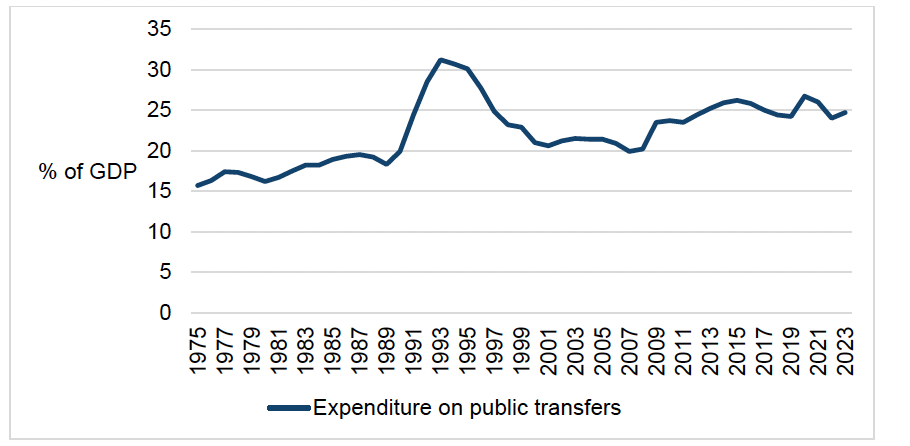
Source: Statistics Finland Annual national accounts table 152j, public transfers include income transfers from Government to households through social security benefits and subsidies.
Shifting political context
In addition to the wider economic context, there was a change to Finland’s political context during this period, which facilitated major reforms and reduced the prevailing nature of universalism in Finland’s socio-political discourse. Key to this was an amendment to The Parliament Act in 1995 to allow new laws and annual budgets to be approved by a simple majority, rather than a majority of two-thirds. Furthermore, in 1995 the incoming Government was a coalition of the Social Democrats and the Conservatives – both of whom have typically advocated for earnings-related benefits in Finland – which lasted for two electoral periods.[99]
This period was also influenced by changing international geo-political influence. Finland joined the EU in 1995, and started drawing greater influence from neo-liberal economies, displacing the long-standing influence of Sweden.[100] These ideas did not replace the previous Keynesian and social investment ideas completely, but introduced competition between these worldviews and neoliberal ideas.[101] This tension grew under the Conservative-left wing coalition which doubled down on austerity policies through structural reforms to the Finnish welfare state after the 2008-09 international financial crisis.[102]
Over this period, the decline in universalism meant that poverty reduction emerged as a policy priority for the first time in this period. In 1996, an expert group headed by the Permanent Secretary at the Ministry of Social Affairs and Health was tasked with reviewing the extent of poverty and social exclusion in Finland, and then suggesting remedial measures.[103] Finland appointed its first Ombudsman for Children in 2005, tasked with strengthening the rights of children in Finland under the UN Convention on the Rights of the Child.[104]
Child Home Care Allowance
Child home care allowance, a cash-for-childcare scheme fully introduced nationally in 1990, was a distinct new policy in this period. It paid a cash allowance to parents with a child under three years old who did not attend a municipal daycare service, and it was in tension with the existing emphasis on mothers’ labour market participation. It was introduced as part of a political compromise between the left and centre-right. This was because of concern from the Centre Party about the availability and growing cost of childcare services, especially in rural areas, as well as a desire to recognise the value of ‘home work’.[105] The introduction of the child home care allowance and a weakening labour market decreased the rate of employment among mothers in particular, especially for single parents.[106] This entrenched disadvantage for some groups. For example, analysis from the 1990s and 2000s showed that the highest long-term unemployment rate was among mothers with children aged three to six years, and suggested this was influenced by child home care allowance encouraging a protracted period of absence from the labour market. During the austerity measures of the 1990s, home care allowance had also been cut by more than 20% in 1995, and it was then frozen until the early 2000s.[107]
4. Recent changes in work and structural reforms (2005-25)
Relative child poverty peaked in 2007 at 12.2%, and has since remained between 9-12%, notably higher than during the early 1990s. In the last two decades there has been growing concern about child poverty rates amongst specific population groups. This has been particularly the case for single parents, larger families and children of migrant parents.
While relative child poverty in Finland remains at an internationally-low level, experts we spoke to believe that recent reforms to unemployment and child benefits will increase child poverty in Finland, especially for children in single parent households. A decline in the number of working adults in households is also a factor in increased poverty rates in the 2000s compared to the 1971-1989 period.[108] Structural changes in the labour market and reforms to social security have increased the risk that households in work and those unable to access full-time work cannot avoid poverty. As a result, there is now increasing concern about how poverty is disproportionately experienced by particular groups, especially those who face barriers to accessing the labour market.
Key factors affecting child poverty in Finland today are:
Continuing tensions about sustainable levels of public spending
Tensions about the sustainability of public spending continues to be a factor, and there have been several cutbacks to child benefits in this period. For example, child benefits were frozen again from 2013 and 2016, and the indexation system was cancelled completely from 2016. Local authorities were allowed to restrict the right to childcare to 20 hours per week from 2015. These reforms were justified by politicians through economic arguments about public expenditure levels, and a continued push for structural reforms to rebalance levels of spending with the economic resources available in Finland’s modern economy.[109]
In 2023 and 2024, several further reforms have been highlighted by experts we interviewed as risking the standard of living for people with low incomes. This includes reductions in the level of housing allowance and further changes to the Unemployment Security Act to extend waiting periods. This legislation increased the number of contribution weeks from approximately six months to one year, and it also educed payments after 40 and 170 days of unemployment.[110] A €300 earnings exemption for single parents was also removed in 2024, which had previously allowed them to earn a small amount while claiming unemployment benefits.[111] Housing allowance will also no longer be available for owner occupied homes from 2025, which is a marked departure from the position adopted in 1987 discussed previously.[112]
Poverty among at-risk groups
There has been an increase in single parent households in the 1990s and the early 21st century. Single mother families (as a share of all families with children under 18) increased from 12% to 20% from 1990 to 2019, and single father families likewise increased from 2% to 3.4% in the same period.[[113] Employment rates for single parents also declined during the 1990s recession and after the 2008 economic crisis, and in 2018 were 11-12 percentage points lower than those for partnered parents.[114] Employment is becoming less secure and unionisation rates in some Finnish industries have fallen, especially for younger part-time workers.[115] As a result, single parents typically face a double disadvantage, with a widening employment and earnings gap.[116] A key element of this picture is the lack of support for part-time work in Finland.
Families with children from immigrant backgrounds are also at a higher risk of poverty than native-born children. Depending on the country of origin, the poverty rate for migrant children can be six times higher than for children from a Finnish background.[117] Experts in our stakeholder interviews also stressed that data collection is limited and poverty rates are potentially underestimated for minority groups such as the Sámi and Roma communities.
European Child Guarantee
In 2021, Finland adopted its first National Child Strategy, as part of the European Child Guarantee initiative. The strategy focuses on respecting the rights of the child, but it also includes a focus on adequate incomes, poverty reduction and promoting shared caring responsibilities.[118] However, experts we spoke to highlighted that the Government elected in 2024 intends to primarily achieve poverty reductions through improving labour market participation, but there are no specific policies to address the barriers to employment faced by the groups at the highest risk of poverty.
As discussed in the previous section, labour market participation, full-time work and the redistributive tax system are important contributors to low child poverty rates in Finland. Alongside this, Finland has a comprehensive social welfare system provided through social insurance and direct Government provision, as shown in the table below. These policies provide comprehensive and near-universal support to ensure the basic sustenance needs of all residents are met.
Contact
Email: TCPU@gov.scot