
Heat networks - installation and maintenance licence: consultation
A consultation seeking views on proposals for an installation and maintenance licence for heat networks.
Closed
This consultation closed 5 June 2026.
View this consultation on consult.gov.scot, including responses once published.
2. Background and Change of Approach to Licensing
Background
The Heat Networks (Scotland) Act 2021 (“the 2021 Act”) was the first piece of legislation passed in the UK to regulate and support the growth of the heat network sector. The 2021 Act includes provisions for heat network licences and consents, as well as zones, permits and Building Assessment Reports.
The Heat Networks (Heat Network Zones and Building Assessment Reports) (Scotland) Regulations 2023 came into force on 30 May 2023. These regulations require Scottish public authorities to produce Building Assessment Reports for some of their buildings, specifically non domestic ones, which assess their potential to connect to a heat network. They also introduced regulations and guidance on heat network zoning.
As we have mentioned in the previous section, Part 1 of the 2021 Act provided powers for Scottish Ministers to introduce a mandatory licensing system, which was intended to ensure that market participants are solvent, competent, fit and proper and provide their essential service in line with conditions set by a Licensing Authority, with ongoing monitoring and enforcement where necessary[1]. This would regulate all heat network developers and operators in Scotland, and in exchange offer licence holders rights and powers covering areas like road works, survey and compulsory purchase. Since then, the UK Government passed the Energy Act 2023 introducing an authorisation regime for heat networks in Great Britain. This meant that the intention of our original licensing proposals in the 2021 Act has been largely superseded.
GB heat network authorisations will regulate the sector covering areas such as consumer protection, technical standards and rules for step-in to cover market failure. The UK Government and Ofgem have consulted on the authorisation regime in 2024 and 2025, with more information on these consultations available on the UK Government website. The Scottish Government is working closely with the UK Government and Ofgem to support the introduction of the authorisation regime in January 2026 through to enforcement in January 2027.
Overlap of Scottish and UK legislation
Diagram 1 shows the requirements which would exist for heat networks in Scotland if both the 2021 Act heat networks licence regime, and the Energy Act GB authorisations regime, were implemented:
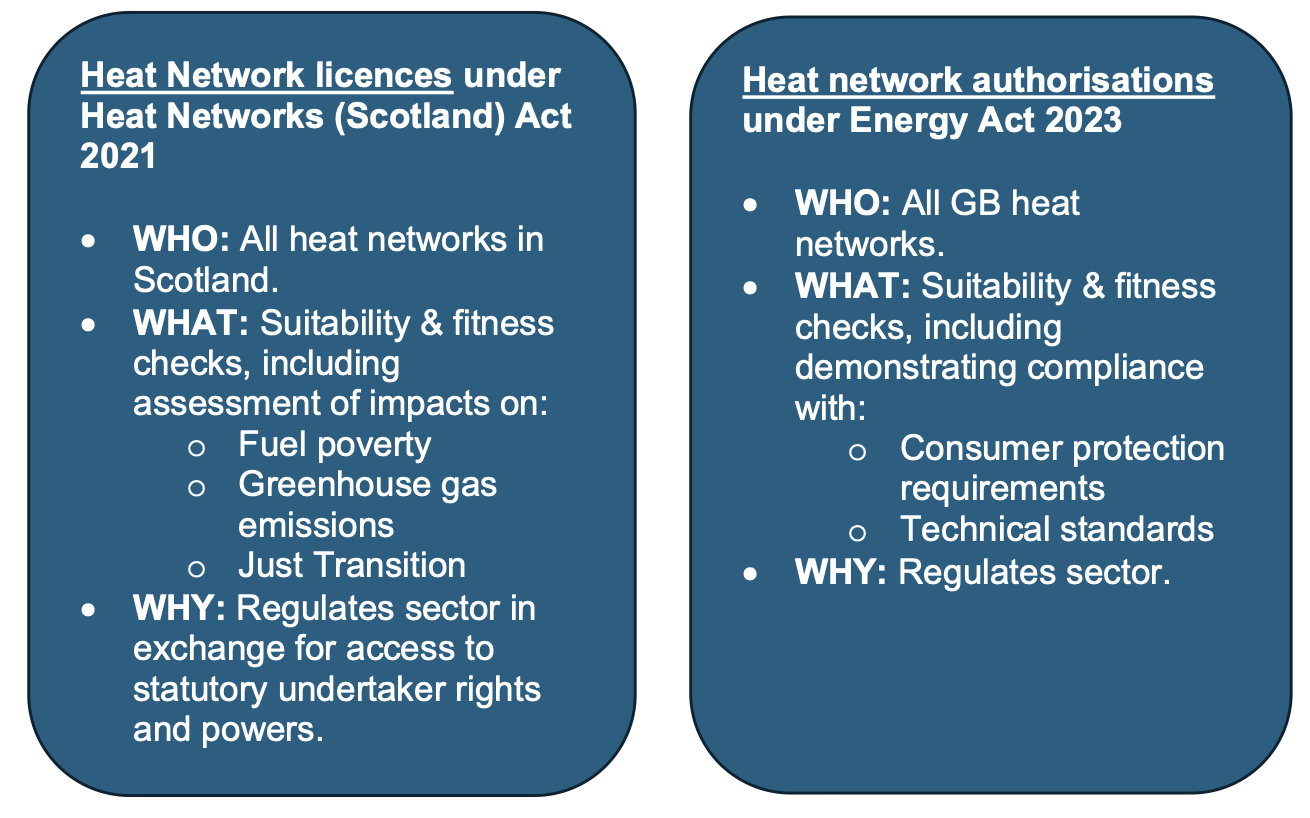
We believe that there is considerable duplication between the two regimes represented in diagram 1. For example, heat network licences must assess an applicant’s impact on fuel poverty while heat network authorisations will apply consumer protections such as safeguards for vulnerable persons and controls on pre-payment meters, billing and pricing.
We think that introducing mandatory heat networks licences under the 2021 Act alongside the GB authorisation regime would not be proportionate to the Scottish heat network sector, which means it would not meet the Scottish Government’s Better Regulation principles[2]. This approach risks overregulating and disadvantaging the heat network sector in Scotland while it is still at the early stages of development. Companies would be obliged to go through multiple application processes, with some duplication between UK and Scottish regimes, whether they require licensee rights and powers or not. There is also a risk that because every heat network company would need a licence, some might be forced to pay for a licence granting rights and powers they don’t need. Because a mandatory regime would involve more applicants, and the 2021 Act applies various criteria before each application can be granted, the cost of delivering this regime would also be higher than our current proposals. This would result in higher fees for applicants which may lead to costs being passed to customers.
Alongside these considerations, there are limits to the devolved powers available to us. Whilst consumer advocacy and regulation of heat is devolved, consumer protection is reserved. This means that the GB authorisation regime will be able to do more to protect consumers than a licensing regime introduced by the Scottish Government could, for example billing and pricing is a reserved matter.
New proposal: installation and maintenance licence
We wish to introduce efficient and streamlined regulation that supports growth in this sector by providing heat network companies in Scotland with access to rights and powers for things like roadworks, survey and compulsory purchase. These rights and powers and the reasons we believe they are necessary are described in more detail later in this consultation.
This is why we are proposing an opt in Scottish installation and maintenance licensing regime, as set out in the draft Heat in Buildings Bill. The proposed regime will focus on providing such rights and powers to those who choose to apply for a licence. This approach is intended to replace the mandatory heat networks licence of the 2021 Act.
Diagram 2 shows how the proposals in the draft Heat in Buildings Bill would work alongside and complement the GB authorisations regime.
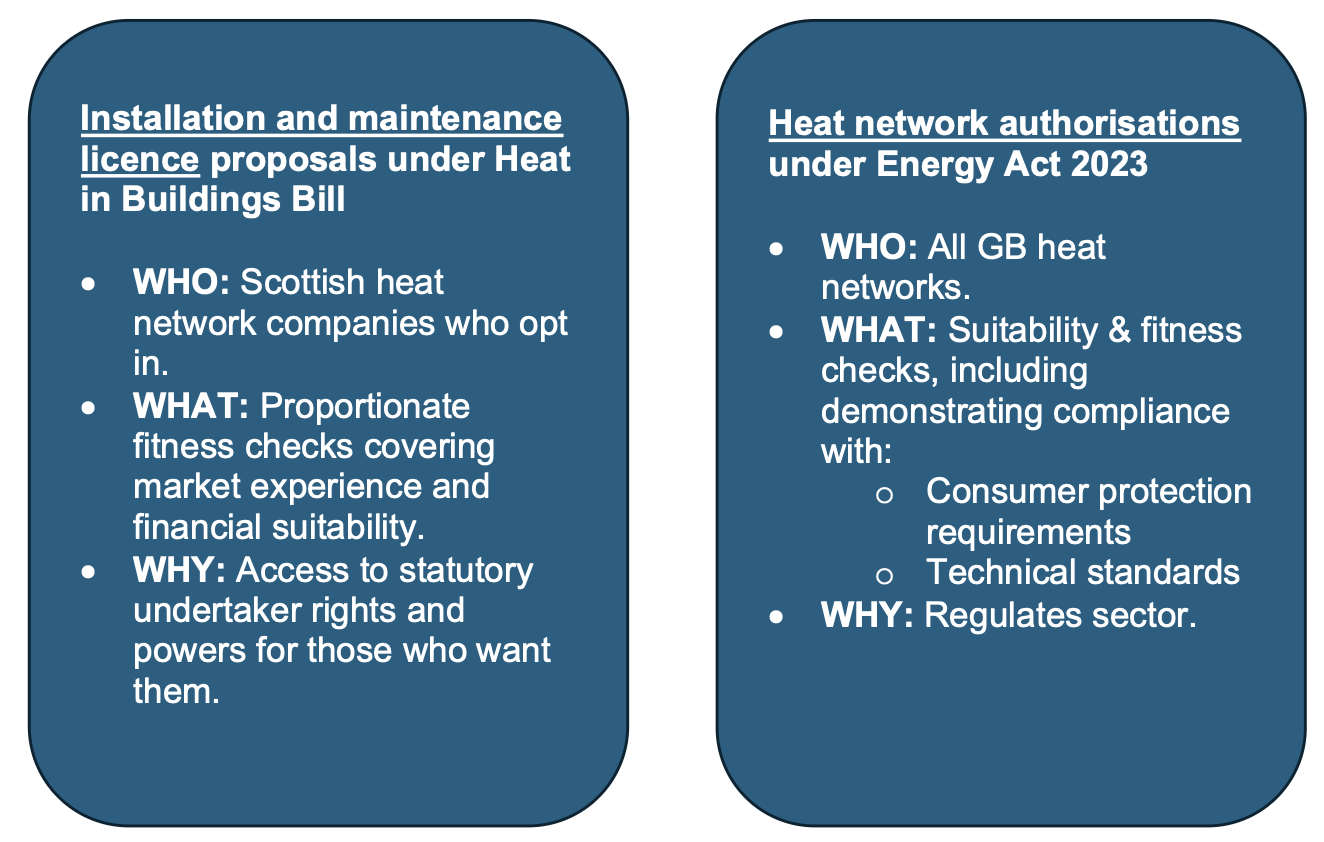
We believe that these proposals will remove the duplication and risk of over-regulation previously discussed and are in line with our Better Regulation principles.
This approach also aligns with a similar opt in rights and powers licence for England, which is currently being developed by the UK Government and Ofgem. Because legislation for areas like road works are devolved, a separate licensing regime is required for Scotland to ensure the correct rights and powers are granted here.
We expect the proposed opt in installation and maintenance licence regime will result in fewer applications than a mandatory regime, meaning that the cost of delivering the licensing regime should be reduced. The financial memorandum at the time of the 2021 Act estimated licensing could cost the Scottish Government between £1 million and £7.1 million over ten years (not adjusted for inflation)[3]. We believe that our more proportionate installation and maintenance proposals should put the cost firmly at the lower end of this range. Lower costs to deliver licensing should also result in lower fees for applicants and ultimately reduce costs being passed on to consumers. Further detail on costs will be provided in the financial memorandum to any future legislation in this area.
Change of approach: other considerations
While developing our proposal to move to an opt in licensing regime, we have carefully considered the need to avoid overburdening our emerging heat network sector while it grows and accommodates the provisions of the UK Energy Act 2023. Therefore, we propose to remove duplications relating to reducing greenhouse gas (GHG) emissions, addressing fuel poverty and supporting a Just Transition and unnecessary regulatory requirements listed in the 2021 Act, such as transfer schemes.
As noted above, the GB authorisations regime will introduce consumer protections for heat network customers, covering fair pricing, clear and accurate billing and protections for vulnerable customers among other areas. These provisions will go some way to address fuel poverty among heat network customers. Authorisations will also introduce the Heat Network Technical Assurance Scheme (HNTAS) which will set out mandatory standards and efficiencies for all heat networks. More efficient networks will produce lower emissions, ultimately helping to contribute to a reduction in GHG emissions, as well as lower costs. As the sector grows and develops in line with UK and Scottish regulation, we believe that the demand for technical knowledge, skills and experience will also grow, creating opportunities and assisting the Just Transition towards net zero.
We recognise more can and must be done to reduce greenhouse gas emissions and fuel poverty and deliver a Just Transition via the Scottish heat network sector. However, because our proposed installation and maintenance licence will be non-mandatory, any requirements relating to matters like these would only apply to organisations which opt in and apply for a licence in the first place. Attaching such requirements to licences risks creating a two-tier system where large organisations who could easily comply with such requirements would obtain a licence, while small and medium organisations would have to weigh up the benefits of licensee rights and powers against the cost of applying and demonstrating compliance. This would not effectively regulate the sector, and could disadvantage and discourage new players trying to enter the Scottish heat networks market.
We believe that the important matters of greenhouse gas emissions, fuel poverty and Just Transition are better addressed at the design and development stage of individual heat network projects. In other words, new heat network projects should be designed and built in a way that minimises emissions and heating bills. The 2021 Act includes provisions for consents and permits which would be a more effective way to apply such regulations to the sector, and we are considering how and when these provisions could best be bought forward. Furthermore, existing delivery programmes such as the Scottish Government’s Heat Network Fund, and the Heat Network Support Unit, already target support at new low or zero emission heat network projects that are as affordable for consumers as the alternative low carbon heating option. We are exploring other ways to incentivise heat network development in a way that aligns with our national objectives.
Diagram 3 shows our timeline for the delivery of heat networks policy and regulation in a way that works alongside UK legislation.
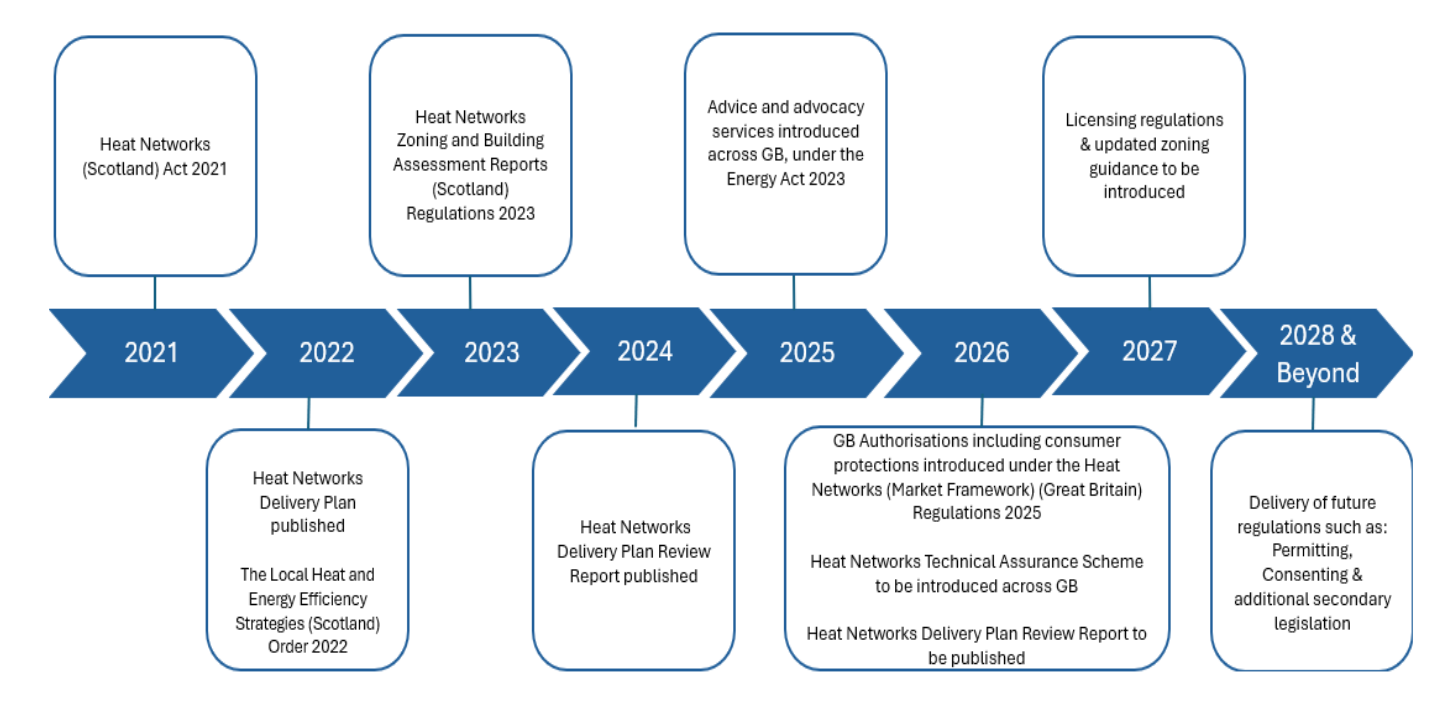
Diagram 3: Timeline for the delivery of heat networks policy and regulation:
2021: Heat Networks (Scotland) Act 2021
2022: Heat Networks Delivery Plan published. The Local Heat and Energy Efficiency Strategies (Scotland) Order 2022
2023: Heat Networks Zoning and Building Assessment Reports (Scotland) Regulations 2023
2024: Heat Networks Delivery Plan Review Report published
2025: Advice and advocacy services introduced across GB, under the Energy Act 2023
2026: GB Authorisations including consumer protections introduced under the Heat Networks (Market Framework) (Great Britain) Regulations 2025. Heat Networks Technical Assurance Scheme to be introduced across GB. Heat Networks Delivery Plan Review Report to be published.
2027: Licensing regulations & updated zoning guidance to be introduced.
2028 & Beyond: Delivery of future regulations such as: Permitting, Consenting & additional secondary legislation.
We believe the proposals for the Scottish installation and maintenance licence outlined within the published draft Heat in Buildings Bill and also in this paper, will complement and work alongside GB authorisations. This will introduce a proportionate and opt in Scottish licensing regime for the heat network sector that provides licensees with similar statutory undertaker rights as other utility providers in Scotland and like the approach being taken across the rest of Great Britain (heat networks in Northern Ireland are covered by separate arrangements).
Contact
Email: heatnetworks@gov.scot