
Health and social care - infection prevention and control strategy: vision and priority statements
This strategy sets out a ten-year vision and priority statements which aim to minimise preventable infection across health and social care in Scotland, supporting safer care, stronger systems and a person-led, rights-based approach to infection prevention and control.
Annex 2: Draft Theory of Change for Infection Prevention and Control across Health and Social Care in Scotland
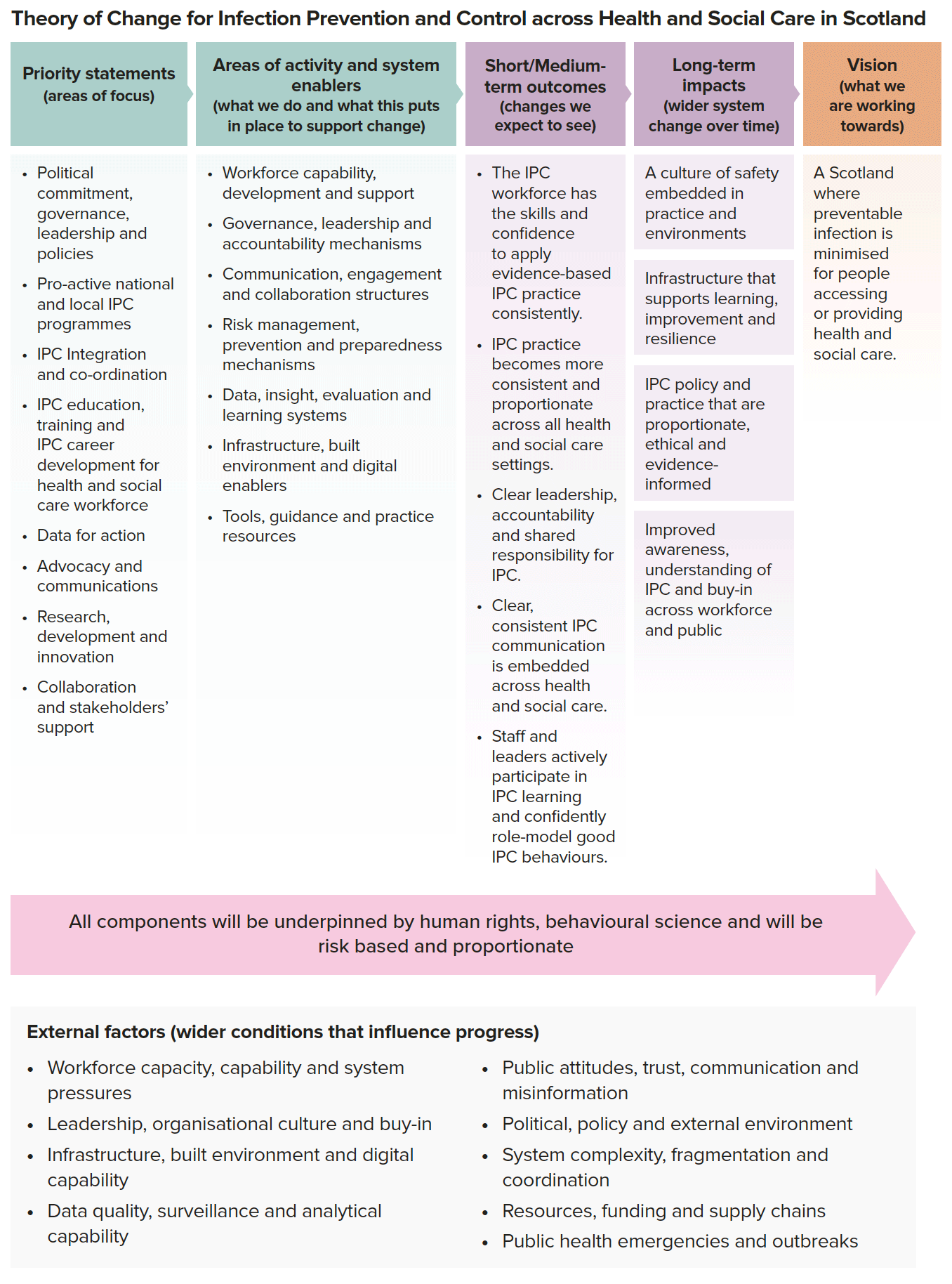
Graphic text below:
Theory of Change for Infection Prevention and Control across Health and Social Care in Scotland
Priority statements (areas of focus)
- Political commitment, governance, leadership and policies
- Pro-active national and local IPC programmes
- IPC integration and coordination
- IPC education, training and IPC career development for health and social care workforce
- Data for action
- Advocacy and communications
- Research, development and innovation
- Collaboration and stakeholders’ support
Areas of activity and system enablers (what we do and what this puts in place to support change)
- Workforce capability, development and support
- Governance, leadership and accountability mechanisms
- Communication, engagement and collaboration structures
- Risk management, prevention and preparedness mechanisms
- Data, insight, evaluation and learning systems
- Infrastructure, built environment and digital enablers
- Tools, guidance and practice resources
Short/Medium-term outcomes (changes we expect to see)
- The IPC workforce has the skills and confidence to apply evidence-based IPC practice consistently.
- IPC practice becomes more consistent and proportionate across all health and social care settings.
- Clear leadership accountability and shared responsibility for IPC.
- Clear, consistent IPC communication is embedded across health and social care.
- Staff and leaders actively participate in IPC learning and confidently role-model good IPC behaviours.
Long-term impacts (wider system change over time)
- A culture of safety embedded in practice and environments.
- Infrastructure that supports learning, improvement and resilience.
- IPC policy and practice that are proportionate, ethical and evidence-informed.
- Improved awareness, understanding of IPC and buy-in across workforce and public.
Vision (what we are working towards)
- A Scotland where preventable infection is minimised for people accessing or providing health and social care.
All components will be underpinned by human rights and behavioural science and will be risk-based and proportionate.
External factors (wider conditions that influence progress)
- Workforce capacity, capability and system pressures
- Leadership, organisational culture and buy-in
- Infrastructure, built environment and digital capability
- Data quality, surveillance and analytical capability
- Public attitudes, trust, communication and misinformation
- Political, policy and external environment
- System complexity, fragmentation and coordination
- Resources, funding and supply chains
- Public health emergencies and outbreaks
This Theory of Change is intended to be applicable to all settings where health and social care is provided, in line with the Scope outlined in Section 3.2 of this strategy.
Understanding the Theory of Change
The Theory of Change presents a high-level model of how activity relating to IPC across health and social care in Scotland is expected to contribute to change over time.
It provides a shared understanding of how improvement is anticipated to occur across the system. The Theory of Change is not a delivery plan and does not set out guaranteed or directly attributable impacts. Rather, it offers a strategic description of the pathways and assumptions through which change is expected to happen.
The model is grounded in stakeholder insight rather than established evidence of causal impact. It should therefore be understood as a working model that supports shared understanding and discussion, rather than a definitive statement of impact.
1. Priority Statements
The model begins with eight priority statements, which set out the main areas of focus for IPC across health and social care in Scotland.
These priorities reflect where national attention and effort are expected to be directed, including political commitment and leadership, proactive IPC programmes, integration and coordination across settings, workforce education and development, use of data for action, advocacy and communication, research and innovation, and collaboration with stakeholders.
Together, they provide a shared strategic direction for IPC across the system.
2. Areas of activity and system enablers
The second component of the model brings together areas of activity and system enablers. These describe the main types of work and the enabling conditions that stakeholders identified as necessary to support improvement in IPC.
They reflect both what happens across the system and what is put in place to support change, rather than setting out specific programmes or deliverables. These areas are framed at a high level to ensure the Theory of Change remains strategic and flexible. More detailed operational planning will be developed separately through accompanying action plans.
3. Short- and medium-term outcomes
The Theory of Change identifies a set of short- and medium-term outcomes that describe the changes expected as the priority statements, areas of activity and system enablers interact over time. These outcomes are not framed as short-term performance measures or directly attributable effects. Instead, they describe intermediate changes that stakeholders highlighted as important steps towards sustained improvement.
4. Long-term impacts
The long-term impacts describe wider system-level changes that are expected to emerge over time where progress is sustained. They reflect the conditions that support safe, high-quality care and reduced avoidable infection, and are framed as characteristics of the system as a whole.
5. Vision
Collectively, the outcomes and impacts support the long-term vision of a Scotland where preventable infection is minimised for people accessing or providing health and social care.
The vision represents the overarching ambition that the Theory of Change is working towards, rather than a short-term or directly measurable endpoint.
Cross-cutting principles
All components of the Theory of Change are underpinned by human rights, behavioural science, and approaches that are risk-based and proportionate to context. These principles shape how activity is expected to be designed, implemented and interpreted across the system.
External factors, assumptions and limitations
The model explicitly recognises that progress in IPC is influenced by a range of external and system-level factors. These include workforce capacity and pressures; leadership and organisational culture; infrastructure and digital capability; data quality and analytical capacity; public attitudes and trust; the wider political and policy environment; system complexity; resource availability; and public health emergencies or outbreaks.
Many of these factors sit partially or wholly outside the direct control of individual programmes or organisations, but they may enable, constrain or moderate how effectively activity leads to change.
Some represent assumptions that underpin the model, such as sustained leadership commitment, sufficient workforce capacity, and the availability and use of relevant data for learning. Others represent risks that could disrupt progress, including competing system pressures, workforce shortages or shifts in public confidence.
Making these influences explicit helps avoid over-claiming what the model can deliver and reflects the complexity of the system in which IPC operates. The Theory of Change should therefore be understood as a structured description of how change is expected to occur under favourable conditions, rather than a guarantee of outcomes.
Contact
Email: HAI-AMR_Policy_Unit@gov.scot