
Post Office (Horizon System) Offences (Scotland) Act 2024 implementation: statutory report
This statutory report to the Scottish Parliament on the implementation of the Post Office (Horizon System) Offences (Scotland) Act 2024 outlines the steps taken by the Scottish Government to fulfil its statutory duties under Section 6 of the Act.
4. Scottish Government’s Powers under the 2024 Act
4.1 Establishment of an operational framework
To fulfil its duty under the Act to take all reasonable steps to identify quashed convictions, the Scottish Government was required to assess cases against the five statutory conditions outlined in the legislation. When all five conditions are met, a conviction is deemed to have been quashed under the terms of the Act.
The conditions in section 2 of the Act are:
- Condition A (referred to in this report as date of offence condition) is that the offence was alleged to have been committed—
a) on a date or dates falling within the period that begins with 23 September 1996 and ends with 31 December 2018, or
b) at any time during a period that falls wholly or partly within the period mentioned in paragraph (a).
- Condition B (referred to in this report as offence type condition) is that the offence is one of the following—
a) embezzlement,
b) fraud,
c) theft,
d) uttering,
e) an ancillary offence.
- Condition C (referred to in this report as carrying on post office business condition) is that, at the time of the alleged offence, the person—
a) was carrying on a post office business, or
b) was working in a post office (whether under a contract of employment or otherwise) for the purposes of a post office business.
- Condition D (referred to in this report as offence committed in connection with post office business condition) is that the person was alleged to have committed the offence in connection with carrying on, or working for the purposes of, the post office business.
- Condition E (referred to in this report as Horizon system condition) is that—
a) at the time of the alleged offence, the Horizon system was being used for the purposes of the post office business, or
b) where the offence was alleged to have been committed at any time during a period as mentioned in paragraph (b) of condition A above, the Horizon system was being used for the purposes of the post office business for the whole or part of that period.
The Scottish Government wanted to identify those convictions which may have been quashed by the Act, and obtain information from justice agencies to assess whether in each case the five conditions listed above were in fact met.
The Scottish Government engaged directly with the previously listed justice agencies – SCCRC, COPFS, SCTS, and Police Scotland – to determine which organisations held information relevant to identifying quashed convictions under the Act. Engagement also took place with POL and, to a lesser extent, RMGL.
It was noted that, for example, Police Scotland were generally less likely to have relevant information than other bodies and agencies as often, though not always, investigations into offences were carried out by POL rather than Police Scotland or its predecessor forces in the period pre 2013.
In engaging with COPFS, it was agreed that access to prosecution information would likely be a key element to inform Scottish Government duties under the Act. This was because COPFS would always have been the prosecutor in relevant cases, unlike the position in England and Wales where RMGL and/or POL were often the prosecuting authority.
As such, COPFS would hold information provided by POL and/or RMGL on relevant investigations leading to prosecutions where they still retained that information. This would mean that while engagement with POL and/or RMGL did remain necessary on specific cases, often the necessary detailed information about the prosecution and files relating to the investigation would be part of the prosecution files, so as to negate the need for engagement with POL and/or RMGL on these matters.
However, it was necessary to engage with POL in respect of one of the conditions; namely the Horizon system condition relating to the operation of Horizon systems within the location of the offence.
For every case assessed, information was sought from POL in respect of use of Horizon specifically with information sought on the date of installation of Horizon in the relevant offence location. This was the case even if information provided by, for example, COPFS revealed references to Horizon as part of the case files which indicated a use of Horizon was evident from case files. This approach was adopted to ensure a consistency of approach across all cases in respect of applying consideration to the Horizon system condition by ensuring Post Office information in respect of use of Horizon was provided to check against the date of the offence.
The engagement with SCCRC focused on two key areas: cases that the SCCRC had under consideration for referral to the High Court of Justiciary at the time the Act came into force, and a list of individuals who the SCCRC had written to since 2020, following disclosures from the POL. The provision of this information to Scottish Government assisted the assessment of relevant cases under the Act and these cases were prioritised.
The role of SCTS centred on providing detailed information about convictions, including dates and other relevant court record data. This input was used in helping add to the initial case-specific information supplied by COPFS. Together, the prosecution papers from COPFS and the court records from SCTS provided sufficient information in many cases to enable the Scottish Government to assess cases and fulfil its duties under the Act, subject to the separate engagement with Post Office in relation to consideration of the Horizon system condition.
A process map, detailed at Figure 2, was agreed in collaboration with justice agencies which was underpinned by DSAs and setting out the flow of information between the Scottish Government and each agency. This structured approach provided the necessary levels of assurance for all parties, fostering confidence in how sensitive case-specific information was being handled and used.
In parallel, the Scottish Government engaged with officials from the UK Government Ministry of Justice and the Northern Ireland Department of Justice for officials from all administrations to share information about the steps taken to interpret and apply the conditions set out in the Act. This was in light of conditions in the Act also applying in the UK Government Act.
4.2 Outreach efforts and self-referral applications
In the summer of 2024, the Scottish Government published an open letter[8] on its website, providing clear guidance for individuals who believed their conviction may have been quashed under the Act. The letter outlined how affected persons could contact the Scottish Government to seek further information or support.
In addition to publishing an open letter on its website, the Scottish Government undertook targeted outreach through key stakeholder organisations, in particular the National Federation of Sub-Postmasters. This engagement played an important role in helping to raise awareness among potentially affected individuals, particularly those who may not have been actively engaged with government channels.
Individuals were able to self-identify to the Scottish Government if they believed they – or someone they knew – had a conviction potentially quashed under the Act. This could be done by contacting the Scottish Government at the dedicated email and postal addresses included in the open letter.
Individuals living in Scotland applying for redress through the Department for Business and Trade (DBT) portal, which was launched in July 2024, were also referred to the Scottish Government for consideration. In such cases, where the Scottish Government had not previously been aware of the conviction, further inquiries were undertaken to gather the necessary case details, including checks against COPFS records.
Figure 2: The process established to implement the Post Office (Horizon System) Offences (Scotland) Act 2024
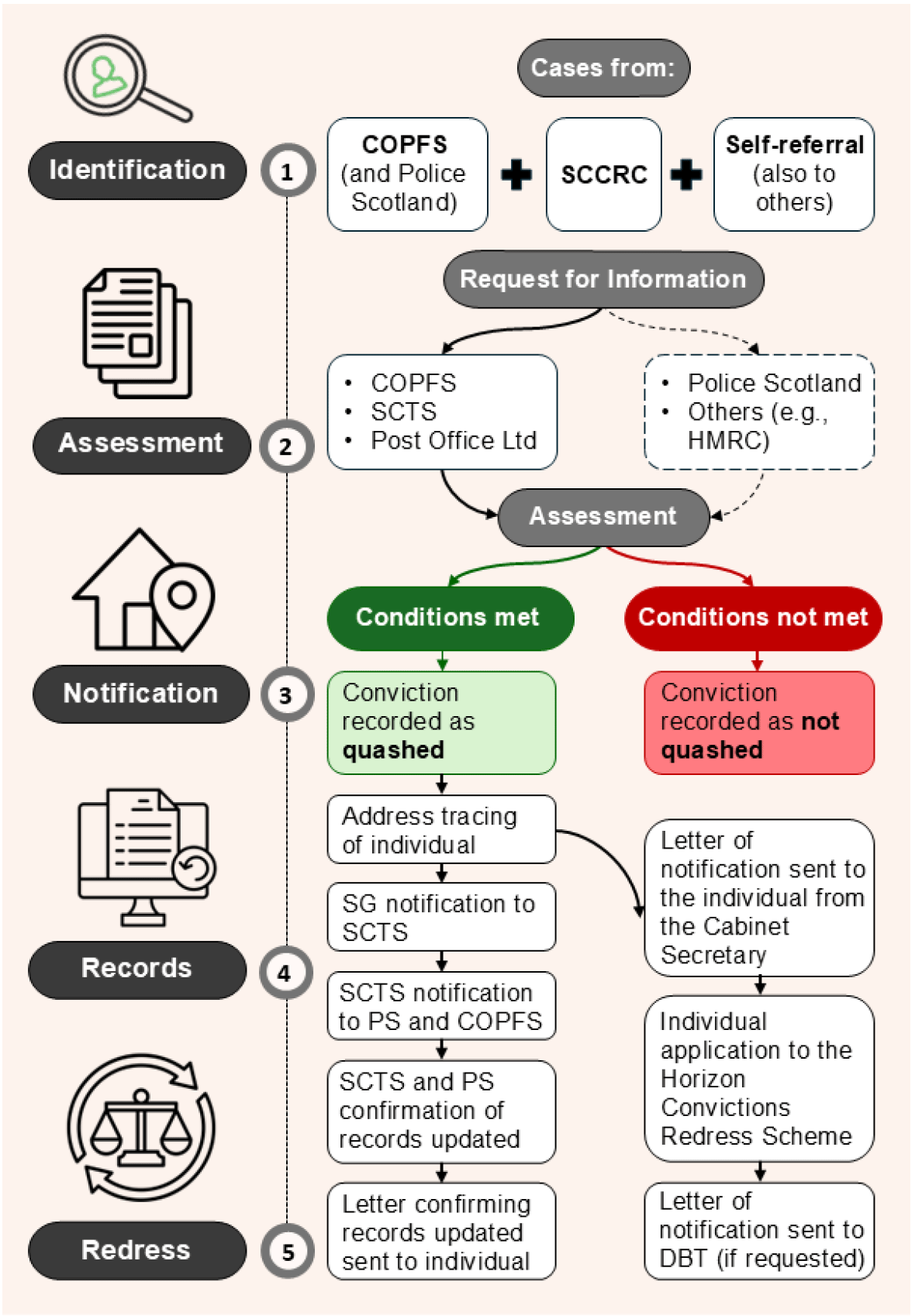
Graphic text below:
1. Identification:
Cases come from three sources:
- COPFS (and Police Scotland);
- Scottish Criminal Cases Review Commission (SCCRC); and
- self‑referrals, which may also include referrals from other organisations.
2. Assessment:
A request for information is sent to COPFS, SCTS, and Post Office Ltd, with additional information gathered where needed from Police Scotland or other agencies, such as HMRC. An assessment stage follows, determining whether the statutory conditions under the Act for quashing the conviction are met.
3. Notification:
If the conditions are met, the conviction is recorded as quashed. This leads to address tracing of the individual, Scottish Government notification to SCTS, and SCTS notification to Police Scotland and COPFS. A letter of notification is then sent to the individual from the Cabinet Secretary, informing them of their quashed conviction and eligibility to access redress.
If the conditions are not met, the conviction is recorded as not quashed.
4. Records:
For quashed conviction cases, SCTS and Police Scotland are required to confirm that the records have been updated to reflect the quashing of the conviction. A letter is then sent to the individual confirming that their records have been updated.
5. Redress:
For quashed conviction cases, the individual is eligible to apply to the Horizon Convictions Redress Scheme (HCRS) administered by the Department for Business and Trade. Once an application is made, the Department of Business and Trade will then request the letter of quashed conviction notification from the Scottish Government.
4.3 Methods used to identify individuals with relevant convictions
The Scottish Government has primarily used three sources of information to identify potential convictions which may have been quashed by the Act. These are:
1) A list of cases compiled by COPFS to identify those which could have been Horizon cases, based on those cases being one of the relevant offences listed in the Act where:
- the case was reported to COPFS by the POL as a Specialist Reporting Agency, or
- COPFS noted Horizon-related evidence was used in the case
2) Using information provided by POL, a list of individuals the SCCRC wrote to between 2020 and 2024, whose cases may have been impacted by the use of Horizon evidence, including those who had asked the SCCRC to review their case; and
3) Individuals who emailed the Scottish Government directly, as a result of the open letter encouraging individuals to self-refer where they believed their conviction would contain a relevant offence under the Act, or those who were referred to the Scottish Government by other agencies (e.g., Post Office Limited, Department of Business and Trade).
The list compiled by COPFS initially included 141 cases. However, 44 cases were quickly confirmed as outwith the remit of the Act, because although the offences were relevant and they met either the criteria of being reported by Post Office or Horizon evidence having been used, the cases did not proceed to result in a conviction or alternative to prosecution. As such, 97 cases were received from COPFS for full assessment under the Act.
Within these 97 cases, there were 13 cases that the SCCRC had provided to the Scottish Government as cases they were requested to investigate as potential miscarriages of justice, and which may have met the conditions of the Act.
Alongside the initial case data provided by COPFS and SCCRC, the Scottish Government also considered subsequently a further list of 153 cases that COPFS were able to identify from Police Scotland’s investigation of 163 additional cases. To identify these 163 cases initially, Police Scotland searched their own records using search parameters broader that had been used by COPFS as noted above to include all cases for relevant offences that could be related to the provision of postal services. This included, for example, where items of post were stolen.
COPFS then interrogated these cases to help inform whether the Scottish Government should carry out a full assessment in accordance with the provisions under the Act. COPFS reviewed each case, noting a summary of what it was about, and as a result of this process, supplied an anonymised list of 153 cases to the Scottish Government. This reduction from 163 cases reflected that 10 were not relevant for the purposes of the Act.
Upon receipt of this information of 153 anonymised cases, the Scottish Government noted that the vast majority of these cases presented a similar set of circumstances, often citing Royal Mail delivery offices, sorting offices, mail centres, and other types of such premises – distinct from a Post Office branch – as the location of the offence. There was no mention of the Horizon system, or the use of Horizon evidence, in any of these cases.
To gain a better insight into whether the 153 new cases could fall within the scope of the Act, the Scottish Government sought clarification from POL and RMGL as to whether the Horizon system could have been installed at these locations. The information received indicates that such premises never used the Horizon system. This is supported also by the Post Office Inquiry where the evidence received confirmed Horizon was not in use in these locations.
From these 153 cases therefore, three cases were taken forward by the Scottish Government for assessment as these were cases where it was uncertain whether Horizon has been installed and further investigation was merited.
4.4 Overview of data sources
The following data sources from relevant agencies were used to inform the assessment of cases:
Crown Office And Procurator Fiscal Service (COPFS)
COPFS provided a range of case materials that were critical for assessing whether the convictions met the conditions for being quashed under the Act. These materials included the Standard Prosecution Report (SPR), Post Office investigation reports, interview records, witness statements, and other relevant documentation, including materials received directly from the Post Office – such as extracts from the Horizon IT system, employment letters, and others.
The SPR was particularly valuable, generally offering detailed factual narratives about the offence, the individual’s role within the Post Office structure, and whether Horizon evidence was involved. It also contained draft charges, which, while not always identical to those ultimately prosecuted, helped establish the context and basis of the case. Additional sources, such as auditor reports and precognition papers, were also able to be requested by the Scottish Government to support the assessment.
Scottish Criminal Cases Review Commission (SCCRC)
While the SCCRC considered several relevant cases for potential referral to the High Court, their data was largely dependent on materials obtained from POL, with some case materials coming from COPFS. However, it was useful to check whether a case had already been reviewed or rejected by the SCCRC under its statutory functions, or if an application was placed on hold. This information was available via the SCCRC’s provided list. Additionally, it was important to verify whether the SCCRC previously contacted the individual, as this may have indicated a Horizon-related conviction.
Scottish Courts and Tribunals Service (SCTS)
SCTS provided copies of official court records, which were a key source of information for confirming the date and nature of convictions to ensure that the conviction was for a relevant offence under the Act.
These records included offence types, conviction dates, and sentencing details. Where available, SCTS also supplied copies of complaints or indictments, and minutes of court proceedings, which helped clarify the charges faced and whether any amendments were made during the case. Additional materials, such as Social Enquiry Reports prepared by social workers, were available upon request by the Scottish Government, offering further context about the individual’s employment and role within a business which was helpful on occasion in assessing the carrying on post office business condition and the offence committed in connection with post office business condition.
Police Scotland
The Criminal History System (CHS) is a secure database maintained by Police Scotland that holds detailed records of individuals’ criminal convictions. When necessary, Police Scotland were able to provide information from the CHS to support the identification of key details about a person and the offence. This included the date and location of the offence for which the conviction was received, the convicting court and the nature of the offence committed. If the case was originally reported by Police Scotland to the Procurator Fiscal (which did occur on occasion with relevant cases), it allowed them to confirm whether they retain any additional information related to that case.
Post Office Limited (POL)
POL were able to provide several types of information to support case assessments. They confirmed the installation dates of the Horizon system in specific post office branches, which was crucial for verifying whether Horizon was in use during the period of the alleged offence for application of Horizon system condition.
POL also held employment records for sub-postmasters, including job roles, branch details, and employment dates, although they do not retain records for individuals employed by sub-postmasters. This employment information was not provided as standard, but the Scottish Government could request this if there was uncertainty about a person’s employment status. Additionally, if case files from COPFS as well as SCTS information did not seem to include sufficient detail to help fully assess the conditions, a request could be made to POL to determine whether they held any additional information, particularly in cases that they reported to COPFS as a Specialist Reporting Agency.
4.5 Assessment process
A team of case handlers was established within the Scottish Government’s Directorate for Justice to assess individual cases under the Act.
Each case handler was provided with detailed guidance on how to apply the five statutory conditions to determine whether a conviction had been quashed. Their role involved reviewing the information received from relevant agencies, identifying whether the evidence supported each condition, and requesting further details where gaps existed.
Although case handlers worked independently on their assigned cases, they participated in regular case handling meetings to discuss common challenges, share insights, and receive updated guidance. Beyond assessment, case handlers were also responsible for maintaining accurate records, completing formal documentation, and preparing notification letters for ministerial sign-off once a conviction was identified as quashed.
Each case was reviewed by a case reviewer. The role of the reviewer was to double check the conclusion reached by the case handler on the basis of the available information to ensure there was a process of verifying a decision by a second person.
4.6 Assessment of conditions
Each of the five conditions contained in the Act was assessed against case-specific information provided to the Scottish Government.
As noted previously, the five conditions are:
- Condition A – date of offence condition
- Condition B – offence type condition
- Condition C – carrying on post office business condition
- Condition D – offence committed in connection with post office business condition
- Condition E – Horizon system condition
Date of offence condition (condition A)
To assess whether date of offence condition is met, the key requirement is that the offence date must fall wholly or partly between 23 September 1996 and 31 December 2018, as specified in the Act. This includes offences with a single date or a date range that overlaps with this period. The assessment of this condition relied on multiple sources of evidence:
- Court records (e.g. complaints, indictments, and minutes) were the primary source for confirming offence dates. If these showed the dates as falling within the specified period, then date of offence condition was satisfied.
- Extracts from the COPFS case management system (PROMIS) also provided offence dates and plea details, although this was less authoritative than court records. These were used alongside other evidence.
- SPR and draft charges offered indicative offence dates, but these could differ from final charges, and were used alongside other evidence.
- CHS records were used to fill gaps, especially where the case was reported by Police Scotland. These records often showed draft charge dates, not necessarily conviction dates, and were used alongside other evidence.
If the offence dates were found to clearly fall outside the specified period under the Act, this was sufficient to determine a conviction was not identified as quashed as the conviction was considered out of scope as the date of offence condition was not met.
Offence type condition (condition B)
To determine whether the offence type condition is met, the offence must be one of those specified in the Act: embezzlement, fraud, theft, uttering, or an ancillary offence. The assessment of this condition relied on multiple sources of evidence:
- Primary evidence included the record of conviction and a copy of the complaint or indictment from SCTS. If these documents confirmed the nature of the offence as listed in the Act, then this condition was satisfied.
- Supporting evidence often came from Police Scotland’s Criminal History System, which could help corroborate the nature of the offence; COPFS PROMIS system, which may show the offence as libelled and whether the plea or finding of guilt was amended; or SPR or charge sheets prepared by investigators, which could suggest the likely offence type, but would have to be considered alongside other evidence.
Carrying on post office business condition (condition C)
To determine whether the carrying on post office business condition is met, the individual must have been either carrying on a post office business or working in a post office – whether formally employed or involved in an informal arrangement – for the purposes of post office operations. The assessment of this condition relied on multiple sources of evidence:
- Primary evidence included information from the SPR and witness statements, which may confirm the individual’s role in the Post Office branch. If the offence dates fell entirely within the confirmed employment dates provided by POL, then this condition was met.
- If formal employment is not confirmed, informal working arrangements (e.g., family members assisting in the branch) may still bring the individual within scope, supported by SPR or other documentation.
- If primary evidence was missing or unclear, other secondary sources are reviewed, such as court records (e.g., complaints, indictments, conviction records), which may indicate the individual’s role; Social Enquiry Reports, which may include self-reported employment details; precognitions or court transcripts, which may provide further context about the individual’s involvement in the Post Office branch, and evidence from other government departments, such as Her Majesty’s Revenue and Customs.
Where discrepancies existed between offence dates and employment dates, or where the information was incomplete, multiple sources had to be considered together to determine whether the carrying on post office business condition was satisfied.
Offence committed in connection with post office business condition (condition D)
Once carrying on a post office business condition was met, the next step was to determine whether the offence was allegedly committed in connection with carrying on, or working for the purposes of, Post Office business. The assessment of this condition relied on multiple sources of evidence:
- Primary evidence included documentation from COPFS or court records such as the record of conviction, copy of the complaint or indictment, and court minutes. If these documents explicitly linked the offence to Post Office business, then this condition is satisfied.
- Supporting evidence included the SPR or investigation report, particularly where the case was reported by POL or RMGL and the carrying on post office business condition was met; a compensation order paid to POL or RMGL as part of sentencing further supported that the offence was connected to Post Office business.
Where discrepancies existed between various sources of information, or where the information was incomplete, multiple sources had to be considered together to determine whether the offence committed in connection with post office business condition was satisfied.
Horizon system condition (condition E)
To determine whether the Horizon system condition was met, the question was whether the Horizon system was in use for the post office business at the time of the offence. The assessment of this condition relied on multiple sources of evidence:
- Primary evidence included Horizon installation and automation dates provided by POL. If Horizon was installed or automated before or during the offence period – either fully or partially overlapping with the offence dates – then this condition was satisfied. Where individuals worked at multiple branches, installation dates for each branch were reviewed to determine whether Horizon was in use at the relevant time.
- Supporting evidence could come from the SPR, audit reports, investigator reports, or witness statements, which may confirm Horizon use at the branch during the offence period.
4.7 Notification to individuals
Once the cases were considered and an assessment made that the case contains a relevant conviction identified as quashed under the 2024 Act, a notification letter from the Cabinet Secretary for Justice and Home Affairs was sent to the individual or their personal representatives, to inform them that their conviction had been quashed under the Act.
A sensitive, trauma-informed approach was adopted for the purposes of making a notification and, in some cases, other persons, such as a family member or legal representative, may have been nominated by the individual to be their point of contact. This was reflected in the standard text developed for use in writing to individuals whose convictions had been identified as quashed by the Act.
In cases where individuals had engaged with the Scottish Government directly, the process of notification for convictions identified as quashed used the contact details provided to update those individuals.
In cases where the person had not contacted the Scottish Government, we would not necessarily have an up to date address for them. This is because the case specific information provided to allow for the case to be assessed was historical and often many years in the past.
We therefore utilised the services of Sheriff Officers to trace those people whose convictions had been quashed but where we did not have up to date contact information. This has ensured as much as possible that those whose convictions were quashed have been traced and advised.
Address tracing was initially undertaken in the form of a desktop search by Sheriff Officers. A desktop search involved using specialised software to verify address-related information, using a range of records to estimate the probability that an individual is located at a specific address. Such probability was returned as ‘low’, ‘medium’, ‘high’, and ‘very high’, and the Scottish Government proceeded to a notification where the results were either ‘high’ or ‘very high’.
If necessary, where a desktop search did not yield an address check reaching the necessary high degree of confidence, a field search was undertaken by Sheriff Officers. This involved a physical visit to verify any newly identified address that may be relevant.
4.8 Updating criminal records
The Scottish Government worked with SCTS and Police Scotland to put a process in place so that appropriate updating of criminal records took place for convictions and alternatives to prosecution identified as quashed or deleted.
This involved developing a process whereby the records relating to convictions held by the SCTS or transferred to the National Records of Scotland had convictions marked as quashed by effect of the Act. This was done in a manner that maintained historical data and did not unduly impact on justice agencies’ records.
The approach developed by SCTS allowed for automatic communication with criminal justice agencies to confirm that the individual court records had been updated and marked as quashed, allowing Police Scotland and COPFS to update their own records.
This approach ensured any individual with a conviction identified as quashed would no longer ever have the conviction referred to in, say, a disclosure check.
Individuals who had their convictions identified as quashed were sent a letter of notification by the Scottish Government to advise them of this position.
A second letter was sent by the Scottish Government once their criminal records were updated by SCTS and removed from the Criminal History System by Police Scotland.
Individuals’ records were updated in all cases where a relevant conviction or alternative to prosecution had been identified.
As part of the notification, all those with convictions quashed and alternatives to prosecution deleted under the Act were provided with the necessary information to engage with the redress scheme operated by the UK Government.