
Healthcare science: redefining our workforce
The approach we will take to redefine the healthcare science workforce in Scotland. This sets out a strengthened identity and leadership model for healthcare science.
A Stronger Scientific Workforce for Scotland
Redefining the scientific workforce in Scotland marks a pivotal shift toward a more unified, visible, and strategically aligned profession. A strengthened identity is the first step in addressing the challenges outlined earlier in this paper; inconsistency around professional identity, job roles, and visibility.
Importantly, it provides the foundation for more accurate data gathering to support future planning and delivery across NHS Scotland which will better allow the profession to align with the Scottish Government’s broader ambitions for service renewal, prevention, and digital transformation, defined within the Service Renewal Framework.
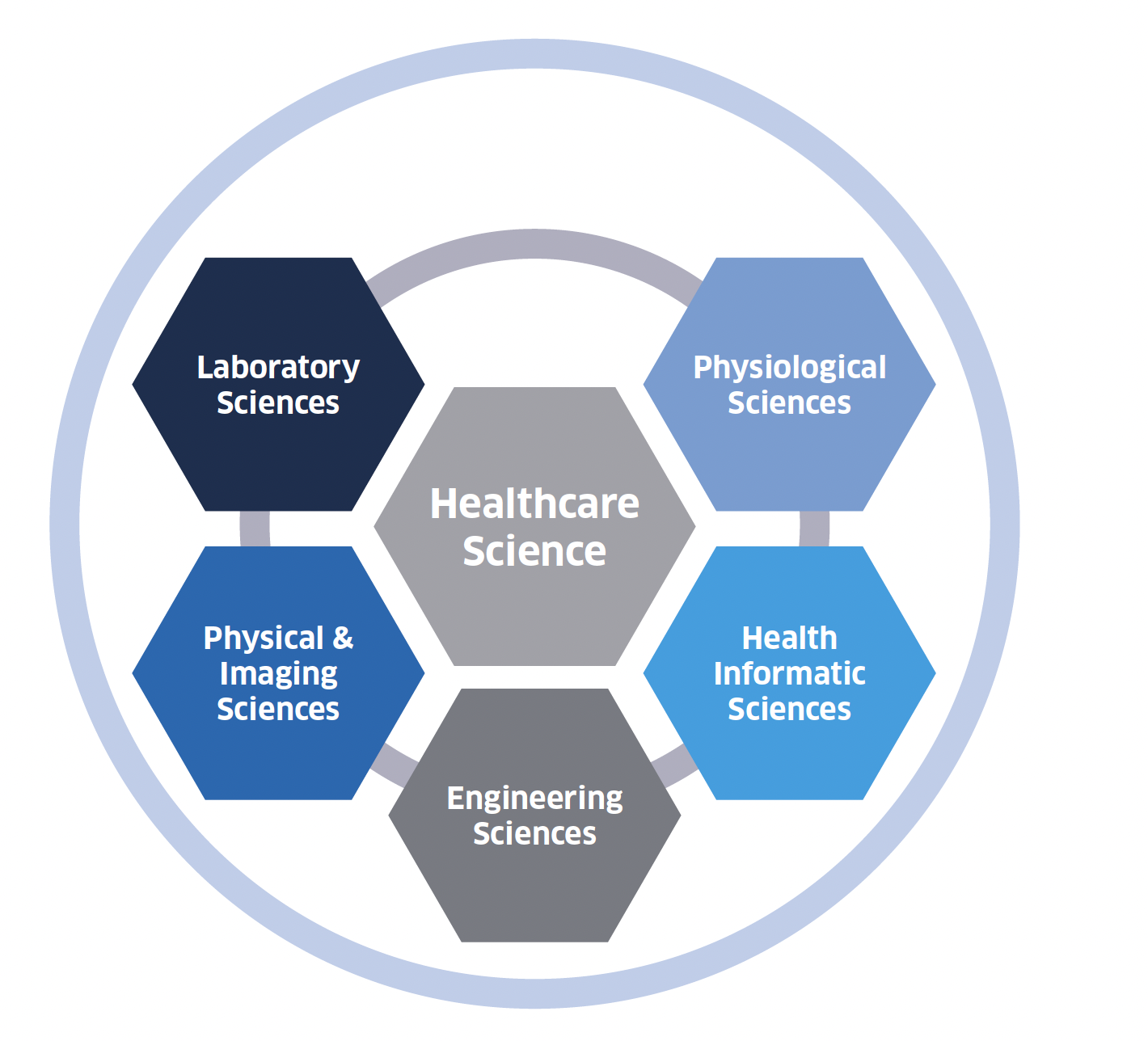
Healthcare Science
- Laboratory Sciences
- Physical & Imaging Science
- Engineering Sciences
- Health Informatic Sciences
- Physiological Sciences
Professional Identity
Professional identity in this context refers to how healthcare scientists perceive and define their role within the NHS in Scotland, and how that is seen by others.
While many professions in health such as medicine and nursing benefit from clearly defined roles and career pathways, this has not been the case across the entire scientific workforce in Scotland. As a result, there has been limited recognition of their impact and insufficient understanding of the nature and opportunities of a career in healthcare science.
Some of the healthcare science specialisms have benefited from long established career frameworks and training pathways: we have an opportunity to develop and strengthen these across all of healthcare science. By strengthening the visibility of healthcare science careers, we can deepen understanding of their impact and inspire more people to see the value and potential of a career in this vital field.
A strong professional identity for the scientific workforce is fundamental to the effective delivery of health services. Clear recognition of their expertise, roles, and contribution not only will support workforce retention and recruitment but also will ensure that their impact is visible and valued within multidisciplinary teams. Establishing a well-defined professional identity enhances collaboration with other health professions, promotes public trust in scientific input to care, and provides a foundation for structured education, training, and career progression. In turn, this strengthens service quality, innovation, and sustainability, ensuring that health systems are equipped to respond to current and future challenges.
A single definition of healthcare science in Scotland has now been established as part of the work described in this paper. This definition will serve as the cornerstone for building a cohesive identity, enhancing visibility, and supporting the strategic integration of healthcare science across NHS Scotland.
A healthcare scientist is a professional working in the NHS who applies scientific, engineering, or technological expertise — underpinned by data and research — to improve the quality of care and health outcomes for the population. Definition of a Healthcare Scientist in Scotland
This is grounded in feedback from the SLWG and through engagement with the workforce. As such, it reflects the central aspects of the profession in a way which is easy to understand. It creates a clear link to redefined professional groupings which sit alongside this and are outlined in the next section.
Professional Groupings
Clear professional groupings and classifications create a strong, flexible framework that supports workforce planning, strengthens identity, and allows new specialisms to be recognised and integrated, advancing healthcare science across Scotland’s health and care system.
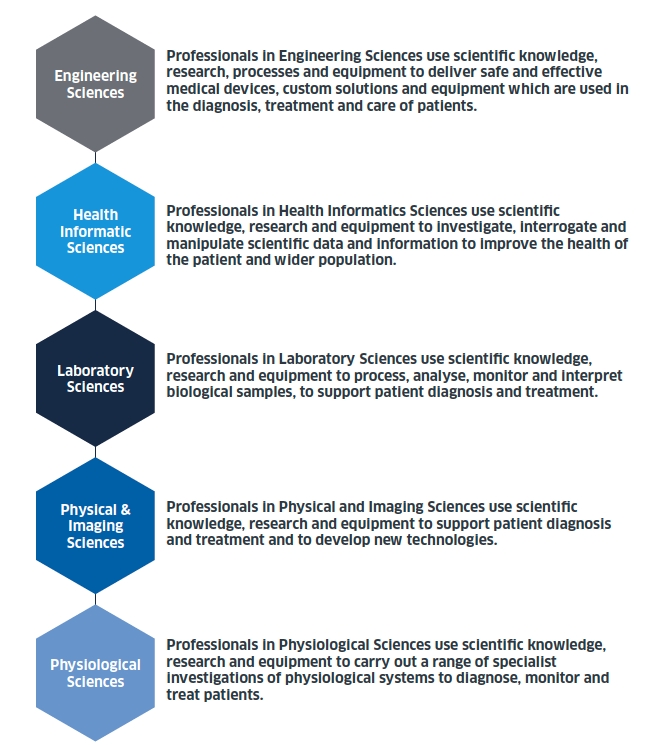
Five professional groupings (Figure 6) for the scientific workforce in Scotland, and definitions (Figure 7) for each, have been agreed as a result of this work, through engagement with stakeholders across the NHS in Scotland and more widely.

Professional Grouping
- Engineering Sciences
- Health Informatics Sciences
- Laboratory Sciences
- Physical & Imaging Sciences
- Physiological Sciences
These groupings better reflect the breadth of the profession in Scotland and create a clearer narrative that will support improved workforce mapping and better understanding and integration across the system.
The use of ‘sciences’ in each of the professional group titles reinforces the collective identity of the healthcare science workforce. It clearly demonstrates that these roles belong to a defined job family, reducing the risk of misclassification and making it easier for colleagues, managers, and patients to understand the scope and contribution of scientific staff. This clarity is especially important in multidisciplinary environments, where collaboration depends on mutual understanding of roles and responsibilities.
Definitions for each grouping have been carefully developed through engagement with the workforce and stakeholders. Scientific knowledge and research were identified as integral parts of scientific practice and so have been reflected in each of the definitions of the professional groupings and in the overarching definition of healthcare science. Not only do healthcare scientists across all groupings use research, but they also undertake and lead research to improve the health of patients and the population.
The development of five clearly defined professional groupings; Engineering Sciences, Health Informatics Sciences, Laboratory Sciences, Physical & Imaging Sciences, and Physiological Sciences, marks a significant advancement in the organisation and articulation of the healthcare science profession in Scotland.
Engineering Sciences
Professionals in Engineering Sciences use scientific knowledge, research, processes and equipment to deliver safe and effective medical devices, custom solutions and equipment which are used in the diagnosis, treatment and care of patients.
Health Informatic Sciences
Professionals in Health Informatics Sciences use scientific knowledge, research and equipment to investigate, interrogate and manipulate scientific data and information to improve the health of the patient and wider population.
Laboratory Sciences
Professionals in Laboratory Sciences use scientific knowledge, research and equipment to process, analyse, monitor and interpret biological samples, to support patient diagnosis and treatment.
Physical & Imaging Sciences
Professionals in Physical and Imaging Sciences use scientific knowledge, research and equipment to support patient diagnosis and treatment and to develop new technologies.
Physiological Sciences
Professionals in Physiological Sciences use scientific knowledge, research and equipment to carry out a range of specialist investigations of physiological systems to diagnose, monitor and treat patients.
Specialisms
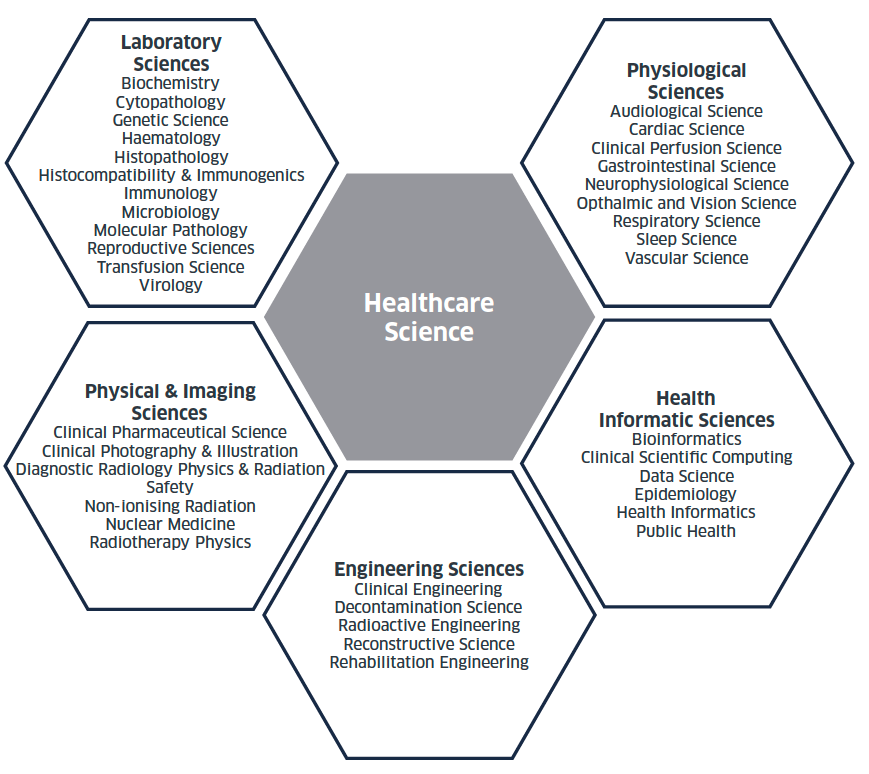
This work has clarified healthcare science specialisms into more clearly defined professional groupings, enabling the profession to move beyond the historic approach of describing significant numbers of specialisms and sub-specialisms. This shift will strengthen professional identity, support improvements to workforce planning, and ensure that healthcare science is better positioned to deliver greater impact within a modern and integrated health system.
Importantly, this approach does not diminish the breadth or complexity of the work carried out by healthcare science professionals. Rather, it provides a simplified and more accessible framework through which the profession’s contributions can be more clearly articulated, understood, and valued, supporting its integration into strategic planning and service transformation.
Healthcare science continues to evolve, and it is anticipated that new specialisms will develop over time, reflecting the dynamic nature of scientific practice and the ingenuity of the workforce.
Laboratory Sciences
- Biochemistry
- Cytopathology
- Genetic Science
- Haematology
- Histopathology
- Histocompatibility & Immunogenics
- Immunology
- Microbiology
- Molecular Pathology
- Reproductive Sciences
- Transfusion Science
- Virology
Physical & Imaging Sciences
- Clinical Pharmaceutical Science
- Clinical Photography & Illustration
- Diagnostic Radiology Physics & Radiation
- Safety
- Non-ionising Radiation
- Nuclear Medicine
- Radiotherapy Physics
Engineering Sciences
- Clinical Engineering
- Decontamination Science
- Radioactive Engineering
- Reconstructive Science
- Rehabilitation Engineering
Health Informatic Sciences
- Bioinformatics
- Clinical Scientific Computing
- Data Science
- Epidemiology
- Health Informatics
- Public Health
Physiological Sciences
- Audiological Science
- Cardiac Science
- Clinical Perfusion Science
- Gastrointestinal Science
- Neurophysiological Science
- Opthalmic and Vision Science
- Respiratory Science
- Sleep Science
- Vascular Science
Levels of Practice
Consultant Healthcare Scientist
A Consultant Healthcare Science combines deep scientific expertise with extensive professional and strategic leadership. They are senior leaders who drive service improvement, innovation, and workforce development across health and care systems. Their roles encompass professional leadership and development, clinical and operational management, commissioning, education, and accountability for service delivery.
Consultants play a pivotal role in advancing healthcare science through the integration of evidence-based practice, translational research, data-driven decision-making, and the application of emerging technologies. They lead and support quality improvement initiatives, shape service design, and drive innovation to ensure that healthcare science contributes effectively to patient outcomes, operational efficiency, and system transformation. Consultant Healthcare Scientists may act as Chief or Principal Investigators for research projects, they are key member of the research team, responsible for leadership, design and conduct of all or part of a research study.
By bridging research, practice, and policy, Consultant Healthcare Scientists ensure that scientific expertise is embedded at every level of decision-making. Their influence extends across education, workforce development, and commissioning, enabling NHS Scotland to deliver safe, effective, and future-ready care while continuously advancing the contribution of healthcare science to the wider health system.
Advanced Specialist Healthcare Scientist
An Advanced Specialist Healthcare Scientist is a highly skilled specialist who applies advanced scientific knowledge to deliver high-quality patient care and support clinical decision-making. Working either directly with patients or within laboratory and technical environments, they use their scientific expertise to perform complex diagnostics, interpret clinical data, and implement innovative techniques and technologies.
Their role focuses on scientific excellence and specialist problem-solving, ensuring the accuracy, reliability, and safety of procedures and equipment. They collaborate closely with clinicians and multidisciplinary teams to translate scientific insights into practice, contributing to service improvement and the delivery of safe, effective, and evidence-based care. They are key members of the research team, and may be involved in any or all aspects of the research process.
Through their specialist knowledge, Advanced Specialist Healthcare Scientists drive innovation within their field, develop new methodologies, and support the advancement of healthcare science, ensuring that scientific expertise is applied to meet the evolving needs of patients and the health system.
Specialist Healthcare Scientist
A Specialist Healthcare Scientist applies scientific knowledge and specialist skills to deliver safe, high-quality services. They may carry out complex tests, investigations, and procedures on patients, samples, or equipment, ensuring accuracy, reliability, and compliance with rigorous quality and safety standards.
Their work may include managing medical devices, supporting therapeutic interventions, complex analysis or providing expert advice within their area of specialty. They often contribute to service development, education, and operational improvement within their teams, providing leadership within their specialist practice. They are members of the research team, and may be involved in supporting specific aspects of the research process.
Whether working directly with patients or in laboratory and technical environments, Specialist Healthcare Scientists play a vital role in diagnosing, monitoring, and evaluating health conditions. They apply scientific expertise to support clinical decision-making, drive innovation, and undertake research to interpret complex biological, physiological, or technical data, ensuring the delivery of safe, effective, and evidence-based care.
Healthcare Scientist
Healthcare Scientist applies scientific knowledge and skills to deliver safe, high-quality services. They may carry out tests, investigations, and procedures on patients, samples, or equipment, ensuring accuracy, reliability, and compliance with rigorous quality and safety standards.
They often contribute to service development, education, and operational improvement within their teams. Healthcare Scientists can work directly with patients, in laboratory or in technical environments. They monitor and evaluate health conditions and apply scientific methods to support clinical decision-making, and take part in research to ensure the delivery of safe, effective, evidence-based care.
Healthcare Science Support Workers
Associate Healthcare Science Support Worker
An Associate Healthcare Science Support Worker applies scientific knowledge and skills to support the delivery of safe, high-quality healthcare services. They combine factual and theoretical understanding within their area of practice with an awareness of its limits, enabling them to contribute effectively to patient care and service operations.
They use their expertise to solve problems, make informed judgements through careful analysis and interpretation, and support the evaluation of treatment outcomes. In addition, they contribute to service improvement initiatives, ensuring that processes and practices are efficient, accurate, and aligned with quality and safety standards.
Associate Healthcare Science Support Workers may also support the development of colleagues through supervision, training, and mentoring. By integrating specialist knowledge with practical application, they play a vital role in underpinning safe, effective, and evidence-based healthcare science services.
Assistant Healthcare Science Support Worker
An Assistant Healthcare Science Support Worker provides essential support to multidisciplinary teams, contributing to the delivery of safe, high-quality healthcare science services. They apply practical scientific knowledge to perform routine tests, procedures, and technical tasks in line with established protocols, ensuring accuracy, consistency, and reliability.
Their responsibilities include preparing equipment, maintaining safe and effective working environments, and supporting clinical and laboratory activities. By adhering to quality and safety standards, they underpin the effectiveness of healthcare science services and contribute to positive patient outcomes.
Assistant Healthcare Science Support Workers play a key role in enabling specialist and professional staff to deliver advanced scientific services. Through their practical expertise and attention to detail, they help maintain high standards of service delivery, supporting the overall efficiency, safety, and effectiveness of healthcare science.