
Greenhouse gas emissions reporting by Local Authorities and other Scottish public bodies: Research into Scope 3 Group 3 emissions
Research into future reporting of scope 3 'Group 3' greenhouse gas (GHG) emissions by Scottish public bodies. 'Group 3' emissions include those from the processing, use and end of life treatment of sold products; downstream transportation and distribution; and franchises.
3 Results
This section presents headline findings from the work, in terms of the relevance, likely scale of impact, level of influence that public bodies have over these emissions, level of effort involved in collecting data to calculate them, and overall value for money in reporting. Further information on the rationale is presented in Appendix B.
3.1 Relevance
The relevance of each Group 3 emissions category is summarised in Table 2, and explanations are provided on the following page. For more information, please refer to Appendix B.
|
Activity |
Relevant to… |
Category 9 - Downstream distribution and transportation: |
Category 10 - Processing of sold products: |
Category 11 - Use of sold products |
Category 12 - End-of-life treatment of sold products |
|---|---|---|---|---|---|
|
Selling of food that is generally eaten on-site |
Organisations selling food such as through a café or staff canteen |
No, transportation of food is paid for by the reporting organisation, so emissions from transportation would fall under Category 4 Upstream distribution and transportation. |
No, as not selling raw ingredients. |
Minor, indirect use-phase emissions if food is taken away to be reheated later such as using a microwave. This is likely to be down to consumer choice and very small so considered immaterial here. |
Minor. A small amount of waste from purchased food may be disposed off-site and not accounted for under Category 5 – Waste Generated in Operations. |
|
Distributing inhalers |
NHS |
No, NHS boards are generally not selling or distributing inhalers themselves |
No, there is no further processing of the products. |
Yes, there are F-gas emissions from the propellants of inhalers. |
Yes, there are emissions from waste at end-of-life disposal, including any propellants remaining in the inhaler. |
|
Distributing medical equipment such as hearing aids, mobility aids, etc. |
NHS, organisations distributing equipment to end-users |
Unlikely. Only applicable if the recipient of the equipment, or another entity (not the reporting organisation) is paying for the transportation and storage of the waste. |
No, there is no further processing of the products. |
Minor, direct-use phase emissions may occur for any products that require electricity or batteries to use. |
Yes, the emissions from the end-of-life treatment of medical equipment that is sold or distributed would be reported under this category. |
|
Selling of waste (e.g. plastics) to be processed into new products |
Local authorities and any other organisations selling waste |
Unlikely. Only applicable if the organisation purchasing the waste (not the reporting organisation) is paying for the transportation and storage of the waste. |
Yes, the emissions from the further processing of e.g. plastics sold would be reported under this category. |
Minor, there are no emissions associated with the direct use-phase of recycled plastic, although some recycled plastic products (e.g. clothing) may have indirect use-phase emissions. |
Yes, the emissions from the end-of-life treatment of e.g. plastics sold would be reported under this category. |
|
Selling of timber |
Organisations selling timber for further processing |
Yes, for downstream transportation and distribution not paid for by the reporting organisation. |
Yes, processing of timber at sawmills and processing into final products. |
Yes, any timber sold as fuel would have direct use-phase non-CO2 emissions associated with combustion. |
Yes, the methane (CH4) emissions from the end-of-life disposal of any timber products by landfill. |
|
Selling of products in shops |
Cultural organisations, colleges and universities |
Yes, for the downstream transportation and distribution of products sold online that are paid for by the customer. |
No, public bodies' shops are unlikely to be selling intermediate products. |
Minor, there may be some minor direct use-phase emissions for products that require batteries or electricity. There may also be minor indirect use-phase emissions of any products that indirectly use energy during their use (e.g. the electricity from the washing of clothes). |
Yes, there will be end-of-life emissions from the disposal of products that are sold online and in-store. |
|
Online learning |
Organisations offering remote learning |
No, as there are no physical products being distributed. |
No, as there are no physical products that are processed further. |
Yes, there are direct use-phase emissions for the electricity used to access the online learning platform (e.g. charging of laptops). |
No, as there are no physical products being distributed. |
|
Selling of other products or materials (e.g. garden furniture or quarry products)[13] |
Any organisation selling or distributing products |
Possibly, for any downstream transportation and distribution that is not paid for by the reporting organisation. |
Possibly, if selling intermediate products that are processed further. |
Possibly, there may be some direct use-phase emissions for products that use energy (e.g. candles or electronic equipment). There may also be minor indirect use-phase emissions of any products indirectly use energy during their use (e.g. the electricity from the washing of clothes). |
Yes, there will be end-of-life emissions from the disposal of products. |
|
Relocation travel and commuting of students |
Educational institutions with international students and students who commute |
Possibly, as emissions occur. Note that although EAUC guidance classifies these under Category 9, there is no clear Scope 3 Category for this activity in the GHG Protocol. |
No |
No |
No |
This research has shown that some of these Scope 3 categories are relevant to the Scottish Public sector, even though they are generally less common and the examples are relatively unique to individual public bodies.
- Category 9 Downstream distribution and transportation: a few examples of relevant Category 9 emissions were identified. For example, some organisations with gift shops sell products online, for which distribution and transportation might be paid for by the customer. The other significant instance of Category 9 emissions relates to the sale of timber products by Forestry and Land Scotland, due to the volume of timber products sold.
- Category 10 Processing of sold products: only two specific examples of Category 10 emissions were identified:
- the sale of timber by Forestry and Land Scotland. This gets processed into other wood products, and is likely to be significant due to the volume of timber sold.
- there was one example of a local authority selling plastic via an ALEO to be recycled into new products. It was not possible to estimate the scale of emissions from processing the plastic material due to lack of readily available data or conversion factors.
- Category 11 Use of sold products: relevant emissions that fall under Category 11 were identified for various public bodies. Emissions from medical inhaler propellants are the most significant example, as these have a high global warming potential (GWP). Other Category 11 emissions mostly involve electricity use, e.g. in medical equipment or online courses, but those are generally minor sources of emissions. A further consideration is that emissions from the electricity grid are decreasing over time, so these minor sources are expected to become even smaller in future.
- Category 12 End-of-life treatment of sold products: relevant emissions that fall under this category were identified for various public bodies and are therefore the most widely applicable, even though they still represent fairly niche cases within the context of the Scottish public sector as a whole. Products sold from gift shops, timber material, and inhalers are all relevant examples. Potentially, some food sold in canteens or cafes may be brought home by customers and disposed of at home, in which case these would also fall under Category 12.
- Category 14 Franchises: this study has found no examples of franchises.
3.2 Impact and influence
Having assessed the relevance of different Scope 3 categories, a qualitative high-level materiality assessment has been undertaken by assigning ratings to each example to indicate their overall GHG impact and public bodies’ level of influence. In this context:
- ‘Impact’ refers to the magnitude of Scope 3 Group 3 emissions expected from the specified activity, in proportion to the total GHG emissions of the organisation.
- ‘Influence’ refers to the estimated amount of control the reporting public body has over emissions from the activity that falls under Scope 3 Group 3 categories.
The results are shown in Figure 4. Impact and influence ratings are presented on a scale of 0-5, with 0 indicating the lowest impact or influence and 5 indicating the highest impact or influence. However, note that these ratings are based on qualitative judgments by the project team, based on the evidence gathered through the desk review and stakeholder interviews. The colour coding and markers indicate the calculation effort required (Red square = high, Orange circle = medium, Green diamond = low).[14] For more information, please refer to Appendix B Section B.2.
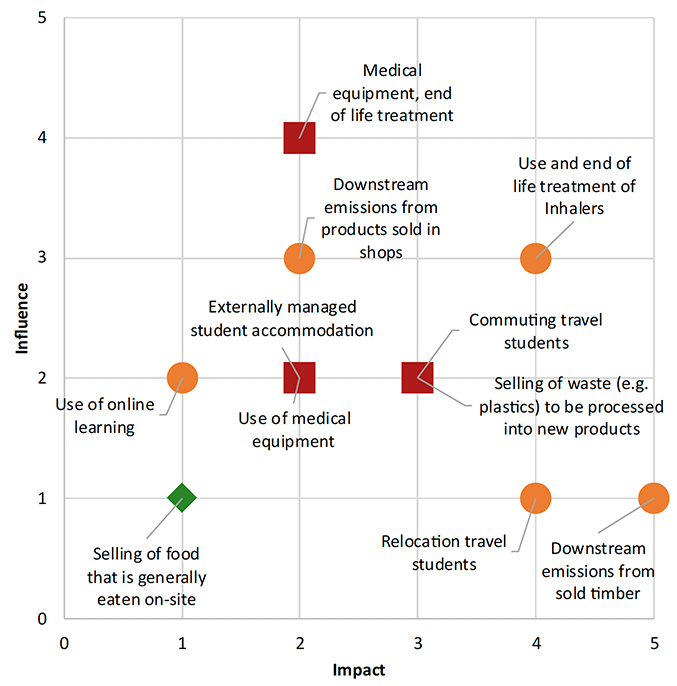
Overall, the emissions sources with the highest combined impact and influence ratings and ‘medium’ calculation effort are the sale of timber products, emissions from inhaler propellants, and student relocation and commuting. Among the activities considered in this study, those are therefore considered the top three highest priorities in terms of future reporting. For more information, please refer to Appendix B, Section B.2.
3.3 Calculation approaches
When evaluating whether or not there is value for money in reporting different sources of emissions, consideration has been given to how easy it would be to obtain data and undertake calculations. Different ‘tiers’ of calculation approach (i.e. options that involve different levels of effort, detail and complexity) have been identified for each of the activities described above. Details are presented in Appendix B Section B.2.
An important point to note is that, in some cases, data that are not readily available at present may become easier to obtain in future. For example, the Department for Energy Security and Net Zero (DESNZ) GHG Conversion Factors for Company Reporting, which are pre-populated in the PBCCR templates, do not currently allow for a comparison of the full GHG impacts of different waste management options as the majority of conversion factors for waste management only consider the emissions associated with transporting waste to the treatment site.[15] Therefore, reporting Category 12 emissions using the standard factors does not necessarily offer value for money because the results would not allow public bodies to track the impact of switching from incineration to recycling unless they derive or obtain conversion factors from elsewhere and enter these manually.[16] Similarly, the Defra spend-based factors that some organisations use to estimate Scope 3 emissions track household expenditure rather than public sector expenditure, so provide limited insight for public bodies. However, this could change in future if the conversion factor methodology is updated or if alternative spend-based factors become available.
3.4 ‘Value for money’ of reporting Scope 3 Group 3 emissions
This section assesses the ‘value for money’ of reporting relevant Scope 3 Group 3 (downstream) emissions. In line with the Scottish Public Finance Manual (SPFM), value for money for public bodies in Scotland is defined as achieving the best possible outcomes from the resources used.[17] This aligns with the statutory ‘best value’ duty, which requires continuous improvement in performance by balancing quality, cost, efficiency, equal opportunities and sustainable development.[18] In this context, ‘value for money’ considers whether reporting a particular Scope 3 Group 3 emissions source provides information that is sufficiently useful for decision-making, accountability and emissions reduction to justify the effort and resources required to collect, calculate and report the data. To support proportionate, evidence-based recommendations, a qualitative ‘value for money’ assessment framework was developed. The framework assesses each emissions source against three key criteria:
1. ‘Impact’ refers to the estimated magnitude of GHG emissions expected from Scope 3 Group 3 from the specified activity in proportion to the total GHG emissions of the organisation.
2. ‘Influence’ refers to the estimated amount of control the reporting public body has over emissions from this activity that fall under Scope 3 Group 3 categories.
3. ‘Reporting effort’ refers to the effort (complexity and resource requirements) associated with calculating and reporting the emissions. This has been informed by interviews with stakeholders to provide a qualitative evaluation, as specific estimates of cost and resource requirements are outside the scope of this study. The assessment also considers anticipated future reporting requirements and emerging developments in the GHG Protocol where relevant.
Findings are summarised in Table 3.
|
Activity |
Relevant to… |
Category 9 - Downstream distribution and transportation: |
Category 10 - Processing of sold products: |
Category 11 - Use of sold products |
Category 12 - End-of-life treatment of sold products |
|---|---|---|---|---|---|
|
Selling of food that is generally eaten on-site |
Organisations selling food such as through a café or staff canteen |
N/a |
N/a |
No, as emissions from reheating food offsite are expected to be minor |
No, because a small amount of waste from purchased food may be disposed off-site but this is expected to be minor |
|
Distributing inhalers |
NHS |
N/a |
N/a |
Yes, there are material F-gas emissions from the propellants of inhalers. |
No, as the emissions from the inhaler casing are likely to be minor and would require a high level of effort to collect data. Emissions from propellants remaining in the inhaler are currently reported with the Category 11 emissions as the methodology NHS boards are using to estimate emissions from inhalers will include any residual propellant. |
|
Distributing medical equipment such as hearing aids, mobility aids, etc. |
NHS, organisations distributing equipment to end-users |
No, as these are unlikely to be applicable |
N/a |
No, as information on electricity use would require a large amount of data collection requiring time to set up and analyse, whereas the emissions will decrease due to grid decarbonisation |
No, because of a lack of data to enable quantification |
|
Selling of waste (e.g. plastics) to be processed into new products |
Local authorities and any other organisations selling waste |
No, as these are unlikely to be applicable |
No, because of a lack of data to enable quantification |
No, as there are no emissions associated with the direct use-phase of recycled plastic, and indirect use-phase emissions are likely to be minor; the latter are also optional to report under the GHG Protocol |
No, because of a lack of data to enable quantification |
|
Selling of timber |
Organisations selling timber for further processing |
Possibly, subject to a materiality assessment |
Possibly, subject to a materiality assessment |
Possibly, subject to a materiality assessment |
Possibly, subject to a materiality assessment |
|
Selling of products in shops |
Cultural organisations, colleges and universities |
Possibly, subject to a materiality assessment |
N/a |
No, as these emissions are likely to be minor and would require a high level of effort to collect data |
No, as these emissions are likely to be minor and would require a high level of effort to collect data |
|
Online learning |
Organisations offering remote learning |
N/a |
N/a |
Possibly, subject to a materiality assessment, but only for institutions offering a high component of online learning |
N/a |
|
Selling of other products or materials (e.g. garden furniture or quarry products) |
Any organisation selling or distributing products |
Possibly, subject to a materiality assessment |
Possibly, subject to a materiality assessment |
Possibly, subject to a materiality assessment |
Possibly, subject to a materiality assessment |
|
Relocation travel and commuting of students |
Educational institutions with international students and students who commute |
Yes, although unclear whether this should sit within Category 9. |
N/a |
N/a |
N/a |
It is important to note that the GHG Protocol, which informs the reporting guidance for the Scottish public sector, is currently under review. Some of the proposed changes could potentially impact the recommended way that emissions are calculated and reported. A key change would be that the GHG Protocol might require organisations to evaluate all sources of Scope 3 emissions, and report at least 95% of the total (see Appendix D).
Further information is provided below. Key findings are grouped first by category, then by type of activity or public body. Additional information is provided in Appendix B.2.
3.4.1 Value for money - by Scope 3 category
An overarching finding of this study is that, because different organisations might classify the same activity differently depending on how they have chosen to define their organisational boundaries, and the specific contractual arrangements in place, it would not be straightforward to define reporting requirements based on GHG Protocol Scope 3 categories alone. Furthermore, because it is not necessary for an organisation to allocate their emissions to a specific Scope 3 category in order to quantify or reduce those emissions, requiring organisations to do this would not represent value for money. Instead, it is recommended that guidance and requirements be framed around general types of activities, using those listed in Section 3.1 as examples, while allowing for the possibility of new activities emerging over time.
- Categories 9 - Downstream distribution and transportation and 10 - Processing of sold products:
- For both of these categories, the main activity that is considered to potentially offer value for money in reporting is the sale of timber products. However, this finding will likely only apply to a few organisations and will depend on the outcome of the materiality assessment.
- Student relocation and commuting may offer value for money in reporting as these emissions are likely to be significant and the EAUC has produced calculator tools to enable estimation, although as stated previously, it is unclear whether this is technically classed as Category 9. Note that colleges and universities are “strongly encouraged to include student travel within their reporting boundary”.[19]
- Organisations operating gift shops or selling other products (including intermediate products that undergo further processing), should undertake a materiality assessment to determine whether to report associated Category 9 and 10 emissions.
- Timber products sold as fuel: non-CO2 emissions from timber sold as fuel should potentially be reported under Scope 3, subject to the reporting organisation undertaking its own materiality assessment. Biogenic CO2 emissions should also be calculated, but these are not considered part of Scope 3 under the GHG Protocol, so have not been explored in detail in this report.
- Online learning courses: the emissions from electricity use are unlikely to be material although this depends on the reporting organisation. Rather than calculating and reporting these, which would not necessarily offer value for money in terms of GHG impact, a better use of officer resource may be (for example) to review how they host their courses and whether there are other options available that have lower environmental impact.
- A key issue to consider for any Category 12 emissions is that the DESNZ conversion factors do not currently allow for a meaningful comparison of the total emissions from different waste management options, so even if activity data could be collected, the results would not necessarily provide useful insights into the benefits of adopting different waste management techniques. If this changes in future, reporting Category 12 emissions might be easier and offer better value for money.
- Note that some local authorities already report on emissions from area-wide waste management, so there is the potential for double-counting if other public bodies also report Category 12 emissions from sold products. There is still potentially a benefit in reporting, because each organisation will have different levers of influence over waste emissions, and a key aim of reporting is to support effective GHG reductions. So for example, the local authority may focus on how it can influence area-wide waste management, whereas the public body selling products from a gift shop may focus on opportunities to change the packaging or type of products sold, to minimise the amount of waste arising in the first place.
- Category 11 - Use of sold products: Most of the use phase emissions of sold products are associated with electricity and are considered minor, therefore likely do not represent value for money in reporting. The key exceptions are emissions from inhalers and timber products sold as fuel. Further details are below.
- Emissions from inhalers: for public bodies that distribute inhalers, the emissions from propellants are likely to be material and should therefore be reported. This requirement should be introduced in the short term. Note that some NHS boards already calculate and report inhaler emissions using a calculation method that does not differentiate between propellant leakage in use and at end-of-life. As long as the total is reported, it is not considered necessary to separate the use phase and end of life phases, but this could be undertaken voluntarily.
- Timber products sold as fuel: non-CO2 emissions from timber sold as fuel should potentially be reported under Scope 3, subject to the reporting organisation undertaking its own materiality assessment. Biogenic CO2 emissions should also be calculated, but these are not considered part of Scope 3 under the GHG Protocol, so have not been explored in detail in this report.
- Online learning courses: the emissions from electricity use are unlikely to be material although this depends on the reporting organisation. Rather than calculating and reporting these, which would not necessarily offer value for money in terms of GHG impact, a better use of officer resource may be (for example) to review how they host their courses and whether there are other options available that have lower environmental impact.
- A key issue to consider for any Category 12 emissions is that the DESNZ conversion factors do not currently allow for a meaningful comparison of the total emissions from different waste management options, so even if activity data could be collected, the results would not necessarily provide useful insights into the benefits of adopting different waste management techniques. If this changes in future, reporting Category 12 emissions might be easier and offer better value for money.
- Note that some local authorities already report on emissions from area-wide waste management, so there is the potential for double-counting if other public bodies also report Category 12 emissions from sold products. There is still potentially a benefit in reporting, because each organisation will have different levers of influence over waste emissions, and a key aim of reporting is to support effective GHG reductions. So for example, the local authority may focus on how it can influence area-wide waste management, whereas the public body selling products from a gift shop may focus on opportunities to change the packaging or type of products sold, to minimise the amount of waste arising in the first place.
- Category 12 - End-of-life treatment of sold products:
- This study has found several relevant examples of Category 12 emissions. The ones that are considered to offer potential value for money in reporting are emissions from propellants in inhalers and timber products; see notes above.
- A key issue to consider for any Category 12 emissions is that the DESNZ conversion factors do not currently allow for a meaningful comparison of the total emissions from different waste management options, so even if activity data could be collected, the results would not necessarily provide useful insights into the benefits of adopting different waste management techniques. If this changes in future, reporting Category 12 emissions might be easier and offer better value for money.
- Note that some local authorities already report on emissions from area-wide waste management, so there is the potential for double-counting if other public bodies also report Category 12 emissions from sold products. There is still potentially a benefit in reporting, because each organisation will have different levers of influence over waste emissions, and a key aim of reporting is to support effective GHG reductions. So for example, the local authority may focus on how it can influence area-wide waste management, whereas the public body selling products from a gift shop may focus on opportunities to change the packaging or type of products sold, to minimise the amount of waste arising in the first place.
3.4.2 Value for money - by type of public body or activity undertaken
Below is a discussion of the likely value for money in reporting emissions from different activities. However, these are generalisations and it is important to emphasise the need for public bodies to undertake individual materiality assessments to make their own judgments; this is explored further in Section 3.5.
The following points apply primarily to NHS boards:
- Emissions from inhaler propellants are likely to be material, and can be influenced by the NHS body prescribing the medication, and therefore represent value for money in reporting. Some NHS boards already report these, so this could be added to SSN guidance as a recommended or voluntary option, and formally introduced in the next round of reporting requirement changes.
- Downstream emissions from distributed medicines and medical equipment are expected to offer low value for money for reporting at present. The effort involved in data collection is likely to be high because of the quantity and variety of equipment used. However, in principle this could change if more organisations start to report on the upstream emissions from products that they purchase. They could use information on purchases as a starting point, then estimate downstream emissions based on the proportion of those products that are ultimately distributed to patients. The timescales for reporting of emissions that fall under Category 12 from medical equipment should therefore be consistent with those for quantifying emissions from purchased goods and services.
The following points apply primarily to public bodies selling a large volume of timber products:
- If there is a very large volume of timber sold, Group 3 emissions will potentially be significant in relation to the public body’s other Scope 1, 2 and 3 emissions, although influence over these is likely to be low. Based on the findings of this study, downstream emissions from sold timber should be considered in a materiality assessment where relevant.
- If downstream emissions from timber are found to be material, emissions reporting should take account of the GHG Protocol Corporate Standard Appendix B, the GHG Protocol Land Sector and Removals Standard and Guidance, or any future equivalent guidance. In the short term, organisations could undertake high-level estimates of emissions from Category 10 – Processing of sold products (for all timber that undergoes further processing) and Category 11 – Use of sold products (for timber sold as fuel only) as there is better data availability for these categories. At the same time, organisations could engage with long-term contracts to assess if activity data Category 9 – Downstream transportation and distribution and Category 12 – End-of-life treatment, could be identified.
The following points primarily apply to educational institutions:
- EAUC guidance categorises student relocation travel and student commuting under Category 9 – Downstream transportation and distribution. It is unclear whether this is the most suitable Scope 3 category for these activities. Regardless, public bodies for whom those activities are relevant should undertake a materiality assessment and hotspot analysis to determine whether they should report the emissions under Scope 3, as they will potentially be large.
- If the institution provides a very large number of online courses and or if these are long, they will need to review whether the emissions from electricity use are significant as part of their materiality assessment.
The following points apply to public bodies that sell food that is generally eaten on site (e.g. in a canteen or café):
- Most of the emissions from this activity are expected to be included in estimates of Scope 1 and 2 or Scope 3 upstream emissions.
- Downstream Scope 3 emissions from the sale of food that is consumed and disposed of offsite are expected to be uncommon and relatively minor. This relies on the assumption that most of the food waste that is generated will be disposed of on-site and therefore will be included in the reporting organisation’s separate estimates of operational waste emissions. However, this assumption should be reviewed when undertaking a materiality assessment.
The following points apply to public bodies that sell products which undergo further processing (other than forestry products, see above):
- Routine reporting of the Category 10 (processing) or Category 12 (end-of-life treatment) emissions is unlikely to represent value for money at present, due to the lack of readily available conversion factors to use in calculations. However, it is possible that changes to the GHG Protocol and or changes to the DESNZ conversion factors could enable this in the future.
- Therefore, in the short to medium term, rather than focusing on quantification, the priority should instead be to review their level of influence across the supply chain and identify any measures that can be taken to minimise environmental impact. For example, a local authority that collects and sorts waste before selling the plastic might be able to implement sorting procedures that facilitate the subsequent recycling process.
- Public bodies to whom this applies should periodically (e.g. every 2-3 years) check whether there are new guidance or calculation approaches relevant to this activity.
The following points are primarily relevant to organisations selling products in shops:
-
Depending on the type of products sold, emissions from Category 9 - Downstream transportation and distribution may be material. This should be explored as part of the materiality assessment, particularly seeking to identify any products where there are large volumes and or heavy items being transported long distances. If this is found to be significant, a phased approach to reporting is recommended for Category 9, initially using lower effort calculation approaches and increasing this in future as data availability improves.
3.5 The importance of individual materiality assessments
To enable effective prioritisation of resources to estimate, report, and mitigate GHG emissions, public bodies should first define their organisational boundary and then undertake a materiality assessment, in line with the GHG Protocol.
Defining the organisational boundary is an important first step because it determines which activities fall within an organisation’s reporting boundary and how emissions should be classified. The same activity might be reported under different Scope 3 categories depending on the chosen organisational boundary, consolidation approach and contractual arrangements.
The purpose of a materiality assessment is to identify which GHG emissions sources are sufficiently significant to include in the inventory and prioritise for action. This should consider all activities that result in emissions across Scope 1, 2 and 3 in relation to each other, rather than assessing individual activities in isolation. Information is considered ‘material’ if its omission, misstatement, or inaccurate treatment could influence the decision-making needs of the intended users of the GHG inventory.
In practice, this may involve a qualitative screening assessment (such as the scoring of impact and influence described in Section 3.2) or incorporate basic calculation approaches to compare the emissions impact of different activities undertaken by an organisation. An organisation should prioritise reporting emissions from the most emissions-intensive activities, and for activities they have meaningful influence over. Any exclusions should be considered collectively and transparently, to ensure that the overall reporting boundary remains sufficiently complete and that material sources of emissions are not omitted.
If a public body identifies that additional sources of emissions are material and therefore should be reported, but doing so would be too resource-intensive, they could choose to undertake a more detailed assessment as a one-off activity, and then assume that the results hold constant in subsequent years until a new assessment can be undertaken. Alternatively, they could undertake a more detailed assessment and scale the results up or down in subsequent years using a more easily available metric. The focus in the interim should be on implementing and monitoring the actions taken to reduce emissions, rather than expending resources on the calculation itself. Provided that this is communicated transparently, this approach can in principle be consistent with the GHG Protocol. For more information, refer to the GHG Protocol Scope 3 Calculation Guidance, including the section on ‘Screening to prioritize data collection’.[20]
Figure 5 illustrates the proposed approach for organisations to assess the emissions impact of activities for a materiality assessment. The emissions impact of activities is relative and can change over time as certain activities are decarbonised by organisations. For this reason, it is important to undertake regular materiality assessments at intervals when there is a significant change to the organisational structure, or at maximum every 5 years or so.
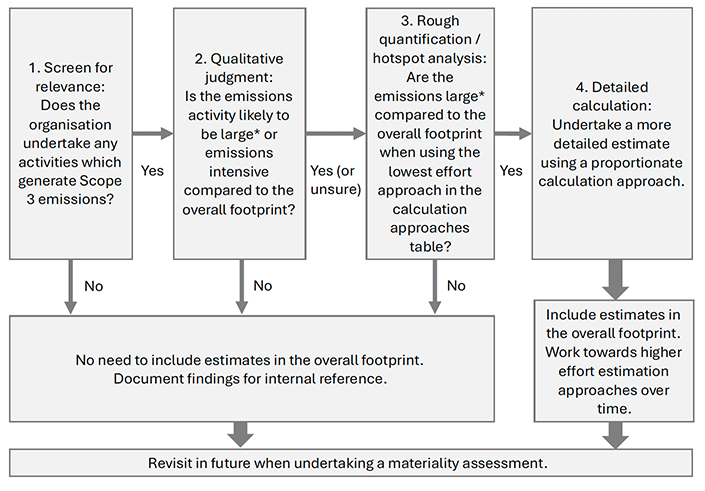
The process for undertaking a materiality assessment will be different for each organisation. However, a typical approach would include a desk-based review to understand the organisation's activities, identify potential emission sources, and assess available data, alongside engagement with key stakeholders to consider the significance of different emission sources and the organisation's ability to influence them. As a rough estimate, this would typically require anywhere from a few days to around one or two working weeks of effort for an individual to plan and undertake. This could be spread over several weeks to allow for stakeholder engagement and information gathering. There would also be some additional staff time across the organisation for stakeholders to participate in meetings or workshops. Depending on factors such as the complexity of the organisation, issues associated with collecting fragmented data, a lack of clear responsibilities, or difficulties with engaging stakeholders in a timely manner, the level of effort could vary.
Undertaking individual materiality assessments may therefore present a challenge for smaller public bodies or public bodies with limited resources. In particular, a materiality assessment may require engagement with different departments within an organisation and expert judgement on which activities are large as well as which activities are emissions-intensive. Compared to the overall effort required to meet existing reporting requirements, the additional resource needed to do this may be small, but for teams that are already stretched, this may not be easy to accommodate. However, a materiality assessment is very useful to prioritise resources into areas with larger emissions and level of influence, so is worth doing from the standpoint of achieving longer-term GHG mitigation. The Scottish Government could support public bodies through providing clear step-by-step guidance for undertaking materiality assessments.
Under the GHG Protocol, organisations have flexibility to determine for themselves how best to screen activities within a materiality assessment. Figure 6 (below) demonstrates one possible approach. This considers both the emissions impact of the activity and the level of influence an organisation has by separating activities into four groups: quick wins, low-hanging fruit, major projects and low priority areas.[21]
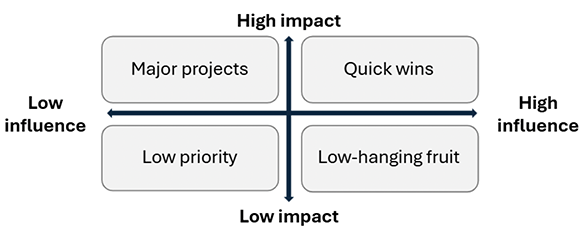
- Quick wins: Activities which are deemed high impact and high influence would fall within the upper right quadrant of the matrix. These are emissions activities which the organisation is able to address due to higher influence, and which would have significant emissions reduction results. The emissions activities in this quadrant are typically scoped in to inventories as material (data permitting) and prioritised for decarbonisation efforts.
- Low-hanging fruit: These are emissions activities that the organisation has high influence over, but which represent lower emissions impact. For these activities, reducing emissions is easier but the results aren’t as significant. These activities are typically deemed materially significant for inclusion in the inventory based on the higher influence score.
- Major projects: The activities in this quadrant represent those where the organisation has lower influence over the emissions activity, but which constitute a significant amount of emissions. Addressing these emissions is difficult due to lack of influence, but the payoff for those reductions is significant. These activities are typically included in the inventory.
- Low priority areas: The activities in this quadrant are those over which the organisation has little influence, and which are relatively insignificant in terms of impact. The emissions activities which appear here are typically scoped out of the baseline inventory as immaterial, and far down the list of reduction priorities.
Contact
Email: climate.change@gov.scot