
Greenhouse gas emissions reporting: Scope 3 Group 3 - research
Research into future reporting of scope 3 'Group 3' greenhouse gas (GHG) emissions by Scottish local authorities and other public bodies. 'Group 3' emissions include those from the processing, use and end of life treatment of sold products; downstream transportation and distribution; and franchises.
1 Introduction
1.1 Background and aims of the study
In greenhouse gas (GHG) accounting, emissions are divided into Scopes 1, 2, and 3. Scope 1 GHG emissions are from sources that an organisation owns or controls directly, such as fuel combustion on-site. Scope 2 emissions are associated with the electricity, heat or steam that is used by an organisation but generated elsewhere. Scope 3 emissions – the focus of this study – are indirect emissions that may occur along the supply chain of a reporting organisation, but sit outside of its direct control.
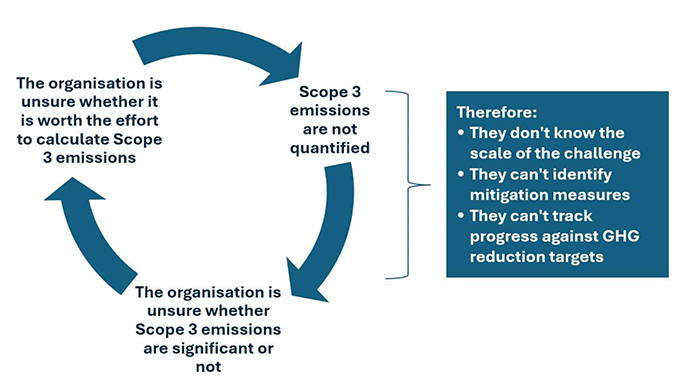
There is often a ‘chicken and egg’ scenario with Scope 3 emissions, illustrated in the diagram below: organisations are unable to assess the scale of emissions, so are unable to ascertain their level of importance, and in turn are unsure whether it is worth the effort to calculate them.
This report seeks to explore some of those issues as they relate to the Scottish public sector. Aether has been commissioned to undertake research into certain Scope 3 emissions categories (termed ‘Group 3’ within this report[2]) which were initially identified as unlikely to be relevant to public bodies, but where further assessment was required. These include the following categories of emissions as defined within the GHG Protocol Corporate Value Chain (Scope 3) Accounting and Reporting Standard:[3]
- Category 9 - Downstream distribution and transportation: Transportation and distribution of products sold by the reporting organisation in the reporting year between the reporting company’s operations and the end consumer (if not paid for by the reporting company), including retail and storage (in vehicles and facilities not owned or controlled by the reporting company).
- Category 10 - Processing of sold products: Processing of intermediate products sold in the reporting year by downstream companies (e.g. manufacturers).
- Category 11 - Use of sold products: End use of goods and services sold by the reporting company in the reporting year. These are split into direct use-phase emissions (required reporting under the GHG Protocol) and indirect use-phase emissions (optional under the GHG Protocol).
- Category 12 - End-of-life treatment of sold products: Waste disposal and treatment of products sold by the reporting company (in the reporting year) at the end of their life[4].
- Category 14 – Franchises: Emissions associated with operation of franchises in the reporting year, if not included in Scope 1 and Scope 2. A franchise is a business operating under a license to sell or distribute another company’s goods or services within a certain location. Franchisors should account for emissions that occur from the operation of franchises (i.e., the Scope 1 and Scope 2 emissions of franchisees) in this category. Franchisors do not own or control the franchisee's operations.
Note: Where definitions refer to products that are sold, these should be understood to also include products that are distributed but not sold (i.e. without receiving payment).[5]
At the outset of the project, the expectation from the Scottish Government was that the above emissions categories are generally not relevant to public bodies, especially local authorities. However, this needed to be confirmed through further research.
This project therefore aims to establish:
- which sources of Group 3 emissions are likely to be relevant (or not) to Scottish public bodies;
- whether, and under what circumstances, reporting these emissions therefore represents ‘value for money’, i.e. whether the effort required to calculate them is worthwhile in the context of their environmental impact and how much influence public bodies have in reducing them (definition outlined in Section 3.4); and
- for relevant sources of emissions, agreeing on a robust, consistent calculation approach that can be used by public bodies as part of their annual reporting.
In this research, specific activities undertaken by public bodies in Scotland that may be sources of Group 3 emissions have been identified. It is important to note that the same activity might be allocated to different Scope 3 categories depending on how the reporting organisation has chosen to define its organisational boundary, and the specific contractual arrangements that are in place. Figure 2 below illustrates this using the example of the transportation and distribution of sold products by an arm’s length external organisation (ALEO) that is wholly owned by a local authority. It shows how emissions might be classified under different Scope 3 categories in different circumstances, depending on whether the reporting organisation controls the activity in question. In this context, ‘control’ would be defined in line with the reporting organisation’s consolidation approach (i.e. financial control or operational control approach).
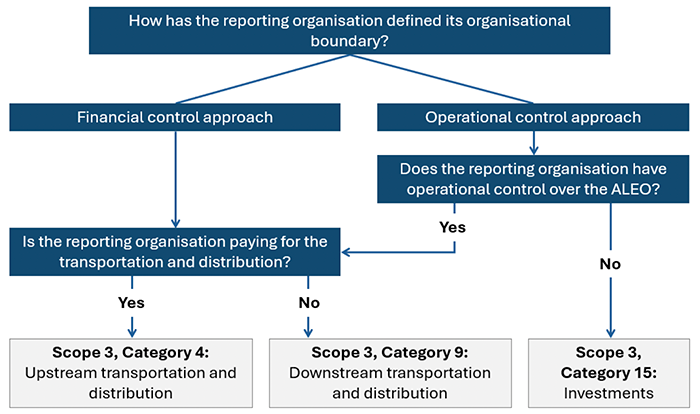
Rather than focusing on precisely which Scope 3 category an activity technically falls under, the focus should be on assessing and reporting emissions that are material to a given organisation. This will be explored further in Section 3.5.
1.2 Additional context
In 2025, the Scottish Government undertook a consultation with Scottish public bodies[6], which although not a part of this work provides useful context on opinions about Scope 3 reporting from a broad range of organisations. The consultation aimed to gather feedback on draft statutory guidance for public bodies on putting climate change duties into practice. Some of the questions asked about the extent to which stakeholders agreed or disagreed with including additional Scope 3 categories in the recommended baseline for reporting. There were 47 respondents to the question on the inclusion of additional Scope 3 categories that form Groups 2 and 3, out of which 43 were organisations and 4 were individuals. A summary of responses is provided below.
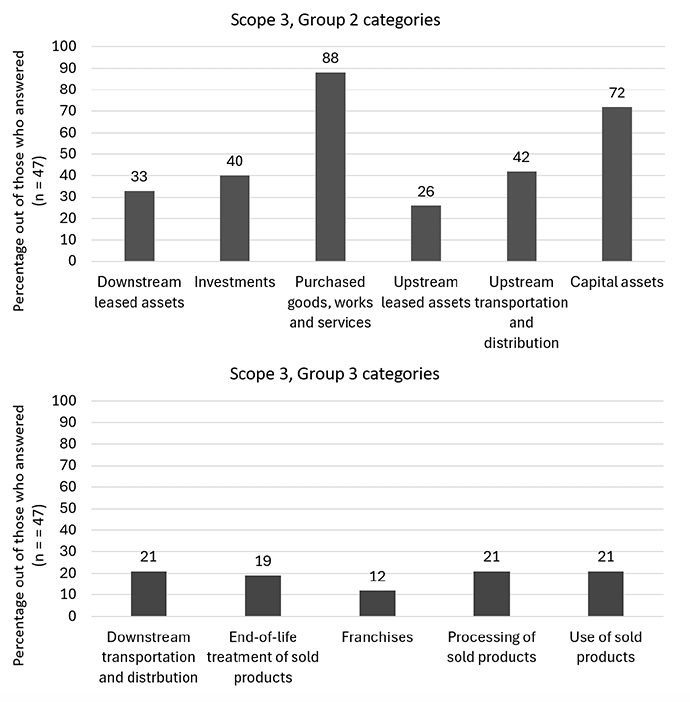
The responses indicate that support for including Group 3 categories was generally low, particularly when compared to reporting emissions from Group 2 categories such as Purchased Goods, Works and Services or Capital Assets. Respondents had the opportunity to provide further comments and explanations for their answers. For Group 3, these often cited lack of resources, data, guidance and tools for Scope 3 reporting as the reasoning for the reluctance to support.
These findings from the consultation responses provide a starting point for understanding the potential relevance and ease of reporting of Group 3 categories for public bodies, and therefore informed the research and results discussed in the rest of this report.
1.3 Structure of this report
This report sets out the methodology, headline findings, materiality of identified activities, and key recommendations from the research conducted.
The remainder of this report is structured as follows:
- Section 2 presents a summary of the research methodology and limitations of the approach.
- Section 3 presents an overview of the relevance of Group 3 emissions, their likely scale of impact, public bodies’ typical level of influence over those emissions, the level of effort involved in different calculation approaches. It then assesses the likely value for money in reporting emissions.
- Section 4 contains recommended changes to reporting requirements, and wider observations, based on the evidence collected.
- Section 5 concludes the report.
- Additional information is provided in the Appendices, particularly Appendix B which describes the rationale for all of the findings in more detail.
Contact
Email: climate.change@gov.scot