
A Fresh Start with Independence
This paper sets out why Scotland should become an independent country, and what an independent Scotland could look like. It provides details of this Scottish Government’s proposals for an independent Scotland, an analysis of the evidence that informs them, as well as references to sources.
Part One: Why Scotland should be independent

Because the best decisions for Scotland are taken by the people who live here
The Scottish Government believes that the people who live and work in Scotland are best placed to make decisions about Scotland.
That is the fundamental democratic and practical argument that this publication makes.
Self-government works
With self-government, decisions about Scotland are taken by governments the people of Scotland vote for: governments that voters in Scotland can choose to remove or to re-elect.
The establishment of the Scottish Parliament in 1999 introduced self-government to Scotland, within the powers of the Scottish Parliament.
And within those powers, improvements in people’s lives have been delivered based on Scottish voters’ priorities and choices.
Free personal care was introduced in 2002 and expanded in 2019.[1] In 2006 Scotland became the first part of the UK to ban smoking in enclosed public spaces, including workplaces and bars.[2] A minimum unit price for alcohol has been introduced, to reduce the health harms caused by alcohol consumption. Introducing the HPV vaccination in 2008 is protecting women from cervical cancer,[3] while Scotland was first in the UK and among the first countries internationally to implement a national PrEP programme, helping us stay on course to eliminate HIV transmission in Scotland by 2030.[4]
The number of staff in our NHS have increased and our Agenda for Change staff, which includes nurses, midwives and paramedics, have the best reward package in the UK.[5] Scotland’s core A&E departments have consistently outperformed those in England and Wales over the past decade.[6] NHS prescriptions have been free in Scotland since 2011.[7]
Life is easier for young families because we were able to deliver a near-tripling of funded early learning and childcare for all three and four-year-olds since the parliament was created, including an increase from 475 hours to 1,140 hours under this government.[8]
We ensured that university education is free, at a time when fees for some students in England have risen above £10,000 per annum,[9] and scrapped the Graduate Endowment.[10] The number of people from the most deprived areas entering university in 2023-24 on full-time first degree courses is up 37% since the Commission on Widening Access was established.[11]
There has been a profound shift in how we generate electricity, away from high-emission technologies to a predominance of low-cost, clean, green renewables. In 2000, coal was responsible for one-third of electricity generated in Scotland, while only 10% was from renewable sources (mostly hydro).[12] Today, there are no coal power stations in Scotland and, in 2023, 70% of electricity generated in Scotland was from renewable sources.[13] We are a net exporter of electricity, with our net electricity exports worth around £1.5 billion in the most recent year.[14]
Our policies across a range of fronts including energy, housing, farming and transport have helped deliver a halving of Scotland’s CO2 emissions since our parliament was created.[15]
In transport, the Scottish Government has introduced free bus travel for under-22s, over 60s and eligible disabled people.[16] The Queensferry Crossing opened to traffic on 30 August 2017 and is the tallest bridge in the UK.[17] Our railways have benefited from an extensive electrification, which means now over 75% of passenger journeys are made on decarbonised rail contributing to emissions reduction.[18] Our integration of planning and operating track and train has brought recognised value for money for the public purse and is minimising disruption for passengers.[19]
The network has been expanded, with new lines and new stations, including the opening of the Borders Railway and the Levenmouth extension.
ScotRail was taken into public ownership in April 2022 with Caledonian Sleeper services also coming under the control of the Scottish Government in June 2023 . And as of 1 September this year, peak ScotRail rail fares have been removed for good.[20]
Since 2007, Scotland’s economy has outperformed that of the UK on a per head basis[21] and productivity, the key driver of living standards, has grown at more than twice the UK rate.[22]
While overall investment in UK start-ups is declining, Scotland is bucking that trend with investment in Scottish firms growing 24% since 2023-24.[23] There has also been a 12% increase in investors making their first investment in Scotland, showing growing international recognition of the strength of Scottish innovation[24].
While it was not possible to find time for land reform legislation in the House of Commons, a Bill to abolish the feudal system was passed in the Scottish Parliament’s first term and a right of responsible access introduced.[25][26] Land reform continues to be a priority for the Scottish Parliament.[27]
We were also able to abolish the ‘right to buy’ policy, which had drastically reduced the availability of social-rented homes Scotland.[28] The number of local authority and housing association homes fell significantly throughout the 1980s and 1990s before stabilising in 2010 and now increasing after 2016.[29]
That has allowed us to deliver more than 136,000 affordable homes since 2007. Up to March 2024, that is just over 45% more affordable homes delivered per head of population than in England, and over 70% more than in Wales.[30]
We have been able to replace the UK’s high-cost Private Finance Initiative (PFI) with a Scottish model that delivers a better deal for Scottish taxpayers.[31] That has enabled us to build more new schools, with over 1,000 built or substantially refurbished since 2007-08.[32] This means that 92% of Scottish schools are in good or satisfactory condition, compared to 63% in 2007.[33]
In those schools, the proportion of pupils achieving the expected level in literacy and numeracy across primary and secondary schools reached a new high in 2023-24.[34]
And 2024-25 saw one of the lowest levels of recorded crime since 1974[35], while the number of police is over 1,500 higher than in the year 2000.[36]
These achievements demonstrate the value of even some self-government.
They show what can be achieved when political decisions are taken closer to the people they serve.
But Westminster is undermining self-government
The Scottish Government believes that the UK Government continuing to take the big decisions—on budget levels, on our relationship with the EU, on immigration, and on the economy—is limiting what Scotland can achieve.
At a UK general election, Scotland does not, on its own, have the ability to remove a UK Government, even if voters in Scotland believed that the government was acting against Scottish interests and causing damage to Scotland’s economy or society.[37]
This democratic deficit was a key argument for devolution and it is still, after a quarter of a century of the Scottish Parliament, one of the most powerful arguments for independence.
In decisions taken by the UK Government, the Scottish Government believes that Scotland is often an afterthought. Sometimes Scotland is not considered, as can be seen in the decision to delay this year’s UK budget without any engagement on what that means for Scotland’s own budget process, or the failure to consult the Scottish Government or Parliament during negotiations key to devolved Scottish industries, like the Sanitary and Phytosanitary (SPS) and fisheries agreements with the EU, or in trade agreements.
Sometimes Scotland’s national interests are actively harmed, as can be seen in recent changes to immigration rules that threaten key Scottish sectors including our universities, colleges and the health and care sector.[38]
Even the self-government that the people of Scotland voted for in 1997—the ability, within the Scottish Parliament’s powers, to make different choices to reflect Scotland’s different circumstances and people’s different priorities—has been undermined by the UK Parliament and Government.
Until Brexit, the UK Parliament and Government respected the ability of the Scottish Parliament and Government to make different decisions, within that Parliament’s powers, for Scotland. The convention that the UK Parliament would not normally legislate with regard to devolved matters without the consent of the Scottish Parliament was respected.
Since Brexit, the UK Parliament has repeatedly proceeded with legislation which the Scottish Parliament refused to give its consent to.
The effective powers of the Scottish Parliament have been reduced without the Parliament, or the people of Scotland, agreeing to it.[39]
The most significant example of this is the United Kingdom Internal Market Act 2020, which none of the devolved legislatures consented to, and which the new UK Government has refused to consider repealing, or to amend, despite the Act having been passed without the consent required.
The Internal Market Act allows UK Ministers to frustrate and impede the delivery of policies in devolved areas. It means that businesses selling into Scotland do not need to comply with laws passed by the Scottish Parliament if their product complies with the law of England, Wales or Northern Ireland.
The result is that self-government is undermined: decisions of the people of Scotland and their Scottish Parliament, even within that Parliament’s powers, can only take effect if they align with decisions taken by other governments.
The Internal Market Act undermines the ability of the Scottish Parliament to use its powers to pursue devolved social and economic objectives in Scotland for the people to which it is accountable. It introduces significant uncertainty as to the effect of laws passed by the Scottish Parliament and effectively provides a veto to UK Ministers where “effective use of devolved competences is now in many cases subject to the willingness of UK ministers to agree exemptions.”[40]
In practice, this means that a party elected on a commitment to legislate on, for example, products harmful to people’s health or the environment, could be prevented from introducing effective laws, despite having a democratic mandate to do so.
These new UK rules represent the most significant threat to devolution since the establishment of the Scottish Parliament a quarter of a century ago.
The Act has created a legislative limit on the powers of the Scottish Parliament, which goes well beyond the equivalent framework that existed in the context of the EU.[41]
Instead of recognising the role of Scotland’s devolved democratic institutions and respecting their choices, the UK Government’s approach increasingly asserts its authority over the Scottish Parliament and Government, something inconsistent with the principles of devolution.
These changes were implemented against the will of the democratic governments and parliaments of Scotland, Wales and Northern Ireland.[42]Although the current UK Government launched a statutory review of the Internal Market Act, the review did not consider repeal of the Act or any of its provisions despite the concerns raised about the Act’s impact on the devolution settlement and the requests of the Scottish Government to do so. The current UK Government chose simply to not engage with the detailed evidence as to the Act’s impact on devolution, despite there being near unanimity on the damage it has caused among academic and legal experts and civil society groups.
If the Scottish Parliament can be undermined once, it can be again, under this UK Government or a future one.
Ultimately, the Scottish Government believes that devolution has not given Scotland the powers or protection that the people of Scotland need. Policies and decisions that the people of Scotland did not vote for are imposed on Scotland, and reforms and changes that current and future generations need are not possible under the current UK economic model and with devolved powers.
There is a ceiling on what the Scottish Parliament’s current powers can achieve
If the fundamental benefit of self-government is that it allows decisions about Scotland to be taken by the people who care most about Scotland—the people who live here—then the Scottish Government believes that the fundamental problem for our country is having decisions taken about Scotland by a government for whom Scotland is not a priority.
One of the reasons Scotland is not matching the success of similar nations is that policies that do not suit Scotland, that do not take account of Scotland’s distinctive opportunities and needs, are being introduced in Scotland.
In some cases, the Scottish Parliament and Government are even having to spend resources and energy to address problems created by UK Government choices.
Scottish success in expanding low-cost renewable generation is not delivering the results it should for Scottish households because UK Government policies ultimately determine the level of household bills. The Scottish Government believes that electricity bills for Scottish households and businesses could be significantly lower than they are.
In areas like child poverty, the Scottish Parliament and Government are taking action, but its effect is limited by UK policy choices.
Scottish action to reduce the number of children in poverty, including innovative policies like the Scottish Child Payment and the significant increase in free school meal provision, have seen both absolute and relative child poverty rates fall in Scotland.
Indeed, the Scottish Child Payment alone is estimated to keep 40,000 children out of relative poverty in 2025-26, with the relative child poverty rate four percentage points lower than it would be without the policy in place.[43]
While child poverty rates in Scotland fell in 2023-24, down four percentage points to 22%, they increased in the UK, up one percentage point to 31%.[44]
UK policy choices, like the two-child benefit cap, which Scotland has chosen to mitigate, push children into poverty.[45]
This means the Scottish Government is spending money to protect children in Scotland from UK policy choices.
Instead of resources being used to deliver further ambitious policies to lift children out of poverty, they are being spent to stop them from falling into poverty as a result of UK Government policy choices.
On both energy and poverty—where some powers are in the Scottish Parliament’s hands, but others are exercised by the UK Parliament—positive changes in Scotland are limited by policy choices taken by the UK Government.
The Scottish Government believes that without UK Government policy choices getting in the way, more children in Scotland could be free from poverty, and Scottish households and businesses could be enjoying lower electricity bills.
The establishment of the Scottish Parliament has been good for Scotland. But if we want Scotland to meet its full potential as a nation, the Scottish Government believes that all decisions about Scotland’s society, economy and wellbeing should be in Scotland’s hands.
Doing all we can for the NHS and social care
A key argument for full self-government rather than devolved government is that it allows coherent and more effective policy to be developed across the full range of levers available.
That can be seen in our NHS, which in day-to-day policy terms is wholly devolved. But Scotland’s NHS, and the people of Scotland’s health and wellbeing, is affected by wider UK Government decisions on budgets, immigration, social security, the economy, the EU and more.
Many of the decisions taken by the UK Government undermine the progress Scotland is making.
This can be seen most clearly with the effect UK Government control over migration is having on our health and social care services.
In December 2023 the UK Government announced a range of measures designed to reduce net migration to the UK, including banning migrant care workers from being able to bring their partners or children with them.[46] The number of care workers in the UK had fallen before the policy was introduced and coincided with a Home Office move to scrutinise applications more.[47]
In July 2025, the new UK Government introduced further restrictive reforms to the UK immigration system, including the closure of the Social Care Worker visa route to new applications from abroad.[48]
Home Office statistics for the year end to June 2025 show the number of Health and Care Worker visas overall issued fell by 77%, from over 89,000 to only 21,000.[49]
The number of Health and Care Worker visas issued in a Caring Personal Service occupation fell by 88% to 7,400 over the same year.[50]
This trend has continued through the change of UK administration last year.
Despite 95% of people in Scotland being registered to a dentist[51] and 7 million dental treatments provided since payment reforms were introduced in 2023[52], the UK Government’s removal of key dental occupations from skilled worker sponsorship in July 2025 risks Scotland’s ability to recruit and retain staff who are pivotal for keeping our dental surgeries running effectively.[53] In 2024, over one fifth of new additions to the Dental Care Professional Groups Register came from outside of the UK.[54] This change by the UK Government means occupations like dental technicians, dental hygienists and dental nurses can no longer come to the UK.
Scotland needs control over immigration to sustain the size of the health and social care workforce we need to rebuild from the Covid pandemic and ensure our ageing population is properly cared for.
While the Scottish Government has increased the NHS workforce by 26.2% since 2006[55] and continues to widen access to medicine, dentistry and nursing for Scottish students, overseas staff continue to make a vital contribution in our hospitals and care sector.[56]
The UK Government’s closure of key migration routes directly undermines Scotland’s ability to provide the safe, dignified and compassionate care we want to see in our NHS and social care system. It reflects a very different set of political priorities and values.
With independence, Scotland would have the power to set its own migration policy, focused on bolstering our NHS and social care workforce. The Scottish Government could also ensure that any migration route meets the particular staffing needs of our rural and island communities.
Beyond migration policy, the decision to impose austerity on public finances has damaged the NHS and health and wellbeing in Scotland, just as the decision to leave the EU did.
Researchers have explored the health impacts of austerity, summarising evidence on how spending cuts affect health inequalities, drawing on extensive research from the UK and other countries during the 2010s austerity period. Their report concludes:
“Assessed collectively, the evidence reviewed here finds that austerity negatively impacts health outcomes and suggests that the health impacts may be worse in contexts where public services and support have already been weakened, and that the risks are greater for people who are already experiencing disadvantage”.[57]
- Scottish Health Equity Research Unit, 2025Even if NHS budgets were increasing, as they did in Scotland, austerity cuts in other public services created new and unnecessary pressures for an NHS that was already dealing with the effects of an ageing population, and later also the impact of Covid.
In Scotland, money has been spent on measures to counter the UK Government’s policies, for example reinstating winter fuel payments and lifting the two-child cap.[58]
Leaving the EU created a range of pressures and problems for the NHS, beyond recruitment difficulties: estimates suggest that lower economic growth as a result of Brexit meant by 2024 a tax revenue shortfall of £40 billion in the UK, reducing the capacity to invest in public services including the NHS.[59]
Our health is linked to our wealth, and economic decisions taken by the UK Government are harming Scottish families and businesses, and in turn harming our NHS and social care sector.
For example, the UK Government’s decision to increase Employer National Insurance contributions is expected to cost Scotland’s social care sector over £84 million, at a time when the sector already faces increasing financial burden as more people get older, live longer and require care.[60]
Scotland’s NHS is on the path to recovery after Covid, with staff numbers—including GP numbers—going up over the last 12 months[61], and more operations[62] and new outpatient appointments taking place.[63] Scotland is the only place in the UK where prescriptions are free, eye tests are free, and dental check-ups are universally free.
But dealing with Scotland’s long term, structural health challenges, often rooted in poverty and inequality, requires a co-ordinated policy response that includes some areas of policy, including elements of drugs policy, which are currently reserved.
Full powers over alcohol labelling and drugs policy would allow us to treat addiction fully as a health issue, and with our own powers we could legislate on the control of drugs like harmful new synthetic opioids.[64]
Beyond this, borrowing powers, for example, would enable the Scottish Government to build more homes for social rent; immigration powers would help us attract staff into the health and social care sector; being in charge of Scotland’s energy resources would enable us to lower energy bills and more effectively tackle fuel poverty; and each of these steps, which independence would bring, would enable us to deliver a stronger and healthier population and a stronger, future-proofed NHS.
The Scottish Government believes that Scotland’s NHS can only be at its strongest when Scotland’s economy and Scottish society are at their strongest.
That is why the Scottish Government believes that independence is so important for our NHS, for our health and for our wellbeing.

Scotland has what it takes to be a successful independent nation
Scotland has got the potential to be a flourishing, successful independent nation.
Scotland’s resources and strengths include:
- Our natural resources, which make us an energy rich nation and provide opportunities to tackle the climate and nature crises. Scotland’s renewable energy sectors and supply chain supported more than 47,000 full time equivalent jobs and contributed £6.6 billion to the economy in 2022.[65]
- Our oil and gas sector. Although the North Sea is a mature basin, oil and gas will continue to be an important part of the Scottish economy for years to come and the skills of North Sea workers will be essential for the transition to a net zero economy.[66] Oil and gas currently account for around 77% of Scotland’s total energy consumption.[67]
- Our food and drink industry is a massive asset for our country. In 2022, 118,000 people worked in jobs in this sector, contributing £7 billion to the economy.[68] In 2024, Scotch whisky accounted for 22% of all UK food and drink exports and was the UK’s biggest drinks export, with turnover of £5.4 billion.[69] In the same year, Scottish salmon was the UK’s largest food export, with an export value of £844 million.[70]
- Our tourism industry is a key strength for Scotland. We have a strong reputation for our incredible scenery, dynamic cities, strong rural and coastal communities, our unique culture, and friendly people. In 2022, tourism employed 229,000 people and contributed £4.8 billion to the economy.[71]
- Our cities. Cities have higher economic growth than more rural areas,[72]and we have the capacity to have a large urban region—even by European standards—that can help drive growth.
- Our creative industries like visual and performing arts, film and TV, video games, music and publishing, make a significant contribution to our economy. Creative industries, including digital, employed 88,000 people in 2022, contributing £5.7 billion to the economy.[73]
- Our universities are among the best in the world, with three in the top 200 in the Times Higher Education World University Rankings 2025, and eleven in the top 200 based on international outlook.[74] In 2023-24, 73,915[75] students from over 160[76] countries came to study in Scotland. The contribution of international students in Scotland to the UK economy was estimated to be £4.21 billion in 2021-22.[77] Scotland also has a higher proportion of our population holding university or college qualifications than the UK overall, and the second highest of any EU country.[78]
- Our strong institutions. Scotland already has many of the institutions an independent country needs – from well-established institutions like our independent legal system and courts, and our education and health systems, to newer bodies like Social Security Scotland and the Scottish National Investment Bank.
- Our seas. An independent Scotland within the EU would have the fourth largest Exclusive Economic Zone of EU core waters. These waters are rich in terms of fisheries, marine biodiversity, and offshore renewable energy potential. The growth and success of Scotland’s offshore wind industry will create significant new jobs and economic opportunities.[79] Scottish Government analysis has estimated that the potential total global capital expenditure value of ScotWind, Innovation and Targeted Oil & Gas (INTOG), port and supply chain projects, assuming the full deployment of the potential pipeline and development of the relevant projects, could be around £100 billion.[80]
The question for Scotland is a simple one: given all that we have—all our talent, resources and ingenuity—why are the people of Scotland not better off?
Because the UK’s economic model leads to lower living standards
Scotland is tied to the UK economic model
One of the key reasons why the Scottish Government believes that people in Scotland should have a fresh choice over their future is because the Scottish Government does not believe that the UK’s economic model can deliver sustainable rises in living standards any more.
Average UK real wages—that is wages after taking account of rising prices—have stagnated since the financial crisis of 2008 (see Figure 1).
During the independence referendum in 2014, this trend of flat-lining living standards was not generally foreseen. But the trend looks set to continue.
The Resolution Foundation suggests that by the end of this decade typical UK family incomes will be no higher than now:
“[…] taking into account the cost of living crisis, the typical income in 2029-30 would remain essentially unchanged (0 per cent growth) compared to 2019-20. This would clearly make the 2020s the worst decade for living standards growth from the 1970s onwards”[81]
- The Resolution Foundation

Source: Office for National Statistics (2025) AWE: Whole Economy Level (£): Seasonally Adjusted Total Pay Excluding Arrears (last accessed 26 September 2025) and Office for National Statistics (2025) AWE: Whole Economy Level (£): Seasonally Adjusted Total Pay Excluding Arrears (last accessed 26 September 2025) and Office for National Statistics (2025) CPI Index (last accessed 26 September 2025)
Notes: Real earnings are nominal earnings deflated by the Consumer Prices Index. Extends analysis presented in Institute for Fiscal Studies The Conservatives and the Economy, 2010–24 figure 2.4
“Staggering but true: in 2024, the typical male worker was earning 7% less than their predecessor twenty years earlier, back in 2004.”[82],[83]
- Torsten Bell MP, UK Treasury Minister, 2025And the impacts of stagnating living standards are not felt equally:
“There are particular concerns about what this stagnation of average living standards could be concealing for many vulnerable families at the bottom of the scale.”[84]
- The Resolution Foundation, 2024Even the most innovative use of limited devolved powers would be insufficient to bring about the fresh start required to boost living standards.
The measures taken using the Scottish Parliament’s powers in the last 26 years have improved lives in Scotland, but they have all been implemented within the wider UK economic model.
Devolution cannot change that, because economic policy is decided by the UK Government.
The UK Parliament and Government have control over:
- most tax policy, including National Insurance, corporation tax and capital gains tax.
- fiscal rules and significant borrowing powers
- monetary policy
- most aspects of energy policy, including pricing
- company law
- employment law, and industrial relations
- trade policy
- migration policy
- competition policy
This means that Scotland is integrated into the UK economy. Our economy tends to follow its broad trends.
And the Scottish Government believes that being tied to the UK’s economic model is holding Scotland back.
Though there is a close relationship between Scottish and UK economic performance, on GDP per head—a more meaningful measure of economic performance—Scotland has outperformed the UK as a whole since 2007: GDP per person has grown by 10.3% in Scotland compared to just 6.8% in the UK (See Figures 2 and 3).

Source: Office for National Statistics, GDP in chained volume measures – real-time database (ABMI) (last accessed 30 September 2025); Scottish Government (2025) GDP First Quarterly Estimate 2025 Q2 (April to June)) (last accessed 30 September 2025)
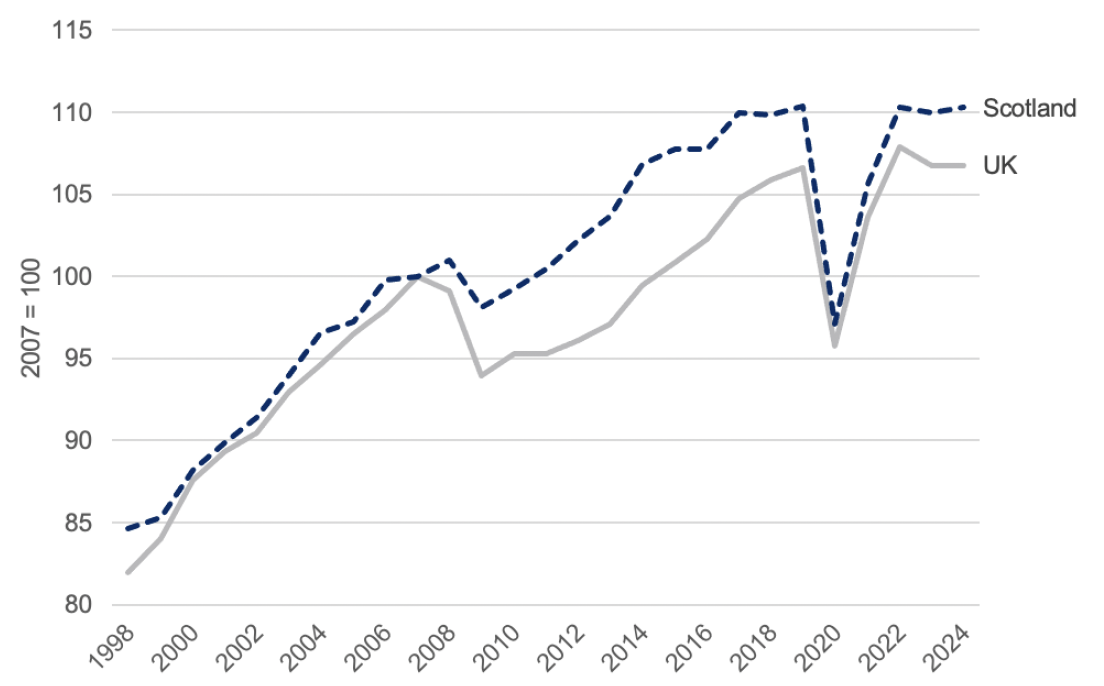
Source: Office for National Statistics, Gross domestic product (Average) per head, CVM market prices (reference year = 2023) £ (last accessed 30 September 2025); Scottish Government (2025) GDP First Quarterly Estimate 2025 Q2 (April to June)) (last accessed 30 September 2025)
Some of the difference in growth rates between overall GDP and GDP per person is due to Scotland’s population growing more slowly than the rest of the UK’s, suggesting a clear need for action to address Scotland’s long-term population challenge.[85]
The UK economy has strengths. It has been described as a ‘services exporting superpower,’ not just in financial and business services but in areas such as cultural and recreational services.[86] It also has strengths in manufacturing industries such as pharmaceuticals,[87] beverages[88] and aircraft.[89]
The UK has long been a hub for business from all over the world as a result of advantages such as a high skilled workforce,[90] the English language and being home to some of the world’s best universities.[91]
But the UK economy and its growth model also have had the following characteristics:
- it has been called a credit-driven and consumption-led model, rather than an investment-led one[92]
- long-standing regional inequality with a heavy reliance on London and the South East of England
- reliance on net migration, which the UK Government now wants to cut
- relatively high energy costs for both people and businesses compared to other countries
In addition, the austerity programme of government cuts initiated after the financial crash and the decision to leave the EU have had, and continue to have, important economic and social impacts.
The UK economic model delivers regional inequality
A leading authority on regional economics examined whether the UK displays high levels of interregional inequality in the context of 28 different indicators and 30 different OECD countries, and concluded that:
“The result is clear. The UK is one of the most interregionally unbalanced countries in the industrialised world…and almost certainly the most interregionally unequal large high-income country.”[93]
- Professor Philip McCann, The Productivity Institute and Sir Terry Leahy Chair of Urban and Regional Economics at Alliance Manchester Business SchoolOne of the key problems of the UK economy is that it has an unusually large concentration of activity in one part of the country: London and the South East of England.
Figure 4 shows GDP per head across regions of the UK in 2023 (the most recent year for which data are published). Darker shading corresponds with greater GDP per head. London’s £64,091 per head is by far the greatest, the second greatest is the South East of England at £38,433. Scotland is the third highest at £34,534.
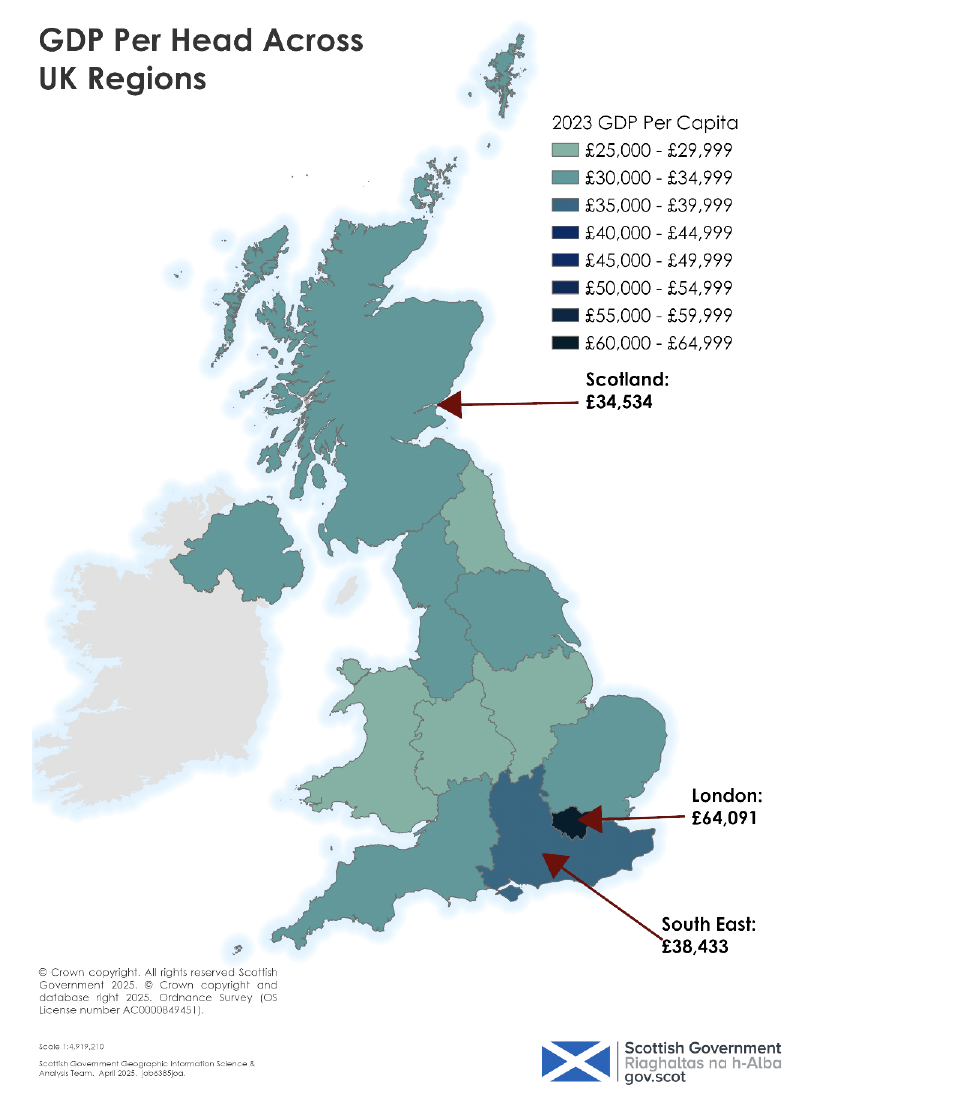
Source: Office for National Statistics – Regional gross domestic product: all ITL regions, Gross domestic product (GDP) chained volume measures (CVM) in 2022 money value, per head, pounds, 2023 (last accessed 5 August 2025)
The UK economy’s inequality and over-dependence on London and the South East of England have long been identified as a problem by successive UK Governments.
“While there are world-leading and enterprising businesses and innovators right across the UK, economic growth and the higher productivity which drives it has been over-concentrated in specific areas, particularly the South East of England. A long tail of low-productivity businesses and places explain why UK productivity growth is too low compared to competitors.”[94]
- UK Government, Levelling Up the United Kingdom, 2022
“Today our economy is heavily reliant on just a few industries and a few regions – particularly London and the South East. This really matters. An economy with such a narrow foundation for growth is fundamentally unstable and wasteful.”[95]
- David Cameron, Prime Minister, 2010“This is no temporary or passing phenomenon. The vote to leave the European Union was fuelled by deep-seated public anger about the huge structural inequalities between the UK’s north and the south – inequalities that, as UK Chancellor of the Exchequer Philip Hammond acknowledged this week, are the worst in Europe.”[96]
- Gordon Brown, former UK Prime Minister, 2016“Go back 100 years, probably: it’s always been the case that London has been significantly in advance.”[97]
- Tony Blair, former UK Prime Minister, 2022Notional estimated budget deficits for areas outside London such as those set out in the Government Expenditure and Revenue Scotland (GERS) publication are entirely consistent with, and indeed driven and explained by, the unbalanced and unequal geographic nature of the UK.
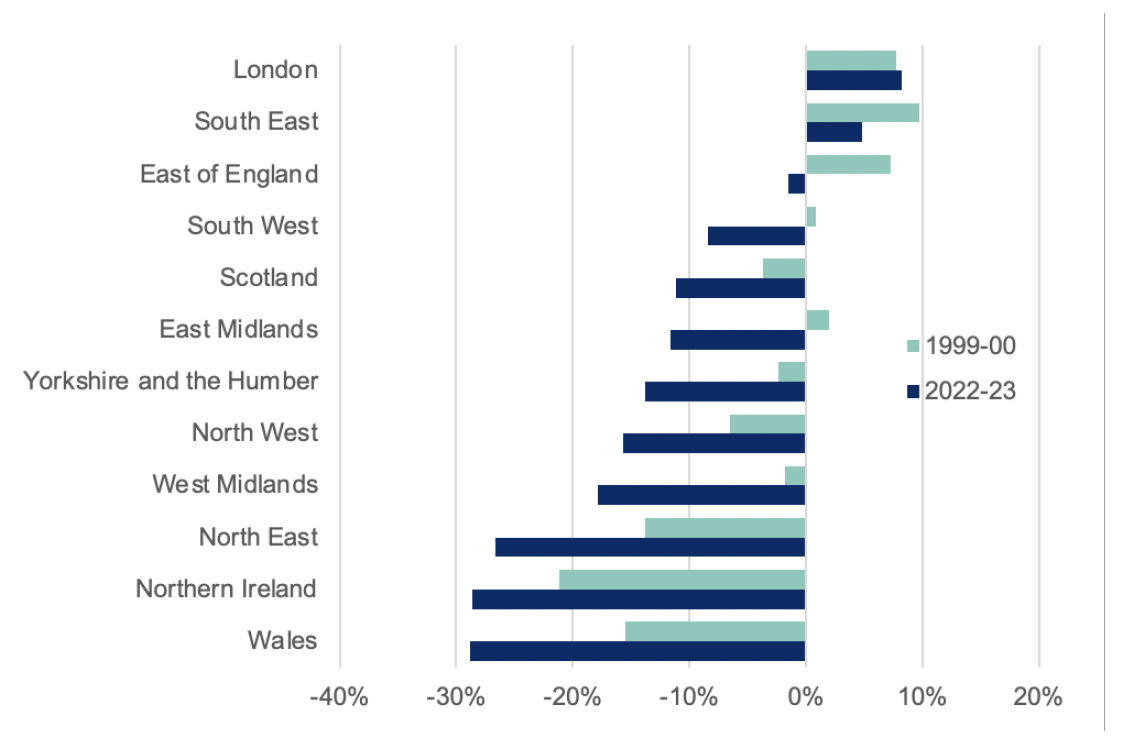
In 2022-23, for example, the only net contributors to the UK Government—that is, areas contributing more in tax than they received in spending—were London and the South East of England (see Figure 5).
Sources: Office for National Statistics Regional GVA (last accessed 5 August 2025); Office for National Statistics Country and Regional Public Sector Finances (last accessed 5 August 2025)
The UK economic model delivers high energy prices
“According to the International Energy Agency, which tracks end-user tariffs, in the rich world, British industry pays the most for its electricity, often by an astonishing margin”[98]
- The Economist, 2025British businesses are faced with some of the highest electricity costs in Europe (see Figure 6).

Source: Department for Energy Security & Net Zero international domestic and industrial energy prices (last accessed 1 October 2025)
Notes: includes taxes
For British industry:
UK “prices are 50-100% higher than in most of continental Europe and more than three times those in America.”[99]
- The Economist, 2025
The UK economic model and Brexit
The UK economy was already underperforming across a range of measures before the UK left the EU on 31 January 2020,[100] but leaving the EU has made that worse.
The evidence is that Brexit means a permanent loss of national income for the UK.[101]
Despite its attempt to reset relations with the EU, the current UK Government has made clear its opposition to the UK rejoining the EU,[102] and has stated that the UK will not rejoin the European Single Market or the Customs Union.[103]
The UK Government is also opposed to reinstating freedom of movement, despite its great benefit to Scotland’s economy, its people and its businesses.[104]
The National Institute for Economic and Social Research suggests that, compared to EU membership, the UK economy was 2.5% smaller in 2023 and it expects that to get worse: it predicts an economy 5.7% smaller in a little more than 10 years’ time.[105]
That would mean £69 billion wiped from national income in 2023, or around about £28 billion in tax revenue.[106]
For Scotland, this would equate to a reduction in GDP of around £5 billion, and a loss to public revenues of £2.3 billion.[107]
This has already started to have an impact on people’s everyday lives.
Research by the London School of Economics Centre of Economic Performance suggests that UK households have already paid £7 billion to cover the cost of post-Brexit trade barriers on food imports from the EU.[108]
This pushed up average household food costs by £250 between December 2019 and March 2023, disproportionately affecting low-income households who spend a greater proportion of their income on food.[109]
In May 2025, the UK and EU announced that further negotiations would take place on issues including border checks on agriculture, food and drink products.[110]
But the UK Government’s stated red lines for its relationship with the EU—on not rejoining the single market, not rejoining the customs union, and against free movement of people—mean that the scope of a deal, and its benefits, will be limited.[111]
The Scottish Government welcomes any closer cooperation with the EU, and will continue to engage positively and ambitiously in EU-UK discussions, but as long as future agreements with the EU are constrained by these red lines, then the Scottish Government believes that they can only ever unpick a small part of the damage that Brexit continues to have on our economy and our living standards.
Indeed, the UK Government’s own figures show that while the two main elements of the proposed deal—a Sanitary and Phytosanitary Agreement, and an Emissions Trading Systems linking measures—could add £9 billion to UK national income by 2040,[112] that represents just 0.2% of GDP,[113] with the loss to GDP caused by Brexit is estimated to be 20 times that, at 4% of GDP.[114]
The loss of freedom of movement also damages Scotland’s economy and society.[115]
All of Scotland’s expected population increase is forecast to come from people moving to Scotland from elsewhere.[116]
European freedom of movement has played a substantial part in ensuring that Scotland’s population did not decline.[117] Now, the proportion of the population who are of working age is projected to be slightly smaller in mid-2047 than in mid-2022.[118]
Inward migration to Scotland plays a key role in ensuring we have sustainable communities, particularly in areas affected by the challenge of population decline. Independence would enable the development of an immigration system tailored to Scotland’s needs, including place-based, targeted migration schemes to support labour markets and the demographic profile of these important communities.
A 2019 report from the Scottish Government’s Expert Advisory Group on Migration and Population reported that Brexit had the potential to negatively impact rural areas in Scotland.[119]
The report indicated that Scotland’s ‘gradually declining and rapidly aging’ working age population would most likely have the greatest impact on rural areas, which are already experiencing population pressures as a result of depopulation.
Increased immigration restrictions and the end of freedom of movement have already affected trade including, for many businesses, being unable to recruit the staff needed,[120] [121] with particular impacts on sectors like hospitality and agriculture.[122]
Research for the Migration Advisory Committee found that all organisations studied experienced a shortage of labour after freedom of movement ended and that none was able to recruit entry-level staff via the skilled visa route introduced by the UK Government.[123]
But even beyond the economic benefits, the Scottish Government believes that freedom of movement was a good thing for our citizens, and for the citizens of Europe, and that its loss is damaging us all.
The UK economic model has failed to tackle long standing issues
The results of the UK economic model have not generally been positive, with living standards remaining stagnant.
Indeed the perceived relative underperformance of the UK economy, as well as policy decisions taken by the UK Government, such as austerity and Brexit, have prompted a great deal of commentary at a UK level from academics, think tanks and politicians.
“For many years, the UK economy has been marred by low growth and flatlining productivity, both by historical and international standards. We’ve been lagging behind other developed economies, and it is making it difficult for everyone to make ends meet.”[124]
- National Institute of Economic and Social Research, 2024“While everyone suffered [from global shocks] – in lost jobs, incomes, lives and wellbeing – those losses have tended to be larger in the UK than elsewhere: more jobs and lives lost, greater hits to incomes and wellbeing. ‘Why is it always us?’”[125]
- Andy Haldane, 2022“Why doesn’t the British economy grow anymore? That’s not just a question about the recent recession, it’s been the fundamental debate ever since the financial crisis, and—unlike the recession—it’s not going away any time soon.”[126]
- Mossavar-Rahmani Centre for Business and Government, Harvard University, 2024“The twin challenges that Britain faces – low growth and high inequality – are substantial issues on their own, but together they create a toxic combination.”[127]
- Resolution Foundation, 2023Flatlining living standards can largely be explained by low productivity—the amount of output produced per hour worked—which has been a particular issue in the UK since the financial crisis. This has led to a productivity puzzle – the reasons why productivity growth in the UK has been so low are contested.[128]
Since 2007, the UK’s productivity growth rate has been half that of the EU27 (see Figure 7).
Source: Scottish Government (2025) Labour productivity statistics for Scotland 2024, Table 5 (last accessed 30 September 2025)
Within the UK itself, Scotland, Wales and Northern Ireland have a long-term productivity gap compared with the UK as a whole.
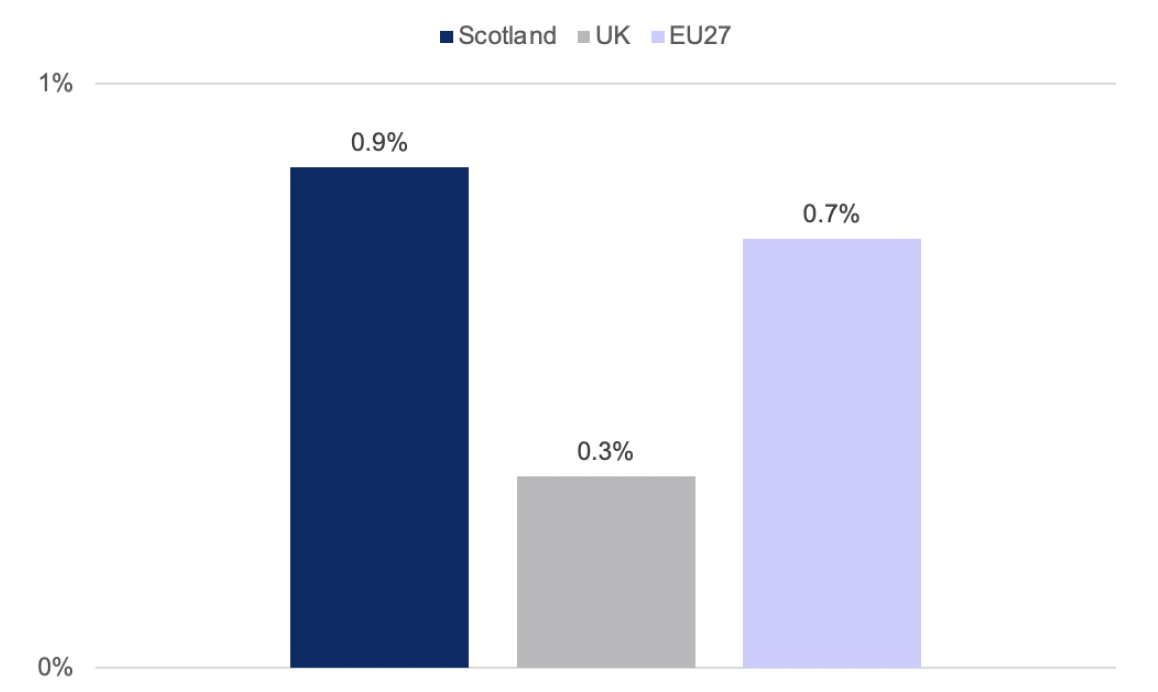
Since 2007, however, Scotland’s productivity has grown at an average rate of 0.9% per year compared to the UK average of 0.3%, and since 2009 Scotland has partly closed the productivity gap (see Figure 8).

Source: Office for National Statistics Regional Labour Productivity, Output per hour (last accessed 5 August 2025)
Stagnating living standards caused by poor productivity growth are clearly more damaging for people on middle and low incomes, and make it more difficult to tackle poverty.
Analysis by the Joseph Rowntree Foundation suggests that child poverty rates in the UK as a whole will increase over the next five years. Only in Scotland—because of Scottish Government policies like the Scottish Child Payment and the plan to mitigate the two-child limit policy—is child poverty projected to fall.[129]
UK living standards are also falling further behind our neighbours in Europe, a particular issue for those on low incomes:
- a 2025 Review of Living Standards by the National Institute of Economic and Social Research found that this is particularly the case for the poorest in our society[130]
- the UK’s lowest 10% of earners are more than £3,000 a year worse off than the poorest households in Germany and £1,500 a year worse off than the lowest earners in France[131]
- the poorest households in Slovenia and Malta are now better off than the poorest households in the UK[132]
Because comparable independent countries are successful countries
If Scotland became independent, it would re-join the family of European nations.
These countries are successful, dynamic economies and societies, and Scotland, rich in resources and talent, could be just as successful. Our potential as a nation to catch up with our neighbours is there: the Scottish Government believes we just need the powers to do it.
Many of Scotland’s near neighbours in Europe have thrived in the globalised economy of the 21st century, outperforming the UK on a range of metrics.
These countries have benefitted from effective monetary and fiscal management by credible institutions which has created the stability on which they have built and sustained economic dynamism and social solidarity.
The success of our European neighbours
Scotland would not be a small EU member state. Twelve of the EU’s 27 member states have a population similar to, or less than, Scotland’s.[133]
The Scottish Government has looked at 10 countries in detail: Austria, Belgium, Denmark, Finland, Iceland, Ireland, the Netherlands, Norway, Sweden and Switzerland. These comparable, independent, European countries—the ‘comparator countries’—and they are all wealthier, happier and fairer than the UK.[134]
They all do better than the UK on the issues that are key to having a successful economy and society.
For example:
All 10 countries are healthier than the UK. All 10 have higher life expectancy at birth than the UK’s 81 years.[135]
All 10 countries are happier than the UK too.[136]
The comparator countries are wealthier than the UK. Except for Finland in 2015, GDP per head of population has been higher than the UK in all 10 countries in every year since 2000.[137]

Source: OECD GDP per capita US $, volume, constant PPPs, reference year 2020 (last accessed 1 October 2025). Calculations based on constant prices.
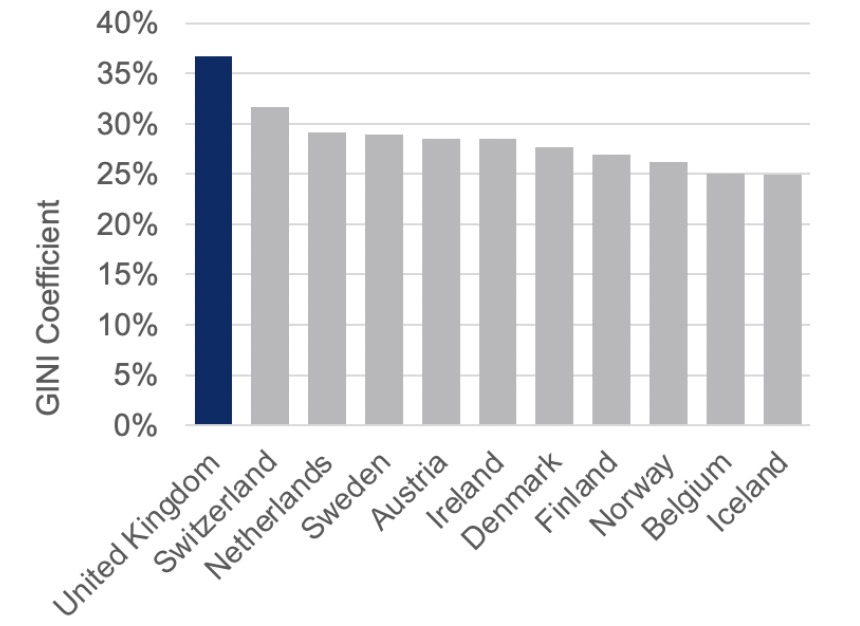
All 10 countries are fairer than the UK. They have much lower income inequality than the UK.[138]
Source: OECD Income Inequality, 0–1 scale all ages (last accessed 1 October 2025)
All 10 countries have lower overall poverty rates. Poverty rates for children (under 18) and pensioners (aged over 65 years) were also lower in all 10 countries than in the UK, except for pensioners in Switzerland.[139]

Source: OECD Income distribution, Poverty rate based on disposable income, 50% of the national median (last accessed 1 October 2025)
The comparator countries outperform the UK on productivity and, leaving aside the year of the Covid pandemic, they maintain better performance over time.[140]

Source: OECD Productivity levels – GDP per hour worked (last accessed 1 October 2025). Calculations based on constant prices.
Business investment is higher in all the comparator countries for which we have data, in most years.[141]
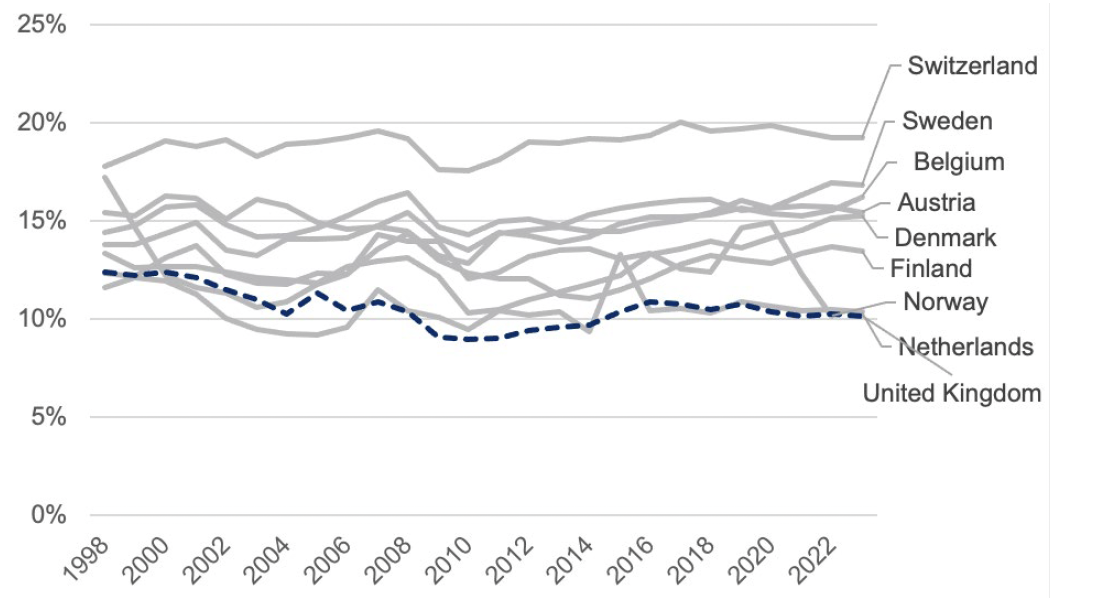
Source: OECD Investment by Sector (data for United Kingdom in 2024 not yet available); World Bank Gross Fixed Capital Formation by Sector (both last accessed 1 October 2025) Notes: Ireland is an outlier with respect to this indicator and has been excluded from the chart for presentational reasons. Comparable data are not available for Iceland for this indicator. Business investment as a share of GDP has been calculated by multiplying Gross Fixed Capital Formation (GFCF) expressed as a percentage of GDP by the proportion of corporate investment in total GFCF for each country.
Countries that are comparable to Scotland have noticeably higher productivity than the UK, and often significantly higher.[142]
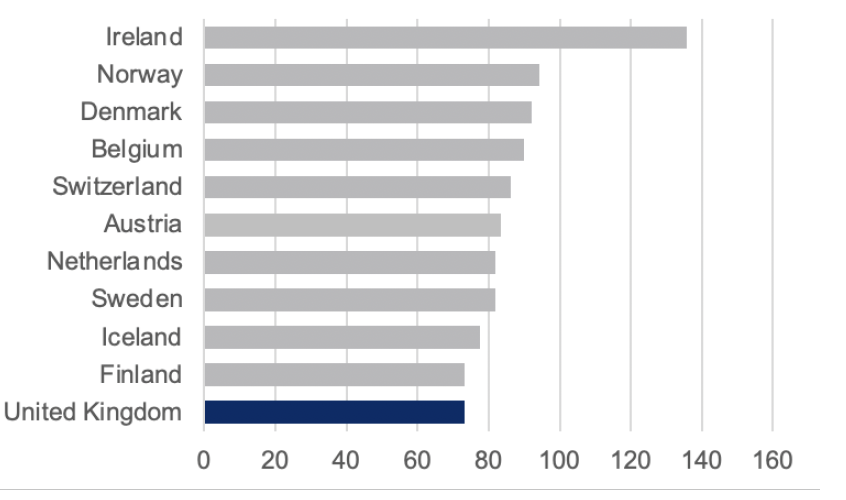
Source: OECD (2025) Productivity levels (GDP per hour worked) (last accessed 1 October 2025)
Scotland’s potential to catch up
Independent European nation states comparable to Scotland have managed to balance excellent economic outcomes over the long term with consistently strong performance across a range of social indicators.
If these countries perform much better than the UK, why couldn’t an independent Scotland, with all its in-built advantages, do the same?
While it would not be possible for a newly-independent country like Scotland to transform growth rates overnight, there is clear catch up potential.
The Resolution Foundation has argued that the UK’s economic performance is not normal for countries like it. If the UK had the average income and inequality of similar countries, the typical household would be £8,300 better off each year.[143]
Using the same analysis for countries that are similar to Scotland, the difference for Scottish households is even greater over time: they could be £10,200 better off each year.[144]
That does not mean Scottish households would instantly be more than £10,000 richer each year if Scotland was a nation state, or even that we would be as successful just by being independent.
Instead it shows how much better those comparable nation states do than the UK, and what we might be able to do if we were able to make our own choices about the shape and direction of our economy.
The prize of independence, the Scottish Government believes, is not matching the performance of these independent countries straight away, but the opportunity to start catching up.
Contact
Email: contactus@gov.scot