
Regional Inshore Fisheries Group: evaluation
Evaluation of Regional Inshore Fisheries Groups (RIFGs).
2024 review
Objectives and Methodology
Overview
Following the latest refresh of the RIFG network in 2023, the Marine Analytical Unit (MAU) was commissioned in late 2023 to gather qualitative evidence to inform the decision making around the future of the network.
The project team consisted of an economist and a social-researcher from the MAU, as well as some additional team support as and when required. The Project Advisory Group was made up of one industry representative, one representative of environmental issues, and the Marine Directorate Inshore Fisheries Policy Team. This group reviewed the methodology, progress reports, and advised on the direction of the project throughout. The FMAC Inshore sub-group were also updated.
This review of RIFGs is the first undertaken in-house by the Marine Directorate, the review in 2015 having been carried out by an external consultant. By delivering the review in-house the Marine Directorate was able to utilize their own expertise and to engage more broadly about current issues.
The primary objectives of the project were:
- To conduct an evaluation of the RIFG network to evaluate how effectively it is working and if it is delivering their objectives.
- To understand whether the RIFG network is fulfilling its role of providing a forum for Scottish inshore fishers’ voice to be heard by Government.
- To use the findings to review the current approach and set up and determine if any changes need to be made to deliver on the objectives.
To deliver these objectives, an online survey and online or face-to-face, semi structured depth interviews were carried out. The 2024 review was done as objectively as possible, however the findings are dependent on those who heard and responded to publicity about the research. As such the sample was largely self-selecting and likely to attract those who had some interest in the topic or who had engaged with the RIFGs. However, in order to target those less engaged with RIFGs, the project team travelled to coastal areas to conduct interviews directly with fishers.
Survey
A survey was developed by the project team and asked questions about the remit, organisational set-up, and impact of the RIFGs. (See Annex B for a copy of the survey.) The survey ran from 3 March until 30 April 2024 and attracted 88 responses. The survey was targeted firstly at inshore fishers via fishery offices and Marine Directorate channels. It should be noted that the survey was a relatively small sample compared to the proportion of inshore fisheries stakeholders, and the sample was self-selecting, meaning those with an interest in RIFGs were more likely to respond.
Over 80% of respondents were either fishers or were from an organisation representing the commercial fishing industry. Other respondents were from organisations representing related interests including seafood processing, the third sector or the environment. Respondents were from around the coast and islands of Scotland, with all but one fishery office area represented; 71% of respondents were administered by mainland offices and 16% by Orkney, Shetland or Outer Hebrides offices. Just over 28% of respondents were members of another government run stakeholder group such as FMAC or MPPs.
Survey responses are integrated into the discussion section below alongside evidence gathered from interviews.
Interviews
One to one interviews were carried out between January and July 2024 with three primary groups of stakeholders. Table 1 below shows the groupings and number of interviews for each.
| Stakeholder group | Number of interviews |
|---|---|
| Inshore fishers | 38 |
| Organisations actively engaged in the network either now or in the past (this mainly comprised fishermen’s associations) | 16 |
| Current and previous Chairs | 7 |
| Other organisations with an interest in the management of inshore fisheries | 3 |
| Total | 64 |
Many interviews were carried out on Microsoft Teams but interviews with inshore fishers and some fishing associations were carried out in-person in Spring 2024 in the west and south east coasts of Scotland.
Respondents were recruited using a variety of approaches: through coastal officers, by word of mouth and by intercepting fishers at ports. Participation in the research was entirely voluntary. Researchers explained what the project was about and that respondents were under no obligation to respond. Respondents were asked to sign a form indicating their agreement to participate and that they understood how their personal data would be handled. Where respondents agreed, interviews were recorded with all data handled securely and confidentially under GDPR. A data protection impact assessment and ethics impact assessment were produced at the start of the project.
A limitation in the interview coverage was that due to time and resource constraints, the project team was not able to travel to the islands nor the North East of Scotland and therefore there is limited representation from the fishing industry in Orkney, Shetland Islands, the Outer Hebrides and North East inshore areas.
Review of minutes and newsletters
Overview
In addition to the survey and interviews, the project team carried out a light/general review of past documentation where they were available. The aim of this evidence gathering was to build a picture of IFG developments and delivery since they began in 2009. Many of these have been referred to in chapter 3 of this report. Chapter 4 looks in more detail at the newsletters and minutes of the IFGs and RIFGs to assess the level of delivery of the groups. These were primarily found online, with some searches done of Marine Directorate files.
From 2009-2014, the groups were still in the early stages of becoming a part of the inshore fisheries management landscape. This period of time included FMPs being developed and a large-scale consultation on measures. Evidence from this time shows the time required for ideas to lead to change. The groups started with enthusiasm and ideas, with well attended regular inshore fishery conferences run by Marine Scotland and regular local meetings. In 2014-2016 the IFGs appear to have initiated a good level of regulatory changes and projects.
However, the 2015 review highlights that stakeholders had slightly lost faith in the groups. The subsequent refresh should have been a turning point and the RIFG newsletters published after that time do demonstrate activity within the networks, a spattering of RIFG funded projects, but also a shift from RIFGs being the primary delivery partner in a project to working alongside funding partners and other organisations. The busy landscape of fishery and local marine and coastal organisations appears to confuse the unique role of the RIFGs during this time as newsletters focused more on wider industry news than specifically RIFG news. Perhaps this demonstrates the main function of the network shifting from delivery of FMPs (which were still being developed in this time), to a conduit of information across the industry.
Review of newsletters
There were four newsletters accessible from 2014-2018 – Spring 2014, Spring 2016[52], Spring 2017[53], Spring 2018[54] – and these give regional updates and then cover national issues. Over this time there were regional FMPs and most regions had a couple of special issue groups which supplemented the management committee. The work undertaken by the groups seems to fall into these broad categories:
- Providing information to fishers about current issues in the marine space including government announcements such as changed minimum landing sizes.
- Being the voice of fishers into government on specific matters raised in RIFG meetings, and coordinating consultation responses
- RIFG run projects and information on new proposals such as the inshore fisheries pilots.
- Co-run projects with other groups such as FAs, councils, community groups on funded projects, some of which received funding from the European Maritime & Fisheries Fund (EMFF).
- Developing local management proposals and presenting them to government.
Overall, one major aspect of RIFGs evidenced through the newsletters is the level of engagement between RIFGs and other fisheries groups such as local partnerships and FAs. There seems to have been a good level of partnership working to delivery trials and other initiatives. However, what is less clear is how many of these projects would have happened without the RIFG in place. Also, during this period there appears to have been a good level of funding available to apply for, including EMFF.
Review of minutes
A review of minutes was undertaken to further establish what has been delivered by the groups. Minutes from 2023-2024 were not reviewed owing to the 2023 refresh. Minutes were gathered from the new RIFG website which held minutes from 2019-2024 only. Therefore four years of minutes were reviewed: 2019 to 2022. In this time period there were four RIFGs: North and East Coast, West Coast, Outer Hebrides, and Orkney. There were no minutes from Orkney, as this is when the RIFG functioned through Orkney Sustainable Fisheries. There was a decrease in regular meetings in 2020 and 2021 owing to the Covid-19 pandemic.
The West Coast RIFG (WCRIFG) published minutes from main meetings and three working-groups covering scallops, creel limits and aquaculture. In addition there were three regional sub-groups: Clyde, Mull and Solway. A North West sub-group was also suggested in 2020. From the minutes it’s clear the WCRIFG was active in discussing a wide range of issues and in actively seeking solutions. Topics included scallop management, creel limitation measures, aquaculture and producing the FMP. However, it is not clear what solutions and therefore improvements were ultimately delivered as these are minutes only. On a positive note, the Mull crab box restrictions continued, and there was the Clyde Voluntary Creel Measures project.
Meetings of the North and East Coast RIFG (NECRIFG) discussed issues including renewables interactions issues, creel issues, lobster V-notching and berried lobsters, a herring pilot. The main delivery item identified from the minutes was an aid to navigation pilot, although making links and being an advocate for the fishing sector in the renewables sector seems a key part of the role of the group. The FMP was also heavily discussed in 2019, though from 2020 onwards the minutes do not reflect how the plan was delivered.
In regards to the Outer Hebrides RIFG (OHRIFG) there were also numerous minutes and papers from the main meetings and sub-groups. Topics covered at meetings included, but were not limited to: the pot limitation trial, cockle fishery, brown crab tagging, vessel monitoring, consultation on future MPAs, blue fin tuna scientific tagging project and socio-economic impact assessment, and a Sound of Barra Habitats Regulations Assessment.
A point to note in relation to all main regional meetings is the attendance of Marine Directorate officials. These officials were clearly closely involved in the information presented at the meetings and in the discussions. Direct engagement with the industry at regular periods is a positive action however, this could be viewed as a duplication of the role of Chair whose job it is to feed information back to government. There were many and detailed information sessions from Marine Directorate officials at regional IFG meetings outlining new or changing policy, or recent scientific data. It could have been more efficient for these to be at a national level, i.e. the FMAC inshore sub-group established in 2013.
Another point to note that covers most groups is that one of the barriers to progress appears to be reaching consensus, indeed one conclusion of the creel limitation discussion was that each region had varying needs. However, what ‘reaching consensus’ entails is also a topic of debate amongst respondents and one that does not appear to be clearly answered in RIFG documentation. Another hindrance to change was the Covid-19 pandemic which occurred at a time when the RIFG appears to have been gathering momentum in terms of producing proposals and discussing tangible actions.
Thematic analysis
The survey analysis was conducted first and themes emerged which were then used for the analysis of the interview transcripts. The themes are organised into a logical ordering determined by the project team. There were 10 themes split into four groups.
Group one contains only one theme which is focused on the system, i.e. how the RIFGs fit within a system of other government groups and processes. These other groups and processes include FMAC, the FMAC inshore sub-group, fishery offices, the Marine Directorate inshore fisheries policy team, the legislative process, and MPPs.
Group two covers what the RIFGs do and contains three themes: remit, delivery, and monitoring and reporting.
- Theme two is the remit and includes objectives and overall purpose of the RIFGs and specifically the topics of the voice of fishers and sustainability.
- Theme three is delivery and focuses on the tangible deliverables of RIFGs and what barriers, if any, exist with regards to delivery.
- The last theme of this group, theme four, discusses how RIFG activity and delivery should be monitored and reported to stakeholders.
Group three covers who is involved in the RIFGs and contains three themes: leadership, engagement, and membership.
- Theme five is leadership and focuses on the characteristics of RIFGs leadership in the past, and what the ideal leadership looks like in the future.
- Theme six is on engagement and discusses RIFG chairs’ engagement with stakeholders (including hard to reach groups) and engagement by fishers with the RIFGs.
- Theme seven concerns membership and looks at how well the membership arrangements work.
Group four focuses on how RIFGs operate and contains three themes: power, resources, and regions.
- Theme eight covers what power RIFGs have to make effective changes in inshore fisheries management, and if more or less power should be given to the groups.
- Theme nine is on resources and discusses government funding, the chair’s time, and broader resources.
- Theme ten concerns the regional boundaries of the individual groups.
Theme 1: The system
Key insight: Clarity on the governance landscape of inshore fisheries management will help stakeholders know where to engage and where decisions are taken.
The first theme concerns the system in which RIFGs operate: the Marine Directorate policy and operations teams, FMAC, and other government organised groups such as MPPs.
Firstly, with regards to governance landscape, some respondents highlighted that they thought that the Scottish Government was under more resource pressure than in previous years and that this was affecting the performance of RIFGs. Respondents felt that officials appeared not to have the same time or resource available for travel to inshore ports to meet with fishers as in previous years or decades. These issues was acknowledged by respondents as being caused by external factors and shifting government priorities and therefore was not in the control of the inshore policy team. Another key point raised by some respondents was that the trust fishers have in the RIFGs as a mechanism for delivery has been declining since the IFG pilots. One reason given by respondents for this was that the groups had not delivered what the industry had expected.
Some fishers noted that they have direct contact with the Marine Directorate which was greatly appreciated, yet those fishers still stated that an RIFG group was useful. Others noted that their local fishing association was a listening ear and represented them within government and therefore RIFGs were potentially duplicating that role. Fishing associations were raised by many respondents as key players in how Marine Directorate connects and listens to the fishing sector. A few respondents noted that the RIFGs need to work more closely with fishing associations, or that the Marine Directorate needs to build up and focus on good relationships with local fishing associations as these groups are who fishers go to and trust. However, it is also important to note that there are fishers who are not members of associations, and RIFGs can fill this gap by providing a link to government.
A few respondents also noted that they were uncertain about the direction that the Scottish Government wanted to take fisheries management and they felt that this could be partly contributing to fewer people entering the sector or less investment by current fishers.
Secondly, in terms of Marine Planning Partnerships, there were a few comments raised. A few respondents were not clear how RIFGs work alongside the partnerships and where the boundaries lie in terms of management of the inshore waters.
Thirdly, respondents mentioned FMAC, and one point raised was that fishers voices could successfully be fed into government at FMAC. One suggestion was that there was too much decided at a national level, and therefore a regional FMAC style gathering is needed. Some respondents felt that this forum, alongside fishing associations strong links with Marine Directorate, means that an RIFG is surplus to their requirements.
Some respondents noted that the involvement at FMAC in recent times of some eNGOs has meant that some fishers feel unable to speak openly about management issues and that the group is therefore no longer suitable for open discussion on regional fisheries management. On the other hand, some felt that the inclusion of wider stakeholders i.e. environmental groups is good as it helps deliver the sustainability part of the RIFG remit.
Theme 2: Remit
Key insight: The remit should be specific, achievable, and measurable. Key elements should include: a Chair-led forum for discussing local issues and potential solutions; ensuring inshore fishers’ voices are heard by government; and encouraging the groups to support the sustainability of the sector.
The term remit is used in an overarching sense to mean the objectives, purpose, and overall expectations of activity that stakeholders should expect from RIFGs. The remit of RIFGs has slightly morphed over the years as discussed in section 3 of this report. They began as the route to create and deliver local FMPs. From 2016 onwards they were reduced in scale and remit. FMPs were produced in most instances but delivery uncertain from the available documents.
During engagement for this project, respondents were provided with the 2023 remit:
a) ‘To improve the sustainable management of inshore fisheries and’,
b) ‘to give commercial inshore fishers a voice in wider marine management developments.’
Survey respondents were asked if they were aware of the remit and if they think the current remit is the right one for a government initiated stakeholder group which concerns inshore fisheries management. The majority of respondents were aware of the remit. 39% thought the remit was the right one, but only 27% thought it was not the right remit, leaving the remaining 34% of respondents unsure.

In both the survey and the interview, comments provided by respondents noted the dependency of the remit on other themes, for example, the remit sounds appropriate but how can the remit be delivered when RIFGs do not have power. Or, the interpretation of the remit depends on how much the chair had a grasp of the industry and is able to demonstrate a strong working relationship with fishers.
In many comments there was a general agreement that the remit was about right, but there were comments on what lay underneath the brief definition. A primary issue raised concerning the remit was that it needs to be clarified. Many respondents recalled the pilot phase and later years when there was a clear remit to produce FMPs. These including producing management measures, suggesting pilots and other new schemes to improve stocks and support the local industry. However, many also noted that the current remit had been diluted, or neglected due it not being delivered upon fully. Therefore many respondents called for clarity on the full scope of the RIFGs remit, and linked to that was, for some, the desire for more locally managed fisheries taking account of local issues. More on the latter issue is covered under the theme of ‘Power’.
The first part of the remit ‘To improve the sustainable management of inshore fisheries’ attracted many comments. Sustainability was of high importance to most respondents and this was viewed as a priority for RIFGs. However, it was clear from the survey comments and the interviews that sustainability means different things to different stakeholders. For fishers, sustainability often means being able to make a living from fishing for the next 5-10 years, and perhaps be able to pass the business on to the next generation. To do so, they appreciate this means not putting too much pressure on stocks. Sustainability of local communities and services were also noted by some as important for fisheries stakeholders. However, there was consensus among fishers that they wanted sustainable fishing and wanted, broadly, to support measures to achieve sustainability.
increasing stock levels to historic levels or to achieve Good Environmental Status. Sustainability also drew in other marine aspects for example, to protect marine habitats from the impacts of fishing.
Therefore, there was a call for the Marine Directorate to define what sustainability meant, so that stakeholders could be clear on what they were to be discussing and working to achieve. However, there was general consensus that RIFGs in the current form had little ability to influence the sustainable management of inshore fisheries, primarily owing to not having power to implement local rules. FMPs were mentioned by a few respondents, noting that these should be produced at a regional or even local level and include short, medium and long term objectives for inshore fisheries management. Some noted there had been attempts to produce these in the past with some positive impacts noted (more on this under the ‘Impact’ theme).
Quite a few respondents mentioned the use of science and that the sustainability part of the remit would only work with up to date science incorporated into decision-making. Some fishers noted that Marine Directorate science data should be used in conjunction with local knowledge. In previous iterations of the RIFGs there was far more close working with Marine Directorate fisheries scientists and this enabled quick responses to local issues. Supermarkets’ increasing demands for fish sourced in environmentally sustainable ways was also noted as a driver of implementing more sustainable ways of fishing.
The second part of the remit ‘to give commercial inshore fishers a voice in wider marine management developments’ was also noted as very important by the fishing community and other stakeholders. The voice of fishers was a key theme throughout both the survey and interviews and it was clear that many fishers wanted to know that there is a way they can communicate views to the government. This part of the remit was of special importance to fishers who are not members of a local fishing association. For some respondents who were members of a fishing association, they found that the association was the voice to government and a RIFG was duplicating that role. However, a number in the fishing industry noted that the RIFG was needed in addition to fishing associations to provide a local voice that had more of a direct ear of the government that an fishing association may do.
While many stakeholders supported a space for fishers’ voices to be heard, many fishers noted that it was not very useful unless they were listened to and actions taken. One respondent noted that ‘… the communication is going up but the actions aren't coming down’. The question was raised by a number of respondents as to whether the government had been listening to RIFGs in recent years. Again, many recalled the early years of RIFGs and the ambition of co-management, and that over the year that initial trust had been eroded as fishers felt decisions are made by government without fully incorporating fishers’ perspectives. The term co-management possibly leads to confusion here, as stakeholders may see that as taking a more active role in management than an alternative term, for example ‘co-production’.
Consensus and membership were other aspects of comments concerning fishers’ voices. Who was in the meetings and who had the loudest voice could have great influence over what was fed back from an RIFG to government. More on membership is found under the ‘membership’ theme.
The chairs were noted as being pivotal to this second part of the remit. Chairs are the voice of fishers to other marine stakeholders as well as the government. They also act as a conduit, passing on information from the government to fishers. Many fishers noted being on mailing lists and even if they did not attend RIFG meetings these would receive emails on government news or other marine news. This two way communication between government and fishers was seen as valuable by most respondents, especially the role of chairs distilling policy documents or consultations into key messages for fishers. Others noted that their fishing association did this job, and that if this was all the that RIFG did, it was not required.
Theme 3: Delivery
Key insight: Tangible deliverables that align with the remit are essential to ensure value and best use of resources.
This section should be viewed in conjunction with the review of documents as recorded in section 3 and where there is discussion of what RIFGs delivered.
The survey asked respondents if, in their view, their local RIFG contributed to the remit: a) ‘improving the sustainable management of inshore fisheries’ and b) ‘giving commercial inshore fishers a voice in wider marine management developments’ in the past five years. Where 1 was low and 5 was high. 77% of survey respondents think their local RIFG has made a low or fairly low contribution to the first half of the remit, and 67% thought the same for the second half. So there were marginally more respondents who thought the ‘voice’ part of the remit had been delivered in their area. There was also a notable proportion of respondents who were unsure.

The time period asked about in the survey was 5 years however in the survey comments and in the interviews some respondents referred to the IFG pilot launched in 2009. A good number of respondents noted the positive benefits felt in the early days of the groups, enthusiasm for new projects and better engagement with government. The majority of respondents were unsure about what management measures delivered in the past 15 years were directly linked to RIFG activity. However, a good number of respondents mentioned projects or development of proposals that they felt would not have happened without the RIFGs. These included the following (dates were not always provided):
- Crab and lobster interim management measures (2024)
- The Outer Hebrides creel limitation pilot (2020-2022)
- Razorfish pilot (2018-present)
- Management of the handline mackerel fishery
- Increase in crab and lobster landing size
- Being the voice of fishers to the aquaculture and renewables sectors
- Improving fishers’ perspectives on what sustainable means
- Tuna quota and Bluefin tuna tagging protocol
- Sustainable eel group
- Clyde creel limit
- Brown crab research
- Voluntary measures for spawning in Gairloch and Clyde
Some respondents felt that the RIFGs have been successful in providing a voice for fishers into government over the years, and that this has been appreciated. A few noted that from 2009 to around 2014 there was activity and tangible outputs for example, new government regulations and pilots being approved. However, there remained a general feeling amongst respondents of government inaction. Respondents noted several reasons including the length of time required for the legislative cycle and general government processes, the Chair lacking training on the fishing sector and how to navigate government processes, duplication of work with fishing associations, the government not taking decisions, RIFGs being restricted due to lack of power and resource, and the lack of requirements for the RIFGs to deliver. Another point raised under delivery of the ‘voice’ part of the remit was membership. Some respondents mentioned the competing voices in the groups (both from within and outside of the industry) and therefore it is tricky for the government to hear a balanced voice.
A few respondents mentioned ongoing challenges in the inshore sector that they felt the RIFGs should have taken action on, some of which are longstanding issues with no clear solution, including:
- High creel numbers putting pressure on stocks
- Clyde cod seasonal closure
- Additional science surveys
- Introducing a spurdog quota
- An Orkney regulating order
- Improving sustainability of the sector
- Improving the reputation of fishers
- Illegal and unlicenced fishing
- Different crab and lobster landing sizes around Scotland
- Banning berried lobsters
Theme 4: Monitoring and reporting
Key insight: Accountability should be delivered via a monitoring and reporting plan and regular published reports.
Closely linked with ‘Delivery’, the next theme concerns the monitoring and reporting of RIFGs activity in regards to their remit. A minority of respondents raised monitoring and reporting, however these were deemed significant enough topics to amount to a theme. Those who mentioned monitoring and reporting noted a lack of reporting of outputs from the RIFGs and therefore a lack of knowledge amongst stakeholders as to what the RIFGs are delivering. Section 3 of this report shows that there has been an effort to publish minutes and, at times, newsletters of the RIFGs’ work. The desk review highlighted that there was not a consistent approach to demonstrate the value of the network to stakeholders.
Therefore, as raised by respondents, there has been a gap in reporting and a lack of a monitoring and evaluation strategy sitting alongside the RIFG remit. Respondents noted that these products would enable stakeholders to see how government funds were being used and how the groups are serving the industry and wider marine users. Another benefit raised would be the ability to distinguish between what is attributable to the RIFG or what would have occurred anyway without the network. An example of this is the Outer Hebrides creel limitation pilot which a few respondents thought would have gone ahead without the RIFG but with a similar locally organised network. Nonetheless, the RIFG does appear to provide the appropriate framework for such a project to receive government support. In 2024, the Chairs sought to fill some of this gap by producing a Progress Report in November 2024.[55]
Theme 5: Leadership
Key insight: Direction should be set by the Marine Directorate and local leadership provided by regional Chairs. The Marine Directorate should maintain oversight of delivery, with Chairs taking initiative for local projects and enabling the voice of fishers to be heard by government.
Almost half of respondents raised issues relating to how the groups were led, both by chairs but also more broadly the guidance they receive from the Marine Directorate. Firstly, respondents felt that the direction for RIFGs should sit with the Marine Directorate and that RIFG chairs should not relinquish the remit to focus on issues less directly concerning fisheries management. Some noted that they felt the Marine Directorate has taken a step away from setting a specific direction for RIFGS to take and therefore some chairs were apt to not follow the expected remit. Respondents noted that this has worked in some cases with the chair being able to devote time and attention to specific issues. On the other hand, other respondents noted that this has led to some chairs focusing too much effort on one fishing sector’s concerns over another. Respondents were therefore keen to see more oversight of the groups from the Marine Directorate to ensure chairs stay within slightly tighter topical boundaries.
Others highlighted that the leadership required extended beyond RIFGs to the wider fisheries objectives of government, i.e. specific inshore objectives which are clearly presented to the industry. For example, in relation to the remit, there needs to be clarity from the Marine Directorate on the definition of sustainability. Overall, respondents want the government to set out a long term vision for inshore fishing which they feel is not currently clear.
Secondly, the role of a Chair’s leadership was raised. Some respondents noted that there have been good Chairs who have listened well and led the RIFG to develop balanced regional proposals. Other respondents noted that different Chairs carry out different activities and therefore respondents felt that there was not always a consistent direction set by Chairs. Respondents noted looking at other RIFGs outside of their region and seeing Chairs carrying out their role differently, and therefore there was doubt cast on how Chairs were leading the network as a whole.
One respondent mentioned that Chairs can have a key role in ‘persuading, influencing, convincing’ stakeholders towards sustainability. That said, there were also questions asked by respondents about how much Chairs can actually influence RIFG delivery in their local region with some noting they were powerless owing to holding no legislative power, leading to some Chairs not setting the direction for their group where they possibly could have, i.e. promoting voluntary measures of pilot proposals.
Some respondents noted that a key aspect of Chair leadership was impartiality between different fishing sectors, and that fishing knowledge was key to being trusted to chair an RIFG. More discussion on the Chair is covered under Theme 10: Resource.
Theme 6: Engagement
Key insight: Chairs should engage with all relevant stakeholders and prioritise regular interactions with inshore fishers. Removing barriers to the involvement of fishers should be a key priority.
The theme of engagement is also in two parts, engagement by Chairs with stakeholders and engagement by fishers with the RIFGs. Survey respondents were asked to what extent they think RIFGs engage effectively with relevant organisations, where 1 was least effective and 5 was most effective. On average, 50% of respondents gave a neutral response to each organisation listed. So there was a lack of knowledge concerning Chair engagement even amongst the fairly engaged group who responded to the survey.
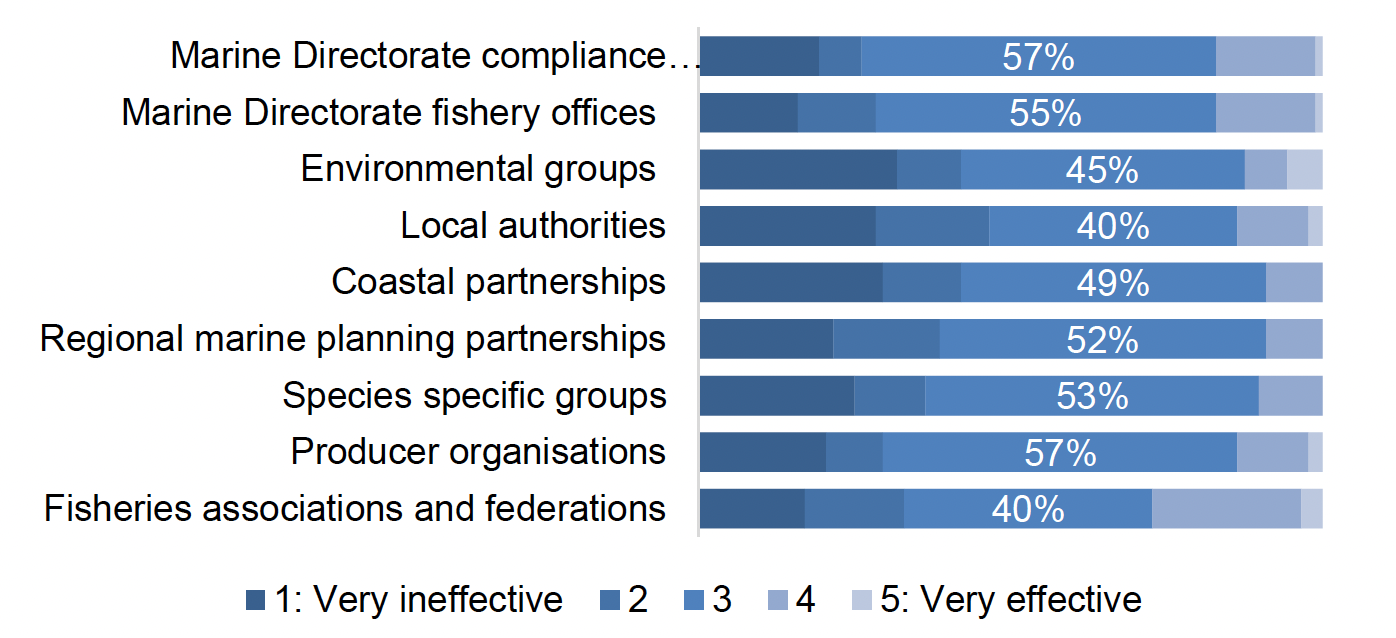
From the survey, RIFGs are engaging most effectively with fishing associations and federations (28%), Marine Directorate fishery offices and compliance operations staff (17%). RIFGs are engaging least effectively with Local Authorities (47%), environmental groups and coastal partnerships (42%). From interviews, there was clear evidence that the Chairs had reached out to many stakeholders including fishing associations and regional coastal or marine related groups. However, the engagement levels varied across groups.
Most survey comments concerning the view that there was a lack of engagement carried out by Chairs were provided by individual skippers. It is important to highlight that the Chairs cover large geographical regions covering many harbours, and fishers are at harbour at varying points in a day. Survey respondents noted engagement as the main change they wanted to happen to the groups, with the majority of respondents saying that RIFGs need to engage more with local fishers. There were not many suggestions provided on how Chairs should best engage. Some fishers suggested a bigger presence at local harbours. The majority of organisations engaged in this review knew the Chairs by name and some had meetings or phone calls with them.
Similarly, many fishers spoken to at harbours by the research team had not directly heard from a Chair, unless they had been on an email list for some time. This is not necessarily a reflection on the Chairs who may engage via fisher representatives. When speaking to Chairs themselves, they noted that previous contact lists were not always made available to them by previous Chairs, or the Marine Directorate. Therefore, reaching out to such a dispersed group of stakeholders is tricky. Chairs and some organisations did note a concerted effort by Chairs to engage across the industry.
In terms of fishers engaging with RIFGs, some fisher respondents reported that they had at one point in the past been engaged but had lost faith that anything would be delivered so had stopped being engaged. Chairs noted similar feedback from some of their engagement with fishers. Some respondents linked this reduced engagement to a lack of trust in RIFGs or in the Marine Directorate which had emerged after not seeing expected deliverables.
Reasons for lower levels of engagement amongst fishers included that some respondents noted trusting the fishing associations to be their voice to government, or because their fishing association was either discouraging or encouraging engagement with the RIFG. There is also a group of fishers, and this emerged primarily from the fieldwork, who simply want to go out and fish and not engage in groups or go to meetings. Time was noted as a barrier to engagement as well as the cost of travelling to in-person meetings or that locations were difficult or time consuming to get to given the wide areas each Chair is covering.
Theme 7: Membership
Key insight: There is strong support for a forum designed for only fishing representatives, however, stakeholders recognise that the marine space is a shared resource so other marine stakeholders should be brought into management discussions. A more formal membership would improve transparency.
In the current iteration of RIFGs there is no formal membership as there is no need to sign up or formally join the RIFG group, and no subscription is payable to participate, and yet it was one of the most contentious issues raised in this review. In previous iterations there were slightly more formalised groups, but in 2024, membership is loosely defined in this review as those who come along to RIFG meetings. At the moment, meeting attendees are primarily members of the fishing community. Participation by some may be fleeting and transitory. Non-fisheries stakeholders may engage with the Chair outwith meetings.
Respondents were specifically asked about membership and this theme attracted many comments. In the survey, 56% of respondents agreed with the statement ‘Membership should be fishers and fishers representatives only’. In the comments provided, there was a majority who reiterated that point, but also a good number who wanted to expand membership to include scientists, academics, or even all other relevant stakeholders.
In the interviews, the strongest point raised was also that membership should remain fishers only as they need a safe space to talk and discuss issues. Most fishers and many of the chairs felt quite strongly that the meetings should be for fishers only as there was a need for fishers to have a private space to discuss local issues.
Also some non-fisheries organisations felt that a fishers only forum was important too, as long as other organisations were brought in before final decisions were taken by government. Several respondents from the fishing industry specifically said that they thought eNGOs should not be at RIFG meetings. A number said that they would be “shouted down” by eNGOs at meetings and that would put them off attending. They also noted that eNGOs are members of FMAC and therefore have a ready forum to engage in fisheries management. A few of the non-fisheries organisations engaged in the project agreed that fishers need a space for themselves to speak. A few respondents (fishers and chairs) felt that it was particularly important to attract fishers who are not currently part of any fishing association to the RIFG meetings as there was no other way for them to have their voice heard. The RIFG played an important role for those fishers.
Conversely, some respondents felt the membership should be expanded. Whilst some eNGOs recognised the need for fishers to have their own space they felt that if the RIFG becomes the place where decisions are made then the participation should be broader than just the fishing industry, as the decisions relate to a public good. The point of when to engage non-fishing stakeholders appears integral, with many respondents noting that all stakeholders should be engaged at some point or at some level, as long as it does not cancel the fisher specific forum. One suggestion was for a public sector environmental organisation to act as a trusted partner to unite fisheries and environmental stakeholders. A couple of respondents noted that the meetings would benefit from having seafood processors present. In some cases processors attend but not always. Having fisheries officers attending some RIFG meetings was also regarded as being a bonus.
Another point raised was that even amongst fisheries stakeholders, the membership criteria needed to ensure balance across fishery types. Some noted that meetings might be dominated by the bigger boats or those from bigger companies. Therefore it was raised that the remit for the groups had to ensure a balance of voices across the inshore sector. Some respondents mentioned the competition for marine space, and therefore they wanted a place where these issues could be discussed in a balanced way. Respondents noted that this would of course require a strong Chair to manage competing views.
There was also a number of respondents who noted membership needed to be clarified as the current RIFG membership was not clear.
Theme 8: Power
Key insight: Groups should be enabled by the Marine Directorate to achieve their remit including encouraging locally led approaches that have the potential to become legislation.
RIFGs are non-statutory which means that they do not have the authority to implement legislation on behalf of the Scottish Government. They cannot set local fisheries management regulations. The original ambitions of IFGs were to devolve some level of regional power to the groups, although this did not fully transpire. Indeed, one fisher who had been involved with RIFGs in previous years, responded saying that he had believed that the original RIFGS would have decision making power but that it did not come to fruition after the pilot period. Currently, fishing in inshore waters continues to be managed through regulations and licence variations which are decided by the Marine Directorate through consultation with stakeholders.
From the survey, 38% of respondents think that RIFGs should become statutory groups, and 29% think they should continue to be non-statutory; leaving a substantial group who are unsure. There was no clear regional distribution of responses. Note that ‘non statutory’ was not defined in the survey and therefore there may be differing views on what this means.
A small majority of fishers were more supportive of RIFGs becoming statutory compared to fishers against. A small majority of fishing organisations were against RIFGs becoming statutory instead of those who were in support. Third sector organisation were more likely to be in favour of RIFGs becoming statutory. Few reasons were provided in the survey comments, although limited power was mentioned as a the second top drawback of the groups as they currently stand (after membership issues), i.e. the groups not being able to implement local management measures. Those unsure either way mainly mentioned that clarity on the remit was needed before deciding if they should have more power.
From interviews, discussions more often used the broader term ‘power’, however the definition was broadly similar: the ability of RIFGs to implement management measures for local areas. There were a few respondents that strongly thought there should be more power to make regional or local regulations. Again, the discussion on power touched on other themes, mainly remit and the system, but respondents doubted that action would be taken and that Marine Directorate would give power to a local management group.
Overall, there were mixed views from respondents on whether there should be greater statutory powers for RIFGs. A few of those who were opposed to RIFGs becoming statutory bodies provided reasons. It was noted that an additional tier of legislation could confuse the governance landscape, and that more power is not required if RIFGs can make proposals to government that can become legislation. A few compared the idea of additional powers with the Inshore Fisheries and Conservation Authority (IFCA) model in England who regulate regionally. This was the viewpoint of one of the eNGOs who also felt that there are benefits from combining fisheries management with wider marine management. However, some noted that having regional regulations could result in inconvenience and confusion for fishers that work across regions.
In addition, a few respondents noted that in order to grant more power, the remit and membership of the groups would need further clarification. One of the Chairs said that the groups should be able to reach solutions through negotiation even without having legislative power. Having the right people on board who can drive through decisions would be sufficient. Another respondent noted that the current regions are too large for local measures as there are varying local issues.
Contrastingly, a number of respondents felt that it is important for RIFGS to have more power, that RIFGs cannot fulfil their remit without power and that having more power would result in greater interest and engagement from fishers. They believed that it would be good for local areas to have more control over what happens in their own waters, and actions could be taken quicker than currently felt. As one respondent summarised ‘Giving IFGs powers to actually introduce local fisheries management by local fishermen should be high up the agenda’. Local knowledge was also cited as a reason for more power, with those working in the areas understanding what measures were best.
A few respondents noted barriers to RIFGs being given more power. For example, the additional resource that would be required from government. There was a recognition amongst some that even if more power was needed, it would be very difficult and expensive to restructure the system to allow it and it would not therefore offer a quick solution to the current challenges. A few respondents questioned whether the government wanted to devolve more power, and therefore whether it was worth discussing. One respondent also felt that government used the RIFG to instruct fishers, rather than using meetings as a forum for decision making.
Challenges around reaching consensus were also raised. If more power was given to RIFGs, working in committees to reach decisions remains difficult owing to varying views. There is the risk that the voice of the smaller fishing associations with fewer members are drowned out by the bigger more influential players. As one fisher put it ‘you’d just get the people that shout the loudest getting what they want to the detriment of everyone else’. Noted also was the risk of enforcing management measures without proper consultation with the industry
Ultimately, the main issue raised under this theme was what was the best route for RIFGs to deliver. If giving RIFGs additional power resulted in more delivery that was a strong reason to support it, however, there may be other routes to delivery that do not require additional power. In theory the negotiated approach should work but quite a few respondents noted that they think things do not make progress when they get to the Marine Directorate.
Theme 9: Resource
Key insight: Chairs must be knowledgeable about inshore fisheries and empowered to initiate regional ideas and solutions to improve inshore management. Chairs should have access to science evidence to ensure it is incorporated into local discussions.
Resources available to the RIFGs fall under four main categories: government resources which includes paying the Chairs and discretionary project funding, the resource of the Chair themselves and their skills, scientific evidence, and stakeholder time. The topic of the Chairs was raised the most often under this theme. It was clear that most respondents felt that a skilled Chair was paramount to delivery.
Firstly, on government resources, this was mentioned but only by a few respondents, perhaps due to lack of knowledge about what fundings was available. From the survey, more respondents think that the current funding arrangements are not appropriate for the functioning of the RIFGs (41%), than those who think that current arrangements are appropriate (12%). The remaining 46% gave a neutral response and from the comments provided on this theme, it was generally felt that clarification of the remit and the deliver issues had to be addressed before determining funding requirements. This would be so that stakeholders know what the resource would be going towards. From the interviews, many of the respondents who were fishers did not comment on resourcing issues and indicated in some occasions that this was because they felt they did not have sufficient knowledge about how RIFGs were financed.
In the comments that were raised about government funding, a few respondents, primarily Chairs, acknowledged that resource was a potential limitation and that with more money they could do more. They felt that a small fund or budget to be helpful to deliver projects such as piloting new ideas locally. Some fishers who had been involved in the earlier RIFGs felt that a lack of funding had led to the original RIFG not delivering as planned, with one fisher saying ‘good management costs [money]’. It was lamented that the RIFGs do not have any other sources of funding other than what the government provides as some felt that they not in a position to apply for grants. However, it should be noted that in the past some RIFGs have applied for grants, with some Chairs more active than others in pursuing grants.
Another issue concerning government resource, mentioned also under the theme ‘System’, was the perceived decrease by stakeholders of time and finance Marine Directorate staff have to travel and attend meetings. Respondents noted that although a government representative was not always necessary at all RIFG meetings, it was useful to have a government (either policy or science) representative to attend meetings on specific topics. Clarity was requested on if government would attend any future RIFG, or replacement, group. Fishers felt that more was expected from the Chairs to step into the gap and be the voice of the Marine Directorate at meetings. There was a desire amongst some fishers to have fisheries policy leads visit local ports, on perhaps an annual visit. On the other hand, some felt the Chair stood effectively in that gap.
A few respondents felt that the funding level was fine as the remit did not require a large fund (in addition to the Chair’s salary). Instead, many respondents noted that it was the work of the Chair that makes the difference between delivery and stagnation in an RIFG. One respondent, from a non-fisheries organisation, mentioned that RIFGs should be funded by the fishers themselves as they are the main beneficiaries of the stakeholder discussions and the natural resource they are discussing.
Secondly, a common point of agreement amongst respondents was that a good Chair is a pivotal resource for the success of RIFGs. Characteristics noted included that they must have knowledge and understanding of the inshore fishing sector and what the job entails. Some past and current Chairs have come into the RIFG role from other sectors and therefore there was a point raised by them and others that a more detailed induction process covering the functioning and history of the fishing industry would be helpful.
The Chair also must be neutral, so they cannot have a vested interest in a particular fishing sector but should also have good connections and networks across the sector. They should also be skilled at building rapport with all stakeholders. Other skills noted as important were the ability to facilitate meetings where there was varying and contrasting perspectives, and an ability to speak out in public. Listening was noted as very important and being able to understand stakeholders points of view. This would also include negotiation skills and assisting stakeholders to reach a consensus. Although the definition of ‘consensus’ could also vary across stakeholders. Chairs should also be able to relay different views on to government.
Overall, strong leadership and the ability of Chairs to get things done were important to respondents. It was noted that it is not just about being nice; fishers need to have confidence that the Chair will take action following meetings. Depending on respondents experience of RIFGs, some felt confident in Chairs taking action but others did not; however, all agreed this was important. Most Chairs felt that they had sufficient time in their contract to do the job, although one Chair felt that they are not allocated enough time. The example given was where two days a week is allocated. One Chair acknowledged that he felt like he worked alone the majority of the time which was deemed difficult when starting in the role, especially in regards to building relationships across the sector and travelling across a wide region. To note, some RIFGs have historically brought in additional support for administration work. In recent years this has happened infrequently, but remains an option available to Chairs.
From interviews with the Chairs, it became clear that some had expected more day-to-day support from the Marine Directorate, and were not anticipating the level of autonomy that came with the role. Again, resource pressures across government were mentioned in this context, however it has been the approach of government to allow Chairs to make their own connections across industry, given they are not government employees. Some Chairs newly instated in 2023 noted that it had taken longer than expected to learn about the sector and their role and therefore they would have benefited from a more extensive induction period; perhaps a reflection of the complexity of that landscape for new entrants to the sector.
The third sub-topic under ‘Resource’ is that of scientific evidence. Quite a few respondents, both fishers and organisations, mentioned the importance of scientific information such as stock assessments for informing management measures. Some fishers felt that there was a mismatch between stock assessments and what they are seeing “on the ground”. Some fishers stated that their knowledge about fish stocks should be considered alongside science evidence. Again, there was a view that in previous years there was closer working with Marine Directorate Science and other providers of scientific evidence and there was interest from some in resuming this engagement again. In earlier years there had been, for example, the presence of public or other environmental organisations at RIFG meetings but this was dependent on staff time.
The fourth and last sub-theme raised under ‘Resource’ was fishers’ time. Some fishers noted that attending meetings was using their own time and they were not able to claim expenses such as travel and subsistence costs; whereas, it was felt that other participants such as those from representative organisations or NGOs were there as part of their job and therefore being paid to be there.
Theme 10: Regions
Key insight: The regions of the Outer Hebrides and Orkney were deemed suitable to have their own RIFGs. Clarity is needed on the role of a RIFG in Shetland owing to the Shetland Islands Regulated Fishery (Scotland) Order 2012. Mainland regions were deemed too large, with the North West RIFG and the North and East Coast RIFG specifically suggested as needing new regional lines drawn.
There are three mainland and three island RIFGs in the current network. In the survey, 40% of respondents were content with the current regional set up, and 33% were not content. The remaining respondents were not sure either way. Overall in both the survey and interviews it was noted that a regional approach worked well due to the variations between areas especially between east and west coast.
However, a key issue noted was that there is a disparity in the size of the geographic areas. Orkney, Shetland, and the Outer Hebrides have their own groups which are relatively small compared with the mainland groups but some respondents noted that this worked as they are discrete island entities. From the limited number of interviews there was some suggestion that the Shetland RIFG is not required owing to the management authority already present there. Although it should be noted that SSMO overs 0-6NM and the RIFG covers 0-12NM (prior to 2021 the RIFG network covered 0-6NM); there is also an active fishing association in Shetland.
In regards to the three mainland RIFGs, several respondents noted that the North and East Coast RIFG region is a very large area for one Chair to cover. The West Coast RIFG was split into two RIFGs in the 2023 refresh, and a number of respondents recognised this split as an improvement. Although some respondents, including Chairs, felt the South West RIFG and North West RIFG were still large regions when considering the geography and fisheries. For example, one respondent noted that getting from Kyle of Lochalsh to Mallaig is only 15 miles as the crow flies but 115 miles by road (if you cannot get the ferry and travel via Skye). The dispersed geography means that the feasibility of all the fishers from one RIFG area attending the same in-person meeting is difficult, resulting in the Chair carrying out multiple such meetings. However, some Chairs did mention being able to move some stakeholder meetings to online. As well as travel, there was noted to be variations in fishing practices, gear types and issues faced by fishers along the coast. Owing to the large coverage, a Chair was more likely to not be able to hear and address all issues raised along the coast. In addition, reaching consensus across such large areas was deemed difficult.
Suggestions for alternative mainland regions included using regions linked to fishery office levels. A couple of respondents remembered that smaller local sub-groups of the RIFG had been utilised in earlier years. These sub-groups had a representative who reported to the regional RIFG and respondents noted that this model could still work. This point is reflected in section 3 of this report where sub-groups were a prominent part of RIFGs.
Others felt that the current set up with the six areas was a reasonable way to do it. One chair described it as “ a reasonable compromise”. The importance of the RIFG chairs being relatively near where the fishers in their area fish was also highlighted so that they could get to know the fishers in their area and build up a working relationship with the locals.
Should RIFGs continue in the future?
Both survey respondents and the majority of interviewees were asked ‘Do you think RIFGs play a role in the future of inshore fisheries management?’ In the survey, just over half (52%) of respondents think they should continue. In the comments, many respondents added the caveat that they would support RIFGs in the future only with the changes suggested throughout the survey being implemented, primarily: the voice of fishers being heard by government, the remit being clearer, and observable deliverables. Around one third (34%) of respondents were unsure if RIFGs should continue, this reflects the comments provided that reflect an uncertainty around the purpose of the groups and what ability they have to deliver better inshore management. Just 14% of respondents think the groups should not continue, as they feel RIFGs have not worked.
In the interviews, there was a similar mixed response with general support for some sort of stakeholder group who developed proposals for inshore fisheries management. There was again reiteration that the groups had the potential to work, as some had done in the early days, but that they did need improved.
Overall, it was clear that incorporating stakeholders’ views into fisheries management continues to be a priority for all respondents, and the question is how best to do so.