
Electrofishing for Razor Clams Scientific Trial: 1 February 2024-31 January 2025
Electrofishing for Razor Clams Scientific Trial: 1 February 2024-31 January 2025 - Progress Report
8. MD Science Evidence Data and Digital
The Science, Evidence, Data and Digital (SEDD) Portfolio of the Marine Directorate of the Scottish Government continue to take responsibility for the biological and ecological goals of the razor clam trial (Annex A).
During the seventh year of the trial, 1 February 2024 to 31 January 2025, work focussed on maintaining data collection (fishers self-sampling and Remote Electronic Monitoring). The fishers and processors continue to play a crucial role in this trial by adhering to the Terms and Conditions, collecting and sending data, and responding to requests to input their knowledge on the fishery and grounds.
All vessels participating in the trial carry REM systems which record details of vessel position, speed, and the current (amperes) output of the generator used to power the electrofishing gear at 10 second intervals. Official Scottish landings and effort data are collated by Marine Directorate Coastal Operations from fishers’ logbooks and sales notes. The data is utilised for a number of purposes including: in combination with information on vessel activity (as detected by on-board REM systems) to monitor fishing activity, in the calculation of landings per unit effort (LPUE) and in stock assessments. Further details are available in the published report and dashboard listed below, and the collected data are used in analyses to inform fishery managers of the status of the fishery.
Nineteen vessels were active in the razor clam electrofishery trial in trial year seven, as determined by REM. Total reported landings were relatively stable in trial years six and seven. Reported landings had previously been highest from the Firth of Clyde trial area, followed by Firth of Forth and Colonsay. In trial year six and seven, there was a decrease in landings from the Firth of Clyde, but an increase from Gigha.(Figure 1).
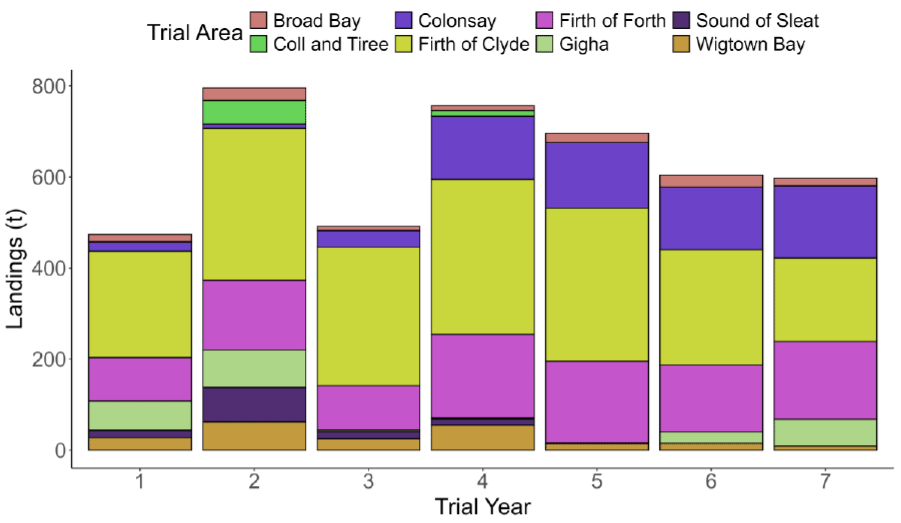
1. Total reported razor clam landings (tonnes) by trial area and trial year for trial years 1-7.
Communicating work on the trial was also a key task during 2024 and knowledge was shared through publishing the progress report Scottish scientific electrofishery for razor clams trial - biological and ecological goals: progress report - gov.scot, launching the dashboard RazorClamTrial and presenting work at the International Council for Exploration of the Seas (ICES) Annual Science Conference ASC 2024.
SEDD staff continued to support the PhD (in collaboration with SAMS) to assess the ecological sustainability of a well-controlled electro fishery for razor clams in Scottish coastal seas. One of the chapters focussed on utilising the data collected by trial participants for Length Based Indicators. The PhD was submitted in November 2025.
An update was also made to the previous survey report in March 2025 (to include further stations completed in the Solway) with further details available: Razor clam surveys - Firth of Clyde 2023 and Solway 2024-2025: report - gov.scot