
Electrofishing for Razor Clams Scientific Trial: 1 February 2024-31 January 2025
Electrofishing for Razor Clams Scientific Trial: 1 February 2024-31 January 2025 - Progress Report
6. Vessel Activity, Landings and Employment
2024 represented the start of the Razor Clam trial’s seventh year, which ran from 1 February 2024 to 31 January 2025. However, due to 2025 data being pre-statistical release which has yet to be fully quality assured, January 2025 data has been omitted from the analysis. Instead, analysis has been conducted on the 2024 calendar year (1/1/24 to 31/12/24), with January 2024 data being from the sixth year of the trial. This is in keeping with the approach taken to the trial updates published in February 2024 and April 2025, but is different from earlier trial update publications.
In 2024, 22 vessels had derogations allowing them to participate on the trial, up/down from 25 in 2023. However, during 2024, only 18[1] trial vessels were active, down from 22 in 2023. It is worth noting that not all vessels involved in the electrofishing for razor clam trial are Scottish-registered.
In 2024, active trial vessels landed 546 tonnes of razor clams, at a value of just under £4.5 million. This represents a 16% and 18% decrease in tonnage andvalue, respectively, compared to 2023’s annual figures of 647 tonnes and just under £5.5 million in landed value. The average tonnage caught per active vessel was 30t in 2024, slightly up from 29t per active vessel in 2023. The nominal average landed value per active vessel was around £250,000 in 2024 the same as in 2023. A fall in the number of active vessels as well as reduced landings, are primary causes of the reductions in tonnage and landed value seen in 2024 compared to previous years.
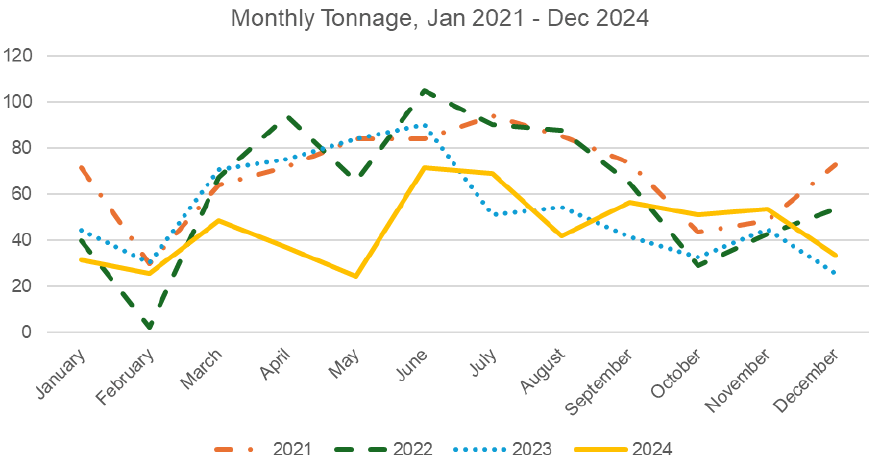
The previous three years of the trial indicate a pattern of higher landings in spring and summer, before falling in autumn; some years also saw higher landings in January and December. As evidenced in Figure 1, 2024’s tonnage figures were below previous years in spring, before following a similar trend to 2023’s, remaining below 2021 and 2022 tonnage figures in the summer months. October and November were the only months where 2024’s tonnage figures were above the levels of the previous three years. December saw a marked decrease in tonnage landed. This was similar to 2023, and in contrast to previous years where tonnages increased in December.
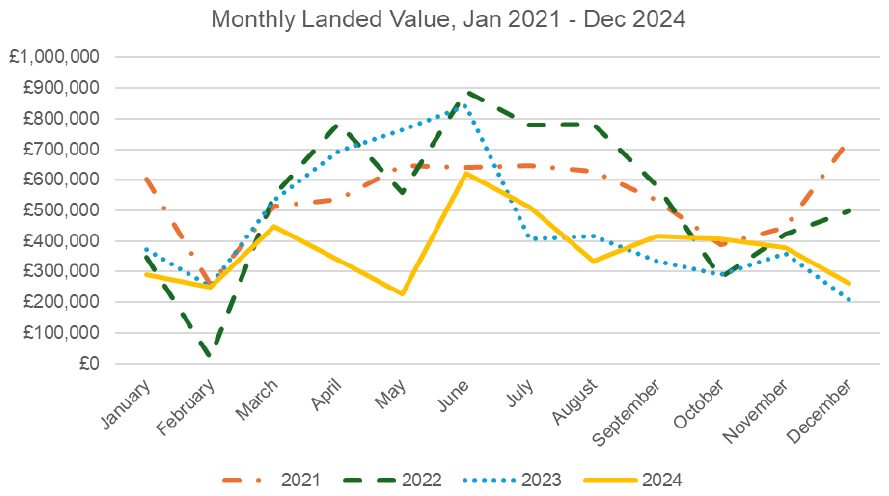
Figure 2 shows the monthly landed value figures since 2021, with 2024’s monthly landed value figures closely following the trend of monthly tonnages.
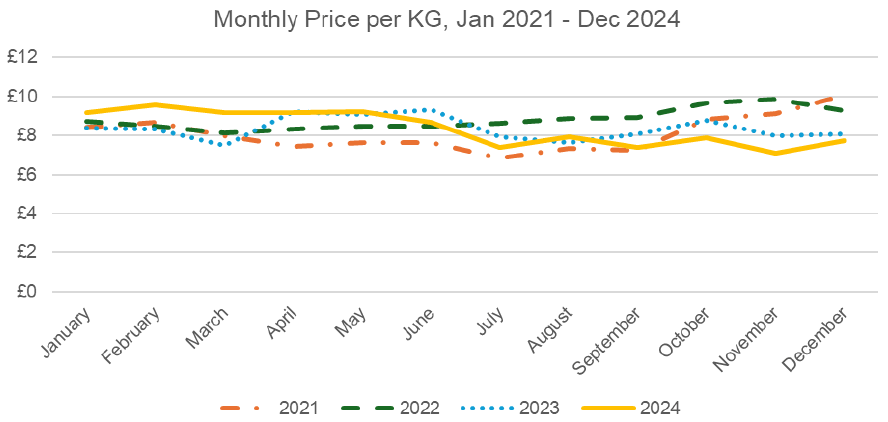
The average price per kilogram (£/Kg) for 2024 was £8.21 (Figure 3), down 3% from 2023’s £8.46. The price per kilogram remained fairly stable throughout the first half of the calendar year, at an average of £9.07, before falling to an average of £7.54 in the second half of the year. Similar to 2023, prices did not follow the trend of increasing towards the end of the year which was seen in previous years.
Throughout 2024, around 81 people were employed by vessels enrolled and active, at any point in the trial. Of which, the majority were regularly employed (regularly employed being those whose fishing was their primary occupation). This is down from 90 in 2023. Employment levels will differ at various times during the year due to vessels leaving the trial or being replaced by other vessels. The trial also supports further economic activity and employment for people in the wider supply chain supporting these vessels in Scotland, and in the transportation of the product to market.