
Digital Inclusion Action Plan
Scotland’s Digital Inclusion Delivery Plan sets out actions to tackle digital exclusion and ensure everyone who wants to can participate and thrive in an increasingly digital world.
Introduction
Digital Strategy for Scotland
The Digital Strategy for Scotland 2025 sets out the Scottish Government’s and Local Government’s joint vision.
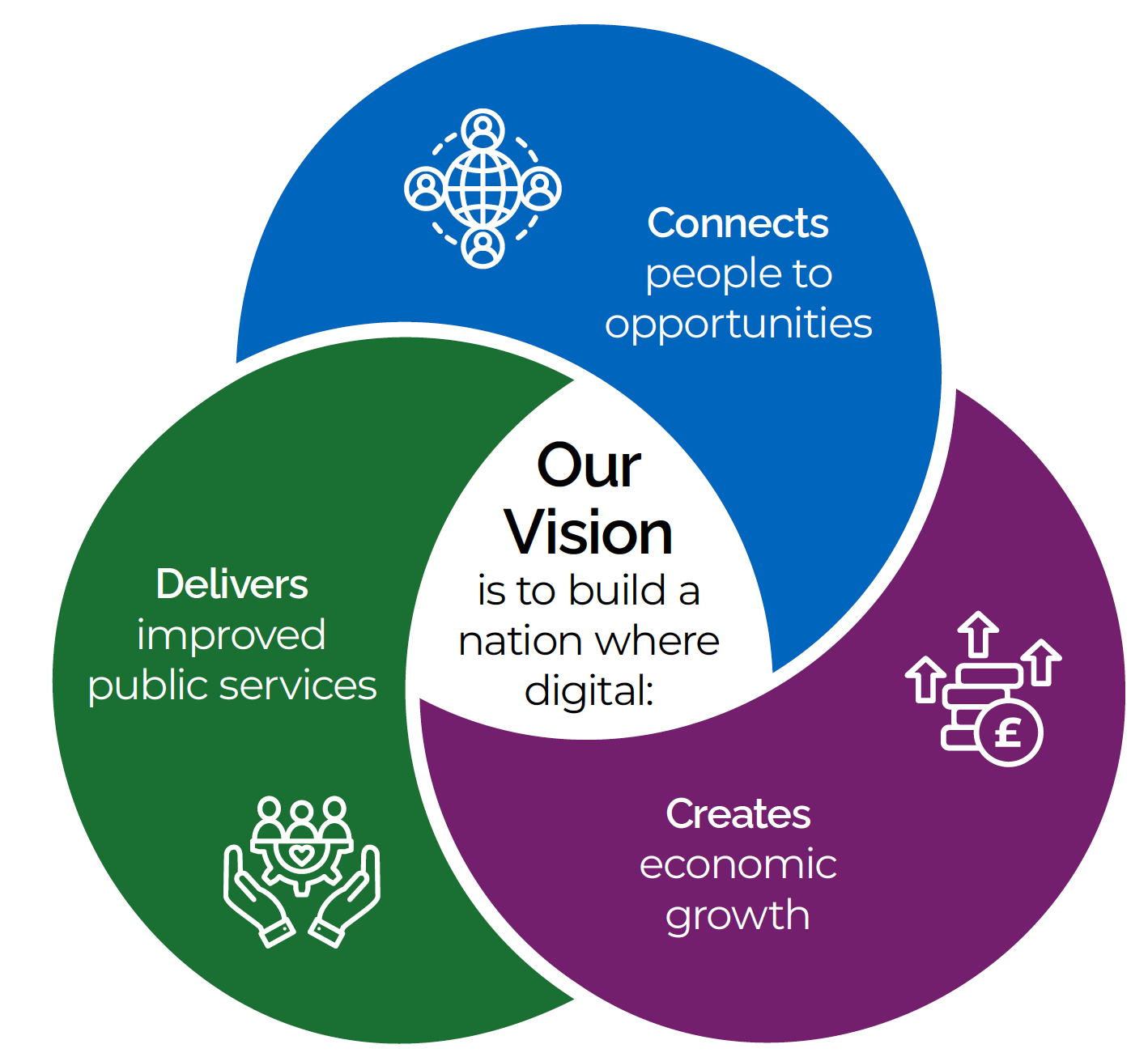
Graphic text below:
Our Vision is to build a nation where digital:
- Delivers improved public services
- Connects people to opportunities
- Creates economic growth
The vision is supported by subject-specific delivery plans which explain how we will deliver the vision. The vision can be read here Digital Strategy for Scotland – Our Vision.
Context
The Scottish Government’s Connecting Scotland programme has left a strong legacy and has contributed significantly to Scotland’s evidence base on digital inclusion. The programme demonstrated the positive impact that investment in devices, connectivity and support can have on people’s lives, while also highlighting that digital inclusion is about more than access to technology alone. Evaluations found that lasting outcomes are most likely to be achieved where access is complemented by trusted support, strong local partnerships and community-based delivery. Building on this learning, future action will focus on addressing the structural barriers that drive digital exclusion and creating the conditions for sustainable digital participation.
Across Scotland, third sector organisations, community groups, libraries, housing providers and local authorities continue to play an important role in tackling digital exclusion. Through trusted relationships and locally tailored approaches, these organisations support people facing some of the greatest barriers to digital participation, including those experiencing poverty, disability, social isolation and homelessness. Their experience and insight have helped shape Scotland’s understanding of what works in practice and continue to provide valuable learning for future action.
Alongside this practical experience, the Scottish Government commissioned research into a Scottish Minimum Digital Living Standard (MDLS). The MDLS seeks to define what people need in terms of devices, connectivity, skills and support to participate fully in modern society. It provides an important evidence-based framework for understanding digital inclusion as a necessity for social and economic participation, rather than simply access to technology.
As digital services become increasingly central to everyday life, the emerging findings from the MDLS will help inform future policy development and investment decisions. Together with the learning from Connecting Scotland and the experience of organisations working to tackle digital exclusion across Scotland, this provides a strong foundation for future action that addresses the systemic barriers to digital participation and supports a more digitally inclusive Scotland.
Delivery plan
This delivery plan sets out actions that will be taken by 2029 to support digital inclusion. The delivery plan explains why these actions are needed, when they will be delivered, and how progress will be measured. It will be overseen as appropriate by joint governance processes.
The plan will be regularly updated, so that it remains current. Case studies and successes will also be shared throughout the delivery span of this plan. We will publish an annual report to summarise our progress.
The development of this plan reflects the shared commitment of Scottish Government and Local Government to improving digital participation across Scotland. It has been shaped by the experience, insight and leadership of councils, supported by COSLA and the Local Government Digital Office, amongst others, and recognises the vital role local government plays in helping people and communities realise the benefits of digital technology in their everyday lives.
As leaders for communities, councils are at the forefront of supporting residents to access services, opportunities, information and support, while helping to address the barriers that can prevent full participation in an increasingly digital society. Building on this leadership, Scottish Government and Local Government will continue to work together to review progress, understand impact and identify opportunities for further action.
Through this continuing commitment to collaboration across the lifetime of this delivery plan, we will seek to remove barriers to digital participation and strengthen a citizen-focused approach to digital inclusion, helping ensure that people and communities can access the services, opportunities and support they need, participate fully in civic and community life and share in the benefits of Scotland’s digital future.
Digital Inclusion
Digital inclusion means ensuring that individuals and communities have equitable access to, and can benefit from digital technologies and online services. It goes beyond simply having a device and an internet connection and includes having access to suitable devices, affordable connectivity, the skills and confidence to use technology safely, securely and confidently, and digital services that are accessible and easy to use.
Digital exclusion is a complex and multidimensional challenge, often requiring multiple barriers to be addressed simultaneously. Evidence from a range of national research and policy bodies, including Audit Scotland, Ofcom, Lloyds Banking Group and Good Things Foundation, highlights that digital exclusion is both widespread and persistent, affecting a broad cross-section of society and not confined to any one age group.
Successful digital delivery and transformation of our public services is fundamental to achieving our ambitions on Public Service Reform. But without a co-ordinated effort to actively include those who we know face barriers to getting online, our digital transformation efforts will fail. Acting on digital inclusion is not just a matter of social equity, it is a practical necessity for Scottish Government and the wider public sector, supporting our ambition to design and deliver person-centred services that better meet people’s needs.
The delivery plan is also informed by the Audit Scotland report Tackling Digital Inclusion, which assessed how effectively Scotland’s public sector is addressing digital exclusion. Scotland’s digital inclusion landscape is challenged by fragmented investment, coordination and measurement, alongside a need to embed digital inclusion more consistently across policy and public services. At the same time, the nature of digital exclusion is becoming more complex, requiring systems and services to be designed inclusively around people’s diverse needs, circumstances and experiences.
Ambition for Digital Inclusion
We want to see a Scotland where:
everyone who wants to can participate and thrive in an increasingly digital world. Whether connecting with friends and family, accessing public services, managing daily life, or pursuing learning and employment opportunities, everyone should be able to benefit from digital technology if they choose. Our aim is to ensure no one is left behind and that every person has the opportunity, confidence, and support to make the most of the digital opportunities available to them.
How we will deliver this
We will achieve this by:
- expanding access to the internet in our communities, with a strong focus on reaching rural, remote, and under-served areas that face unique connectivity challenges
- supporting people who want to get online, and ensuring they can do so safely, securely, and with confidence
- designing inclusive public services by involving those who use them
Digital inclusion and connectivity
The Scottish Government is playing a pivotal role in driving improvements to digital connectivity across Scotland, particularly in rural and island communities. Through targeted investment and strategic partnerships, we are closing the digital divide and ensuring that every citizen, regardless of location, can access the benefits of a connected society. This is reflected in the 2026/27 Programme for Government which sets out that across this Parliament, we will invest in digital connectivity, making improvements to both broadband and mobile coverage.
Scotland’s Digital Inclusion Alliance
Since 2024, Scottish Government and COSLA have worked together to develop a stronger and more coordinated national approach to digital inclusion. The Scottish Government, with input from stakeholders, created a Digital Inclusion Alliance (DIA) through which partners can work collectively to address digital exclusion at scale.
The DIA acts as national infrastructure which supports partners to align around shared outcomes, coordinate activity, facilitate shared learning, strengthen measurement and maintain momentum across the system. The DIA’s role is to enable collective action rather than direct delivery, ensuring local and national efforts contribute to a common agenda for change.
What will we do
The following pages set out actions that Local Government, the DIA, and the Scottish Government will take between now and 2029.
Actions are organised around the following themes:
- System Leadership
- Evidence Gathering and Sharing
- Inclusive Public Service Transformation
Contact
Email: DIPH@gov.scot