
Biodiversity Programme Advisory Group - nature restoration target topic recommendations: final advice
The Biodiversity Programme Advisory Group (PAG) has provided expert recommendations to inform statutory nature restoration targets under Scotland’s proposed Natural Environment Bill, a key component of the strategic framework for biodiversity in Scotland.
8. Annex 2 – PAG target pre-workshop questionnaire results.
8.1 Results of the PAG Targets Pre-Workshop Questionnaire
Before the PAG Natural Environment Bill Targets workshop members of the PAG were asked to complete a questionnaire to streamline workshop planning. PAG members were asked to select a maximum of ten target topics in answering the two workshop questions:
3. What is the minimum selection of target topics that will demonstrate whether Government is delivering the ambition of halting biodiversity decline by 2030 and, restoring and regenerating biodiversity by 2045?
4. Accounting for the target topics selected in Question One, are there any other outcome or output target topics that are critical to driving the action needed?
There was also scope for PAG members to suggest additional target topics to be considered in the workshop.
The PAG Targets Pre-Workshop - Microsoft form questionnaire
This document briefly summarises the results of the workshop.
8.2 Question 1 Results
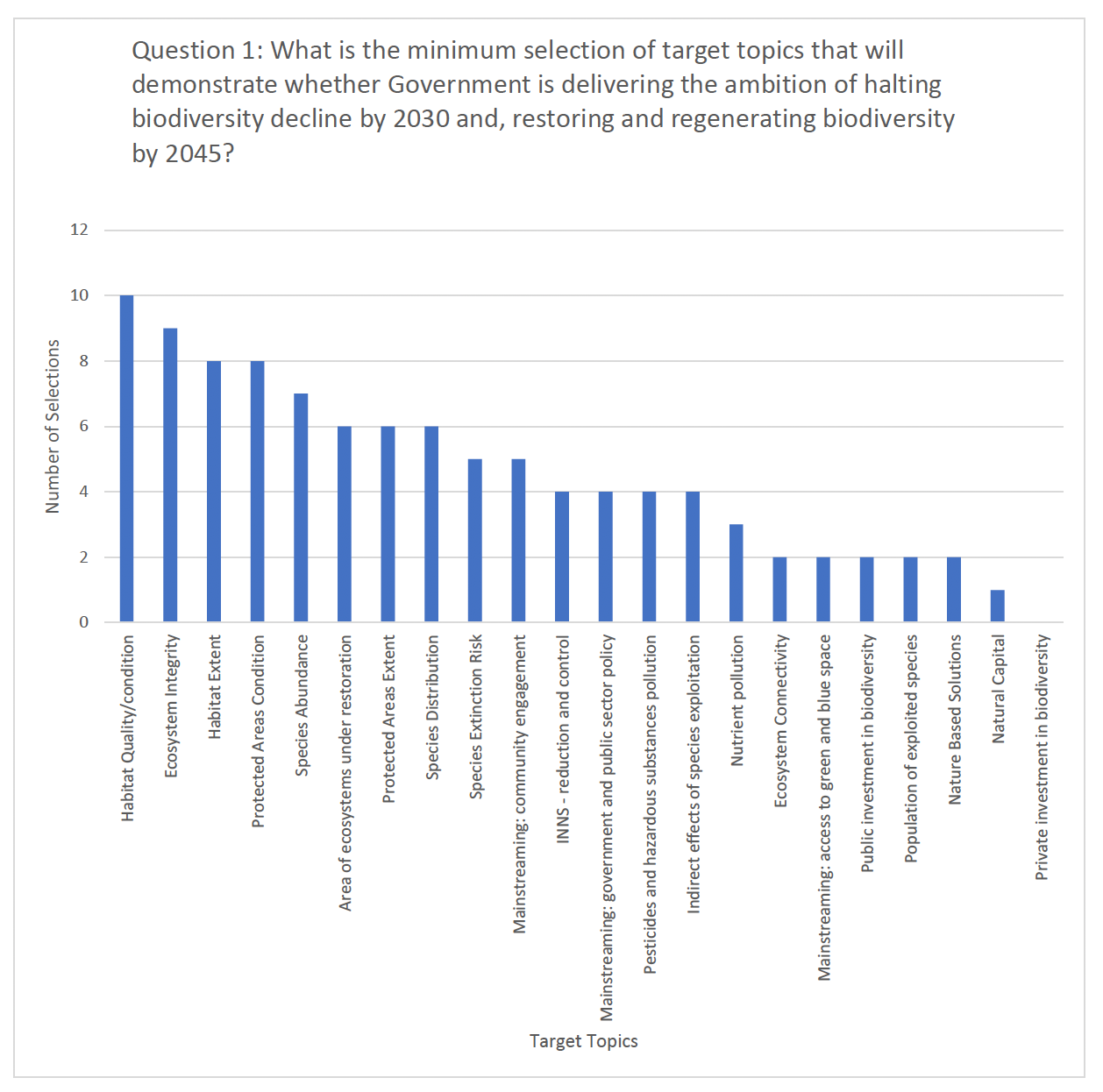
The breakdown of results can be found in the bar chart in Figure 1.
Target topics can be split into the following prioritisation groupings based on the questionnaire
8.2.1 Top prioritised target topics (selected by 75% of respondents):
1. Habitat quality/condition
2. Ecosystem integrity
3. Habitat extent
4. Protected areas condition
8.2.2 Mixed prioritised target topics (selected by 40%-75% of respondents):
5. Species abundance
6. Area of ecosystems under restoration
7. Protected areas extent
8. Species distribution
9. Species extinction risk
10. Mainstreaming: community engagement
8.2.3 Lower prioritised target topics (selected by less than 40% of respondents):
11. INNS - reduction and control
12. Mainstreaming: government and public sector policy
13. Pesticides and hazardous substances pollution
14. Indirect effects of species exploitation
15. Nutrient pollution
16. Ecosystem Connectivity
17. Mainstreaming: access to green and blue space
18. Public investment in biodiversity
19. Population of exploited species
20. Nature Based Solutions
21. Natural Capital
22. Private investment in biodiversity
8.2.4 Additional suggestions for target topics:
- “There is a need for a target dealing with mainstreaming of biodiversity particularly across Scottish Government and public bodies. The Biodiversity Duty is not, however, fit for this purpose”
- “total investment in biodiversity conservation ie (public + private). I don't see why we care about either element in isolation.”
- “Species Abundance - needs to add Trend - including level of oscillation - and needs to show link to use of Ecosystem functionality”
- “Species Distribution - it should be Species Distribution/Connectivity - as scale of distributions can be misleading - as metapopulation characteristics more important than simple distributions”
- “There has been a significant increase in the inclusion of genetic diversity in the global targets - GBF T4- and this is entire level of biodiversity is conspicuously absent here. Scotland is well placed to respond to this target in practical terms, and support the global implementation in conceptual terms. We could integrate genetic diversity into either species distribution/abundances Targets, or species extinction risk target.”
- “GBF 4 TARGET: "Ensure urgent management actions to halt human induced extinction of known threatened species and for the recovery and conservation of species, in particular threatened species, to significantly reduce extinction risk, as well as to maintain and restore the genetic diversity within and between populations"
- “The species abundance metric is not quite right - it is the indicator of species abundance, drawn from monitoring of 350+ species that is so important, so have not ticked that one.”
- “I'm not sure about the Nature based solutions target as phrased. Would be sharper as extent under nature bases solution activity”
- “Recognizing that the climate is changing, we need to think about target setting which does not simply attempt to recreate what we had in the past. The climate is different, at least 1.5 C higher, and so recreating the past is impossible, and undesirable if we need more resilient ecosystems”
- “The specific performance of each of the Scottish Government agencies (and associate organisations under Scottish Government control) and departments in respect of their actions, so more of a SMART target than just 'mainstreaming....'”
8.3 Question 2 Results
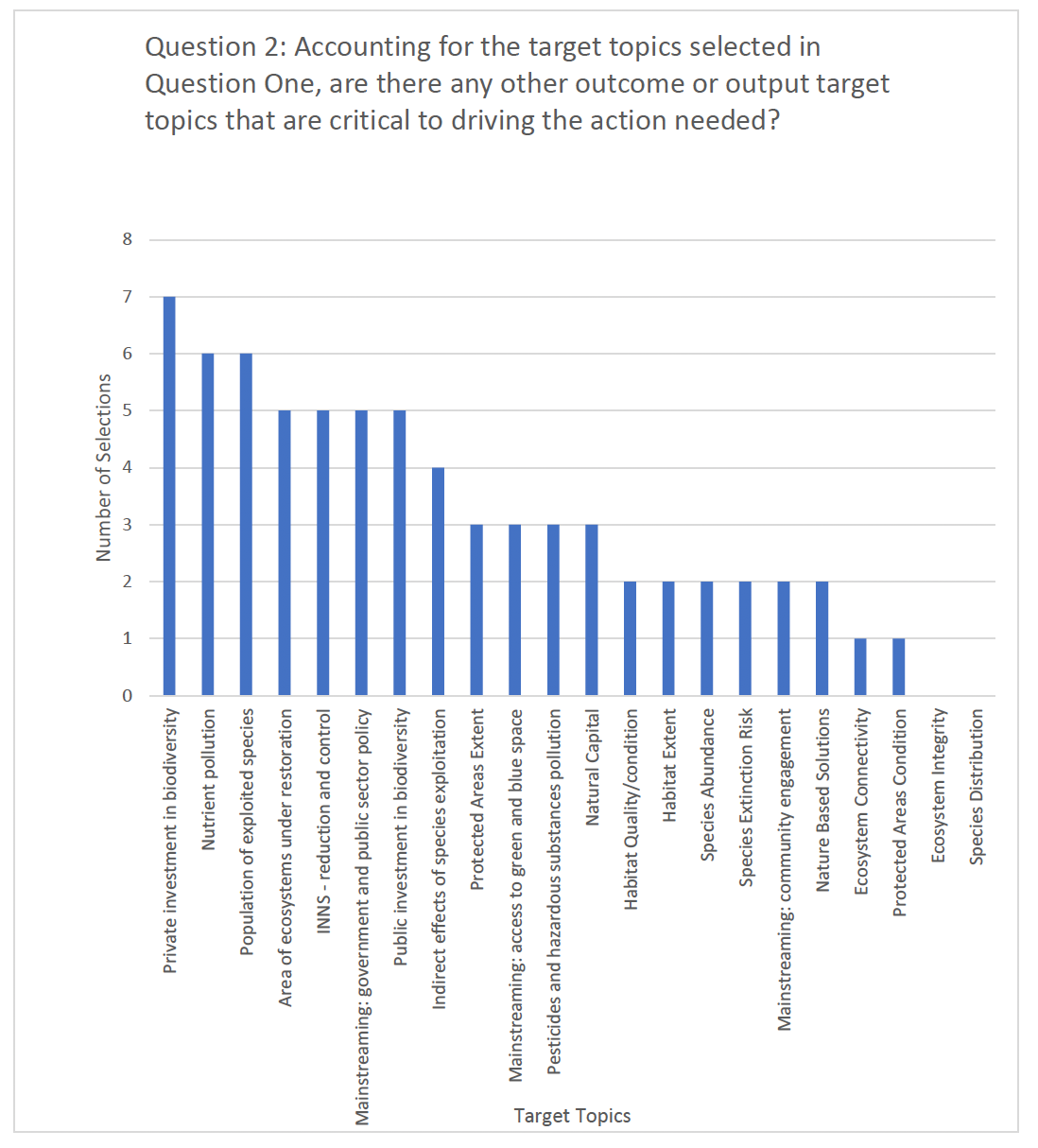
The breakdown of results can be found in the bar chart in Figure 2.
Target topics can be split into the following prioritisation groupings based on the questionnaire
8.3.1 Top selected target topics (selected by over 75% of respondents):
1. Private investment in biodiversity
2. Nutrient pollution
3. Population of exploited species
8.3.2 Mixed response target topics (selected by 40%-75% of respondents):
4. Area of ecosystems under restoration
5. INNS - reduction and control
6. Mainstreaming: government and public sector policy
7. Public investment in biodiversity
8. Indirect effects of species exploitation
8.3.3 Lower response target topics (selected by less than 40% of respondents):
9. Protected Areas Extent
10. Mainstreaming: access to green and blue space
11. Pesticides and hazardous substances pollution
12. Natural Capital
13. Habitat Quality/condition
14. Habitat Extent
15. Species Abundance
16. Species Extinction Risk
17. Mainstreaming: community engagement
18. Nature Based Solutions
19. Ecosystem Connectivity
20. Protected Areas Condition
21. Ecosystem Integrity
22. Species Distribution
8.3.4 Additional suggestions for target topics:
- “Better to focus on developing a small number of targets well than overstretching and doing a larger number poorly”
- “Identifying adaptions to climate change - which habitats /species will most likely make it through (which are just changing distribution - not INNS - so they are going to be here in the future - don't waste energy on eradicating ) and which are at edge of distribution and going to go with CC.”
- “Invesment in greenskills economy including capacity building and new technologies for biodiversity monitoring and delivery (essentially reflecting GBF T20 & T21).”
- “I feel that we need a category for 'land and sea use' that allow targets related to integration of biodiversity outcomes the major land and sea use sectors - agriculture, forestry, game/deer management, fisheries and energy production”
- “Three of the above (and INNS, which I ticked earlier given impact) are IPBES drivers, so as topic areas it could be easier to establish targets around reducing levels of driver X by Y% against an agreed milestone.”
- “Something around active engagement in restoring biodiversity by the public (in all its various guises), including citizen science and both formal and informal education.”
Contact
Email: biodiversity@gov.scot