
Atlanto Scandian Herring: Fisheries Management Plan
The Atlanto Scandian herring (ASH) Fisheries Management Plan (FMP) is one of 43 FMPs set out in the Joint Fisheries Statement (JFS).This FMP sets out the policies and actions to manage the Atlanto-Scandian herring (ASH) stocks at sustainable levels.
Background
Stock
ASH is the largest herring stock in the world and is of significant commercial importance to the vessels that target it.
ASH is the generic term used for several stocks of herring found in waters north of 62ºN, the largest of which is the NSS herring.
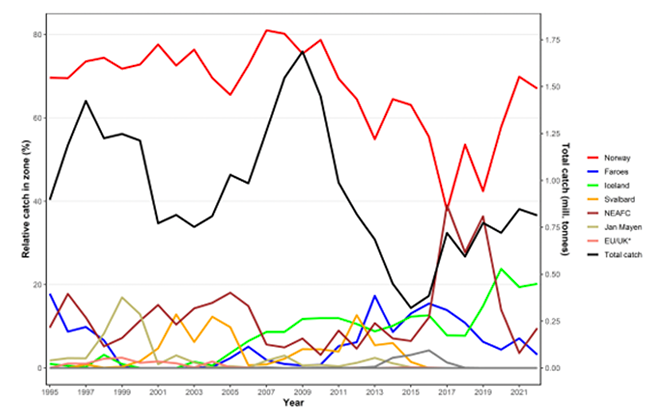
NSS herring, spawn during February and March along the northern Norwegian coast, before feeding across the Norwegian sea during summer months. The majority of UK landings are during this period, targeting spawning stock, although other nations target the stock during both this period and also at the end of the calendar year. The southernmost extent of this feeding distribution lies in the UK waters of the northern North Sea, but the majority of the fishery takes place outside of UK waters. The feeding migration takes place just after spawning, with the larger fish travelling further, leading to a size gradation in distribution during the feeding months. Herring will spend the winter in overwintering areas, although the location of these has varied over the years.
The stock is typically sustained through sporadic large recruitment events producing strong year classes (e.g. 1993, 2004, 2006, 2016 Since then, SSB has declined due to absence of strong year classes between 2005 and 2015. The 2016 year-class was, however, estimated to be well above average in the 2023 assessment and resulted in an increase in SSB from 2020 to 2021. After that, the SSB declined over the period 2022 and 2023 and is predicted to be below Bmgt in 2026 but above Bmgt in 2027. At the time of writing fishing pressure on the stock is below FMSY. Spawning-stock size is below MSY Btrigger and between BPA and Blim.
Location
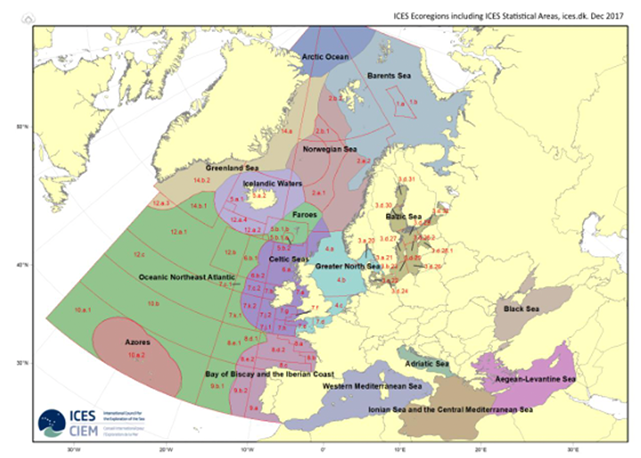
This stock is found in International Council for the Exploration of the Sea (ICES) subareas 1, 2, and 5, and in divisions 4.a and 14.a (Northeast Atlantic and Arctic Ocean). For management purposes, the fishing area for this stock for UK vessels is set as ICES subareas 1 and 2. As noted below, given the management arrangements that are in place, the content of this FMP only applies to UK waters (division 2a and 4a).
Fishery
ASH are caught almost exclusively by the pelagic-targeting fleet, which accounted for over 99% of the total ASH catch in UK waters between 2018 and 2024. Whilst the stock is present in UK waters of 2a, in recent years UK vessels have primarily caught ASH in Norwegian waters, under bilateral access arrangements[6]. Analysis was undertaken of the UK fishing fleet catching ASH in all of ICES area 2a, as this is the data that we have available.
In 2024, Scottish registered vessels were responsible for 100% of the UK fleet landings. The tonnage of these landings varies significantly year on year, with no landings seen in 2021 (as no bilateral agreement was in place between the UK and Norway for reciprocal access), and 9,620 landings in 2022.
Analysis of UK fisheries data shows that almost all ASH landings by UK vessels are caught using trawls, which accounted for over 99% of the catch between 2018 and 2024.
Table 1 shows the value and weight of landings of ASH between 2018 and 2024[7]. Landings peaked in 2021 at 9,620 tonnes, while the value peaked in 2024 at £20,280 million
| Landings | 2018 | 2019 | 2020 | 2021 | 2022 | 2023 | 2024 |
|---|---|---|---|---|---|---|---|
| Landed Value (£ thousand) | 1,040 | 610 | 1,070 | 0 | 4,540 | 5,550 | 20,280 |
| Tonnage | 2,582 | 1,801 | 1,981 | 0 | 9,620 | 7,607 | 5,843 |
| Price per tonne (£) | 403 | 339 | 540 | 0 | 472 | 730 | 3,471 |
Between 2015 and 2024, the primary landing locations for the UK fleet catching ASH were outside of the UK. Norway was the most popular landing destination for ASH, seeing 89% of the total catch, whilst Denmark saw 10%. Less than 1% was landed outside of these two countries. It appears that no significant amount of ASH is landed into the UK, suggesting that the species is not of significant importance for any ports within the UK.
The only Seafish fleet group[8] who caught ASH between 2015 and 2024 was the over 40m pelagic segment. The ASH stock represented only 1% of this fleet segment’s total landed value, and 1% of their tonnage. As such, the stock of ASH is of less commercial importance than other pelagic stocks to this fleet segment, but has nevertheless of economic significance in the UK.
Pelagic fisheries are, in the main, classed as a relatively ‘clean’ fishery, meaning that issues with discarding and bycatch are deemed to be minimal. However, given the capability of pelagic trawl vessels to take large tonnage hauls, the impact of any discarding, misreporting or slipping of catch, should it take place, would be considered high. The introduction of Remote Electronic Monitoring (REM) in Scottish waters, where the majority of pelagic fishing takes place in the UK, provides an enhanced level of confidence and ensure that effective tools are in place to deter and detect any illegal activity. Defra is also working towards introducing REM in this fishery.
Contact
Email: fmps@gov.scot