
Abattoir provision and opportunities for mobile slaughterhouses in Scotland by the Scottish Animal Welfare Commission
Report on abattoir provision and opportunities for mobile slaughterhouses in Scotland produced by the Scottish Animal Welfare Commission
2. Background
This section considers the current provision for the slaughter of terrestrial animals in Scotland and the impetus for a local/mobile abattoir network. The key animal welfare factors associated with access to abattoirs, such as effects of transport distance/duration are discussed and the relevant legislation summarised.
In 2020 the Scottish Government published a report entitled ‘Assessing the Viability and Sustainability of Mobile Abattoirs in Scotland [1]’. The report highlighted that although there are no perceived issues with the overall slaughtering capacity in Scotland, recent closures of abattoirs in rural areas have resulted in animals having to travel further to be slaughtered. The report concluded that there is a demand for a local abattoir service, however a significant amount of private investment would be required. Since 2020 a further four red-meat abattoirs have closed including Scotland’s second largest pig processor at Ardrossan. In June 2025 Scotbeef announced the closure of their abattoir in Inverurie.
The closure of small and medium-sized abattoirs is a UK wide issue [2], however specific characteristics of the Scottish livestock industry can make access to abattoir services particularly challenging. These include:
- The particular nature of the geographical area compared to the other parts of the UK.
- Restricted transport infrastructure in remote rural areas such as the Highlands and Islands, often leading to long journeys on minor roads and reliance on ferry crossing when abattoirs are not operational or do not exist on Scottish islands.
- High numbers of small scale producers and crofting systems of which over 16,000 rear livestock [3]. Many require private kill services, or do not produce batch sizes viable for larger, direct to retail abattoirs, thereby restricting the number of abattoirs they can supply.
The Good Food Nation plan published in 2024 [4] outlined the Scottish Government’s aim to increase the consumption, production, and provision of local food as well as the ambition to improve animal welfare standards. SAWC believes that access to local abattoirs has a key role to play in meeting these objectives.
2.1 Livestock Slaughter Provision in Scotland
As of January 2025, there were 22 licensed red meat abattoirs and 2 licensed poultry abattoirs operating in Scotland (Table 1), with six abattoirs located on the islands (Figure 1). The map shown in Figure 1 also highlights what has previously been reported by the Scottish Government, that there are many areas of mainland Scotland including parts of Caithness, Sutherland, Ross & Cromarty, Argyll and Bute where access to an abattoir necessitates journeys of over 100 miles. For livestock on the majority of islands, including Orkney, transport to slaughter requires a sea leg.
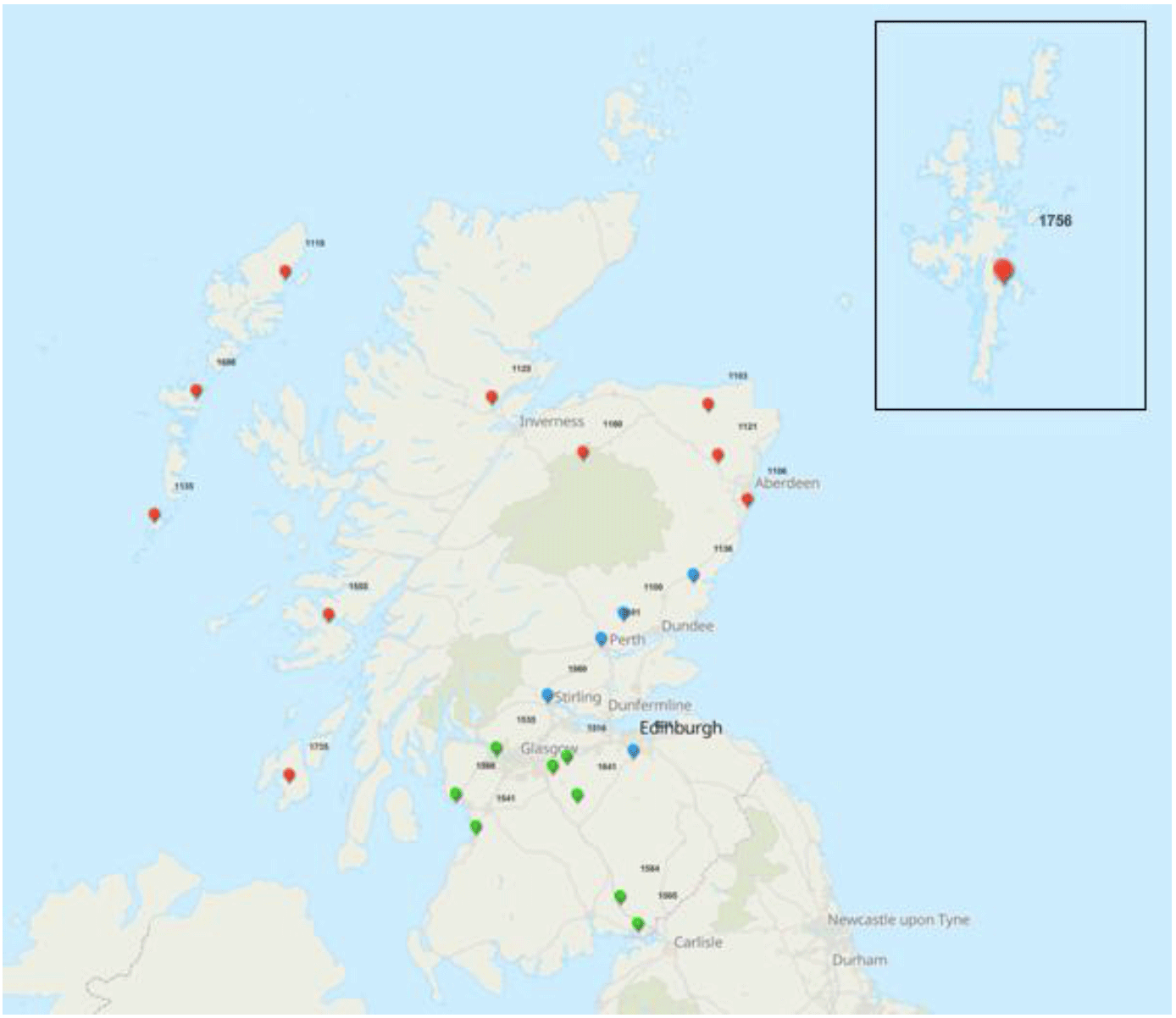
Figure 1 is a map showing locations of abattoirs in Scotland. The pins represent the locations of the abattoirs, with colour coding to represent the region they are based in, i.e red = Northern local authorities, blue = Eastern local authorities, green = Western local authorities. N.B Scotbeef Inverurie was still included on the map at the time of publication, however, is no longer operational. Source: FSS - https://fsscot.maps.arcgis.com/apps/dashboards/acf7fe8f246e47ddb929b3de3e1ff8fd
| Name | Location | Livestock Slaughtered - Cattle | Livestock Slaughtered - Sheep | Livestock Slaughtered - Pigs | Livestock Slaughtered - Poultry | Private Kill | Size* |
|---|---|---|---|---|---|---|---|
| Aberdeen | Kepak McIntosh Donald | Y | Y | N | N | N | L |
| Paisley | John Scott (Meat) Ltd | Y | Y | N | N | Y | M |
| Perth | ABP Scotland | Y | N | N | N | N | L |
| Inverurie# | Scotbeef Inverurie Ltd | Y | Y | Y | N | N | L |
| Grantown-on Spey | Millers of Speyside | Y | Y | Y | N | Y | M |
| Wishaw | Wishaw Abattoir Ltd | Y | Y | Y | N | Y | M |
| Bridge of Allan | ABP (Bridge of Allan) | Y | Y | N | N | N | L |
| Brechin | Quality Pork Scotland (Brechin) | N | N | Y | N | N | L |
| Turriff | Woodhead Bros | Y | Y | Y | N | N | L |
| Lockerbie | Border Meats | Y | Y | Y | N | Y | S |
| Saltcoats | Dunbia Highland Meats (Dawn Meats) | Y | N | N | N | N | L |
| Ayr | AK Stoddart Ltd | Y | Y | Y | N | N | L |
| Dingwall | John M Munro | Y | Y | Y | N | Y | M |
| Shotts | James Chapman | Y | Y | Y | N | Y | M |
| Thankerton | Richard Carmichael | N | Y | N | N | N | S |
| Annan | Vivers Scotlamb | N | Y | N | N | N | L |
| North Uist | Lochmaddy abattoir | Y | Y | Y | N | Y | S |
| Mull | Mull abattoir | Y | Y | Y | N | Y | S |
| Barra | Barra abattoir | Y | Y | Y | N | Y | S |
| Lewis | Western Isles Council | Y | Y | Y | N | Y | S |
| Islay | Avonvogie abattoir | Y | Y | Y | N | Y | S |
| Shetland | Shetland abattoir | Y | Y | Y | N | Y | S |
| Coupar Angus | 2 Sisters | N | N | N | Y | N | L |
| Penicuik | SAC | N | N | N | Y | N | S |
*S - Small Abattoir <5,000 livestock units (LSU) average annual throughput
M - Medium abattoir 5,000 <30,000 LSU average annual throughput
L - Large abattoir ≥30,000 LSU average annual throughput
As of 2022-2023 throughput. Livestock unit as per EC 1099/2009 Adult bovine = 1 Pig over 100kg = 0.2 Other pigs = 0.15 sheep/goat = 0.1
# Scotbeef Inverurie closed during the production of this report.
There is significant discrepancy between large and small abattoirs, both in the number and type of animals slaughtered and the services offered. These differences include:-
- Private kill services (where the animals are killed for individual producers and the carcass returned to them) tend to be offered only by smaller abattoirs (Table 1) which can limit the availability of the service.
- Some large ‘direct to retailer’ abattoirs (abattoirs that supply meat directly to retailers such as supermarkets) restrict the animals they will accept; for example, accepting only animals from retailer assured farms or refusing to process small batches of animals.
- Not all abattoirs are equipped to deal with certain breeds or types of animals such as horned cattle or large boars/sows. Cull sows can be particularly vulnerable during transportation due to increased susceptibility to heat stress.[5]
- There is currently no abattoir in Scotland that will accept end-of-lay hens which necessitates them being transported on long journeys into England. This presents particular welfare risks due to their less robust condition. [6]
Such restrictions can further limit access to abattoirs in Scotland, in particular for small holders and crofters.
2.2 Welfare of livestock during transport
The welfare of animals during transportation has been reasonably well studied. For example, an extensive review was undertaken in 2018 as part of a DEFRA funded project [7]. The report highlighted that during transport animals can be subjected to a variety of different stressors, such as thermal loads, motion, vibration, acceleration, impact, fasting and the withdrawal of food and water, behavioural restrictions, social disruption and mixing with unfamiliar animals, noise and air contaminants. Further, the Farm Animal Welfare Committee (FAWC, now the Animal Welfare Committee (AWC)) drew on the evidence in this report in drawing up its opinion on the Welfare of Animals during Transport [8], leading the Committee to recommend a reduction in the legal maximum journey times, inspections of all vehicles transporting livestock, increased headroom heights, minimum and maximum permitted temperatures for transportation, policy reforms in respect of sea journeys and increased space allowance for all species. The Scottish Government (SG) undertook a public consultation in 2020/2021 seeking views on FAWC’s recommendations, the responses to which led the Scottish Government to conclude that there was ‘no clear majority’ either in favour or opposed to the recommendations [9].
More recently, in 2022 the European Food Safety Authority (EFSA) produced scientific opinions on the welfare at transport of cattle [10], small ruminants [11], pigs [12] and poultry [13]. Based on evidence of stress and negative affective states impacting the welfare of animals throughout the transportation process, each of these reports recommended that journey duration and frequency, should be kept to a minimum.
That said ,whether welfare issues arise during transport is not only dependent on journey duration; indeed, journey duration is rarely the root cause of poor welfare during transport [14]. Four aspects of animal transport have been identified as having a progressively greater detrimental impact on animal welfare as journey time increases. They relate to: the physiological and clinical state of the animal; feeding and watering; rest; and the thermal environment [14].
Assessing animal welfare during transport
Animal welfare during transport can be assessed using a range of different measures, including, but not limited to: physiological measures (e.g. heart rate, breathing rate and hormone levels), behavioural measures (e.g. vocalisation, fighting, and refusing to move) and carcass and mortality measures (e.g. carcass bruising, broken limbs and dead on arrival (i.e. died during transport)) [15]. Commercial transport conditions can make assessing animal welfare during transport very challenging. Oftentimes mortality records are the only source of information available about welfare conditions during the journey [15]. However, it should be noted that considerable suffering may occur without mortality.
Welfare of adult cattle during transport
Although there is some evidence that, in respect to adult beef cattle transport journey duration of up to 15 hours has a limited negative impact on welfare [16], increased journey length, especially during times of thermal stress, has been associated with increased mortality rates [17]. A study in dairy cattle reported mortality rates of 0.013% for journeys under 50km, which rose to 0.183% for journeys longer than 300km [18]. Mitchell et al (2018) summarised that there was little evidence that journey duration per se, has a detrimental effect on cattle welfare, however this interacts with journey distance, prevailing road conditions and season [7].
Welfare of sheep during transport
As a result of long periods standing rather than lying down, increasing journey durations may be associated with increased physiological stress in sheep [19] and subsequent weight loss (if feed and water are withheld) [20]. There have been some reports that shorter journeys induce higher stress than longer journeys (40 mins vs. 4.8 hours in this study) due to the impact of loading, initial transport novelty and time taken for adaption [21]. The opposite results were found when comparing lambs transported for 1 hour versus 24 hours, where increased stress indicators were found in the animals that experienced the longer transport duration [22]. Similarly, a Brazilian study also found that increased journey times to slaughter negatively impacted the welfare of lambs [23] and a study in China found that under cold conditions, journeys of 2 hours were associated with greater stress than journeys of 1 hour [24].
Welfare of adult pigs during transport
Compared to ruminant species, pigs are more vulnerable to mortality and transport stress [25]. A study in Czechia assessed transport to slaughter records of 33,912,125 pigs and found that there was a higher mortality (0.335%) during journeys over 300km compared with those under 50km (0.062%), but thermal conditions also had a significant impact on mortality [26]. Comparable studies conducted with over 7 million pigs in Germany [27] and over 3 million pigs in Italy [28] reached similar conclusions. Perez et al [29] assessed physiological measures of stress including blood glucose and cortisol and concluded that journeys of 15 minutes elicited a more intense stress response than journeys of 3 hours. The authors suggested that the longer transport time might allow the animals to adapt to transport conditions [29]. There is evidence, however, that an animal's ability to adapt to transport is not linear, as it has been shown from blood samples that an increase in transport time from 4 to 8 hours had a greater negative impact on pig welfare than an increase from 8 to 12 hours [30].
Welfare of broilers during transport
There is a body of evidence showing that an increase in duration and distance of transport can be a significant factor in the mortality rate of broiler chickens [31-38]. There have also been reports that increased journey times are associated with an increase in meat quality defects such as pale, soft, exudative (PSE) meat [39], weight loss due to transport stress [40] and blood biomarkers of stress [41]. In summary, published evidence suggests that journeys of over 4 hours impose an increased risk to broiler welfare, survival and product quality [7].
Welfare of laying hens during transport
Mortality of end-of-lay hens is also impacted by journey distance/duration [6,33,37,42] however compared to broilers and other livestock species, there are comparatively few studies published on the welfare of laying hens during transport.
Welfare impacts of road type and conditions
Animal welfare can be impacted by road condition and classification (for example rural single lane roads/unpaved roads/motorways etc.). Vehicle vibration is a known stressor in livestock species and can be impacted by vehicle design, driver skill and road conditions such as surface type. For example, gravel roads and the presence of potholes can increase vibration on transport vehicles and thus negatively impact welfare[43,44]. Road classification can also impact the welfare of livestock during transport; animals will experience increased lateral acceleration on more rural roads with a high number of bends compared to a straight motorway. Lateral acceleration can lead to motion sickness in pigs [44] and loss of balance in cattle [45]. Due to the available road network in particular areas of rural Scotland (such as the Highlands and Islands) livestock being transported to slaughter may have an increased exposure to road related stressors compared to those in the central belt where there is ready access to motorways and A roads.
Welfare of animals being transported by sea
There is limited literature on the impact of ferry transportation on the welfare of livestock. Much of the current work is centred on long-distance export journeys for example Ireland to Spain rather than the shorter journeys experienced by Scottish livestock when being transported to/from/between the Northern and Western islands. In an attempt to address this gap, the Scottish Government recently published a report from the SRUC entitled ‘Welfare outcomes for livestock transported on the Northern Isle ferry routes’ [46].
When animals are moved by ferry from Orkney or Shetland to mainland Scotland, they are transported in a unique livestock ‘cassette’ system (Figure 2). These cassettes are of a two-tier module structure, separate from the land transport vehicle. Animals are unloaded from the transport vehicle into the cassettes which are then loaded onto the ferry. Food (hay) and water are provided and there is a slurry removal system incorporated. As part of the SRUC report, three journeys focusing on store cattle from Orkney and three journeys focusing on store lambs (animals not yet at desired weight bought to be finished for slaughter) from Shetland were accompanied by a researcher and the animals’ behaviour and welfare assessed. The average duration from entering the cassette to the vessel docking in Aberdeen was 14h 54 mins for cattle and 19h 40mins for sheep. The duration from docking to unloading the cassette varied from 10mins to 2h 30 mins. The report concluded that the systems work very efficiently, it was difficult to see how it could be made quicker, and it is unlikely that animal welfare is detrimentally affected in the long-term. However, there were some indicators that during the journey the animals did experience stress, for example cattle were not observed to lie down, rapid breathing was observed, and there was also a lack of rumination. Some animals (sheep in particular) consumed all the hay in the first few hours of the journey, or even before the journey began, resulting in periods without food. Journey roughness also increased the number of animals that stood during transport. The report recommended that the amount of hay should be increased, access to water at port should be improved, temperature inside the cassettes required on-going monitoring and an effort is required to reduce the heat load in cattle cassettes on warm days.
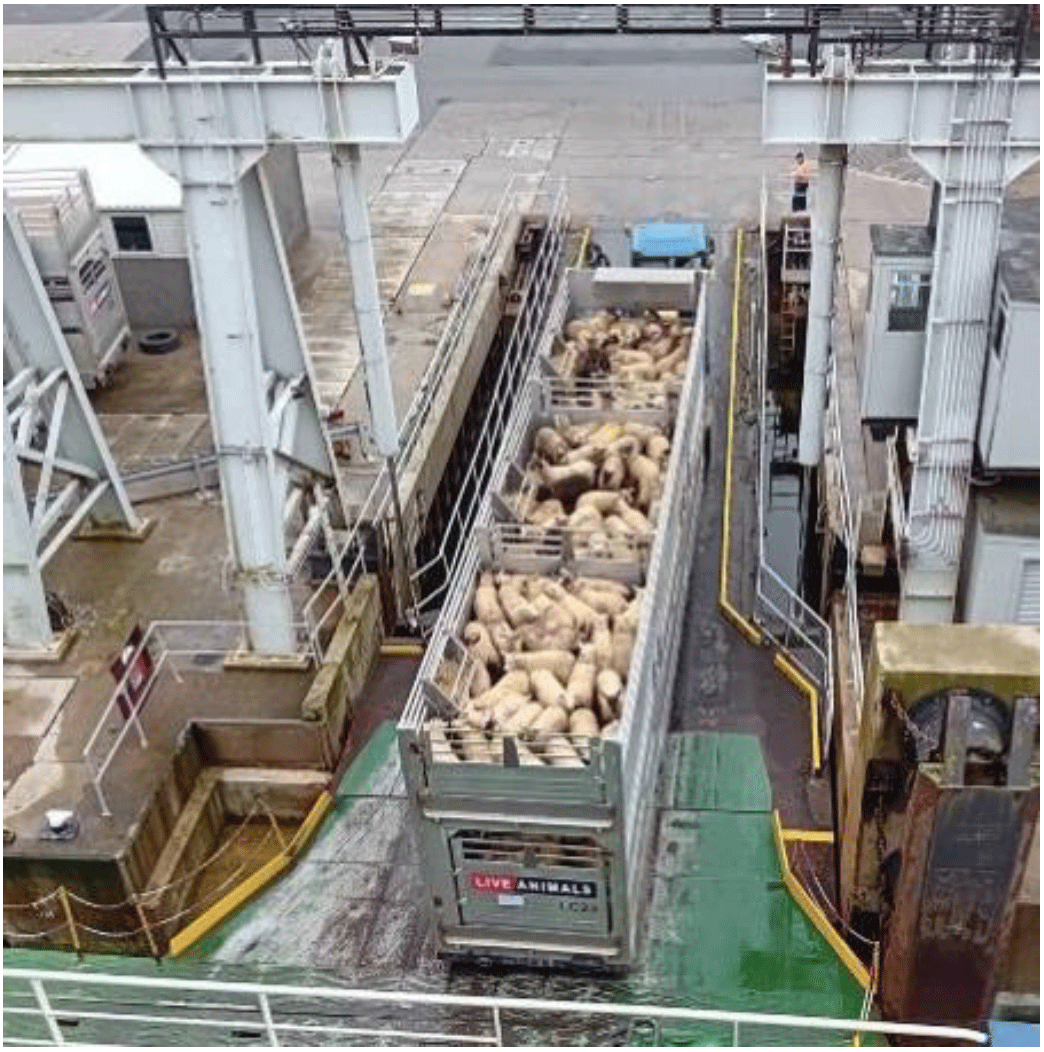
When transporting livestock from the Western Islands, the animals tend to remain on their transport vehicle during the sea voyage (roll-on-roll-off (RO-RO) ferries). At the time of writing this report there was no published literature around the welfare of livestock during such journeys, however in their scientific opinions EFSA [10-12] have noted five major concerns specific to RO-RO ferries. These are:
1. Exceeding maximum journey time, due to delays with ferry boarding and disembarking.
2. Weather disruptions, causing postponement or cancellation, resulting in animals having to wait at the port.
3. Inadequate ventilation, heat or cold stress.
4. Difficulties in being able to attend to animals in case of emergencies, as it is not possible to unload animals if emergency care is required.
5. Motion stress, especially if vehicles are not properly secured against movement.
2.3 Legislation
In this section, the regulations that apply to the welfare of animals during transport and slaughter are reviewed.
The Welfare of Animals (Transport) (Scotland) Regulations 2006 (SSI 2006/606) implement Council Regulation (EC) No 1/2005, which applies to the transport of live vertebrate animals within the European Community, covering the transport of mammals, birds, reptiles, amphibians and fish. The Regulation became part of assimilated EU law following the withdrawal of the UK from the European Union and therefore remains in force in Scotland.
General requirements of the regulation include ensuring transport arrangements be made in advance to minimise the length of the journey and meet the animals’ needs. Specific requirements include maximum journey length and resting periods, fitness to transport, feed and water provisions, personnel training and vehicle specifications.
In response to the FAWC Opinion on the Welfare of Animals during Transport, [8] DEFRA produced proposals intended to improve animal welfare during transport. These included new maximum journey times (FAWC opinion on the Welfare of Animals during transport, pp. 40), an increase in the minimum post-journey rest period, space and headroom requirements, restrictions on sea transportations in adverse weather conditions and limitations on transport when external temperatures are outside of a range of 5-30oC for mammals and 5-25oC for poultry. The SG ran a public consultation around the FAWC recommendations on animal welfare during transport in 2020/2021 which returned a mixed response. These responses were summarised by the SG as having ‘no clear majority’ either in favour or opposed to the recommendations [9]. The National Farmers Union (NFU) and NFU Scotland have been critical of the proposals included in both the DEFRA and SG consultations, with concerns over the impact the changes would have on the livestock and poultry sector [47,48]. The DEFRA proposal for 5oC minimum ambient temperatures permitted for transport would be significantly restrictive to producers needing to transport their animals in the winter months.
More recently in December 2023, the European Commission published proposals for reform of EU animal welfare rules during transport. Changes included a reduction in the maximum journey time to slaughter to 9 hours, restrictions to transport in extreme hot or cold temperatures and revision of rules on space allowance. SAWC plans to review the animal welfare implications should changes to the transport legislation come into effect in Scotland.
The Welfare of Animals at the Time of Killing (Scotland) Regulations 2012 (SSI 2012/321) make provision in Scotland for the implementation of assimilated Council Regulation (EC) No 1099/2009, which introduces welfare rules for the killing or slaughter of animals kept for the production of food and products such as fur and leather.
Mandatory Use of Closed-Circuit Television in Slaughterhouses (Scotland) Regulations 2020 (SSI 2020/384) outlines the requirement for CCTV in all areas of an abattoir where live animals are present.
2.4 Published reports on abattoir provision in Scotland and the rest of the UK
Indicative of growing concern, the issue of abattoir provision generally and the closure of small/medium abattoirs in particular has been the focus of a number of recently published reports.
These include the SG report ‘Assessing the Viability and Sustainability of Mobile Abattoirs in Scotland [1]’ which evidences how recent closures of abattoirs in rural areas have resulted in animals having to travel further to be slaughtered. The report concluded that there is a demand for a local abattoir service, but a significant amount of private investment would be required to deliver this.
In 2024 the Scottish Agricultural Organisation Society (SAOS) published the ‘Scottish Small Producer Access to Abattoirs’ report [49], which included results of a survey of producers utilising private kill services (where the animals are killed for individual producers and the carcass returned) and the abattoirs that provide these services. The key findings of this report include the uneconomic nature of opening small micro-abattoirs and that the priority should be preventing the closure of the existing network of abattoirs (especially those offering private kill) in Scotland. As a result of the report, SAOS published six key recommendations:
1. understand the cost to abattoirs of servicing private kill;
2. trial dedicated private kill coordination;
3. support a supply chain development coordinator;
4. signpost to sources of capital funding;
5. consideration of provision of rates relief to abattoirs; and
6. encourage a culture of innovation and knowledge transfer throughout the supply chain.
The Sustainable Food Trust in collaboration with National Craft Butchers also carried out a survey of abattoir users across the UK both in 2022[50] and 2025[51]. Its results highlighted that the average journey distance and time to slaughter in Scotland (61-70 miles/ 90mins) was considerably longer than the UK average (31-40 miles / 50 mins). The report went onto state: ‘abattoir provision in Scotland is spread much more thinly and that journeys can be more challenging, often requiring travel along single track and winding roads or the use of ferries in the case of those respondents based on islands’[50]. The survey results listed animal welfare as the main benefit of local and small abattoirs and 88% of respondents said their closest abattoir is either essential or important to the success of their business. The 2025 report stated that ‘Respondents consistently raised concerns about the animal welfare implications of long-distance transport (typically beyond 30-40 miles) and the need to send animals to market unnecessarily. Many felt this undermines their high on-farm welfare standards - a consequence of limited access to local slaughter facilities.’
In 2020 the All Party Parliamentary Group for Animal Welfare (APGAW) released a report titled ‘The future for small abattoirs in the UK: Report on an inquiry into small red meat abattoir provision’.[2] The report concluded that, with regard to animal welfare, ‘small, well geographically distributed abattoirs provide the opportunity for transport to slaughter to be shortened and this meets the Government’s objective that opportunities should be sought for a short, single journey. They may also help to reduce illegal slaughter, facilitate emergency slaughter, provide slaughter for wider species and benefit the welfare of animals born and reared on a single farm by avoiding mixing of unfamiliar animals’. Animal welfare was also highlighted in one of the report’s four overarching recommendations; namely that small abattoirs’ contribution to animal welfare could be recognised in future support for animal welfare as a public good in the Agriculture Bill.
The Royal Countryside Fund (previously the Prince’s Countryside Trust) shared its research report in 2021 [52] which was commissioned to provided actionable evidence of the economic and environmental benefits of abattoirs across England, Northern Ireland, Scotland, and Wales. Similarly to the APGAW report it is recommended that the UK government and devolved administrations should acknowledge the contributions small abattoirs make to the viability of farm businesses, higher animal welfare, the provision of public goods from land, enhancing rural distinctiveness, the size of the rural economy, and the rural and wider tourism sectors. It goes on to also recommend that the UK government and devolved administrations should support and extend abattoir networks on the islands including Orkney and the Outer Hebrides and other particularly remote rural areas of the UK.
All the reports mentioned above focus on the red meat supply chain. There has been comparatively little discussion on poultry slaughter provisions in Scotland and the wider UK. Unlike red meat species, small-scale suppliers of poultry (defined as those who slaughter less than 10,000 birds a year) are permitted to slaughter their birds on farm and supply fresh meat directly to the final consumer or a local retail establishment. Although these producers require a certificate of competence for the activities and must be registered with the relevant local authority, this legislative exemption negates the requirement for private kill provisions for smaller scale poultry producers.
There has however been some discussion around the lack of slaughter provision for end-of-lay hens in Scotland. In 2024 SAOS produced a report evaluating options for disposal of end-of-lay hens in Scotland[53]. It is reported that around 4.8 million Scottish hens are disposed of every year. Due to the lack of abattoirs that accept end-of-lay hens in Scotland, these birds are transported up to 12 hours to the closest facility in the North of England. The report concludes that alternative options for more local end-of-lay hen processing are not a priority for egg producers, and this scenario is not likely to change unless maximum journey times are reduced by legislation or there is a major problem with one of the abattoirs that accept end-of-lay hens. The highly marginal and competitive nature of this sector would not make it economically viable to establish a new premise to slaughter end-of-lay hens in Scotland but partnerships with existing broiler slaughterhouses, or establishment of alternative company structures could be explored.
Contact
Email: SAWC.Secretariat@gov.scot