
Bringing Hope, Building Futures: Tackling child poverty delivery plan 2026-2031 – annex 4: Child Poverty Measurement Framework (2026 update)
This annex to Bringing Hope, Building Futures: the third tackling child poverty delivery plan 2026 to 2031 provides an update on the measurement framework to monitor whether and how the drivers of poverty change over time.
What is the measurement framework
The measurement framework tracks progress across the three drivers of poverty. That is: income from employment, cost of living, and income from social security and benefits in-kind. Figure 1 shows the diagram with further detail on what is included under each driver.
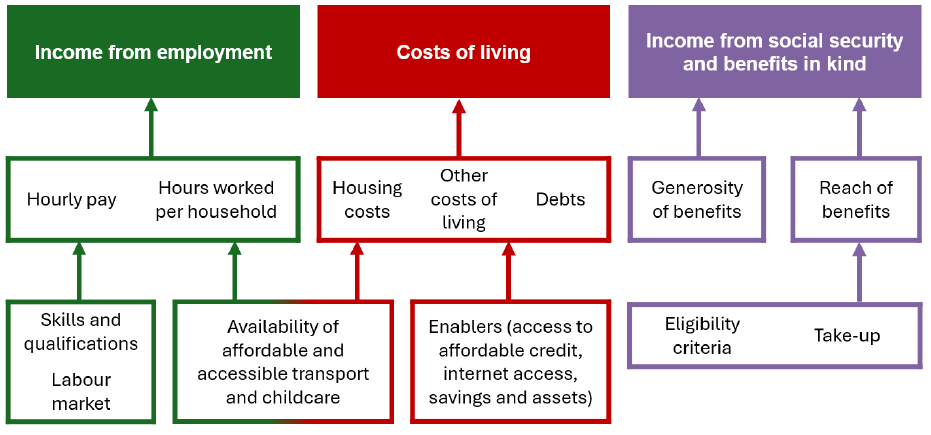
Drivers of poverty include: income from employment, cost of living and income from social security and benefits in-kind. As part of income from employment, we look at: hourly pay, hours worked per household, skills and qualifications and labour market. Availability of affordable and accessible transport and childcare are both part of income form employment and part of cost of living. As part of cost of living, we have: housing costs, other costs and debts. There are also enablers like access to affordable credit, internet access, savings and assets). In income from social security and benefits in-kind, we look at the generosity of benefits, reach of benefits, eligibility criteria and take up.
A range of indicators have been selected to track progress over time across the drivers of poverty reduction. Assessing whether progress is being achieved or not, requires a dual approach. On one side, it requires wider understanding of the context of each individual indicator. In addition, it also requires the reader to assess progress cumulatively. That is, not focusing solely on a single indicator, but looking across the whole basket of indicators. A summarised assessment of progress achieved over the year is included as part of the annual progress reports.
The measurement framework helps us to understand what is working or not, and whether there is balance across policy actions. It is purposely focused on actions that have a clear link to poverty reduction, by impacting on families’ incomes. However, as this is the final Delivery Plan towards the 2030 targets, it is important to assess any potential long term impact of the Plan and repercussions on progress achieved.
The original logic model (see Figure 2), already included a range of long term consequences of poverty. While we are keeping the measurement framework focused on the three drivers of poverty, we are now including an additional element that allows us to track progress on the long term consequences of poverty/poverty reduction. This is now part of the ‘Long term view to poverty reduction’ chapter.
Going forwards, updated data on the indicators will be published as annexes to annual progress reports. Explanations and analysis of what it means will be included as part of the main progress reports as usual.
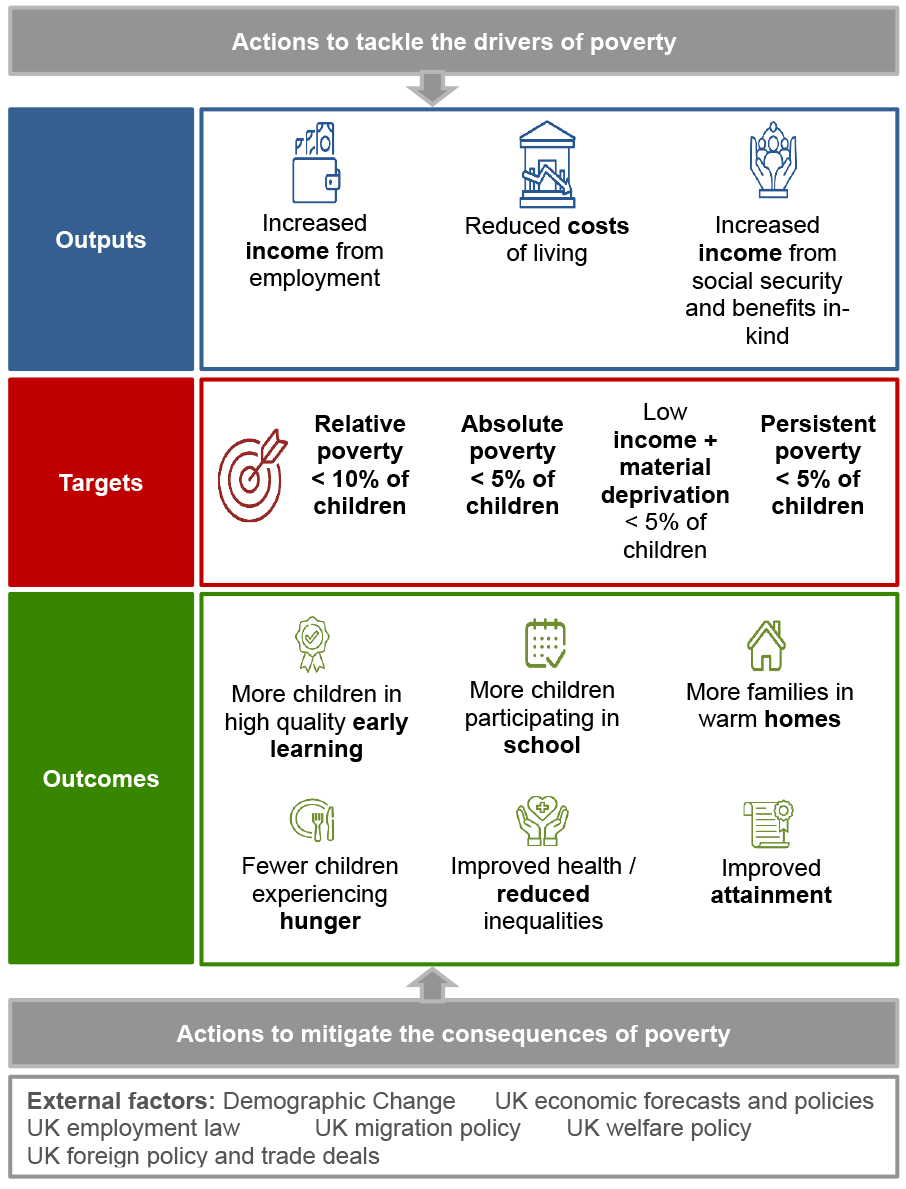
Theory of change for child poverty. actions to tackle the three drivers of poverty reduction, which are labelled as Outputs and include: increase income from employment, reduce costs of living and increase income from social security and benefits in kind. The drivers directly impact on the four child poverty targets. This in turn to mitigate the consequences of being in poverty. External factors are also to be considered. These are factors for which Scottish Government does not have any control over.
Contact
Email: TCPU@gov.scot