
Supporting Children's Learning - Code of Practice: summary
Brief summary of the Supporting Children's Learning Code of Practice. It does not replace the full guidance or the law. We are consulting on the refreshed guidance, designed to improve clarity, readability, and navigation for all users.
Supporting Children’s Learning Code of Practice Summary document
1. This document is a brief summary of the Supporting Children’s Learning Statutory guidance. It does not replace the full guidance or the law, and it does not include all legal duties, exceptions, or detailed requirements.
2. For complete and authoritative information, readers must refer to the full statutory guidance and the relevant legislation. It is important to read the code as a whole and not consider individual chapters in isolation from the entire document, the 2004 Act, or related secondary legislation.
Introduction
3. Scottish education should be ambitious, inclusive, and supportive in order to deliver:
- Excellence through raising achievement and improving outcomes: ensuring that every child and young person achieves the highest standards they can.
- Achieving equity: ensuring every child and young person has the same opportunity to succeed.
4. These aims are supported by the National Improvement Framework 2025[1].
5. The Education (Additional Support for Learning) (Scotland) Act 2004[2] (“the 2004 Act”), as amended by the 2009 Act[3] and the 2016 Act[4], provides the legal framework for identifying and supporting children and young people who experience barriers to learning.
6. The legislation requires education authorities and other services to work together, and sets out the rights of children, young people and parents to be involved in decisions and to receive appropriate support.
Purpose of the code
7. Under Section 27[5] of the 2004 Act, the Code of Practice (“the code”) provides statutory guidance on the duties of education authorities, appropriate agencies, and others in supporting children’s and young people’s learning. It sets out the 2004 Act’s provisions and the secondary legislation that supports it.
8. The code includes good practice examples illustrating how the provisions of the 2004 Act can be applied in different situations to support consistent, lawful practice. It also details procedures for resolving disagreements between families and education authorities.
9. Education authorities and appropriate agencies (such as NHS Boards) must have regard to the code when exercising their functions under the 2004 Act.
10. The code is intended for everyone involved in supporting children and young people with additional support needs.
11. It is important to read the code as a whole and not consider individual chapters in isolation from the entire document, the 2004 Act, or related secondary legislation.
Overview of the legislation
12. The 2004 Act establishes a legal framework to support children and young people in their school education, along with their families. This framework is centred on the concept of additional support needs.
13. Under Section 1 of the 2004 Act a child or young person has additional support needs if, for whatever reason, they are unable or likely to be unable, to benefit from school education unless they receive extra help.
14. The 2004 Act automatically considers all looked after children and young people to have additional support needs unless the education authority determines otherwise[6].
The definition focuses on the educational needs of the child or young person and does not require a formal diagnosis.
15. The wide range of circumstances that may lead to children and young people requiring additional support include:
- Health or Disability Related Factors.
- Social and Emotional Factors.
- Family Circumstances Related Factors.
- Learning Environment Related Factors.
16. This list is provided only for guidance purposes and is not exhaustive. Not all potential circumstances giving rise to additional support needs are listed above and not all children captured by these circumstances will necessarily require additional support.
17. Section 1(3)(a) of the 2004 Act defines additional support as “provision (whether or not educational provision) which is additional to, or otherwise different from, the educational provision made generally for children or, as the case may be, young persons of the same age in schools (other than special schools) under the management of the education authority responsible for the school education of the child or young person.”.
18. While it is not possible to list every possible form of additional support, they often fall into three overlapping categories:
- Approaches to learning and teaching.
- Support from school/ education or external personnel/ agencies.
- Provision of specific resources (e.g., assistive technology).
19. Additional support can be short-term or long-term, depending on the child’s or young person’s needs. A child may also require support due to multiple factors at the same time.
20. The Getting it right for every child framework[7] enhances the 2004 Act by encouraging early intervention and preventative support, promoting a holistic view of well-being using eight indicators: Safe, Healthy, Achieving, Nurtured, Active, Respected, Responsible, and Included.
Rights of children, young people, and parents
21. Under the 2004 Act parents and young people have a range of rights including:
- Requesting the education authority to assess whether the child has additional support needs.
- Receiving information and advice about the child’s additional support needs.
- Requesting specific types of assessments or examinations to evaluate the child’s additional support needs.
- Requesting mediation services.
- Using dispute resolution arrangements[8] for matters specified in regulations.
- Making a placing request.
- Requesting the education authority to assess whether the child needs a co-ordinated support plan.
- Referring specified matters to the First-Tier Tribunal for Scotland, Health and Education Chamber (“the Tribunal”).
22. Eligible children (12-15 years old) share most of these rights except for placing requests and mediation.
23. Safeguards are in place to ensure that eligible children can exercise their rights only if they have:
- Capacity: meaning they have sufficient maturity and understanding to exercise their rights.
- There is no adverse impact on their wellbeing: meaning that exercising their rights would not negatively affect their emotional, physical, or social wellbeing.
24. Each time a child seeks to exercise a right (or when an education authority takes action regarding them), the education authority must assess both capacity and wellbeing.
25. The 2004 Act is a key legislative mechanism for realising the rights set out in the UN Convention on the Rights of the Child (UNCRC) within the Scottish education system. It puts inclusive education into practice by ensuring tailored support, legal protections, and child-centred planning processes.
Duties of education authorities and other agencies
26. The 2004 Act places several duties on education authorities regarding the provision of school education (including funded ELC provided to eligible pre-school children) for children and young people with additional support needs in their area including:
- Identify additional support needs and put arrangements in place for identification.
- Publish, review, and update information on their policy and procedures for identifying, supporting, and reviewing the additional support needs of children and young people.
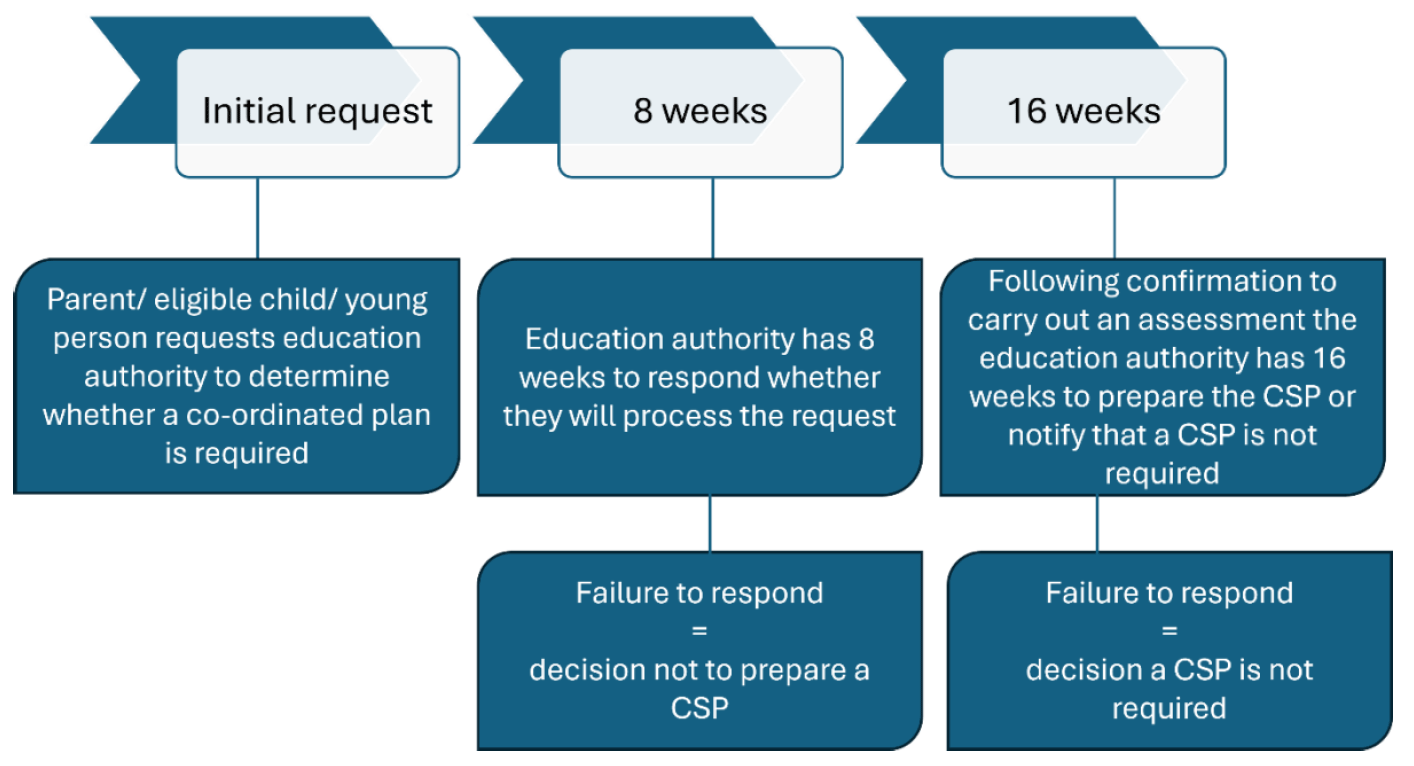
- Provide parents (and eligible children or young people) with all legally required information regarding additional support needs and the services available.
- Provide a co-ordinated support plan for those who meet the criteria and keep it under regular review.
- Establish formal arrangements for resolving disputes related to additional support needs.
- Supporting children and young people during transitions.
27. Education authorities must provide additional support to certain disabled pre-school children (under the age of 3)[9] if:
- They have been brought to the attention of the education authority as having, or appearing to have, additional support needs.
- Their additional support needs arise from a disability as defined by the Equality Act 2010.
- The education authority confirms the child has additional support needs through assessment.
28. An appropriate agency - any other local authority, any health board, Skills Development Scotland, all colleges for further education and all higher education institutions in Scotland - must help the education authority in carrying out its functions, if requested.
29. An appropriate agency is not required to comply if the request is incompatible with the agency’s own statutory duties or unduly prejudices the agency’s discharge of its own functions[10].
Working with children and young people
30. Children and young people want to be seen as individuals, not as different from their peers. To ensure the support provided is effective and inclusive:
- Needs should be identified and support provided early to prevent barriers to learning from escalating.
- Support should be:
- Person centred.
- Positive and strengths-based.
- Integrated into everyday classroom practice, reducing stigma and ensuring inclusion.
- Sensitive to individual needs and wellbeing.
- Children and young people should not feel singled out because they receive support.
31. Children and young people must be actively involved in decisions about their support.
32. Education authorities must:
- Involve children in planning and evaluating their learning (e.g., through personal learning planning).
- Seek and consider the views of children and young people[11] when:
- Deciding if they have additional support needs.
- Determining what support they require.
- Determining if they require a co-ordinated support plan.
- Preparing or reviewing a co-ordinated support plan (CSP).
Working with families
33. Parents bring a unique insight into their children’s needs and are partners in the process. As such they should be:
- Included in planning and decision-making.
- Supported to understand their rights and those of their child.
- Be given clear, accessible information (in writing, audio, or visual formats).
Identifying and assessing needs
34. Education authorities must have clear processes for identifying children and young people with additional support needs[12]. This includes:
- Identifying children and young people who require additional support to benefit from their education.
- Assessing the specific additional support needs of those identified.
- Determining whether a child or young person requires a co-ordinated support plan.
35. Most children and young people with additional support needs can be identified through:
- Ongoing classroom assessments – Teachers observe and assess learning daily.
- Tracking educational progress – Schools monitor each learner's strengths, challenges, and progress.
- Involving children and young people in planning – Teachers work with students to identify what support they need for their next steps in learning.
- Early intervention – Schools take action as soon as learning difficulties arise to prevent further barriers to education.
36. Any person working with the child may raise concerns. Sometimes, a teacher, early year practitioner, educational psychologist, general practitioner, social worker, or therapist may notify the education authority that a child or young person may have additional support needs.
37. Assessment is an ongoing process of gathering, organising, and analysing information about a child or young person and their circumstances. Under the 2004 Act, the primary goal of assessment is to identify the necessary support actions that will help maximise a child’s development and learning.
38. When a child or young person’s additional support needs require multi-agency support, the assessment process should use the Getting it right for every child (GIRFEC) principles.
Planning and providing support
39. Planning for learning is a continuous process, evolving from pre-school through school and into lifelong learning. Education authorities must ensure that every child or young person with additional support needs receives adequate and efficient support for their education.
40. In alignment with Getting it right for every child, schools and early learning settings follow a staged approach to ensure needs are identified and met at the earliest possible stage. The process typically follows these steps:
1. Initial identification by the practitioner
- The practitioner notices that a child or young person requires additional support.
- The practitioner adapts teaching strategies to help overcome barriers to learning.
2. School-based support
- If initial support is not effective, the practitioner consults within-setting support, such as:
- Learning support staff.
- Additional in-class support.
- The school may develop a profile of need prior to considering an Individualised Educational Programme (IEP).
3. External educational services involvement
- If school-based interventions do not meet the child’s additional support needs, the school seeks external advice, for example:
- Visiting teachers (e.g., for sensory impairments).
- Educational psychologists.
- This information is incorporated into a single-agency plan.
4. Multi-agency support
- If further support is needed, the school consults services outside education, such as:
- Health services (e.g., speech and language therapy, mental health support).
- Social work services.
- Voluntary organizations under service-level agreements.
41. Local authorities use a wide range of approaches to planning and providing support. In education they usually reflect a staged approach varying from three to six stages.
42. These variations may be influenced by local priorities, resources, and specific community needs. Despite the differences, the underlying principles of early identification, targeted support, and collaborative planning remain consistent.
43. The 2004 Act does not prescribe any particular model of support provision. The paragraph below shows some of the common features to be found in most models of staged assessment and provision and in the approach adopted through Getting it right for every child and the National Practice Model[13].
44. Core components of staged intervention:
Stage 1 - Universal Support
- At this foundational level, educators implement inclusive teaching strategies and classroom adaptations to meet diverse learning needs.
Stage 2 - Additional Support
- When universal approaches are insufficient, further assessment is needed and targeted interventions are introduced. This may involve small group work, specialised teaching methods, or short-term programs designed to address specific challenges.
- A named individual from within the school co-ordinates the approach. Interventions at an individual level may be recorded in a local Additional Support for Learning Plan, a Child’s Plan or an individualised educational programme (IEP).
Stage 3 - Enhanced Support
- For children and young people with more complex needs, enhanced support includes individualised plans, and may involve collaboration with external specialists such as educational psychologists or speech and language therapists.
- A named individual co-ordinates the approach. A Child’s Plan or individualised educational programme (IEP) is expected to be in place.
Stage 4 - Intensive Support
- At this level, multi-agency collaboration is essential. Comprehensive, individualised programmes are developed, potentially involving health services, social work, and other relevant agencies to provide holistic support.
- A lead professional is responsible for co-ordinating the overall approach. A co-ordinated support plan will be considered and may be in place, if the criteria are met.
Co-ordinated support plans (CSPs)
45. Education authorities must have clear processes to identify children and young people in their area who may require a co-ordinated support plan and assess their particular additional support needs.
46. Under the 2004 Act, all looked-after children and young people are presumed to have additional support needs unless proven otherwise. Authorities must also assess whether each looked-after child or young person needs a co-ordinated support plan, ensuring their education is properly supported.
47. A co-ordinated support plan is a legally required document that must be regularly reviewed for children and young people who have one.
Co-ordinated support plan criteria:
48. A child or young person requires a plan for the provision of additional support if:
a. an education authority are responsible for the school education of the child or young person,
and
b. the child or young person has additional support needs arising from one or more complex factors, or multiple factors,
and
c. those needs are likely to continue for more than a year,
and
d. those needs require significant additional support to be provided by the education authority in the exercise of any of their other functions as well as in the exercise of their functions relating to education; or significant support to be provided by the education authority as well as at least one other appropriate agency.
49. If the legal criteria is met, education authorities have a statutory duty to ensure a co-ordinated support plan is in place.
50. Authorities should follow a structured assessment process to determine co-ordinated support plan eligibility. Under Section 2(1) of the 2004 Act, the decision should be based on:
- Is the education authority responsible for the school education of the child/ young person?
- Does the child/ young person have additional support needs arising from complex or multiple factors?
- Are these needs likely to continue for more than a year?
- Is significant additional support required from the education authority and from another local authority function (e.g., social work) or an appropriate agency (e.g., NHS)?
51. If the answer is "yes" to all relevant questions, a co-ordinated support plan is required. If any criteria are not met, alternative support arrangements may be more appropriate.
52. When determining whether a co-ordinated support plan is required, or in preparing one, an education authority must seek and take into account relevant advice and information from appropriate agencies and individuals. These may include health services, voluntary organizations, and social work services within the authority.
53. Additionally, the authority must consider any independent assessments or reports provided by or on behalf of the child or young person. This includes assessments privately commissioned by parents, eligible children or the young person themselves.
54. Furthermore, the views of the child, young person and parents, must be actively sought and taken into account throughout the process.
55. When an education authority is responsible for a child or young person’s school education, they must respond to requests from a parent, an eligible child, or a young person, to determine whether the child or young person has additional support needs or requires a co-ordinated support plan unless the request is deemed unreasonable.
56. If the education authority does not respond to a request for assessment within eight weeks, this is treated as a decision that no co-ordinated support plan is required. In this case, the parent, young person, or eligible child may refer the authority’s deemed refusal to the Tribunal. This eight-week deadline may be extended to 16 weeks if the request is made during a school holiday of four weeks or more.
57. If an authority agrees to assess whether a co-ordinated support plan is required but fails to make a decision within 16 weeks, this is also treated as a decision that no co-ordinated support plan is required. In such cases, the decision can be referred to the Tribunal.
Graphic text below:
Initial Request
- Parent/ eligible child/ young person requests education authority to determine whether a co-ordinated plan is required
8 weeks
- Education authority has 8 weeks to respond whether the will process the request
- Failure to respond = decision not to prepare a CSP
16 weeks
- Following confirmation to carry out an assessment the education authority has 1 weeks to prepare the CSP or notify that a CSP is not required
- Failure to respond = decision a CSP is not required
CSP timeframes
58. Within the 16-week timeframe, the education authority must:
- Seek and consider all relevant views and information.
- Determine whether the child or young person meets the co-ordinated support plan criteria.
- Reach a decision.
- Notify the parent, eligible child, or young person of the outcome.
- If a co-ordinated support plan is required, prepare and complete the plan in accordance with the Co-ordinated Support Plan Regulations[14].
59. The 2004 Act and associated co-ordinated support plan regulations outline the required structure and content of a co-ordinated support plan. The plan must include[15]:
- The child’s or young person’s additional support needs and the factors contributing to these.
- The educational objectives that require co-ordination.
- The additional support required to meet these objectives.
- The individuals or agencies responsible for providing support.
60. While education authorities are expected to comply with the 16-week deadline, the Additional Support for Learning (Co-ordinated Support Plan) (Scotland) Amendment Regulations 2005 allow for exceptions in circumstances where compliance is impracticable. These exceptions include:
- A requested assessment or examination cannot take place or its results are unavailable before the deadline.
- An appropriate agency or other party has been asked for assistance but cannot provide a response in time.
61. The plan must also specify the coordinator's name, address, and telephone number. The co-ordinator is responsible for monitoring and ensuring the provision of all services outlined in the co-ordinated support plan. Their key responsibilities include:
- Ensuring that required services are in place for the child or young person.
- Taking action to secure services as necessary.
- Providing clarity on roles and expectations to parents, eligible children, young people, and all professionals involved.
62. The 2004 Act requires the education authority responsible for a child or young person’s school education to regularly assess whether the co-ordinated support plan remains appropriate and formally review[16] it at least once every 12 months.
School placements
63. Education authorities must provide school education in mainstream settings unless specific legal exceptions apply[17]. Before deciding on any alternative placement, they must consult the child or young person and their parents or carers, and must take the child or young person’s views into account.
64. Alternative placements may be made by the education authority when this better meets a child’s additional support needs. This can include attending another mainstream school in the same authority or a special school, unit or class.
65. In some situations, a home education authority may arrange for another authority to provide education and in rare circumstances, a child may be placed in a grant-aided or independent special school, or in a specialist school elsewhere in the UK.
66. In these cases, the home education authority retains responsibility for the child’s education, and all duties under the 2004 Act continue to apply.
Placing requests
67. The term “placing request” refers to the parent of a child making a request in writing to place the child in a school that is specified in the request.
68. The process for placing requests for children with additional support needs is outlined in Schedule 2 of the 2004 Act.
69. Under the 2004 Act, education authorities have a duty to comply with placing requests, unless certain exceptions apply.
70. Parents of children with additional support needs and young people themselves can make a placing request (unless the education authority determines that they lack capacity, in which case parents can act on their behalf). For simplicity, this section often refers to parents, but the same rights apply to young people in their own name.
71. Eligible children (aged 12–15) do not have an independent right to make a placing request.
72. Parents can request for their child to attend:
- A different school within their home education authority, outside their local catchment area.
- A school managed by another education authority.
- An independent or grant-aided special school in Scotland, or a similar school in England, Wales, or Northern Ireland, if the managers of that school are willing to accept the child.
- A pre-school provision (e.g., a partnership early learning and childcare setting) within their home or a host education authority area.
73. Parents cannot make a placing request for independent or grant-aided schools that are not special schools.
74. An education authority must approve a placing request unless one or more exceptions apply. Schedule 2 of the 2004 Act sets out grounds for refusal of placing requests.
75. If a placing request is refused, parents and young people have the right to appeal.
76. Education authorities must inform parents and young people of their rights regarding placing requests. They are required to provide clear reasons for any refusal of a placing request.
Placing requests timeline summary table:
Event: Submission deadline for August start
Timeline: By 15 March
Event: Authority must notify decision (if request made by 15 March)
Timeline: by 30 April
Event: Authority must notify decision (if request made after 15 March)
Timeline: within 2 months of receipt
Event: Appeal committee must hold hearing
Timeline: within 2 months of receiving appeal
Event: Failure to meet deadline = deemed refusal
Timeline: Various defaults apply (see following paragraphs)
Transitions
77. School education involves a series of transitions that every child and young person will experience. These include:
- Starting early learning and childcare (pre-school).
- Moving into primary school.
- Progressing through different stages of primary and secondary school.
- Transitioning beyond school into adult life.
78. Children may also experience other types of transitions, such as changing school due to relocation or gaps in their education. Regardless of the type of transition, all children and young people are entitled to support that helps them make the most of their learning and achieve positive, sustained destinations beyond school.
79. Education authorities should follow key principles[19] of good practice whenever a child or young person with additional support needs is approaching a transition in their education. These include:
- Early planning: The earlier planning begins, the smoother the transition. Early discussions should take place with the new school, college, or post-school provider to help ensure a smooth transition.
- Child-centred approach: The wishes of children and young people should be at the centre of any decisions made about their support.
- Collaboration: There are effective arrangements in place to involve children, young people, families, education staff and appropriate agencies (health, social work, Skills Development Scotland etc.) in designing transitions for those requiring additional support.
- A named person or lead professional coordinates the process. Shared approaches agreed to record keeping and passing on of information.
- Clear communication: Use language understood by all involved. Be mindful of different communication needs.
- Continuity: Sound arrangements are in place for transferring information from one named person/ lead professional to another to ensure continuity of plans (e.g., a Child’s Plan, co-ordinated support plan). If the child or young person has a co-ordinated support plan, discuss changes to the designated co-ordinator with the child or young person and their parents well in advance.
- Monitor and review regularly: Plans should be flexible and updated as needed.
80. Under the 2004 Act, education authorities have some discretion over which children or young people are covered by the statutory transition duties. It would not be practical or necessary to apply these duties to every child with minor or short-term needs.
81. However, it is anticipated that the duties will certainly apply to children and young people with additional support needs in any of the following situations:
- They have a co-ordinated support plan (CSP).
- They are placed in a special school, unit, or enhanced provision.
- Their needs arise from a disability under the Equality Act 2010.
- They are at risk of struggling with transition (e.g., looked after children, young carers).
82. The 2004 Act sets the latest permissible dates by which key stages of planning must be completed. However, starting planning earlier is often better, especially in post-school transitions, where preparation may begin in the early years of secondary school.
83. The Additional Support for Learning (Changes in School Education) (Scotland) Regulations 2005 outline what education authorities must do at key transition points in a child’s education journey.
Resolving disagreements
84. Using good practice when working with families and children can help prevent disagreements or stop them from escalating into formal disputes.
85. When all other routes have been exhausted. This chapter provides a summary of how the three formal options for resolving disagreements under the 2004 Act work and how they differ. These are:
- Mediation[20]
- Dispute resolution (independent adjudication)[21]
- First-tier tribunal for Scotland, Health and Education Chamber (Additional Support Needs jurisdiction)[22]
86. Mediation is a voluntary, confidential process where an independent mediator helps families and education authorities resolve disagreements relating to the functions of the authority under the 2004 Act.
87. Dispute resolution involves an independent third party, known as an independent adjudicator, reviewing the facts of a disagreement and making recommendations to both sides.
88. Dispute resolution is usually for cases outside the Tribunal’s remit, where a CSP isn’t required. These processes complement each other, but don’t overlap.
89. Using dispute resolution does not affect the right to go to the Tribunal if the child’s or young person’s circumstances later fall within its remit[23].
90. The Additional Support Needs jurisdiction of the Health and Education Chamber of the First-tier Tribunal for Scotland[24] hears references (appeals) against decisions of education authorities regarding the provision of educational support under the 2004 Act.
91. The 2004 Act requires the Scottish Ministers to provide a free advocacy service to support parents and young people during Tribunal proceedings[25].
92. In exceptional circumstances, an interested person may refer alleged failures to carry out a statutory education duty to Scottish Ministers under section 70 of the Education (Scotland) Act 1980.
93. Section 70 gives a discretionary power for Scottish Ministers to intervene where they are satisfied that an education authority or others have failed to discharge any duty imposed on them by education legislation.
94. A matter which can be referred to the Additional Support Needs Tribunal cannot be referred to Scottish Ministers under section 70 of the 1980 Act.