
Women's Health Plan: Phase Two (2026 - 2029)
This plan sets out new actions to address health inequalities faced by women and girls in Scotland. Building on the first Women’s Health Plan, these actions advance our ambition that all women and girls in Scotland enjoy the best possible health throughout their lives.
Introduction by Deputy Chief Medical Officer and Co-Chair of the Women’s Health Plan Short Life Working Group
As Deputy Chief Medical Officer for Scotland, I have had the unique privilege of leading both the development and the implementation of the very first Women’s Health Plan ever to be published in the UK. I am proud to be able to see that initial vision through to the next phase, shaping the next steps in our journey towards a Scotland where ‘women and girls experience the best possible health, throughout their lives’.
More than half of the population accessing healthcare in Scotland are women, but we know through our work to develop the Women’s Health Plan that women and their health needs are not necessarily considered as different to men, and our services are often not fully meeting the needs of women.
The first Women’s Health Plan for Scotland was published in August 2021 and it is important to acknowledge that much has changed since then. The Covid 19 pandemic was an unprecedented period in time, the significant impact of which continues to be felt today as our health services work towards recovery.
For our Plan, this meant delivering our actions in challenging times, alongside delivery partners whose capacity and resilience was stretched like never before. I am extremely proud of what was achieved in the first three years of the Women’s Health Plan and I believe it has brought positive change for Scotland.
In 2023, we appointed Scotland’s first ever Women’s Health Champion, Professor Anna Glasier OBE, who is leading ground-breaking work and providing demonstrable leadership in the Women’s Health Plan’s priorities and beyond. We launched the NHS Inform Women’s Health Platform to ensure women and girls are able to access a reliable source of information, empowering them to make informed decisions about their health. We commissioned NHS Education for Scotland (NES) to develop training resources on Menstrual Health and Menopause for healthcare practitioners across primary care. We published a menopause and menstrual health workplace policy for NHS Scotland, supporting staff to positively manage their menopause and menstrual health at work within a sector where women make up the vast majority of the workforce.
These achievements demonstrate tangible progress and provide a strong foundation from which to move into the next phase of the Women’s Health Plan.
Anchoring all of our work are two core Scottish Government products. Firstly, the Health and Social Care Service Renewal Framework which sets out the strategic policy intent for health and social care in Scotland for the medium to longer term. The framework is focused on key principles of improving access to treatment and services; shifting the balance of care to community; expanding digital and technological innovation and focussing on prevention, all of which will benefit women.
Alongside this, the Population Health Framework has been co-developed with the Convention of Scottish Local Authorities (COSLA) and in collaboration with Public Health Scotland (PHS), NHS Directors of Public Health and other local, regional and national partners. This Framework sets out how we work collaboratively across all sectors to support people to live healthy and fulfilling lives and stop health problems arising in the first place.
This next phase of the Women’s Health Plan has been crafted to align closely with both these frameworks and their fundamental principles.
The development of the next phase of the Women’s Health Plan is collaboration and co-design in action. We have engaged with clinical experts, academics, the third sector and those working in the women’s health arena, bringing our partners together to share their expertise and to help shape our next steps. Women from across Scotland, from a wide range of ages and backgrounds, gave their time and shared their views helping to ensure that our Plan reflects the needs of the women of Scotland. We are truly grateful to you all.
It is only through collective effort that we will be able to achieve improved health outcomes for women and girls across Scotland. Whilst we may have a long way to go to fully achieve our ambitions we have already demonstrated that, together, progress is possible.
Professor Marion Bain
Deputy Chief Medical Officer for Scotland
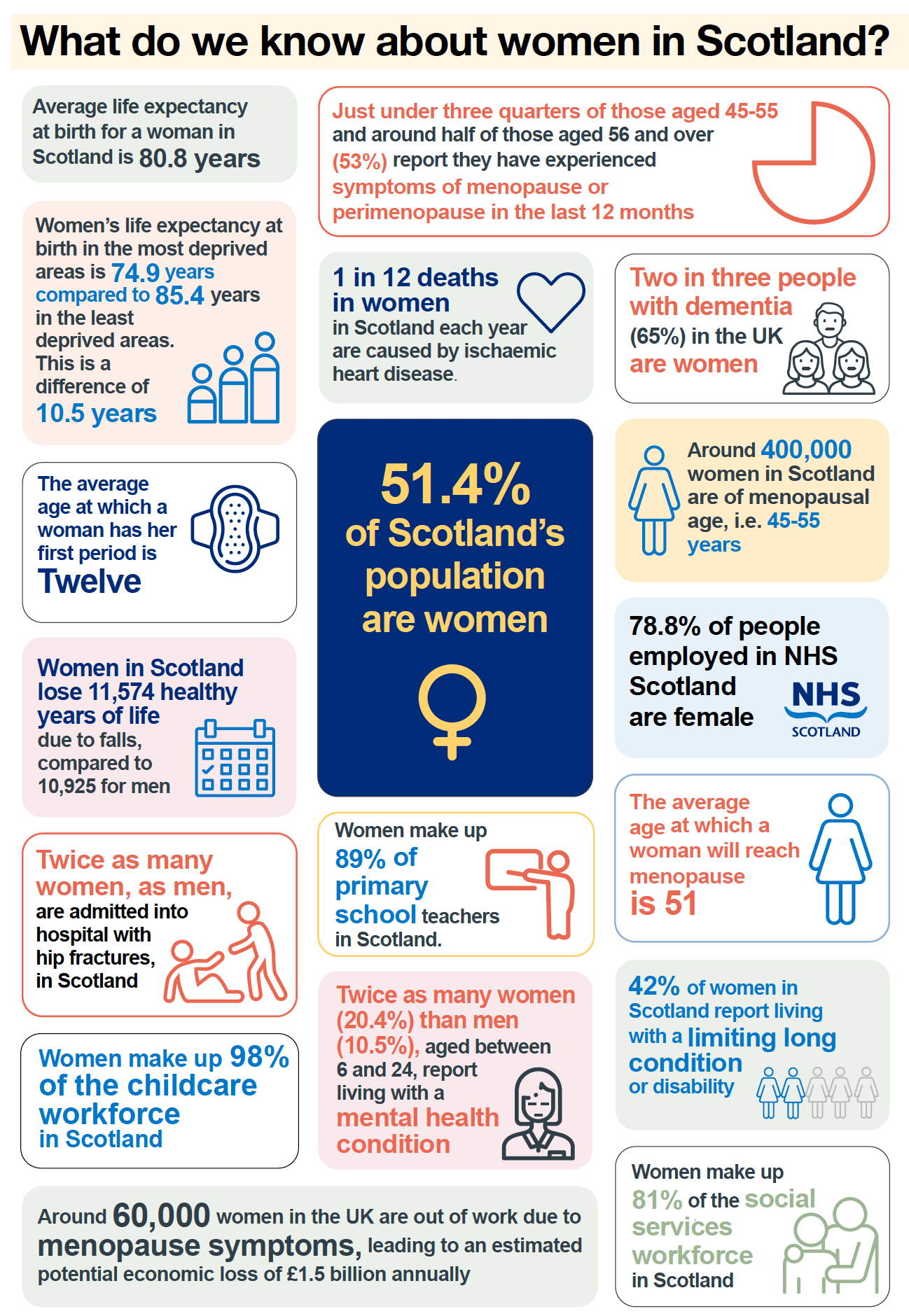
Infographic text below:
- Average life expectancy at birth for a woman in Scotland is 80.8 years
- Women’s life expectancy at birth in the most deprived areas is 74.9 years compared to 85.4 years in the least deprived areas. This is a difference of 10.5 years
- The average age at which a woman has her first period is Twelve
- Women in Scotland lose 11,574 healthy years of life due to falls, compared to 10,925 for men
- Twice as many women, as men, are admitted into hospital with hip fractures, in Scotland
- Women make up 89% of primary school teachers in Scotland.
- Around 60,000 women in the UK are out of work due to menopause symptoms, leading to an estimated potential economic loss of £1.5 billion annually
- Just under three quarters of those aged 45-55 and around half of those aged 56 and over (53%) report they have experienced symptoms of menopause or perimenopause in the last 12 months
- 1 in 12 deaths in women in Scotland each year are caused by ischaemic heart disease.
- 51.4% of Scotland’s population are women
- Women make up 98% of the childcare workforce in Scotland
- Twice as many women (20.4%) than men (10.5%), aged between 6 and 24, report living with a mental health condition
- Two in three people with dementia (65%) in the UK are women
- Around 400,000 women in Scotland are of menopausal age, i.e. 45-55 years
- 78.8% of people employed in NHS Scotland are female
- The average age at which a woman will reach menopause is 51
- 42% of women in Scotland report living with a limiting long condition or disability
- Women make up 81% of the social services workforce in Scotland
Contact
Email: womenshealthplan@gov.scot