
Offshore wind - strategic compensation policy: strategic environmental assessment
Strategic environmental assessment assessing the impact of the proposed strategic compensation policy for offshore wind on the environment identifying potential effects and mitigation measures.
1 Introduction
1.1 Background
1.1.1 Globally, twin reinforcing crises are being faced; climate change acts as a contributor to biodiversity loss, and biodiversity loss will exacerbate the climate crisis[10]. The Scottish Government has set out its commitment to addressing these twin crises in two plans: the Scottish Biodiversity Strategy[11] and Scotland’s Climate Change Plan[12]. This commitment is supported by the policy principles in Scotland’s National Planning Framework 4 (NPF4)[13] which aims to facilitate development that addresses the global climate emergency and nature crisis, resulting in zero carbon, nature positive spaces. Both crises are given parity within the NPF4 and are placed at the heart of the vision for a future Scotland.
1.1.2 Scotland holds an abundance of renewable energy resources and a key component for meeting Scotland’s and the wider UK’s net zero targets is further offshore wind development. Offshore wind is set to play a vital role in meeting future electricity needs, coupled with a decarbonisation of our electricity system. Scottish Government’s Offshore Wind Policy Statement[14] set out a commitment to increase offshore wind energy generation capacity in line with just transition principles.
1.1.3 Following on from this statement, new seabed leasing rounds for offshore windfarms were launched by Crown Estate Scotland (CES). The Sectoral Marine Plan for Offshore Wind Energy (SMP-OWE), published in October 2020[15], identified 15 Plan Options (POs) and assessed the potential impacts of an assumed development scenario of 10 GW. The leasing process, managed by CES, and known as ScotWind, announced in 2022 the awarding of Option Agreements to 20 projects within the 15 Plan Option areas for a total potential capacity of 27.6 GW[16]. In 2022 CES launched a leasing round that will help deliver projects for the electrification of oil and gas infrastructure and wider net zero commitments, known as Innovation and Targeted Oil and Gas (INTOG). Thirteen projects were selected and announced on 25 March 2023[17]. Scottish Government’s Offshore Wind Directorate (OWD) is updating the SMP-OWE to take account of these leased capacities and to set out a strategic framework for delivery of offshore wind in Scotland[18]. This plan is subject to its own Strategic Environmental Assessment (SEA)[19].
1.1.4 The scale of infrastructure development needed to address the climate crisis and meet net zero targets comes with the risk of significant impacts on nature and biodiversity. Both floating and fixed turbines at offshore sites have the potential to impact on wild species during both the construction and operational stage. Additionally, impacts on the integrity of the seabed may be observed.
1.1.5 The Scottish Biodiversity Strategy sets out an ambition for Scotland to be nature positive by 2030, and to have restored and regenerated biodiversity across land, freshwater and seas by 2045[20]. This policy principle suggests that any adverse effects from developments in the marine environment should be mitigated. A reduction in key pressures, and effective management of emerging pressures, is highlighted as a priority action for delivering improved resilience in the marine environment and aiding progress toward Good Environmental Status (GES)[21]. This sentiment is supported by the (updated) UK Marine Strategy (2019)[22] and Scotland’s Marine Assessment (2020)[23], the former of which showed that GES had not been achieved for 11 out of 15 assessed components.
1.1.6 The Marine Protected Area (MPA) network forms a key component of ensuring a healthy marine environment. Special Areas of Conservation (SACs) and Special Protection Areas (SPAs) are a type of MPA designated under the Habitats Regulations[24],[25],[26]. The Habitats Regulations provide a framework for protecting certain habitats and species in the marine environment. This includes ensuring the coherence of the ‘National Site’ (consisting of SACs and SPAs). There are protective provisions to ensure that ‘plans and projects’ do not have an adverse effect on site integrity.
1.1.7 The Habitats Regulations, under specific circumstances, provide for a derogation to be applied when it is considered that a plan or project must proceed despite a conclusion that it would have an adverse effect on site integrity. In these circumstances compensatory measures to address the environmental impacts must be taken. The UK Energy Act[27] sets out the compensatory regime in relation to offshore wind projects[28],[29]. Secondary regulations are in development by UK Government to implement requirements of the UK Energy Act.
1.1.8 To help address the global climate emergency and nature crisis, the Strategic Compensation Policy for Offshore Wind (hereafter referred to as the ‘Strategic Compensation Policy’) is being developed by the Scottish Government to introduce amendments to the process for how compensatory measures can be identified and implemented under the Habitats Regulations for offshore wind plans and projects in Scottish waters. This policy is being developed in close collaboration with the UK, Wales and Northern Ireland Governments. The agreed policy will underpin new UK Government and Scottish Government Legislative Instruments. The Scottish Government will also release statutory guidance which will provide offshore wind developers and delivery partners in Scotland with practical guidance to support them in putting the legislative reforms to the Habitats Regulations into practice. The Strategic Compensation Policy aims to support:
- The protection of the marine environment and maximisation of environmental enhancement and restoration opportunities at a pace to meet Scottish Government 2030 and 2045 biodiversity and climate change targets, through blended effort across the public and private sectors; and
- A coordinated approach to the implementation of compensatory measures so they have the largest possible benefit for the environment and so that securing compensatory measures is not a limiting factor to consenting offshore wind.
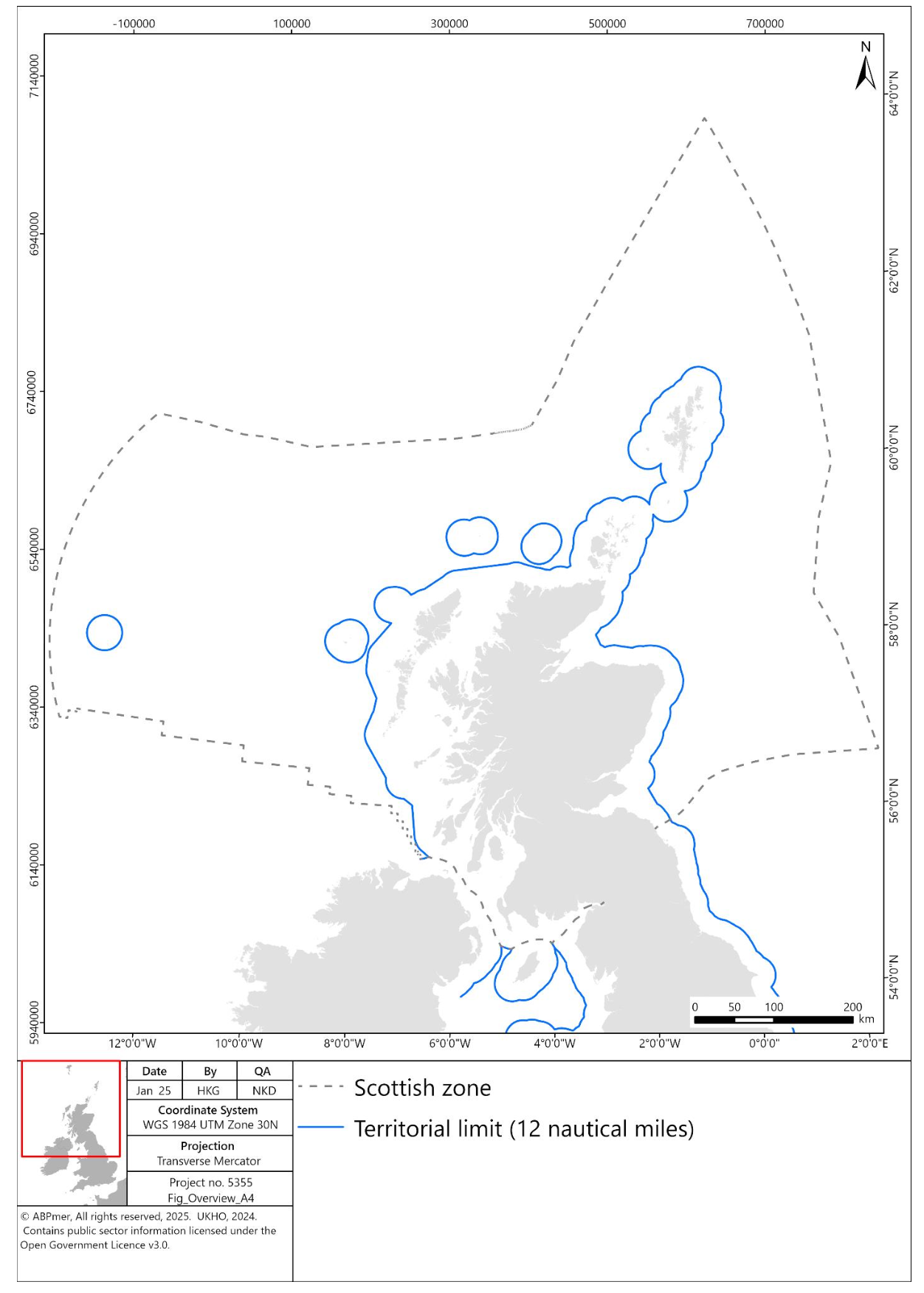
1.1.9 The spatial extent of the Strategic Compensation Policy is shown in Figure 1 covering both the Scottish inshore region (0 - 12 NM) and the Scottish offshore region (12 – 200 NM), with specific focus being on offshore wind developments. It is recognised that whilst the spatial extent of the policy relates to the above, compensation measures could come forward beyond these areas. For example, compensation measures could take place on land, or outside of Scotland/Scottish waters. The Strategic Compensation Policy has not yet been implemented, and this SEA assesses options for the principles within the policy.
1.2 Strategic Environmental Assessment
1.2.1 Strategic Environmental Assessment (SEA) identifies the likely significant environmental impacts of plans and policies and proposed reasonable alternatives to them. SEA also identifies mitigation measures that are required to avoid or minimise any significant adverse effects and highlights opportunities for enhancements of beneficial effects. Taking place at an early stage in the plan or policy preparation process, it ensures that decision-making is informed by relevant environmental information. SEA provides opportunities for the public to consider this information and use it to inform their views on the draft plan or policy. In accordance with the 2005 Act and Scottish policy, Scottish Ministers are committed to applying the SEA process as part of the development of the Strategic Compensation Policy.
1.2.2 The Environmental Assessment (Scotland) Act 2005[30] (“the 2005 Act”) requires Scottish public bodies or those exercising functions of a public character (Responsible Authorities) to undertake a SEA when preparing plans, programmes or strategies if they are likely to have significant environmental effects. This applies to both significant positive or negative environmental effects. The proposed Strategic Compensation Policy falls under Section 5(4) of the 2005 Act and is therefore subject to SEA. The 2005 Act also sets out the information that is required to be provided in this Environmental Report.
1.2.3 The SEA has also been undertaken in line with the UK’s Environmental Assessment of Plans and Programmes Regulations 2004 (“the 2004 Regulations”) which require that certain public plans, programmes and strategies be assessed for their potential effects on the environment.
1.2.4 A screening and scoping exercise was undertaken by Scottish Government in accordance with the requirements of the 2005 Act. A combined Screening and Scoping Report was published in July 2023 (updated September 2023), setting out the proposed approach to the SEA, including the proposed scope and level of detail. Comments were invited from the Scottish Consultation Authorities[31].
1.2.5 The outcome from the Screening and Scoping Report and the consultation responses confirmed the need for an SEA as there is potential for significant environmental effects to occur as a direct result of the proposals. Scottish Government commissioned ABP Marine Environmental Research Ltd. (ABPmer) to undertake the assessment stage of the SEA and prepare this Environmental Report.
1.3 Purpose and Structure of this Report
1.3.1 This SEA provides a high-level and qualitative assessment of the potential environmental effects that are likely to result from the Strategic Compensation Policy. This SEA builds on previous and ongoing SEAs that have been undertaken on marine conservation and offshore wind work by the Scottish Government.
1.3.2 The SEA identifies positive and negative effects. The assessment identifies the individual and cumulative effects of the Strategic Compensation Policy on the SEA topics that are scoped into the assessment, specifically Biodiversity, Flora and Fauna; Soil (benthic (seabed) substrates and habitats); Water; Climatic Factors; Cultural Heritage; and Landscape/Seascape. At a cumulative level the assessment considers the proposals in relation to other relevant plans, programmes, or strategies.
1.3.3 The assessment also considers the effects of development on a series of key statements (‘SEA objectives’). These objectives reflect the scope of the assessment as well as the environmental protection objectives from relevant legislation.
1.3.4 The potential economic and social impacts that may result from the implementation of the legislative reforms does not form part of the scope of this SEA. Additional assessments may be undertaken, as appropriate, to help estimate the socio-economic benefits, costs, and risks associated with the Strategic Compensation Policy.
1.3.5 Recognising duties under Section 14 of the UK Withdrawal from the European Union (Continuity) (Scotland) Act 2021[32], this report also considers the duty on Scottish Ministers to have due regard to the guiding principles on the environment in making policies (including proposals for legislation) and record how due regard has been given to the principles in preparing the Environmental Report. The guiding principles on the environment are set out in Section 13 of the UK Withdrawal from the European Union (Continuity) (Scotland) Act 2021 and include:
a) the principle that protecting the environment should be integrated into the making of policies;
b) the precautionary principle as it relates to the environment;
c) the principle that preventative action should be taken to avert environmental damage;
d) the principle that environmental damage should as a priority be rectified at source; and
e) the principle that the polluter should pay.
1.3.6 The views of the public and the Consultation Authorities on the draft Strategic Compensation Policy and the findings of this Environmental Report are now being sought.
1.3.7 The remainder of this Environmental Report is structured as follows:
- Section 2 provides background information on the draft Strategic Compensation Policy;
- Section 3 presents the approach to the SEA and the methods used;
- Section 4 sets out the results of the assessment;
- Section 5 considers the duty on Scottish Ministers to have due regard to the guiding principles on the environment;
- Section 6 considers the next steps in the development of the Strategic Compensation Policy and the SEA process;
- Appendix 1 describes the relevant components of the environment that could be affected by the draft Strategic Compensation Policy;
- Appendix 2 sets out the Screening and Scoping Consultation Authority comments; and
- Appendix 3 presents abbreviations.
1.3.8 The Non-Technical Summary precedes Section 1.