
Shared services programme: phase 1 programme closure report
This report captures the experience of delivery, and the outcomes and learning that can be derived for the benefit of future transformations in the Scottish Government and the public sector. It covers objectives, post-implementation, governance, costs, benefits realisation, and future work.
10.0 Appendices
Appendix 1. Individual Directorate reflections
During the initial months of live operation, People Directorate, Finance and Procurement provided their own reflections on the journey from programme delivery through ‘go live’ and the initial experience of the Oracle Cloud platform. We also gathered early observations from our Corporate Hub and Digital Operations colleagues.
HR
Achievements in phase 1
- The implementation of Oracle Cloud, a shared platform across HR, Finance and Purchasing.
- Payroll processing and employer reporting commenced following successful cut-over
- A support model for the ongoing maintenance and improvement of the Oracle Cloud platform (albeit further clarity required on the support model post August 2025) including the centralisation of system support
- Establishment of Memorandums of Understanding for all HR Shared Service Customers
- Centralisation of customer management for HR, Finance and enabling services
- Cost transparency re: system licences and support to allow improved budgeting from areas that use Oracle enabled HR services
Notable successes
- Cutover was a particularly successful part of the Shared Services Programme, strong plans were developed and clear communications were shared with the organisation meaning Cutover felt smooth. Payroll system closure, as part of the cut-over, was successful with effective off-line processes introduced and surge team utilised to minimising pay processing backlog following go-live
- Job architecture implemented with position management and professions categorisation introduced as the basis for improved workforce controls and reporting
- Integrated HR and recruitment system removing the requirement for integration and manual processing
Continued focus
- Centralisation of further shared platforms (pathways) and system support teams
- The stabilisation of the oracle platform, there are defects and issues outstanding, to allow the stabilisation of service delivery, in particular Time and Labour
- Oracle module to manage workflows and sensitive case management (HR Help Desk)
- Development of workforce planning tools so that modules support strategic workforce decisions and reporting as well as financial forecasting
Future outlook
- Optimisation of service delivery, once services have stabilised, to allow efficiency in processes to be identified and implemented, increase use of technology for Tier 0-1 activity and realisation of benefits from new enabling technology
- Embedding position management, as an entirely new concept for HR and users, across all HR processes and determine HR support role
- Quarterly update process established that is technically delivered without having a detrimental impact on service delivery (doesn’t create further defects, doesn’t remove configuration requirements, doesn’t create increased queries/tickets) and can be effectively supported be functional teams alongside business-as-usual operational delivery
- Cost transparency beyond technical support to include costs of services and onboarding
- Onboarding strategy, costs and plans to allow extension of shared services without compromising either functional budgets or current service delivery
- The development of a shared service offer which can initially capture the services available in the short-term and longer-term planning and resource to develop an offer that will allow delivery to the varying needs of various customers (e.g. different Terms and Conditions, policies, processes)
- The organisational change (structure, culture, infrastructure) needed to develop a service offer that can be shared across more customers
- System or database to hold the Terms and Conditions, policies and guidance for various customers to ensure accurate advice and support can be given to a wider range of customers and support the utilisation of AI technology
- Improvement work across operational delivery teams to realise the predicted benefits of Oracle Cloud
- Beyond 2025 will be a pivot from a focus on system/technology to a focus on services
Finance
Achievements in Phase 1
The go-live from a finance perspective has been a complete success, despite the challenging timescales faced to deliver the SSP programme. We achieved the go-live in line with the agreed requirements. While Finance and Purchasing customers experienced some early go-live issues, these were anticipated and promptly resolved. We implemented a support model that is currently functioning effectively and delivering quality services to our customers.
Finance delivered Oracle Cloud Finance and Purchasing modules and functionality below:
- Chart of Accounts
- General Ledger
- Purchasing
- Accounts Payable
- Accounts Receivable
- Cash Management
- Expenses
- Fixed Assets (Non Current Assets)
- Tax
- Reporting
- Period End
- Project Accounting
- EPM (Currently under delivery phase)
- Integration across Finance, HR and external suppliers.
Notable successes
- ‘Day 1’ funding payments to NHS and other public sector organisations paid immediately upon system going live.
- Volume and value of Purchase to Pay (P2P) transactions in system, committed and paid throughout the financial year. For example all local authority funding previously had been committed off system and was only available when making the payment.
- Accounts Payable function quickly operating on business-as-usual basis, with ministerial 10 day payment target met over the financial year.
- System enforcing compliance with P2P and Award to Pay/grant policies, with significantly reduced incidence of payments paid manually through the bank.
- First VAT returns in new system compiled and submitted to HMRC deadlines, with central team able to identify and correct more underlying errors than in SEAS.
- Initial rollout of e-invoicing.
- Accurate accounting and successful first financial year end closure.
- Aligned all public sector organisations to a standard period end closure timetable and successfully closed within three working days of period end.
- Finance and Purchasing policies aligned in system. Procurement legislation requirement to report on contract spend now met.
- Cleansed supplier database for go live, new supplier validation policy and processes in place across all 6 organisations that manage suppliers.
- One centralised Accounts Payable function implemented in Scottish Government removing 3 satellite Accounts Payable functions.
- New centralised citizen payment function in Accounts Payable to monitor compliance and reduce customer access or potential misuse.
- One approval hierarchy for P2P and Award to Pay that had previously been customised for a large number of customers and was difficult to control and maintain.
- Collaborative operating model between all the key corporate functions: HR; Finance; Procurement and Digital Operations.
- Full suite of robust process maps for all finance and P2P functions, e-learning, new customer guidance and procedures to improver controls, knowledge and understanding and compliance.
- One support model for iFIX for all customers, both on our SCOTS and non-SCOTS network. All customers enabled to access Pathways for consistent training materials and guidance which previously had been a split model and had resulted in poor document management and low customer experience.
Continued focus
- Extend e-invoicing to more suppliers to reduce need for manual input of invoices.
- Implement Supplier Portal to enable suppliers to create their own invoices in-system.
- Implement automated workflows for transmission of payroll files to BACS.
- Implement integrations for Bankline Direct to automate other payment types besides BACS (Inter Account Transfers , CHAPS, Faster Pay, foreign) as well as to automate import of bank statements directly into Oracle.
- Complete implementation of EPM
- Enhance system reporting to improve the suite of management information.
- Improve balance sheet monitoring and reconciliation processes.
- Extend the implementation of the Expenses and Accounts Receivable modules.
Future outlook
- Identify and implement more opportunities for automation and efficiency
- Produce widely available and easy to use dashboards and reports from the underlying Oracle data. This is work in progress.
- Reduce friction in processes by increasing user knowledge and ability.
- Support getting transactions right first time – fewer holds, VAT errors, etc.
- Support enabling of user self-service reporting through training.
- Budget process, provisional and final outturn properly enabled and supported by EPM.
- Development above Minimum Viable Product in EPM product (including speed of system).
- Develop compliance and assurance reporting, ideally implementing the available Oracle tools to support efficient reporting and data analytics.
- Pursue Payment Strategy to implement long term solution for transmission of payments from Oracle.
- Work towards more formal service offering – SLAs, KPIs, customer management, etc.
- Support the next stage of Shared Services development.
Procurement (Purchasing)
Achievements in phase 1
Data
- 751 live contracts migrated for go live.
- 1,100 Non contracted spend Contract Purchase Agreements (CPAs) raised for go live
- 1,539 lines of CPA and Smart Form data migrated for 32 customer organisations prior to go live.
- 4506 CPA and Smart Form lines checked for validation
- 56 new Delegated Purchasing Officers (DPOs) trained from 1 September 2024
- 162 DPO trained as approvers a mixture of existing DPO and new DPO ‘buyers’
- Training sessions developed and delivered with over 300 attendees at each
- Familiarisation of Oracle in Procurement (Scottish Procurement and Property Directorate (SPPD), buyers and DPO)
- Procurement Templates changes (SPPD buyers and DPO)
- CPA/Smart Form ifix completion (SPPD buyers and DPO)
- Procurement Approval Role for Non-Contracted Requisitions (buyer approvers 4 SPPD and DPO’s)
- What is the Impact of Oracle from procurement perspective (SPPD buyers, DPO and contract managers)
- 36 queries handled though hypercare teams channel and
- 90 queries into DPO mailbox.
- General queries direct to team members offering guidance and advice
- Communications with Purchasing user community
Pre ‘go live’ activities/deliverables
PMO
- Action log and risk log maintained
- Weekly updates to Senior Responsible Owner (SRO)
- Communications to SPPD team on progress
Processes
- Process mapping ‘as is’
Non-contracted spend
- Non-contracted spend: CPAs writing to all directorates 3 times to determine what they needed.
- Updating Oracle with CPAs for non-contracted spend.
System support – User Acceptance Testing (UAT)
- UAT support with 3 buyers each doing 44 tests
- Worked with all buyers on data for live contracts for migration, developed files and issued to Purchase to Pay (P2P) team for data migration of all live contracts.
Guidance, policy and training
- Guidance developed and policy manual reviewed
- Training pack developed and delivered
- Reviewed and updated Procurement Templates to amend wording for Oracle
- 'Sofa sessions’ set up and run to support familiarity with the new system
- Worked with P2P team to develop the IFix form template for CPAs/Smart Forms
- Shared data migration process with other SG organisations, including Social Security Agency, Scottish Courts
eProcurement shared service deliverables
- eInvoicing implemented prior to go live
- Purchase to Pay (PECOS) Gateway implemented prior to go live to give users access to content.
- New Chart of Accounts implemented for ePC users and successful transition managed to new processes in Oracle.
Post ‘go live’ activities and deliverables
Communications and support
- Saltire page updates for single supplier frameworks, general procurement pages
- Management of queries from business managers
- Hypercare support through a Teams channel and staff rota to respond to queries from SPPD buyers and DPO
- Lesson learned from Hypercare period
- Provide support to organisations (predominantly regarding CPA forms)
Data migration
- Active involvement in data migration exercise
Guidance, policy and training
- Feed into P2P policy
- Guidance update in reference to new CPA template being issued by P2P
- Updated Operating Model
Non-contracted spend
- Confirmation of buyer role for SG Directorates
- Non Catalogue retrospective governance for approval in SPPD
- guidance developed for contract managers to check their purchase orders are against the correct CPA
CPAs
- Options paper on CPAs loading to Oracle to reduce the risk of procurement policy and legislation breach.
Notable successes
- eInvoicing successfully implemented with temporary and interim staff suppliers, capturing over 18,000 invoices per annum.
- Close working between SPPD and P2P team
- Guidance and training for buyers/DPO on CPA/Smart Form
- Communications in SPPD
Continued focus
- Implement agreed option on CPA governance to reduce the risk of procurement policy and legislation breach.
- Non Catalogue retrospective governance for approval in SPPD
- Ownership of compliance roles and responsibilities
- Develop Reporting, MI/Data and Assurance
Future outlook
- Increase the number of eInvoicing suppliers
- Maintain the PECOS Gateway
- The chief outstanding deliverable is the full implementation of the Enterprise Performance Management system (EPM).
Corporate Hub
A new service and support model
To support the introduction and adoption of the new systems, a new end-to-end support structure was introduced with the launch of the Oracle Cloud platform. This involved a new Corporate Operations Hub, now commonly known as the Corporate Hub, and existing Digital capabilities as well as specialised knowledge within People Directorate and Core Finance teams. Through a range of recruitment and managed moves, the majority of the posts in the Hub structure were filled either permanently or through contactor or IBM resource pre-go live. The Hub also led the weekly readiness assessment meetings working closely with SSP PMO resource to indicate the transition needed from Programme to business as usual (BAU) resources.
Throughout 2024, the Hub began to form the BAU governance structures including agreeing with DG Corporate the purpose and membership of the Oracle Cloud Management Board, the primary governance forum to agree changes to BAU operations for Oracle Cloud and scrutinise post go live performance. As the decision-making forums for the programme started to sunset, similar forums stood up under the aegis of the Corporate Hub to ensure successful start to the BAU support model.
In the first year of Oracle Cloud operation, we have seen:
- Almost 4 million unique logins into Oracle Cloud
- Over £51 billion of payments
- 12 successful payrolls completed
- 750,000 timesheets submitted and 280,000 personal detail changes
- 81,000 requisition lines and 33,000 journal postings
- 84,000 support tickets raised with 96% of them closed since 1 October 2024.
Notable successes
The Hub remains at the centre – working closely with service providers across the operating model - of considerations of stabilisation of the platform, leading on reporting to Ministers, DG Assurance and is the primary mechanism to keep internal and external customers updated. Some notable achievements of the Hub to date include:
- Creating and managing the new governance framework to manage change and broader management decisions that affect the platform and the services enabled by it;
- Leading on quarterly update and monthly maintenance patch implementation, reviewing processes and improving operational delivery based on lessons learned across the operating model including knowledge transfer from IBM;
- Leading on stabilisation and improvement work to quantify, manage and report on the necessary actions to optimise the platform for current customers;
- Gathering customer feedback including on emerging benefits, making connections back to the benefits anticipated in the Programme’s FBC;
- Communicating known issues and future features to customers while troubleshooting emerging issues, keeping content and Oracle Guided Learning (OGL) aligned to business need and escalating tickets where speedy fixes are required;
- Setting up and driving commercial relationship with Oracle, IBM and other suppliers central to the smooth running of the platform as well as agreeing a commercial model for platform access with Ministers and supporting discussions on a commercial model for HR and Finance services;
- Establishing ongoing audit requirements of the platform with Audit Scotland and agreeing an audit framework for procurement from an external supplier;
- Delivering a baseline set of reports for users with an ambition to maximise platform data for a variety of users with some pilots underway.
Continued focus
- Continue to establish and develop the operating model based on operational experience
- Similarly, the governance framework will mature and evolve over time as Oracle beds into the organisation and wider considerations of corporate services come to the fore
- Support the ambitions for the Oracle platform with the onboarding of new organisations, including those created through structural reform in line with Ministerial ambitions
Digital Operations
New service arrangements put in place
The development and implementation of the technical support team for Oracle Cloud stretches back to mid-2023. iTECS worked with IBM who delivered a Service Design Package (SDP) which provided various roles which would be required to provide OC technical support.
Based on the SDP, the SEAS and e-HR support teams from Financial Operations Division and People Directorate respectively were transitioned to Digital Operations (DO) with colleagues in those teams and staff from DO then being mapped into specific roles articulated within the SDP.
To prepare for the launch of Oracle Cloud, DO staff were provided with knowledge transfer sessions run by IBM and the Shared Service Program and also had access to Oracle University training licences to focus on particular modules which were relevant to the individual’s role.
As well as training staff in Oracle Cloud, new processes and ways of working were being developed to support operation in conjunction with Corporate Hub, HR, Finance and Procurement colleagues.
What’s been learned so far
Supporting Oracle Cloud, it’s applications, environments and Oracle Integrations Cloud (OIC) is complex and requires effective knowledge transfer working with IBM colleagues as well as Oracle University training access. The security model (RBAC) for OC is also complex and time consuming to manage and support (more so than the E-Business Suite models for SEAS and E-HR), however the system is secure and we will continue to look at ways to increase automation and reduce the management overhead.
The technical support SDP requires additional headcount and roles to effectively support Oracle Cloud, especially in the Environments and Integrations space. DO are working to resolve these resource requirements to ensure appropriate support is in place. The support model across DO, Corporate Hub (CH) and the business should continue to evolve as we learn more about Oracle Cloud and how best to refine our processes.
Oracle Time and Labour (OTL) continues to be especially problematic for the organization to use effectively and has been responsible for a high percentage of support calls raised. There is now a dedicated team focussing on OTL to look at addressing and resolving the current issues.
Notable successes
Digital Operations has dealt with an extremely high number of iFix calls since go-live. The team continue to undertake training and where possible undertake training and knowledge transfer from IBM colleagues.
Processes and security tasks have been developed and been further improved as knowledge has increased.
Future outlook
Some the main tasks being addressed in the near future include:-
- Continuing to work with IBM and CH colleagues to deploy and manage changes in the production environment including supporting Pay Award implementation.
- Upgrade work starting for OIC Generation 2 to Generation 3 migration.
- Supporting onboarding of new customer organisations.
- Continuing to evaluate tools to automate and streamline testing and configuration management.
Appendix 2. Programme Information
Programme overview
Project Name: Shared Services Programme
Project Reference: 10000041
Directorate: Corporate Transformation
Area
DG Corporate:
- Directorate for Financial Management
- Directorate for People
- Scottish Procurement and Property Directorate
In scope
A high-level summary of scope is shown below.
- In scope
- Organisations – All DGs, SEAS or eHR users (32 organisations)
- Business applications – SEAS, Hubble, Hyperion, eHR, Mitrefinch, ATS
- Business process – Finance processes, HR processes
- Corporate shared service – People, Finance, Carers Allowance Support, Customer/Service Management, System Administration, Technical Processing, Business System Support, Data and Analytics
- Partially in scope (some elements will be impacted)
- Business applications – Time recording terminals, PECOS
- Business process – Grants administration, Project accounting, People strategy and planning, Building the workforce
- Corporate shared service – Procurement and property, iTECS, Automation Centre of Excellence
- Out of scope
- Organisation – All other organisations, all other customer organisations not currently a user of either SEAS or eHR
- Business application – Procurement portal, Learning Pathways, PlanView
- Business process – Investment appraisal, Inventory
- Corporate shared service – All other shared services, Beneifts payments, Risk Management
The business processes and applications within the scope of SSP Phase 1 are:
- eHR: replaced by Oracle Cloud
- e-Overtime: replaced by Oracle functionality
- Mitrefinch (flexitime): replaced by Oracle Cloud
- Terminals (partial): physical clocking in/out for users who are migrating to Oracle Cloud
- Applicant Tracking System: replaced by Oracle Cloud
- SEAS: replaced by Oracle Cloud
- Hubble: to be replaced by Oracle functionality (with EPM delivery)
- Hyperion: to be replaced by Oracle functionality (with EPM delivery)
- PECOS (partial): Purchase to Pay (P2P) functionality will be replaced by Oracle Cloud for SEAS users
- ERP: part of the Oracle Cloud platform supporting Finance and Procurement services
- HCM: part of the Oracle Cloud platform supporting HR services
- People - People Strategy and Planning (partial): Strategic Workforce Planning is in scope (with EPM delivery)
- People - Manage Organisation and Positions: fully in scope
- People - Joining Work: in scope (related to the decommissioning of the Applicant Tracking System)
- People - Building the Workforce (partial): Talent & Succession is in scope. Some requirement for consolidated reporting for Learning & Development
- People - Managing the Workforce: all elements in scope
- People: Rewarding the Workforce: in scope with the exception of processes related to the structural change of staff compensation and benefits
- People - Leaving Work: all elements in scope
- People - Managing Service: all elements in scope
- Finance/Procurement - Purchase to Pay: all elements are in scope
- Finance - Order to Cash: all elements in scope
- Finance - Cash Management: all elements in scope
- Finance - Grants Administration: The creation of a fully functioning grant administration platform including the application and assessment of grant requests is out of scope. The element in scope is the payment of grants once they are agreed.
- Finance/HR - Payroll: all elements in scope
- Finance/HR - Expenses: all elements in scope
- Finance – Project Accounting (partial): This item is in scope for Marine Scotland and out of scope for all other users, hence partially in scope.
- Finance - Record to Report: all elements in scope
- Finance – Tax: all elements in scope
- Finance - Non-Current Assets: all elements in scope
- Procurement & Property (partial): elements of the P2P process are in scope
- iTECS (partial): iTECS forms part of the support model for Oracle Cloud
- HR & Finance Customer Service Management: to support successful delivery and post go-live support of the new solution
- HR & Finance System Administration: to support successful delivery and post go-live support of the new solution
- HR & Finance Transactional Processing: to support successful delivery and post go-live support of the new solution
- HR & Finance Business Systems Support: to support successful delivery and post go-live support of the new solution
- HR & Finance Data & Analytics: to support successful delivery and post go-live support of the new solution
- Carers Allowance Supplement (CAS): in scope as previously made from SEAS
- Automation Centre of Excellence (partial): key to SSP and delivering value to HR & Finance
Out of scope
The business processes and applications outside the scope of SSP Phase 1 are:
- The re-engineering of end-to-end business processes
- Learning Pathways: The functionality currently delivered by Pathways is unaffected by this programme
- PlanView: including any integration with PlanView, is out of scope of Phase 1
- Finance – Inventory
- Finance – Investment Appraisal
- Procurement – Supplier Relationship Management
- Procurement – Negotiation and Contract
- Procurement – Sourcing Strategy
- Procurement – Needs Analysis & Budgeting
- Digital – The non-iTECS services provided by Digital are out of scope
- Property & Ethics – out of scope for this programme
- Legal - out of scope for this programme
- Communications and Ministerial Support - out of scope for this programme
- Corporate Transformation & Workplace - out of scope for this programme
- Organisational Continuity - out of scope for this programme
A detailed analysis of the customer organisations was completed. The list below details those customers that were either users of SEAS or e-HR or, in some cases, both. These customers form the basis of SSP Phase 1:
- Accountant in Bankruptcy
- Boundaries Scotland
- Community Justice Scotland
- Consumer Scotland
- Crofting Commission
- Disclosure Scotland
- Education Scotland
- Environmental Standards Scotland
- Food Standards Scotland
- Mental Welfare Commission
- National Records of Scotland
- Office of the Advocate General for Scotland
- Office of the Scottish Charity Regulator
- Office of the Secretary of State for Scotland
- Parole Board for Scotland
- Police Investigations and Review Commissioner
- Redress Scotland
- Revenue Scotland
- Risk Management Authority
- Scottish Courts & Tribunal Service
- Scottish Criminal Cases Review Commission
- Scottish Fiscal Commission
- Scottish Housing Regulator
- Scottish Law Commission
- Scottish Parliamentary Corporate Body
- Scottish Public Pensions Agency
- Scottish Road Works Commissioner
- Scottish Social Services Council
- Social Care and Social Work Improvement Scotland, known as The Care Inspectorate
- Social Security Scotland
- Student Awards Agency for Scotland
- Transport Scotland
Success criteria
Functionality deployed successfully with Phase 1 of SSP:
- HCM: HR processes from hire to retire – including core HR employee records, structures, positions management, payroll, talent management, recruitment, sensitive case management, compensation, time & absence, compliance, diversity and inclusion (D&I).
- ERP: a new financial platform connecting and automating our financial management processes, including payables, receivables, fixed assets, expenses, and reporting, for a clear view of our total financial health. We are also using supplier portals, enterprise performance management and bank integrations.
Programme closure summary
The programme is being closed because all objectives and deliverables for Phase 1 have been met. The one exception at the time of writing is full delivery of the Enterprise Performance Management (EPM) functionality, which delivered a minimum viable product (Consolidated Accounts) in March 2025, followed by Budget Monitoring in June 2025, and Workforce Planning in September 2025, with further functionality on track to deliver in subsequent releases during 2026.
Post-programme tasks
The chief outstanding deliverable is the full implementation of the Enterprise Performance Management system (EPM).
The key ongoing task remains improving operational performance from a system and a user perspective, and supporting People Directorate in particular, in tackling the operational pressures experienced.
Information management
Document retention strategy:
- Final versions of key programme documents have been stored in the Scottish Government Electronic Record and Document Management System (eRDM).
Appendix 3. Programme Management
Governance and oversight
The Programme has been governed in accordance with robust Project Portfolio Management (PPM) practices and SG policy. Oversight has been provided via a monthly Steering Committee chaired by DG Corporate, with attendees including PPM Head of Profession, and by representatives of our non-executive directors (NXDs). In addition, a monthly Programme Board supported the SRO (Brian Reid) in the governance and management of the Programme. Delivery, Change and Project Boards supported that Programme Board as set out in the Governance Framework for the Shared Services Programme.
A regular Customer Board provided engagement with the Chief Executives of the customer organisations making this transition with Scottish Government, including an opportunity to hear and address their concerns, risks and issues. Programme progress, risks and issues were reported on a regular basis through the DG Corporate Assurance Board, and to Scottish Government Audit and Assurance Committee (SGAAC), to People and Place Board and to our Corporate Board. The SRO and the Accountable Officer (AO) provided regular advice and updates to Ministers on all aspects of the programme including finance and risk management. That included monthly updates to the Cabinet Secretary for Finance and Local Government, updates to Cabinet, and confirmation that any significant issues emerging would be flagged for her attention and any action required.
The design, build, and testing of the application followed a typical waterfall development process. HR, Finance, Purchasing, Procurement and Digital experts were involved throughout, and Nicky Richards (People Director), Jackie McAllister (Chief Financial Officer) and Nick Ford (Director for Scottish Property and Procurement) provided assurance on the functional readiness of the system and business processes as part of the programme assurance. IBM have been our Systems Integrator, with many years' experience of Oracle implementations of this scale and complexity. This process was led and facilitated by Oracle Cloud experts, and Brian Reid, with 30 years’ change and transformation expertise, was SRO for the Programme.
The Programme has had regular engagement with Internal Audit, the Digital Assurance Office and Audit Scotland. The Programme has an Integrated Assurance and Approvals Plan and has passed through formal internal stage gates (see Appendix for the timeline). It has also received regular independent assurance via a sequence of external checkpoints throughout the life of the Programme, run under the auspices of Internal Audit’s Gateway Framework, and Digital Assurance Office’s Technology Assurance Framework (TAF). These reviews considered a range of factors including the ongoing strategic alignment of the Programme, testing, risk, security, accessibility, readiness for the technical implementation as well as business readiness to accept the change. Prior to implementation, Oracle conducted a Go Live Readiness Review (GRR) which confirmed that there were no obstacles to Go Live from their perspective.
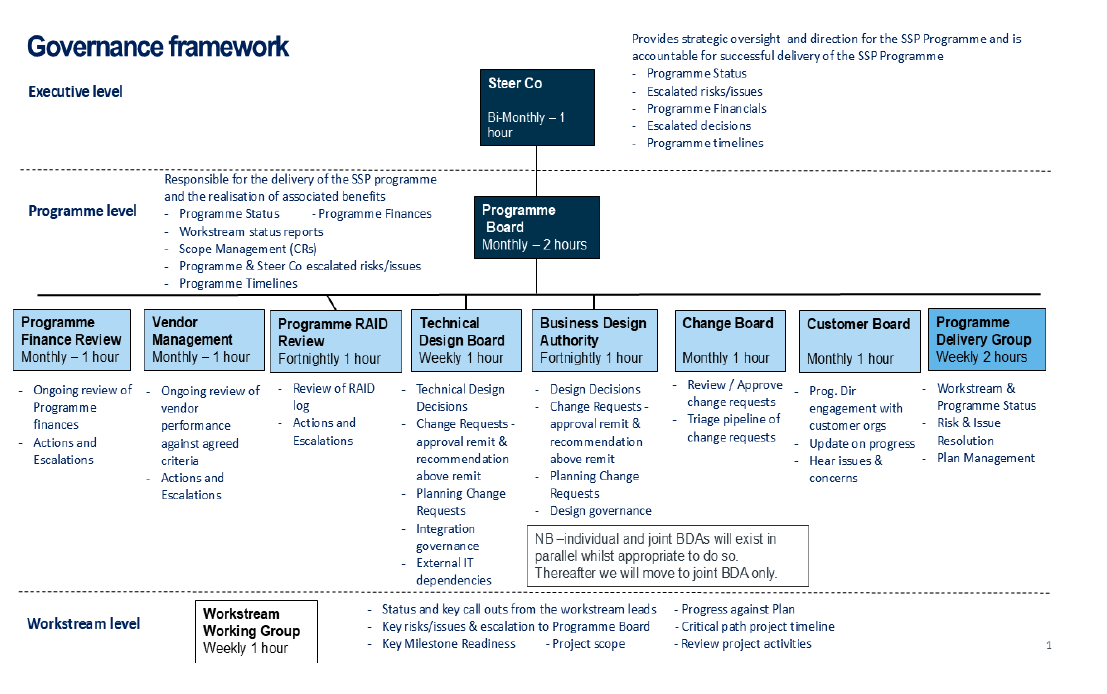
The image is a structured diagram titled “Governance framework”, illustrating the hierarchy, meeting cadence, and responsibilities of different governance bodies within a programme.
The diagram is divided into three horizontal sections: Executive level, Programme level, and Workstream level. Each section contains boxes describing committees or working groups, their frequency, duration, and responsibilities.
Executive Level
- Steer Co
- Cadence: Bi‑monthly
- Duration: 1 hour
- Responsibilities:
- Provides strategic oversight and direction for the SSP Programme
- Accountable for successful delivery
- Discusses programme status, escalated risks and issues, financial considerations, and timelines
Programme Level
Programme Board
Cadence: Monthly
Duration: 2 hours
- Responsibilities:
- Delivering the SSP programme
- Realisation of associated benefits
- Reviewing programme status and finances
- Workstream status review
- Managing scope
- Reviewing Steer Co escalated risks/issues
- Reviewing programme timelines
Below the Programme Board are several governance forums:
- Programme Finance Review (Monthly, 1 hour)
- Ongoing review of programme finances
- Actions and escalations
- Vendor Management (Monthly, 1 hour)
- Ongoing review of vendor performance
- Programme finances
- Actions and escalations
- Programme RAID Review (Fortnightly, 1 hour)
- Review of risks, actions, issues, dependencies (RAID)
- Actions and escalations
- Technical Design Board (Weekly, 1 hour)
- Technical design decisions
- Change requests
- Approvals
- New/changed solution requirements
- Review of timeline change impacts
- Internal governance items
- Business Design Authority (Fortnightly, 1 hour)
- Design decisions
- Change requests
- Approvals
- Review of new requirements
- Planning change
- Reviewing governance items
- (Note: Individual and joint BDAs exist in parallel, switching to joint only when appropriate.)
- Change Board (Monthly, 1 hour)
- Review and approve change requests
- Triage pipeline of change requests
- Customer Board (Monthly, 1 hour)
- Engagement with customer or operations
- Customer issues and concerns
- Programme Delivery Group (Weekly, 2 hours)
- Workstream and programme status
- Risks and issues
- Mitigation
- Plan management
Workstream Level
- Workstream Working Group (Weekly, 1 hour)
- Status and key call‑outs from the workstream lead
- Key risks and issues
- Milestones
- Key readiness activities
- Progress against plan
- Critical path and timeline
- Review of project activities
Contact
Email: corphub.servicemgt@gov.scot