
Serious Organised Crime Taskforce: progress report 2025
This progress report details some of the advances made by the Serious Organised Crime Taskforce and its partners.
Disrupt
The disrupt strand aims to disrupt SOCGs.
Notable prosecutions
In April 2024, five members of a SOCG who ran a major drug trafficking operation from a housing estate in the Inverclyde area were sentenced to a combined total of 31 years.
The group controlled the sale and supply of class A drugs, including cocaine, heroin, cannabis and etizolam, from a heavily-fortified property in Greenock. Their operation was foiled after French authorities gained access to encrypted messages exchanged on the EncroChat platform and passed them on to Police Scotland. The court heard one message referred to valium pills with a street value of more than £70,000. The group were notorious for causing widespread fear and anxiety in Inverclyde.
In October 2024, James Stevenson was sentenced to 16 years and three months in prison for orchestrating a plot to smuggle cocaine worth £76 million from South America hidden inside boxes of bananas. Five other criminal associates were jailed for a total of 29 years.
Stevenson had also planned to flood Scotland with millions of Etizolam tablets, also known as street valium, from a factory in Kent.
His plan was thwarted after Border Force officers at Dover intercepted the consignment from Ecuador, which was bound for an office at the Glasgow Fruit Market. Each accused denied the charges but pled guilty following the start of the trial at the High Court in Glasgow due to the weight of evidence and the strength of the Crown’s position.
Stevenson has long been recognised as one of Scotland’s most high-ranking SOC nominals. He was brought to justice following a multi-agency operation involving the NCA, Police Scotland and COPFS.
His arrest, under the auspices of Operation Pepperoni, came after French law enforcement broke into the encrypted communications platform EncroChat leading to hundreds of arrests across the UK.
In December 2024, a man was jailed for nine years for SOC offences in Fife after he admitted being involved in the supply of controlled drugs, and possession of criminal property.
Following an intelligence-led investigation by detectives in Fife, supported by specialist units, including analysts, cybercrime and financial investigators, police officers discovered this individual had developed a wide network of dealers working on his behalf.
Drugs, primarily cocaine and cannabis, were recovered as well as mobile phones and financial records linking him to the group, which resulted in him being arrested and charged.
Interventions and disruptions – Environmental Waste Crime
While SEPA continues to use all available enforcement tools available, such as civil penalties, enforcement notices and prosecution reports, it has placed a concerted effort into targeting effective interventions and disruptions as early as possible once illegal activity is detected, in order to prevent further or future harm being caused. Examples across the past year are displayed below:
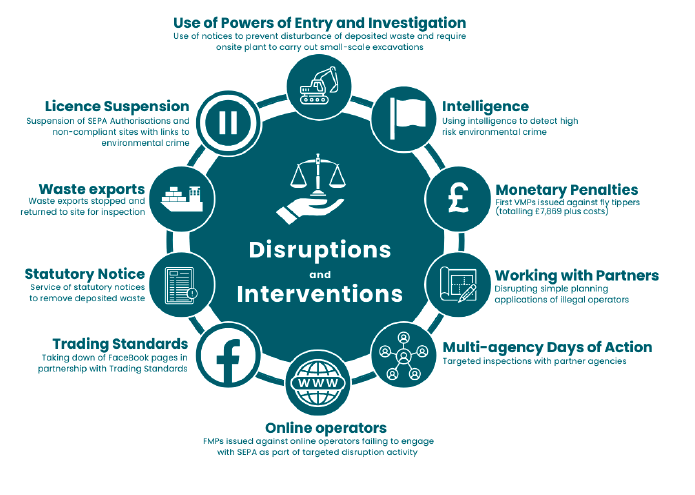
The image provides an overview of disruption and prevention activity undertaken by the Scottish Environmental Protection Agency.
Using intelligence helps to detect high risk environmental crime.
Monetary penalties – first penalties issued against fly-tippers (totalling £7,869 plus additional costs).
Working with partners – helps disrupt planning applications off illegal operators.
Multi-agency days of actions – undertaking targeted inspections of areas with partner agencies
Online operators – money penalties issued against online operators who fail to engage with the Scottish Environmental Planning Agency.
Trading Standards – removing Facebook pages in partnership with Trading Standards of those who operate illegal waste crime businesses.
Statutory Notice – issuing statutory notices to remove illegal waste.
Waste experts – working with partners to stop waste exports and return to sites for further inspection.
Licence suspension – suspension of SEPA licences and authorisations. This includes non-complaint sites with links to environmental crime.
Illegal Aberdeenshire waste site prosecution results in multiple penalties
An investigation by SEPA into an illegal waste site in Aberdeenshire, which started in 2020, resulted in a 150-hour community payback order, a £3,000 confiscation order and an 18-month supervision requirement served on a local man.
Derek McAllister was given the penalties at Aberdeen Sheriff Court for keeping controlled waste without the required authorisation and disposing of controlled waste by burning at the site in Den Quarry, Potterton. He also pled guilty to a further offence, of failing to remove waste from the site as required by a Statutory Notice served by SEPA and was admonished for that offence.
Many local residents living in the vicinity of the site complained over a two-year period regarding the deposit and burning of waste, and the impact it was having on the local community. Police Scotland and the Scottish Fire and Rescue Service were called out on multiple occasions even after SEPA officers had made it clear that the burning of waste at the site was unauthorised and unacceptable. The matter was investigated by SEPA officers, including those from SEPA’s dedicated Enforcement function, and a report sent to the COPFS recommending prosecution.
Operation CeCe – Illegal tobacco trade
North Lanarkshire Council’s Trading Standards team continues to collaborate with HMRC and Police Scotland as part of Operation CeCe, a UK-wide initiative aimed at tackling the illegal tobacco trade, which is closely linked to SOC. Significant enforcement action has been taken locally with over 130,760 illicit cigarettes and 27.83kg of illegal hand-rolling tobacco seized from 20 premises, including three repeat offenders. In addition, 6,232 non-compliant vapes were confiscated.
The illegal tobacco trade presents serious health risks, with counterfeit products often containing higher levels of harmful substances and contaminants such as glass and rat droppings. Illegally manufactured cigarettes also pose a fire hazard due to their failure to self-extinguish.
The trade also causes significant economic harm, costing the UK Treasury an estimated £2 billion annually, while undermining legitimate businesses and funding wider criminal activity such as drug smuggling, human trafficking, and illegal alcohol production.
Operation CeCe has delivered measurable outcomes in North Lanarkshire, removing dangerous products from circulation and helping to protect communities. Ongoing partnership working and intelligence-sharing remain vital to sustaining progress and effectively disrupting organised criminal networks linked to the illicit tobacco trade.
SOCGs and Nominals
Police and partners in Scotland monitor the activity of known SOCGs and nominals identified as being involved in SOCGs. The data included below is Police Scotland’s Q4 management information and covers 1 December – 28 February for the four financial years.
The number of known nominals has decreased by 34% since 2021-22, where there were 1,827 to 1,202 in 2024-25.
In 2024-25 Q4, 108 SOC nominals were incarcerated, the lowest figure of the relevant time series.
| Management information | 2021-22 | 2022-23 | 2023-24 | 2024-25 |
|---|---|---|---|---|
| SOCGs | 97 | 101 | 90 | 94 |
| SOC nominals | 1,827 | 1,726 | 1,421 | 1,202 |
| SOC nominals incarcerated | 196 | 165 | 158 | 108 |
| % of SOC nominals incarcerated | 11% | 10% | 11% | 9% |
Serious Crime Prevention Orders (SCPOs)
SCPOs are court orders which may be applied for by COPFS where a person has been convicted of, or is involved in, SOC. They were introduced in 2016 through the Serious Crime Act 2015.
The aim is to protect the public by restricting the activities of offenders once they are released from serving custodial sentences, to prevent them from becoming involved in SOC again. They are a valuable tool in disrupting SOC and are considered as a key part of the prosecution strategy in all significant SOC cases.
SCPOs can contain a range of restrictions, such as prohibiting the ownership of multiple mobile phones, or preventing someone from travelling abroad. A SCPO can last for a maximum of five years. The penalty for failing to comply with a SCPO is up to five years in prison and/or a fine.
As of March 2025, 151 individuals have had SCPOs imposed on them by Scottish courts. The majority of SCPOs granted in Scotland relate to individuals convicted of SOC.
| Year | 2020 | 2021 | 2022 | 2023 | 2024 | 2025 (to Mar) |
|---|---|---|---|---|---|---|
| Annual SCPOs Granted | 13 | 7 | 18 | 18 | 8 | 4 |
97 individuals remain in prison with SCPOs granted but inactive until date of release. 41 nominals are ‘live’ with 40 being actively monitored in the community, one individual has since been recalled to prison.
Proceeds of Crime Act 2002 (POCA)
POCA provides for the criminal confiscation or civil recovery of the financial benefit derived from criminal activity. A key element of the SOC Strategy to disrupt SOC is ensuring that criminals do not profit from their illegal activities and in 24-25, £11,070,907 was remitted to the Scottish Consolidated Fund (SCF) through criminal confiscation and civil recovery under POCA. COPFS has a specialist team which works with a range of partners to ensure that the proceeds of crime are restrained and confiscated from offenders, following their conviction.
Civil Recovery Unit (CRU)
The CRU operates on behalf of the Scottish Ministers. The CRU uses civil court proceedings to make Scotland a hostile environment for people involved in unlawful conduct, including SOC. To achieve this, the CRU conducts non-conviction based asset recovery, investigating the source of funds used to acquire assets and recovering any property obtained through unlawful conduct. The CRU can also recover money which may be intended for use in unlawful conduct. By removing assets, including money, this disrupts the activities of SOCGs. The sums recovered are remitted to the SCF and used by the CashBack for Communities programme.
The CRU works closely with law enforcement, Government departments and agencies, and the financial sector. To maximise disruption, the CRU routinely refers cases to HMRC for the possible taxation of criminal gains.
| Year to 31 March |
Court of Session (Asset Recovery) (£) |
Cash Forfeiture (£) |
Listed Assets (£) |
Account Freezing Orders (£) |
Yearly total – all business areas (£) |
Amounts returned to victims following CRU actions | Total recovered through civil recovery actions |
|---|---|---|---|---|---|---|---|
| 2020 -2021 | 2,275,962 | 2,141,445 | 129,387 | 972,912 | 5,519,707 | 197,984 | 5,717,691 |
| 2021 -2022 | 2,243,247 | 2,235,104 | 47,634 | 464,267 | 4,990,253 | 231,016 | 5,221,269 |
| 2022 - 2023 | 4,296,396 | 2,738,459 | 51,049 | 1,793,447 | 8,879,351 | 75,643 | 8,954,994 |
| 2023 -2024 | 2,196,738 | 2,534,249 | 63,633 | 554,133 | 5,348,753 | 426,037 | 5,774,899 |
| 2024 - 2025 | 1,555,217 | 2,910,641 | 75,891 | 423,401 | 4,965,150 | 79,952 | 5,045,102 |
Contact
Email: OrganisedCrimeUnit@gov.scot