
Scottish seabird conservation action plan
Plan setting out a series of priority actions for building seabird resilience and focusing collaborative seabird conservation action.
Our approach: Making a difference where it matters most
Our efforts to safeguard seabird populations are multi-faceted and chimes with our Scotland-wide ambitions to transition to net zero, be nature positive, restore and regenerate biodiversity, deliver sustainable fisheries and well-placed marine development, and to achieve and maintain GES for our seas. Collective progress across all sectors to address seabird declines in Scotland is being made with some significant steps in the right direction already implemented or underway (for example, developing technical measures to reduce bycatch in the fishing sector). However more can be done. Seabird conservation requires the coordinated effort of many stakeholders, including government, it’s agencies, conservation organisations, marine industries, local communities, academia and the tourism sector. This action plan provides a framework for collaboration and ensures that efforts are well-coordinated, strategically targeted, and backed by evidence. By taking this holistic approach to seabird conservation, our efforts are focused where they are most needed and can be most effective.
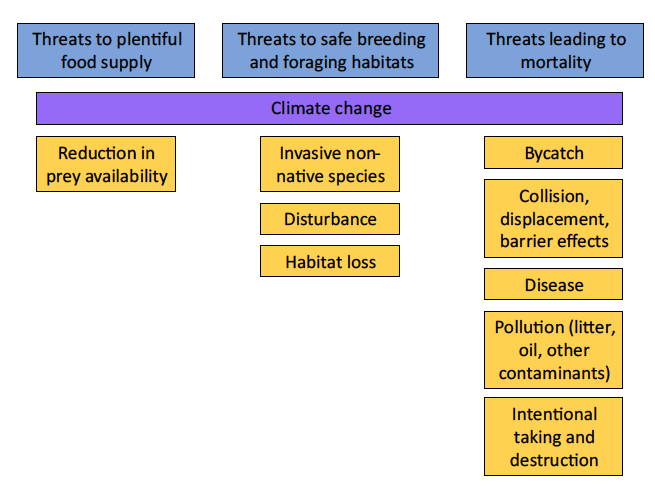
Seabirds are long-lived species that spend most of their time at sea, in many cases only coming to land to breed. This means that seabird populations are affected by a wide range of pressures, some at sea, not just in Scottish waters, and others in coastal environments where they breed, or during migration. These pressures act on seabirds in three main ways; on their food supplies, availability of safe breeding and foraging habitats, or through direct mortality.
This action plan therefore focuses on three core themes for action in Scotland:
1. ensuring plentiful food supplies,
2. restoring and improving seabird habitats and;
3. maximising resilience and survival.
Actions required to support these themes such as research, raising awareness and international collaboration are also included. We recognise that there will be overlap between some themes and their actions.
The action plan has been developed in partnership by a Working Group taking account of stakeholder views from a workshop held in February 2022 and a report on potential actions to support recovery of seabird populations in Scotland (Furness et al. 2024). Actions are focused on addressing the main pressures acting on seabirds whilst in Scottish waters and/or at breeding colonies, as identified in ‘The Scottish Seabird Vulnerability Report’ (Marine Directorate, 2025) that accompanies this action plan. Each pressure is grouped under the relevant theme that reflects its impact on seabird populations, ensuring a targeted approach to addressing the specific challenges faced by seabirds in Scotland. We recognise that not all of the pressures act in isolation or are necessarily equal in how they affect seabird populations. The identified pressures are also likely to vary over time, space and across seabird species. In recognition of these complexities and the need for a multi-faceted approach to address seabird declines at the scale and pace required, the plan does not attempt to prioritise the pressures.
Climate change is recognised as a contributing factor to declines in global seabird populations and a key driver affecting several of the pressures presented within the action plan. Scotland’s ambition to be net zero through the delivery of offshore wind energy has the potential, alongside other measures, to bring benefits to seabird species in the longer term through resilience building. The plan and accompanying vulnerability report recognise offshore wind developments as presenting a threat to seabirds in terms of collision, displacement and barrier effects. This plan acknowledges that there will be difficult decisions to be made in terms of how we balance our offshore wind ambitions and safeguard our seabird populations.
Contact
Email: marine_species@gov.scot