
Publication - Research and analysis
Scottish economic bulletin: July 2025
Provides a summary of latest key economic statistics, forecasts and analysis on the Scottish economy.
Inflation
The inflation rate fell marginally in May to 3.4%, driven by easing transport prices.
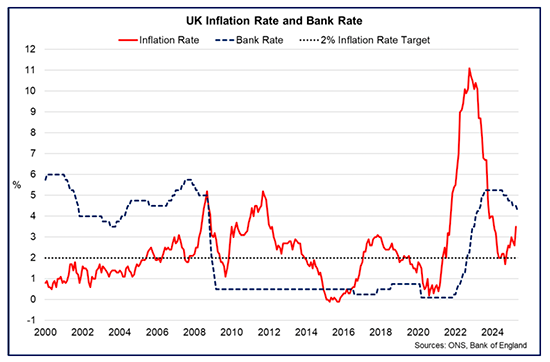
- Inflation fell from 3.5% in April to 3.4% in May. The decrease reflected a data error in the April figures that has not been revised by ONS, and which contributed to transport annual price growth slowing from 3.3% to 0.7% in May, offsetting a rise in food price inflation (4.3%, up from 3.3%) and furniture and household good price inflation (7.8%, up from 7.7%).[4]

- There remains a difference in the rate of goods and services price inflation, although the gap continued to narrow in May with services inflation falling to 4.7% while goods price inflation rose to 2% - its highest rate since November 2023. Core inflation (excluding energy, food, alcohol and tobacco) fell to 3.5% (from 3.8%), returning broadly back in line with its average annual rate over the past year.
- In May, the Bank of England (BoE) forecast inflation to rise to 3.7% in September (3.5% on average over the third quarter) as a result of higher energy and water bills, the indexation of bills such as broadband and phone charges and the impact of higher employer NICs. From there, inflation is forecast to gradually fall back to around 2% by the start of 2027, though there remain risks in both directions to this forecast, including the current uncertainty surrounding global energy prices and the persistence of domestic factors.[5] Reflecting this, the Bank’s Monetary Policy Committee held the Bank Rate unchanged at 4.25% in June, following its 25 basis point cut in May and is consistent with its gradual approach to loosening monetary policy over the past year.[6]
Contact
Email: economic.statistics@gov.scot