
Publication - Research and analysis
Scottish economic bulletin: February 2025
Provides a summary of latest key economic statistics, forecasts and analysis on the Scottish economy.
Labour Market
Unemployment fell to 3.8% in November while the pace of earnings growth softened.
Employment, Unemployment, and Inactivity
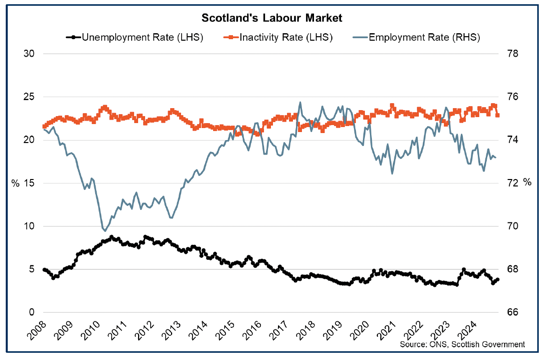
- The labour market in Scotland remained resilient towards the end of 2024 with low unemployment and high, stable levels of employment, however latest data also indicates the underlying tightness is continuing to ease from more elevated levels earlier in the year.
- For September to November, latest Labour Force Survey data show that Scotland's unemployment rate fell 0.2 percentage points over the quarter, and fell 0.5 percentage points (p.p) annually, to 3.8%. The employment rate rose over the quarter by 1 p.p. and by 1.2 p.p over the year, to 74.1%. The inactivity rate fell by 0.8 p.p over both the quarter and on an annual basis to 22.9%.[8],[9]
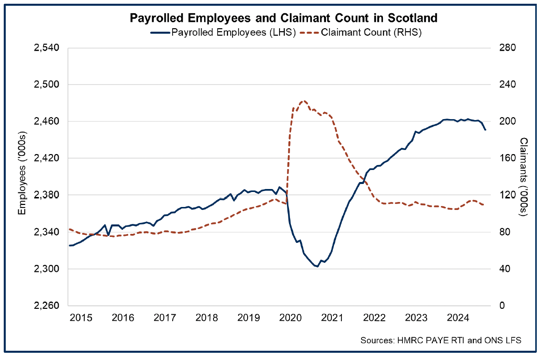
- Wider labour market data also continues to indicate stability alongside some loosening over the past year. The number of payrolled employees in Scotland fell slightly in December by 0.3% from November and by 0.5% (c. 11,000 employees) over the year from December 2023. Similarly, Scotland's claimant count unemployment rate was unchanged at 3.8% in December, however rose from 3.7% in December 2023 with the number of claimants rising by 1,800 over the year to 109,100.[10],[11]
Recruitment Activity
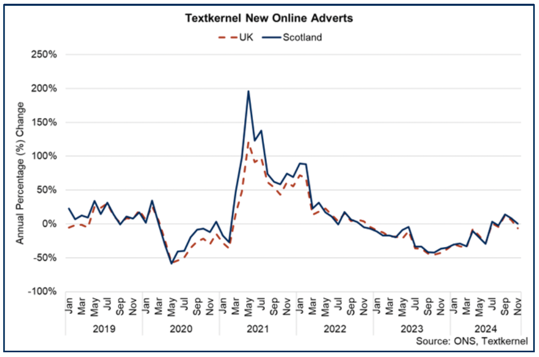
- Online vacancies data shows that recruitment activity continued to stabilise during the second half of 2024 to around pre-pandemic levels, having fallen from elevated recruitment activity levels in 2022 and 2023.[12]
- In November 2024 there were over 39,500 newly advertised jobs online in Scotland, having peaked at over 74,500 during 2022. This is an increase of 0.4% relative to November 2023 while there was a decrease of 6.6% for the UK as a whole.[13]
- Wider business survey data also indicates a stabilisation in recruitment activity and a degree of loosening through the turn of the year. RBS Growth Tracker data for December indicated that private sector businesses decreased staffing levels for the first time since January 2023, following a trend of easing recruitment over the second half of 2024.
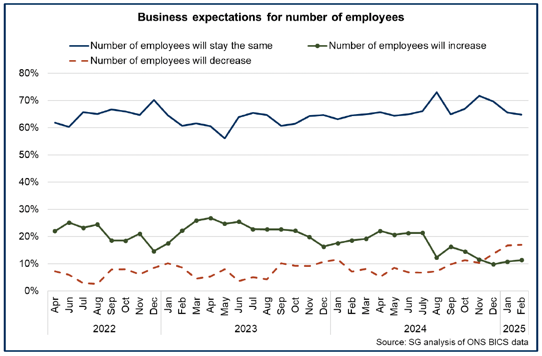
- BICS data also points to further loosening in the labour market in 2025 compared to 2023 and 2024. Most businesses (64.7%) expect employee numbers to stay the same, however the share of businesses expecting the number of employees to decrease has risen to 16.9% while the share of business expecting employee numbers to rise has also fallen to 11.4%.
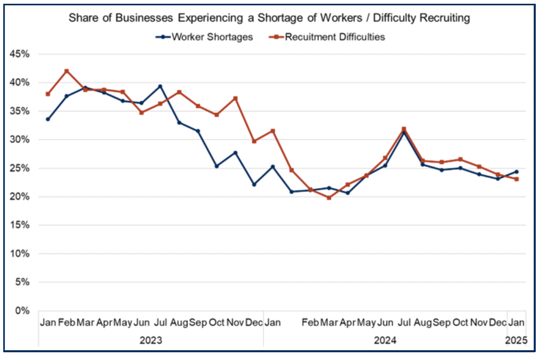
- Furthermore, BICS data also continues to indicate further stabilising in the share of businesses reporting worker shortages and recruitment difficulties. In January, 24.4% of businesses are experiencing worker shortages while 23.1% are experiencing recruitment difficulties, both of which have eased across the second half of 2024.
Earnings
- Labour earnings continued to grow in real terms at the end of 2024, however the pace of growth cooled somewhat from recent months reflecting a combination of slower nominal growth and the recent pick-up in inflation.
- In December, nominal median monthly PAYE pay in Scotland was £2,485, and grew by 4.8% on an annual basis (down from 7.4% in October and November). This is the lowest nominal growth rate since February 2024, and is consistent with pay growth moderating from the high rates of growth seen in 2023.[14]
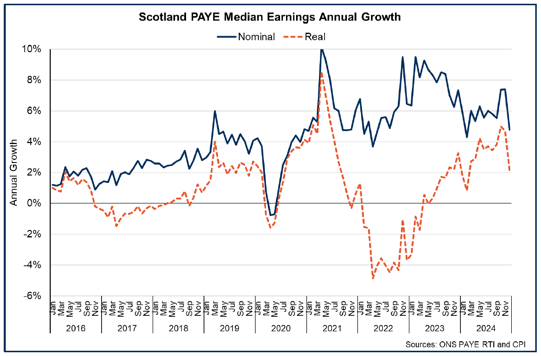
- Adjusting for inflation, earnings grew by 2.1% in real terms on an annual basis in December (down from 4.7% in November), and is similarly consistent with the broader trend of the pace of real earnings growth gradually stabilising over 2024 as a whole.
- The outlook is also one of continued real wage growth albeit at a slower pace. The Bank of England Decision Maker's Panel (DMP) reported annual UK wage growth of 5.4% in the 3-months to December and anticipated year-ahead wage growth of 4.0% (unchanged from November), signalling wage growth to decline by 1.4 percentage points over the next year.[15]
Contact
Email: economic.statistics@gov.scot