
Blue Economy scenarios: final report - summary
Scottish Government commissioned Waverley in December 2023 to create different scenarios for use of marine space in Scotland to help identify reasoned descriptions of alternative possible futures in order to explore how current and alternative development trajectories might affect the future.
3. Backcasting the future
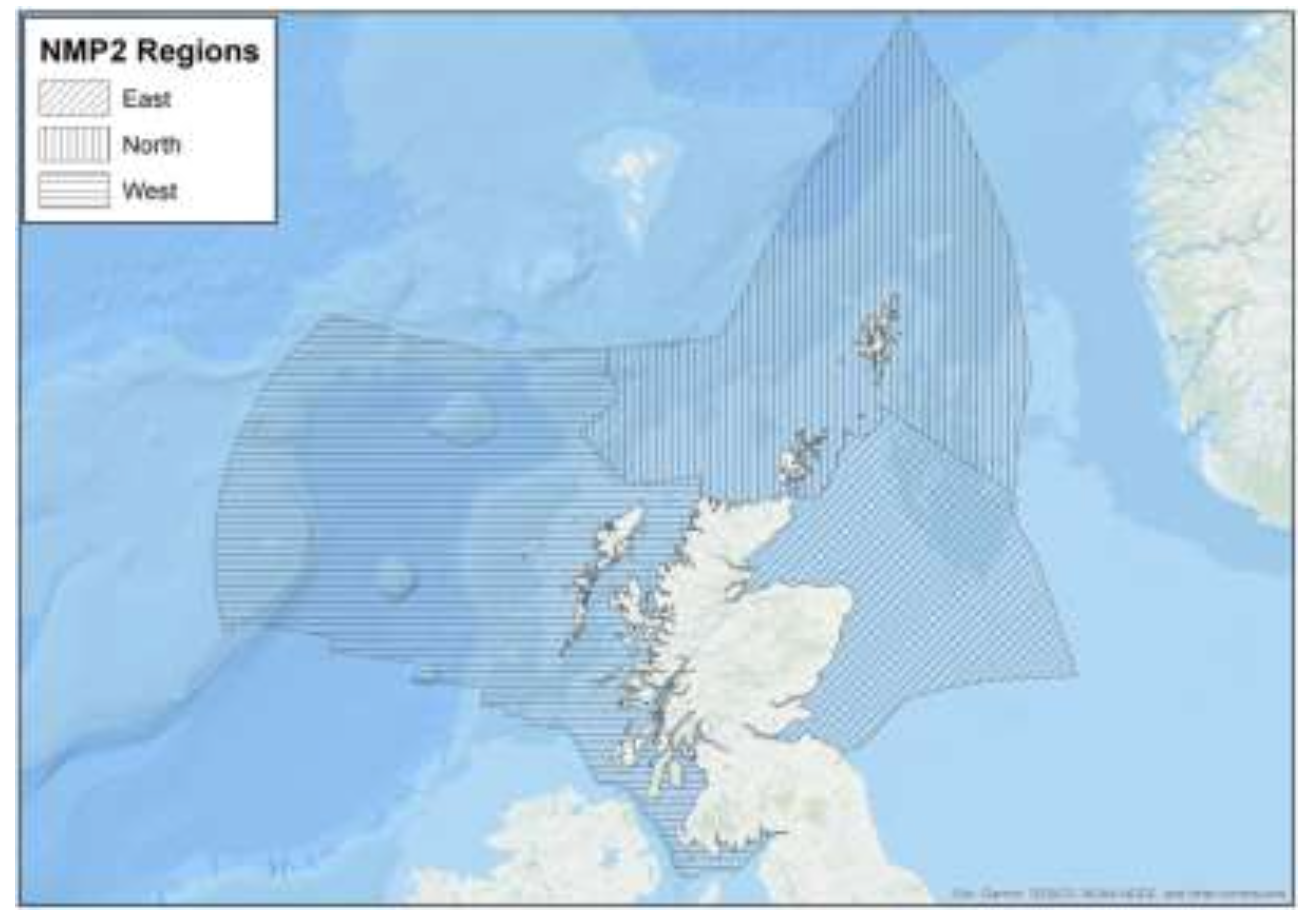
Backcasting is a technique for determining the steps that need to be taken to deliver a preferred future and setting out the key changes required to deliver it and using the conversation to identify what is wholly in governments’ control and what is not.
Stakeholders were unanimous that End of the rainbow is the scenario that most closely represents the future they aspire to. We therefore asked them to conduct a backcasting exercise to determine the steps required to deliver this future. Stakeholders worked in three groups, each focussing on one of the NMP2 Regions – North, East or West (see schematic on the right) – and backcasting the steps required to deliver End of the rainbow.
We asked groups to identify the steps that are required to deliver the future and to distinguish between
Steps that are wholly in government’s control
Steps that are not wholly in government’s control
The backcasts
North – Steps that are wholly in government’s control
2025 – 2045
- We have a good understanding of Scot Nat Cap resource indicators
- Natural capital valuation in place accompanied by monitoring of user trust
- NMP2 gives clarity over marine spatial planning and facilitation of multi use of marine space
- Industry understands climate impacts and builds resilience design
- Increased ocean literacy (environment "source to sea")
- Shared understanding of biodiversity/ecosystems services/ecosystem functioning
- Scotland actively participates in international decisions and influences UK Gov (eg treaties)
- Space for nature protection/enhancement
- Increased/clear community involvement in marine decision-making
- Build our understanding of scale, evidence, science to inform what we restore and how we do it
- Cultural change to transparent evidence based decision making
- Strategic compensation measures – not like for like compensation – in play
- Monitoring of MPA network
- Better use of data – including developers’ data
- Feedback loops. Regular reporting on outcomes/reach/balance (not all equal growth at all times)
- Designated sites are more protected
- Structure for participatory decision making
- Nature positive design/net gain
- Recognition of cultural heritage (tangible and intangible)
- Space for transport marine
- Nature (space) based solutions for adaptation increased
- Review of management approaches and adaptation of approach
- Microrenewables are enabled
- More affordable access/transport to coast
- Decarbonisation/economic solutions for all sectors incl. vessels
- Increased local management/ownership
- Better transport links to improve access to markets. Resilient in bad weather.
North – Steps that are not wholly in government’s control
2025-2045
- Grid!
- Political and economic stability (national and international) is achieved
- Retained UK gov decisions mean political commitment across UK
- Unknown/unpredicted environmental change
- Long term confidence builds
- Mature open debate in media
- Build trust and credibility
- Allocate sufficient funding/resources to local authorities
- Knowledge of climate impacts (adaptation) and openness to required change (landward movement/giving up land to sea) is widespread
- Change the political culture
- Green finance/market/lease
- Viable alternatives for oil and gas:
- energy profession
- skills
- pay
- Oil and gas expansion – market driven
- Change land use
- Increase ocean literacy
- Global emissions: progress towards net zero 2050 (vs Scotland's contribution?)
- Deliver viable diverse island economies. Housing/transport/jobs/digital connectivity
- Change diets
- Local and central government have a different relationship
East
2025-2045
- Clear national single consenting regime (all sectors fall under same regime)
- Support for all sectors to adapt practices in line with NMP2 vision
- Clear priorities and objectives stated in NMP2
- Education regime to encourage next generation to make lifestyle changes
- Repowering OWF within the existing array
- Approved/efficient spatial planning in place
- Marine net gain
- Make green policies a priority
- Investment and increased resources for public sector workers at gov and local levels
- Nature finance market enables marine nature enhancement
- Innovative tech to support co-location. Maximise efficient use of marine space
- Consistent approach to regulation across all sectors
- Al and technology and innovation support evidence gathering and monitoring
- Strong evidence base that is utilised correctly
- Public education on how everyone wins if environment wins
- Holistic decision-making for sector development
- Skills passport established to support move from O&G work to offshore energy
- Planning priorities are specific to areas (one sector wins in one area but not necessarily in others)
- NMP has been followed and implemented
- Appropriate licensing and consenting regime covering all sectors in Scottish waters (some, like oil and gas and gas storage, are reserved)
West
2025-2045
- Regional Marine planning to support community participation and ownership
- Community wealth building (supported by businesses). Community benefit schemes
- Resourced public sector (civil service, local authorities, etc)
- Evaluate the cost (financial and other) of inaction
- Higher risk appetite towards innovations and their impacts (eg licensing) but hard for some sectors
- Clearer guidance on implementation of agreed/aligned policy that is codesigned
- Policy to incentivize business (financial and non-financial) to be nature positive
- Nature biodiversity policy alignment
- Long-term adequate protection of restored nature
- Short-term policy approaches stop
- Adapt to climate change effects on islands (eg flooding, shrinking coastlines)
- Scaling up of nature base solutions in coastal and Marine spaces
- Skills development focused on innovation in nature positive and circular economy
- Increase in public and private funding invested in innovation
- Quantification of externalities ensures businesses pay these costs, not public taxation
- Tourism tax invested to mitigate impact & to support communities
- Conservation tax/fees. With exemptions for locals/enables nature access for all
- Scrutiny via Future Generations Bill/Commission and ESS
- Better evaluations – fail fast and learn
- Innovations drive circular economy, nature positives etc
- More citizens’ assemblies/panels (less reliance on conventional public consultation methods)
- Communities see benefits of change
- Cross party collaboration (de-politicised decision making)
- Strategic and spatial planning for nature restoration with international linkages for migratory species
- Scotland remains active in international bodies (OSPAR etc)
- Polluter pays principal is enacted efficiently so money goes to where the impact is left
- Public, business, communities are willing to adapt to change
- National and international policy alignment
- More devolved and delegated authority for decisions (less central control)
- Digital investment in coastal communities provides more opps for jobs and spending in areas
- International change to nature positive business models
- Businesses change business models: circular, nature, life cycle, co-existence
Recommendations on next steps
What needs to be included in NMP2
We have clustered suggestions together by theme. There are seven:
- Clarity
- Transparency
- Better use of data
- Prioritisation
- Nature based solutions
- Instruments
- Ownership
Clarity
- NMP2 must give clarity over marine spatial planning and facilitation of multi-use of marine space
- Clear setting out of resources for delivery and indication of responsibilities
- Clear implementation for every objective within NMP
- Clear monitoring strategies (spatial and sectoral)
- Transparency around decision-making and evidence-based decision-making
Better use of data
- Monitoring of MPA Network and making better use of data (encourage developer data sharing)
- Foster/encourage innovation to gather/collect/ review more joined-up evidence gathering/use
- Central/single marine data repository that is public domain/open to all
Prioritisation
- Spatial planning is a must. Prioritisation criteria are needed
- Investment/prioritisation of nature protection – both through MPA designation and monitoring and through active restoration of habitats e.g. seagrass
Nature based solutions
- Nature (space)-based solutions for adaptation e.g. blue carbon habitats
- Space for nature recovery and enhancement
Instruments
- Revision of marine consenting such that all regimes/sectors fall under a single national regime
- Develop green finance
Ownership
- Focus on bringing people along – social license areas
- Increased/clear community involvement in marine decision.
- Building ocean library and source to sea literacy
Triggers that will indicate government needs to be directive in driving NMP2 forwards
Participants identified 5 triggers
- When outcome intervention becomes clear (accelerate/decelerate as system requires)
- Ecosystem collapse despite action taken
- Unforeseen events (pandemics, war, etc)
- Conflict resolution to make national interest decisions
- Final say on national priorities (energy v food v health)