
Razor clam scientific trial: fisheries assessment
A fisheries assessment for the Scottish razor clam scientific trial extension. This report assesses the potential impact of the razor clam scientific trial with reference to priority marine features, and the conservation objectives of a variety of sites in Scotland's MPA network.
3. Appropriate Assessment: Assessment of implications of fishing activity on protected features in view of the site-specific conservation objectives.
3.1 Outer Firth of Forth and St Andrews Bay Complex SPA
The following figures and information are referred to against the relevant features in relation to site-specific advice and information.
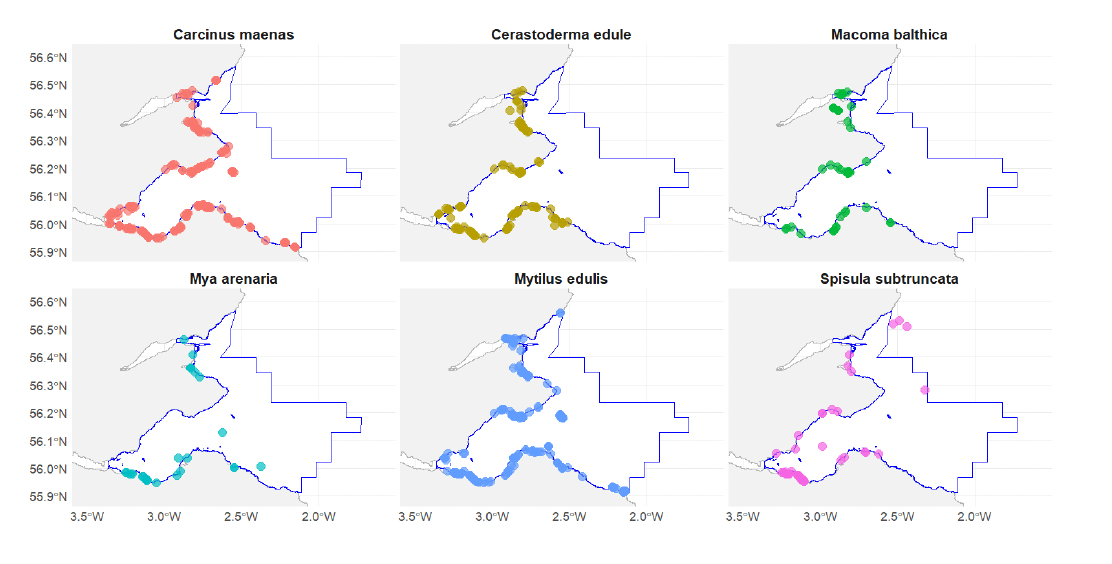
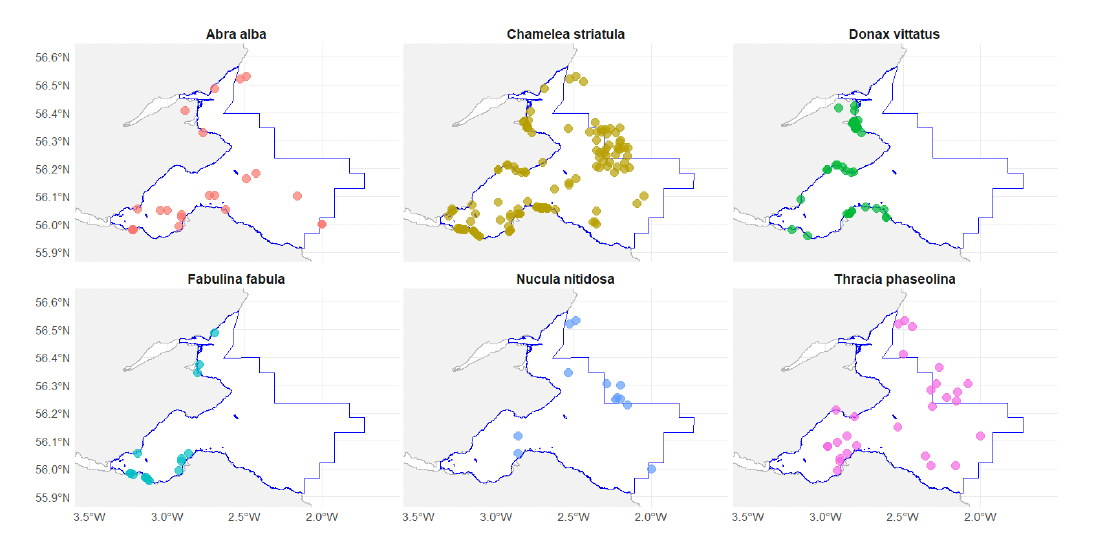
Data from GBIF are ‘presence’ records, not records of abundance and are derived from a data portal that combines many different datasets, so these records do not constitute a comprehensive census of prey species distribution in the area. Instead, they are indicative of the best available knowledge of the occurrence of these species.
The BTO publishes Wetland Bird Survey (WeBS) alert reports periodically that highlight if trends within a particular SPA depart from regional or national trends. This is useful in determining if there are site-specific pressures to examine.
The BTO carries out its WeBS counts at four locations in the Outer Firth of Forth and St. Andrews Bay Complex SPA: Tay Estuary, Forth Estuary (actually in the firth at Inchcolm), St Andrews Bay and Eden Estuary. The closest site to razor clam fishing activity is Forth Estuary. In comparison to aerial surveys these counts may underestimate abundance, however WeBS is a useful resource for examining trends. Trends and peak counts are determined from records that exclude incomplete surveys.
3.1.1 Razor clam fishing activity
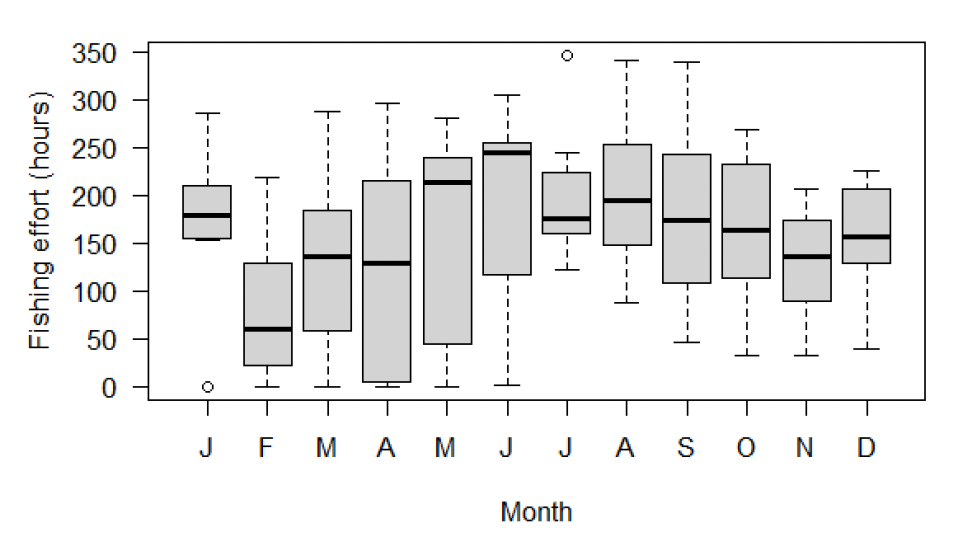
There are four participating vessels active in this trial area, compared to a total of 209 fishing or fishing-associated vessels operating from ports in Anstruther and Eyemouth districts (Scottish Government, 2025), as well as various other vessels as summarised in 3.1.2. Vessel activity associated with the trial inside this SPA involves travel from the ports of Methil and Pittenweem to razor clam grounds in Largo Bay and Gullane Bay (Blackadder, 2024). The annual average number of fishing days is 347 with a range of 231 to 428. Fishing occurs throughout the year, though there is more effort in summer, and in January as the participating vessels respond to high demand from Asia associated with Lunar New Year (Figure 4). The fishing gear in use on razor clam vessels is a lightweight electric current device towed at approximately three metres per minute, followed by divers (Blackadder, 2024). Individual fishing tows are limited by divers air supply, typically less than one hour. Electrodes leave a slight indent in the seabed, less than 1cm deep (Murray, Copland, Boulcott, Roberston, & Bailey, 2014).
Beginning in 2024, a seasonal closure was introduced to the trial, with fishing suspended between mid April and mid May. This closure was informed by knowledge gained in the trial of razor clam spawning activity.
3.1.2 Non-razor clam vessel activity
The SPA is home to a major port, Grangemouth, as well as several other harbours. The main vessel types that have a presence in Largo Bay or Gullane Bay are fishing vessels, cargo vessels, tug and towing vessels, high speed craft, pleasure craft and other uncategorised vessels (EMODnet, 2024). Vessel activity by category is summarised below.
- Fishing vessels are active throughout the SPA. The main fishing activity in the SPA is trawling for Nephrops which mostly occurs in the deeper portions in the central firth (Table 1). There is vessel overlap with razor clam grounds in Largo Bay and Gullane Bay. Other than razor clam fishing gear, the types of gears most in use by vessels fishing in Largo Bay and Gullane Bay are creels, pots and traps and bottom trawls. A small amount of fishing for species other than razor clams by diving and hand gathering occurs in both Largo Bay and Gullane Bay. Fishing with dredges and by hook and line is also a feature, but generally not in the vicinity of either Largo Bay or Gullane Bay. A targeted fishery for surf clams operates along the fife coast and into the eastern margin of Largo Bay.
- Cargo vessels principally use the main channel of the firth, with activity connecting the main navigation channel to the ports of Grangemouth, Rosyth, Dundee, Edinburgh, Burntisland, Kirkcaldy, Methil. There is some overlap with razor grounds in Largo Bay associated with use of the port of Methil. There is little overlap with razor grounds in Gullane Bay.
- Tanker vessels principally use the main navigation channel of the firth, with activity connecting the channel with Grangemouth, Kirkcaldy and Edinburgh. There is little overlap between tanker vessels and razor grounds in Largo Bay or Gullane Bay.
- Passenger vessel activity is focused on Port Edgar, Edinburgh, North Berwick, Anstruther and Dundee. There is little overlap between passenger vessels and razor grounds in Largo Bay or Gullane Bay.
- Tug and towing vessels are active throughout the SPA, with particular hot spots around Grangemouth, Port Edgar, Edinburgh, Methil and Anstruther. There is some overlap with razor grounds in Largo Bay. There is little overlap with razor grounds in Gullane Bay.
- High speed craft are associated with renewables energy development and mainly travel from Port Edgar, Edinburgh, Burntisland and Kinghorn. There is a further hot spot of activity in Largo Bay that overlaps with razor grounds.
- Military and law enforcement vessels have some presence in the firth, principally docking at Edinburgh and Rosyth. There is little overlap with razor grounds in Largo Bay or Gullane Bay.
- Pleasure and sailing craft operate out of many ports throughout the SPA with particular hot spots at Port Edgar, Dundee, St. Andrews, Anstruther and North Berwick. There is some overlap with razor grounds in both Largo Bay and Gullane Bay.
- Dredging (in connection with harbour maintenance rather than fishing) and underwater operations vessels operate out of several ports in the firth. There is little overlap with razor grounds in Largo Bay or Gullane Bay.
- Service vessels operate out of several ports in the firth with particular hot spots in Edinburgh, Dundee, Rosyth, Burntisland, Kirkcaldy and Methil. There is little overlap with Largo Bay or Gullane Bay.
- Other and unknown vessel types operate out of several ports including Port Edgar, Rosyth, Edinburgh, Methil and Dundee. These appear to be active in offshore renewables. There is overlap with razor clam grounds in Largo Bay. There is little overlap with razor clam grounds in Gullane Bay.
| Activity | Annual Average Fishing Effort (Days) | Swept seabed area (km2) | Footprint (c-squares) |
|---|---|---|---|
| Razor clam trial | 347 | no data | 10 |
| Nephrops and crustacean bottom trawls >12m | 2818.4 | 2120.1 | 114 |
| Dredges >12m | 71.3 | 58.6 | 40 |
| Pots and traps <12m | 109.9 | no data | 190 |
| Rods and Lines <12m | 13 | no data | 51 |
| Bottom trawls <12m | 19.9 | no data | 150 |
| Dredges <12m | 46.5 | no data | 32 |
| Diving/gathering <12m | no data* | no data | 5 |
Note: Under 12m data from Scottish Sea Fisheries Statistics spatial data. Over 12m data from ICES. ICES data are reported in hours and were converted to days by dividing by 12. * redacted due to number of vessels. C-square resolution: 0.05x0.05°.
3.1.3 Eider
Site-specific advice 2a
The site-specific advice for eider is to:
- Maintain the population of non-breeding common eider at a stable or increasing trend relative to the site reference population and ensure common eider can move safely between the site and important areas of functionally linked land outwith the site.
The small number of vessels operating out of established fishing ports against the context of fishing and wider non-razor clam vessel activity in the SPA and connected areas at large, and the slow speed while engaged in fishing is not considered to represent a significant risk to the population through either collisions or effects of evading vessel movements.
There is evidence that eiders have to some extent become habituated to the presence of razor clam vessels. Groups of up to 100 ducks have been observed following razor clam vessels and observed on video of diving operations taking stunned clams (Fox, Report on razor clam surveys in Largo bay (Firth of forth)., 2021). There have been no reports of mortality or injury attributable to fishing operations during the trial in this area.
WeBS alert data for eider at the overlapping Firth of Forth SPA up to winter of 2021/22 show a log term declining trend. The BTO consider the decline of eiders in this area to have been exacerbated as a result of site-specific pressures (Caulfield, Feather, Smith, Frost, & Woodward, 2025). WeBS peak counts for the Forth Estuary site on Inchcolm Island also show a decline in eiders when comparing the period prior to the razor clam trial to after the commencement of the trial, though many surveys are flagged incomplete and excluded from statistics by BTO (Table 1).
| Period | Five-year moving average peak count |
|---|---|
| 2019/20 to 2023/24 | 4529 |
| 2018/29 to 2022/23 | 4529 |
| 2013/14 to 2017/18 | 5391 |
Data from BTO WeBS Programme (Calbrade, et al., 2025).
Site-specific advice 2b
The site-specific advice for eider is:
- Ensure eider continue to have access to and can utilise all optimal habitats suitable for all relevant aspects of their life cycle associated with the site
- Avoid significant disturbance to eider and ensure individuals can move safely between these areas within the site.
Razor clam fishing activity involves travel from established ports to razor clam trial grounds for fishing operations. This does not constitute a large-scale physical barrier.
A seasonal closure is in place in the trial from late April to Late May during which no fishing activity will take place, this overlaps with the end of the non-breeding season between September and April. The flightless moult period is between July and September. 31.2% of fishing hours have occurred during the flightless moult months, with effort declining from August (Figure 4).
Razor clam fishing activity occurs in depths that eiders are capable of foraging in. As noted, eider in this trial area are reported to follow razor clam vessels while foraging and are therefore not considered to be disturbed by vessel activity.
Site-specific advice 2c
The site-specific advice for eider is:
- Maintain the extent and distribution of the supporting habitats for common eider within the site
- Maintain the variety and abundance of food resources and the condition of supporting habitats and associated processes
- Existing water quality should be maintained and any increase in nutrients, turbidity or contaminants where this could reduce supporting habitats and/or prey, should be avoided.
Eider feed on razor clams and other organisms that may inhabit razor clam fishing grounds. The stock assessment for the Forth trial area found the level of fishing mortality to be below the estimated maximum sustainable yield level, therefore fishing activity within the SPA is not reducing the biomass of razor clams (Blackadder, et al., 2024). Eiders have a preference for small prey, with a maximum prey size of 80mm in length (Larsen & Guillemette, 2000). Razor clam harvesting is limited to a minimum conservation reference size of 100mm and a strong market preference for clams of 150mm or greater means that small numbers of small clams and negligible numbers of undersized clams are harvested across the trial (Blackadder, et al., 2024).
The population of clams in Largo bay is heavily weighted towards large clams (Blackadder, et al., 2024), therefore there is limited overlap in harvesting between eider foraging for razors and targeted removal by razor clam vessels.
As noted, eiders follow razor clam vessel and have been observed diving close to divers and taking small clams. This may constitute an additional prey source that ducks have become habituated to exploiting as the energetic cost of taking shocked clams versus digging for them is likely to be lower. Consequently, any change in razor clam fishing may impact the variety and abundance of food resources for eiders.
Largo Bay is in shallower water than Gullane Bay and therefore there may be greater following behaviour in the former than the latter. The stronger tidal currents in Gullane Bay may make this habitat less suitable for eider than Largo Bay (Scanlon & Strickland, 2024).
Eider have a preference for small sized mussels. Razor clam fishing is not expected to affect blue mussel habitat. These are mainly found on rocky or cobbly substrate that is separated from razor clam activity (Scottish Government, 2018) subtidal beds on muddy or sandy sediment are not found within the areas of razor clam fishing activity (NatureScot, 2025). Intertidal mussels are widely distributed within the SPA, as are other prey fauna such as common cockles and shore crabs (Figure 1).
Evidence gathered before and during the trial points to only short term and recoverable effects of electric current on crabs (Blackman, Fox, & Albalat, 2024) and bivalves (Murray, Copland, Boulcott, Roberston, & Bailey, 2014). Combined with the minimal physical impact on the seabed and highly localised footprint of the trial fishery, the activity is not considered to be capable of damaging benthic habitats in the SPA to the extent that it adversely affects prey availability for eiders.
Scotland’s Marine Assessment indicates while nutrient inputs and chlorophyll concentrations are high in the Forth and Tay Scottish Marine Region which overlaps with the SPA, this did not amount to eutrophication (Scottish Government, 2020). Razor clam fishing activity may cause localised increases in turbidity at the seabed during fishing operations, but this is not considered likely to contribute to a deterioration in water quality locally or at the water body scale.
Overall assessment in relation to relevant pressures and site-specific advice
The eider population is in decline in the SPA, though it should be noted that assessing sub-SPA trends is complicated by the high number of incomplete surveys in WeBS data. Eider primarily target prey that are not removed by the fishery, and in Largo Bay may have developed a dependency on access to undersized clams brought to the surface that are bypassed by divers. The fishing activity is not considered to constitute a barrier or disturbance to eiders, nor is it considered capable of adversely affecting prey availability. Razor clam fishing activity does not compromise the integrity of this feature within this SPA.
3.1.4 Goldeneye
Site-specific advice 2a
The site-specific advice for goldeneye is:
- Maintain the population of non-breeding common goldeneye at stable or increasing trend relative to the site reference population.
Wetland Bird Survey data for goldeneye at the overlapping Firth of Forth SPA up to winter of 2021/22 show a fluctuating trend that makes it difficult to compare to broader scale trends (Caulfield, Feather, Smith, Frost, & Woodward, 2025).
The main population of goldeneye inhabits the Firth of Forth portion of the SPA. Peak counts have declined when comparing pre- and post-establishment of the trial (Table 3), though several surveys were incomplete and excluded from statistics by BTO, complicating understanding trends at sub-SPA level.
| Period | Five-year moving average peak count |
|---|---|
| 2019/20 to 2023/24 | 1310 |
| 2018/29 to 2022/23 | 1310 |
| 2013/14 to 2017/18 | 2419 |
Data from BTO WeBS Programme (Calbrade, et al., 2025).
Site-specific advice 2b
The site-specific advice for goldeneye is:
- Ensure common goldeneye continue to have access to and can utilise all optimal habitats suitable for all relevant aspects of their life cycle associated with the site.
- Avoid significant disturbance to common goldeneye and ensure individuals can move safely between these areas within the site.
Goldeneye are present in the SPA between September and April, with a flightless moult period from July to September. 31.2% of fishing hours have occurred during the flightless moult months, with effort declining from August (Figure 4)
Goldeneye have been recorded in shore-based counts at both Largo Bay and Gullane Bay, however the main areas they utilise are to the west of both areas, separated from razor clam fishing activity (Nature Scot/JNCC, 2016).
Goldeneye can dive to depths at which razor clam fishing occurs in Largo Bay, but they are less likely to be able to access grounds in Gullane Bay, which is beyond their typical maximum dive depth.
Razor clam fishing, principally in Largo Bay, is not considered to be a physical barrier to goldeneye accessing and utilising habitat or moving between areas of habitat within the site. In the context of vessel activity at large within the areas, razor clam vessels are not considered to constitute a significant disturbance to goldeneye.
Site-specific advice 2c
The site-specific advice for goldeneye is:
- Maintain the extent and distribution of the supporting habitats for common goldeneye within the site.
- Maintain the variety and abundance of food resources and the condition of supporting habitats and associated processes.
- Existing water quality should be maintained and any increase in nutrients, turbidity or contaminants where this could reduce supporting habitats and/or prey, should be avoided.
Goldeneye may utilise habitat that overlaps with some razor clam beds, as the portion fished in inner Largo Bay is found in water between three and five metres depth. Most fishing activity in Gullane Bay is in water depths in excess of six metres, so goldeneye are not considered likely to utilise the fished areas in Gullane Bay.
Razor clam fishing has no effect on blue mussel beds as these are found elsewhere in the SPA (Scottish Government, 2018). Subtidal beds on muddy or sandy sediment are not found within the areas of razor clam fishing activity (NatureScot, 2025). Intertidal mussels are widely distributed within the SPA, as are other prey fauna such as shore crabs (Figure 1).
Bittium reticulatum or Rissoa membranacea are noted as prey items, however they are not found at all on the east coast in the case of B. reticulatum (Marine Biological Association, 2025), or only recorded well to the north and south of the SPA in the case of R. membranacea (National Biodiversity Network Atlas, 2025), so are not likely to be diet components of goldeneye in this SPA or to be impacted by razor clam fishing activity.
Scotland’s Marine Assessment indicates while nutrient inputs and chlorophyll concentrations are high in the Forth and Tay Scottish Marine Region which overlaps with the SPA, this did not amount to eutrophication (Scottish Government, 2020). Razor clam fishing activity may cause localised increases in turbidity at the seabed during fishing operations, but this is not considered likely to contribute to a deterioration in water quality locally or at the water body scale.
Evidence gathered before and during the trial points to only short term and recoverable effects of electric current on crabs (Blackman, Fox, & Albalat, 2024) and bivalves (Murray, Copland, Boulcott, Roberston, & Bailey, 2014). Combined with the minimal physical impact on the seabed and highly localised footprint of the trial fishery, the activity is not considered to be capable of damaging benthic habitats in the SPA to the extent that it adversely affects prey availability for goldeneye.
Overall assessment in relation to relevant pressures and site-specific advice
The goldeneye population fluctuates in the SPA. Goldeneye primarily target prey that are not removed by the fishery. Razor grounds in Gullane Bay are not considered to overlap with optimal goldeneye habitat, and information on distribution within the Firth of Forth indicates the eastern portion of Largo Bay is not densely occupied compared to areas further west. The fishing activity is not considered to constitute a barrier or disturbance to goldeneye, nor is it considered capable of adversely affecting prey availability. Razor clam fishing activity does not compromise the integrity of this feature within this SPA.
3.1.5 Common scoter
Site-specific advice 2a
The site-specific advice for common scoter is:
- Maintain the population of nonbreeding common scoter at a stable or increasing trend relative to the site reference population.
WeBS alert data for common scoter at the overlapping Firth of Forth SPA up to winter of 2021/22 show a fluctuating trend that tracks the regional trend but not the British trend, suggesting site-specific pressures may affect the population of common scoter (Caulfield, Feather, Smith, Frost, & Woodward, 2025).
There are two main concentrations of common scoter in the SPA – the population in the Firth of Forth, and a larger population in St. Andrews Bay, with smaller counts recorded annually at the Tay and Eden estuaries. The population in the Firth of Forth is closest to razor clam fishing activity. Five-year moving average peak counts are higher post-establishment of the razor clam trial than pre-establishment (Table 4).
| Period | Five-year moving average peak count |
|---|---|
| 2019/20 to 2023/24 | 3047 |
| 2018/29 to 2022/23 | 3006 |
| 2013/14 to 2017/18 | 2681 |
Data from BTO WeBS Programme (Calbrade, et al., 2025).
Site-specific advice 2b
The site-specific advice for common scoter is:
- Ensure common scoter continue to have access to and can utilise all optimal habitats suitable for all relevant aspects of their life cycle associated with the site
- Avoid significant disturbance to common scoter and ensure individuals can move safely between these areas within the site.
Common scoter are present in the SPA between July and April, with a flightless moult period between July and October. 31.2% of fishing hours have occurred during the flightless moult months, with effort declining from August (Figure 4).
Razor clam fishing in both Largo Bay and Gullane Bay occurs at depths that common scoter can forage at, and they were identified in site selection documents as projected areas of important habitat for this species (Nature Scot/JNCC, 2016).
Wetland Bird Survey dot-density map data for 2023/24 indicate particularly high common scoter occupancy of subtital habitat in Aberlady bay, with sparser records in Gullane Bay and Largo Bay (Calbrade, et al., 2025). Razor clam fishing activity does extend into the area of the sea adjacent to Aberlady Bay,
Common scoters are highly sensitive to disturbance and are known to disperse in the presence of moving vessels, however they appear to preferentially occupy areas away from the busiest ship traffic (Kaiser, et al., 2006). Given the Firth of Forth is an area of high ship traffic, and vessels from several sectors occupy both Largo Bay and Gullane Bay, the small number of vessels active in the razor clam trial are not considered to constitute an addition to traffic that amounts to a significant disturbance of this species.
Notwithstanding common scoters wariness of vessels in general, the razor clam vessels in the trial area are not considered to be a physical barrier to ducks ability to move safely between areas of optimal habitat within the SPA.
Fishers on the trial note that Gullane Bay clams are considered to be higher quality than Largo Bay, however vessels make greater use of Largo Bay and less use of Gullane Bay in winter months as it avoids crossing the Firth in poorer weather conditions.
Site-specific advice 2c
The site-specific advice for common scoter is:
- Maintain the extent and distribution of the supporting habitats for common scoter within the site
- Maintain the variety and abundance of food resources and the condition of supporting habitats and associated processes
- Existing water quality should be maintained and any increase in nutrients, turbidity or contaminants where this could reduce supporting habitats and/or prey, should be avoided.
Several studies have identified bivalve molluscs including razor clams as a key component of common scoter diet, however their preference is for prey in the range of 5-40mm shell length (Kaiser, et al., 2006), far below the 100mm minimum conservation reference size in operation in the trial. Largo bay has proportionally higher abundance of clams larger than 100mm (Blackadder, et al., 2024). The stock assessment for the Forth trial area indicates fishing mortality is below the estimated maximum sustainable yield level (Blackadder, et al., 2024), therefore removals of clams by the fishery are not considered to affect variety and abundance of razor clams for common scoter foraging.
Figure 1 and Figure 2 illustrate distribution of several species of importance to common scoter.
Common cockle are present in the SPA with records along most coastlines, including the coastlines immediately adjacent to razor clam fishing grounds. The Tay estuary and St, Andrews Bay may be of particular importance to the species (Shelmerdine & Mouat, 2021).
The surf clam Spisula solida has been observed to kick with their foot or display no visible reaction to electric current (Murray, Copland, Boulcott, Roberston, & Bailey, 2014). The surf clams Spisula subtruncata are harvested by dredge within shellfish harvesting areas on the Fife coast, including within eastern Largo Bay, where razor clam fishing does occur. Surf clam beds are generally in shallower water than razor clams (CEFAS, 2008) so it is unlikely that razor clam fishing activity affects surf clam populations. The targeted surf clam fishery in operation in the Fife coast area of the SPA landed an average of 31.8 ± 10.5 tonnes annually between 2019 and 2024.
Baltic clams are present throughout the SPA, with records in both Largo Bay and Gullane Bay areas. There is a cluster of records in the coast of Elie and Earlsferry.
Evidence in the Celtic Sea in relation to the Irish razor clam fishery suggests common scoter distribution is not affected by razor clam fishing activity, with availability of surficial bivalve prey being a predictor of distribution (Breen, Clarke, & Tully, 2022). The Irish fishery uses hydraulic dredging rather than electric current fishing gear, which is a method associated with greater seabed impact and removes more clams per unit effort than electric current fishing (Hauton, Howell, Atkinson, & Moore, 2007) (Fox, 2023).
In the Irish fishery, key bivalve fauna that appeared to be important determinants of scoter habitat use were Abra alba, Chamelea striatula, Fabulina fabula, Nucula nitidosa and Donax vittatus (Breen, Clarke, & Tully, 2022). The authors further noted that Thracia phaseolina, while not reported to be a prey species for scoters, was a component of most surficial bivalve assemblages that was a significant predictor of scoter habitat use.
All of these species have been recorded in the SPA or nearby. Occurrence records in from 2000 to 2024 in the Global Biodiversity Information Facility (GBIF) are presented in Figure 2 and summarised below:
- Abra alba records appear to mainly be in deeper water than razor clam grounds. Razor clam fishing activity is not considered likely to affect extent or distribution of habitat, or abundance of this species.
- Chamelea striatula is found throughout the SPA, including in areas adjacent to or overlapping with razor clam grounds. Razor clam fishing may interact with this species.
- Fabulina fabula has been recorded in the southern part of the SPA and in the St. Andrews Bay and Tay estuary areas. Razor clam fishing activity in Gullane Bay may interact with this species, but activity in Largo Bay is not considered to have the same potential.
- Donax vittatus is found in the SPA including in both Largo Bay and Gullane Bay. St. Andrews Bay contains a large number of occurrence records in the vicinity of the Eden Estuary.
- Nucula nitidosa is found in deeper water in the SPA and is not considered likely to be affected by razor clam fishing activity.
- Thracia phaseolina is mainly in deeper water in the SPA. Razor clam fishing activity in Gullane Bay may interact with this species, but there are few records in Largo Bay.
Overall, there appears to be the widest variety of potential prey species in St. Andrews Bay, followed by Gullane Bay, then Largo Bay. These are all fauna that typically inhabit upper layers of sandy habitats. British Geological Survey sediment maps show sandy seabed extends from Kirkcaldy to St. Monans on the Fife coast, while gravelly muddy sand is found from Cockenzie to North Berwick, with large extents of sandy mud or muddy sand in the main channel of the firth (British Geological Survey, 2025). This points to widely distributed prey items in shallow waters that common scoter are known to favour using for foraging.
Evidence gathered before and during the trial points to only short term and recoverable effects of electric current on crabs (Blackman, Fox, & Albalat, 2024) and bivalves (Murray, Copland, Boulcott, Roberston, & Bailey, 2014). Combined with the minimal physical impact on the seabed and highly localised footprint of the trial fishery, the activity is not considered to be capable of damaging benthic habitats in the SPA to the extent that it adversely affects prey availability for common scoter.
Scotland’s Marine Assessment indicates while nutrient inputs and chlorophyll concentrations are high in the Forth and Tay Scottish Marine Region which overlaps with the SPA, this did not amount to eutrophication (Scottish Government, 2020). Razor clam fishing activity may cause localised increases in turbidity at the seabed during fishing operations, but this is not considered likely to contribute to a deterioration in water quality locally or at the water body scale.
Overall assessment in relation to relevant pressures and site-specific advice
The common scoter population is fluctuating in the SPA, though peak counts at the Forth Estuary WeBS survey site indicate the Firth of Forth population may be increasing. Common scoter target a wide range of benthic bivalve species that appear to be widely distributed within the SPA. While scoter are sensitive to disturbance, the level of additional traffic represented by razor clam vessels is low, and they are slow moving while fishing. The fishing activity is not considered to constitute a barrier or disturbance to common scoters, nor is it considered capable of adversely affecting prey availability. Razor clam fishing activity does not compromise the integrity of this feature within this SPA.
3.1.6 Long-tailed duck
Site-specific advice 2a
The site-specific advice for long-tailed duck is:
- Maintain the population of nonbreeding long-tailed ducks at a stable or increasing trend relative to the site reference population.
WeBS alert data for long-tailed duck at the overlapping Firth of Forth SPA up to winter of 2021/22 show a declining trend. The authors note this species is not well monitored by WeBS counts (Caulfield, Feather, Smith, Frost, & Woodward, 2025). Long-tailed ducks are mostly distributed in St. Andrews Bay, however there is projected occupancy in Largo Bay and to a lesser extent in Gullane Bay (Nature Scot/JNCC, 2016).
The overlapping SPA trend is visible at the individual survey site level as well (Table 5).
| Period | Five-year moving average peak count |
|---|---|
| 2019/20 to 2023/24 | 96 |
| 2018/29 to 2022/23 | 107 |
| 2013/14 to 2017/18 | 232 |
Data from BTO WeBS Programme (Calbrade, et al., 2025).
Site-specific advice 2b
The site-specific advice for long-tailed duck is:
- Ensure long-tailed duck continue to have access to and can utilise all optimal habitats suitable for all relevant aspects of their life cycle associated with the site
- Avoid significant disturbance to long-tailed duck and ensure individuals can move safely between these areas within the site.
Long-tailed duck are present between September and April. 60.5% of fished hours have occurred between these months.
Long-tailed duck foraging behaviour and diving habits may overlap with razor clam fishing activity. The razor clam vessels in the trial area are not considered to be a physical barrier to their ability to move safely between areas of optimal habitat within the SPA. Long-tailed ducks are moderately sensitive to disturbance (Furness, Wade, & Masden, 2013), however there are uncertainties about the extent to which ducks may encounter vessels.
The seasonal closure of the trial fishery overlaps with ducks presence into late April, meaning there will be no interactions at this time. Furthermore while modelled distribution indicates Gullane Bay will be marginal habitat compared to Largo Bay, WeBS dot-density map data for 2023/24 indicate sparse long-tailed duck occupancy of subtital habitat in Aberlady bay, Gullane Bay, Portobello and the East Lothian coast in the vicinity of Fidra and the Bass Rock, with no observations in Largo Bay (Calbrade, et al., 2025). Vessels make lighter use of Gullane Bay in winter, favouring Largo Bay due to sea conditions.
Site-specific advice 2c
The site-specific advice for long-tailed duck is:
- Maintain the extent and distribution of the supporting habitats for long-tailed duck within the site
- Maintain the variety and abundance of food resources and the condition of supporting habitats and associated processes
- Existing water quality should be maintained and any increase in nutrients, turbidity or contaminants where this could reduce supporting habitats and/or prey, should be avoided.
Long-tailed ducks habitat use spans a variety of sediment types and therefore the presence of razor clam fishing in two discrete areas in the SPA does not constitute a significant adverse effect on the extent of supporting habitat.
Long-tailed ducks preference for blue mussels means razor clam fishing is unlikely to have a significant adverse effect on the variety and abundance of food resources that this species needs. Subtidal mussel beds are found elsewhere in the SPA (NatureScot, 2025), corresponding with the projected area of highest density of ducks (Nature Scot/JNCC, 2016).
The size of their preferred prey is far smaller than that of razor clams, so the fishery is not removing prey that long-tailed ducks would otherwise seek to exploit.
Common cockle and various clam species are present in the SPA with records along most coastlines, including the coastlines immediately adjacent to razor clam fishing grounds (Figure 1). The Tay estuary and St, Andrews Bay may be of particular importance to the species (Shelmerdine & Mouat, 2021).
Scotland’s Marine Assessment indicates while nutrient inputs and chlorophyll concentrations are high in the Forth and Tay Scottish Marine Region which overlaps with the SPA, this did not amount to eutrophication (Scottish Government, 2020). Razor clam fishing activity may cause localised increases in turbidity at the seabed during fishing operations, but this is not considered likely to contribute to a deterioration in water quality locally or at the water body scale.
Overall assessment in relation to relevant pressures and site-specific advice
Long-tailed ducks are poorly sampled by WeBS data, but there does appear to be a decline in numbers of this species in the Firth of Forth when comparing pre- and post-trial establishment periods. Razor clam fishing however is not considered to be the driver of this decline – long-tailed ducks make particular use of mussels, and these are separated from areas of razor clam fishing. They occupy a broad range of habitats from sheltered bays to open coast while in the SPA. The fishing activity is not considered to constitute a barrier or significant disturbance to long-tailed ducks, nor is it considered capable of adversely affecting prey availability. Razor clam fishing activity does not compromise the integrity of this feature within this SPA.
3.1.7 Red-breasted merganser
Site-specific advice 2a
The site-specific advice for red-breasted merganser is:
- Maintain the population of nonbreeding, red-breasted mergansers at a stable or increasing trend relative to the site reference population
- Ensure red-breasted mergansers can move safely between the site and important areas of functionally linked land outwith the site.
Vessel activity associated with the trial inside this SPA involves travel from the ports of Methil and Pittenweem to razor clam grounds in Largo Bay and Gullane Bay (Blackadder, 2024). Red-breasted mergansers are known to be sensitive to vessel movements, however the small number of vessels operating out of established fishing ports against the context of other fishing and non-fishing vessel activity in the SPA and connected areas at large is not considered to represent a significant risk to the population through either collisions or effects of evading vessel movements.
WeBS alert data for red-breasted merganser at this SPA up to winter of 2021/22 show a stable trend (Caulfield, Feather, Smith, Frost, & Woodward, 2025). This is reflected in peak counts for the Forth Estuary site (Table 6).
| Period | Five-year moving average peak count |
|---|---|
| 2019/20 to 2023/24 | 340 |
| 2018/29 to 2022/23 | 340 |
| 2013/14 to 2017/18 | 323 |
Data from BTO WeBS Programme (Calbrade, et al., 2025).
Site-specific advice 2b
The site-specific advice for red-breasted merganser is:
- Ensure red-breasted merganser continue to have access to and can utilise all optimal habitats suitable for all relevant aspects of their life cycle associated with the site
- Avoid significant disturbance to red-breasted merganser and ensure individuals can move safely between these areas within the site.
Red-breasted merganser have a flightless moult period between July and September, with males moulting earlier and females later. 31.2% of fished hours have occurred in these months (Figure 4).
Red-breasted merganser foraging preferences mean they are unlikely to seek out habitat overlapping with razor clam fishing operations as this mostly occurs in deeper water, though there are some portions of Largo Bay that are within typical diving depth range of mergansers. They may roost in areas that overlap with razor clam activity, but this occurs overnight and there is therefore separation between this behaviour and fishing operations which operate during the day.
Red-breasted merganser mainly utilise St. Andrews Bay, however there are records of occurrence in the Firth of Forth (Nature Scot/JNCC, 2016). WeBS dot-density map data for 2023/24 indicate sparse red-breasted merganser occupancy of Largo Bay and Gullane Bay (Calbrade, et al., 2025).
Razor clam fishing is not considered to constitute significant disturbance, or a physical barrier to moving safely between areas of optimal habitat within the SPA.
Site-specific advice 2c
The site-specific advice for red-breasted merganser is:
- Maintain the extent and distribution of the supporting habitats for red-breasted merganser within the site
- Maintain the variety and abundance of food resources and the condition of supporting habitats and associated processes
- Existing water quality should be maintained and any increase in nutrients, turbidity or contaminants where this could reduce supporting habitats and/or prey, should be avoided.
Four vessels are active in the trial, operating only during the day and therefore are not considered to have an adverse effect on mergansers ability to utilise deeper open water for loafing, moulting and roosting.
Red-breasted merganser mainly forage for fish, including sandeels, herring and sprats. Shore crabs are also an occasional prey items. Herring, which will shoal pelagically and are not considered to be impacted by razor clam fishing. The SPA contains spawning grounds for herring, but these do not overlap with razor clam fishing grounds. Sprat, which are predicted to occupy much of the SPA but as a pelagic shoaling species are not considered to be affected by razor clam fishing activity. Evidence from the razor clam scientific trial and preceding studies indicates that sandeels may be shocked by electric current gear but have been observed to recover soon after and resume swimming (Murray, Copland, Boulcott, Roberston, & Bailey, 2014). In a study in Largo Bay during the razor clam trial, only a single sandeel was observed in the course of ten tows (Fox, 2021). Sandeels appear to mainly be distributed further offshore and in St. Andrews Bay (Langton, Boulcott , & Wright, 2021). Shore crabs are widely distributed in the SPA (Figure 1), and experiments during the trial point to only short-term recoverable effects of electric current.
Scotland’s Marine Assessment indicates while nutrient inputs and chlorophyll concentrations are high in the Forth and Tay Scottish Marine Region which overlaps with the SPA, this did not amount to eutrophication (Scottish Government, 2020). Razor clam fishing activity may cause localised increases in turbidity at the seabed during fishing operations, but this is not considered likely to contribute to a deterioration in water quality locally or at the water body scale.
Overall assessment in relation to relevant pressures and site-specific advice
Red-breasted merganser numbers appear to be stable in the SPA, with little evidence of interaction with razor clam fishing vessels. Mergansers tend to make use of shallow water close to land and forage for prey species that are unlikely to be affected by razor clam fishing to the extent that if adversely affects availability. Razor clam fishing activity does not compromise the integrity of this feature within this SPA.
3.1.8 Red-throated diver
Site-specific advice 2a
The site-specific advice for red-throated diver is
- Maintain the population of nonbreeding red-throated divers at a stable or increasing trend relative to the site reference population.
WeBS alert data for red-throated diver at the overlapping Firth of Forth SPA up to winter of 2021/22 show an increasing trend (Caulfield, Feather, Smith, Frost, & Woodward, 2025). Examining moving average peak counts in the Forth Estuary WeBS site shows an increasing trend as well (Table 7).
| Period | Five-year moving average peak count |
|---|---|
| 2019/20 to 2023/24 | 63 |
| 2018/29 to 2022/23 | 57 |
| 2013/14 to 2017/18 | 49 |
Data from BTO WeBS Programme (Calbrade, et al., 2025).
Site-specific advice 2b
The site-specific advice for red-throated diver is:
- Ensure red-throated diver continue to have access to and can utilise all optimal habitats suitable for all relevant aspects of their life cycle associated with the site
- Avoid significant disturbance to red-throated diver and ensure individuals can move safely between these areas within the site.
Red-throated diver are present in the SPA between September and March, with a flightless moult period between September and December. 33.5% of fished hours have occurred during these moult months (Figure 4).
Red-throated divers make use of both marine and freshwater habitat. They may dive for fish and benthic invertebrates in waters that are typically used by razor clam vessels. DNA evidence from overwintering divers in the German Bight indicates clupeids, mackerel, gadoids, flatfish and sandeels to be important components of diet (Kleinschmidt, et al., 2019). During the breeding season benthic invertebrates are a more important prey item to feed chicks (Duckworth, et al., 2021), however the main breeding locations are restricted to lochs in the west of Scotland, therefore any occupation of benthic invertebrate habitat by razor clam fishing operations is not considered to present a risk to divers utilisation of optimal habitat.
Razor clam activity occurs in areas away from the main high concentrations of red-throated divers in St Andrews Bay and the Firth of Tay (Nature Scot/JNCC, 2016). WeBS dot-density map data for 2023/24 indicate sparse red-throated diver occupancy of Gullane Bay and no occurrences in Largo Bay (Calbrade, et al., 2025). Given razor clam vessels preferentially fish in Largo Bay during winter, the potential for encounters appears to be modest while red-throated divers are present during the non-breeding season.
Red-throated divers are highly sensitive to disturbance (Furness, Wade, & Masden, 2013), however the small number of razor clam vessels and their slow speed while fishing when considered against the context of wider fishing and non-fishing vessel activity in Largo Bay and Gullane Bay means the activity is not considered to constitute significant disturbance to the species. Razor clam fishing is not considered to be a physical barrier to red-throated divers ability to safely travel between areas of optimal habitat.
Site-specific advice 2c
The site-specific advice for red-throated diver is:
- Maintain the extent and distribution of the supporting habitats for red-throated diver within the site
- Maintain the variety and abundance of food resources and the condition of supporting habitats and associated processes
- Existing water quality should be maintained and any increase in nutrients, turbidity or contaminants where this could reduce supporting habitats and/or prey, should be avoided.
Red-throated diver forage for a variety of fish species including herring and whiting. Herring shoal pelagically and are not considered to be impacted by razor clam fishing. The SPA contains spawning grounds for herring, but these do not overlap with razor clam fishing grounds (Scottish Government, 2014). Whiting use the SPA as a nursery area, but the main area that juvenile whiting are predicted to occupy does not overlap with razor clam grounds (Scottish Government, 2014). If red-throated divers in the SPA prey upon sandeels, they are predicted to be present mainly further offshore and in St. Andrews Bay (Langton, Boulcott , & Wright, 2021).
Red-throated divers can be associated with frontal zones. Frontal zones within the SPA are principally found following the southern shoreline and do not intersect with either razor clam ground (Miller, Xu, & Carruthers, 2015).
Scotland’s Marine Assessment indicates while nutrient inputs and chlorophyll concentrations are high in the Forth and Tay Scottish Marine Region which overlaps with the SPA, this did not amount to eutrophication (Scottish Government, 2020). Razor clam fishing activity may cause localised increases in turbidity at the seabed during fishing operations, but this is not considered likely to contribute to a deterioration in water quality locally or at the water body scale.
Overall assessment in relation to relevant pressures and site-specific advice
Red-throated diver numbers appear to be increasing in the SPA, with little evidence of interaction with razor clam fishing vessels. Relatively few red-throated divers are recorded in the Firth of Forth in comparison to St. Andrews Bay. Red-throated divers primarily forage for species that do not overlap to a great extent with razor clam grounds, and are not expected to be affected to the extent that their availability as prey is adversely affected. Razor clam fishing activity does not compromise the integrity of this feature within this SPA.
3.1.9 Slavonian grebe
Site-specific advice 2a
The site-specific advice for Slavonian grebe is:
- Maintain the population of nonbreeding Slavonian grebes at a stable or increasing trend relative to the site reference population.
There is no WeBS alert status assessment for Slavonian grebe. In WeBS survey site information, the Forth Estuary site has the most peak counts (Table 8). Peak counts prior to the establishment of the trial are higher than after trial began. Peak counts have been in a declining trend since the 1990s at this site.
| Period | Five-year moving average peak count |
|---|---|
| 2019/20 to 2023/24 | 20 |
| 2018/29 to 2022/23 | 20 |
| 2013/14 to 2017/18 | 26 |
Data from BTO WeBS Programme (Calbrade, et al., 2025).
Site-specific advice 2b
The site-specific advice for Slavonian grebe is:
- Ensure Slavonian grebe continue to have access to and can utilise all optimal habitats suitable for all relevant aspects of their life cycle associated with the site
- Avoid significant disturbance to Slavonian grebe and ensure individuals can move safely between these areas within the site.
Slavonian grebe are present between September and April. 60.5% of fished hours have occurred during these months (Figure 4).
Slavonian grebe foraging habits mean they are likely to occupy water depths that overlap with diving operations in razor clam fishing. They have a varied diet which includes benthic species (Liley, Fearnley, Waldon, & Jackson, 2014) which could be affected by razor clam fishing, which occurs in two sheltered bays within the SPA. During winter, fish and crustaceans are more important diet components (Natural England, 2014).
Slavonian grebe have been observed in shore-based counts to make use of the inshore area of Largo Bay. They also make use of habitat in the vicinity of Aberlady Bay, however counts from surveys at Gullane Bay indicate this area is not utilised to the same extent by this species (Nature Scot/JNCC, 2016).
Razor clam fishing activity does not constitute a physical barrier to Slavonian grebe, however the evidence of the importance of Largo Bay to this species combined with their moderately high vulnerability to disturbance (Furness, Wade, & Masden, 2013) gives rise to a risk that razor clam fishing activity in Largo Bay may contribute to hindering this species-specific objective.
Site-specific advice 2c
The site-specific advice for Slavonian grebe is:
- Maintain the extent and distribution of the supporting habitats for Slavonian grebe within the site
- maintain the variety and abundance of food resources and the condition of supporting habitats and associated processes
- existing water quality should be maintained and any increase in nutrients, turbidity or contaminants where this could reduce supporting habitats and/or prey, should be avoided.
Slavonian grebe utilise sheltered inshore areas with sandy substrates, as are found in the SPA and in the areas used for razor clam fishing. Their preference to dive to depths between 6 and 9 metres and a maximum depth of 14 metres means they are capable of reaching razor clam areas in both Largo Bay and Gullane Bay.
Sandeels are noted as a diet component. Evidence from the razor clam scientific trial and preceding studies indicates that sandeels may be shocked by electric current gear but have been observed to recover soon after and resume swimming (Murray, Copland, Boulcott, Roberston, & Bailey, 2014).
In a study in Largo Bay during the razor clam trial, only a single sandeel was observed in the course of ten tows (Fox, 2021). Sandeels appear to mainly be distributed further offshore and in St. Andrews Bay (Langton, Boulcott , & Wright, 2021)
A significant sandeel fishery principally targeted by the Danish fleet began operations on the east coast of Scotland in 1990. In response to poor breeding success among seabirds, areas were closed to fishing in 2000 (Daunt, et al., 2008), and subsequently fishing for sandeels was prohibited in all Scottish waters following the coming into force of The Sandeel (Prohibition of Fishing) (Scotland) Order 2024. With the exception of scientific surveys and incidental capture by fishing gear of all types including razor clam gear, there is essentially no fishing pressure on sandeels in Scottish waters. Removal of fishing pressure on its own has not consistently resulted in high abundance of sandeels as it has no effect on the natural processes that determine recruitment success (Greenstreet, Fraser, Armstrong, & Gibb, 2010).
They may take crustaceans which can occur in nearby habitat. Experimental results exposing shore crabs Carcinus maenas to electric current fields have shown no statistically significant difference in mortality and only a short-term increase in stress metabolites, suggesting exposure to the field is recoverable for this relevant prey species.
Grebes otherwise principally take a variety of fish species which are not anticipated to be significantly adversely affected by razor clam fishing operations.
Scotland’s Marine Assessment indicates while nutrient inputs and chlorophyll concentrations are high in the Forth and Tay Scottish Marine Region which overlaps with the SPA, this did not amount to eutrophication (Scottish Government, 2020). Razor clam fishing activity may cause localised increases in turbidity at the seabed during fishing operations, but this is not considered likely to contribute to a deterioration in water quality locally or at the water body scale.
Overall assessment in relation to relevant pressures and site-specific advice
There is no WeBS alert trend analysis for Slavonian grebe in the overlapping Firth of Forth SPA, but individual site survey peak counts indicate the population is in decline in the area. Slavonian grebe forage for a wide range of species and are likely to seek to utilise areas where razor clam fishing occurs as optimal habitat for this behaviour. Razor clam fishing is not considered to affect prey supporting habitat to the extent that it affects prey availability, but the importance of Largo Bay to this species, and its sensitivity to disturbance suggests razor clam fishing activity may impair Slavonian grebes ability to utilise all optimal habitat and therefore may constitute a risk to the integrity of this feature within this SPA.
3.1.10 Velvet scoter
Site-specific advice 2a
The site-specific advice for velvet scoter is:
- Maintain the population of nonbreeding velvet scoter at a stable or increasing trend relative to the site reference population.
WeBS alerts data for velvet scoter at this SPA up to winter of 2021/22 show a fluctuating trend. The authors note this species is not well monitored through WeBS counts (Caulfield, Feather, Smith, Frost, & Woodward, 2025).
The fluctuation is apparent in WeBS peak count data at the Forth Estuary site, with larger numbers prior to the trial, a decline (which began in 2015/16) and a slight increase in the latest five-year moving average period (Table 9).
| Period | Five-year moving average peak count |
|---|---|
| 2019/20 to 2023/24 | 491 |
| 2018/29 to 2022/23 | 442 |
| 2013/14 to 2017/18 | 1058 |
Data from BTO WeBS Programme (Calbrade, et al., 2025).
Site-specific advice 2b
The site-specific advice for velvet scoter is:
- Ensure velvet scoter continue to have access to and can utilise all optimal habitats suitable for all relevant aspects of their life cycle associated with the site
- avoid significant disturbance to velvet scoter and ensure individuals can move safely between these areas within the site.
Velvet scoters are present between September and April. Their flightless moult period occurs between July and October, with males moulting earlier and females later. 39.9% of fished hours occurred between these moult months (Figure 4).
Velvet scoters mean dive depth puts Gullane Bay razor clam grounds at the limit of typical depths, though well within their maximum dive depth capability.
While velvet scoter are projected to make use of both Largo Bay and Gullane Bay (Nature Scot/JNCC, 2016), WeBS dot-density map data for 2023/24 indicate high occupancy of Aberlady Bay, but few if any records in Gullane Bay or Largo Bay (Calbrade, et al., 2025). Note that this species is not well recorded in WeBS data.
Velvet scoter are vulnerable to disturbance by marine traffic (Furness, Wade, & Masden, 2013). Given the Firth of Forth is an area of high ship traffic, and vessels from several sectors occupy both Largo Bay and Gullane Bay, the small number of vessels active in the razor clam trial are not considered to constitute an addition to traffic that amounts to a significant disturbance of this species. Velvet scoter are reported to be present in the SPA between September and April, meaning they go through their summer flightless moult period outside the SPA, reducing risk of disturbance.
Notwithstanding velvet scoters wariness of vessels in general, the razor clam vessels in the trial area are not considered to be a physical barrier to ducks ability to move safely between areas of optimal habitat within the SPA.
Fishers on the trial note that Gullane Bay clams are considered to be higher quality than Largo Bay, however vessels make greater use of Largo Bay and less use of Gullane Bay in winter months as it avoids crossing the Firth in poorer weather conditions. This further reduces scope for encounters between vessels and ducks.
Site-specific advice 2c
The site-specific advice for velvet scoter is:
- Maintain the extent and distribution of the supporting habitats for velvet scoter within the site
- Maintain the variety and abundance of food resources and the condition of supporting habitats and associated processes
- Existing water quality should be maintained and any increase in nutrients, turbidity or contaminants where this could reduce supporting habitats and/or prey, should be avoided.
Razor clams are not known to be a component of the diet of velvet scoters (Durinck, 1993). They have a size preference for prey up to 45mm in length (Lewis, 2008). This is far below the minimum conservation reference size of 100mm in operation in the trial. Largo bay has proportionally higher abundance of clams larger than 100mm (Blackadder, 2024). It is therefore unlikely that velvet scoters would seek to utilise razor grounds to forage for razor clams, though they may seek other species with overlapping habitat.
Both sandy and coarser substrate is widely distributed in the SPA (British Geological Survey, 2025). Razor clam fishing is not anticipated to constitute a risk of significant adverse impact on prey supporting habitats, as these are likely to extend throughout the SPA. Bivalve prey identified as important for velvet scoters in the Baltic sea include Baltic clams, cockles and soft-shell clams (Forni, Morkunas, & Daunys, 2023). All of these species are widely distributed in the SPA beyond areas of razor clam fishing (Figure 1).
Common cockle are present in the SPA with records along most coastlines, including the coastlines immediately adjacent to razor clam fishing grounds. The Tay estuary and St, Andrews Bay may be of particular importance to the species (Shelmerdine & Mouat, 2021).
Baltic clams are present throughout the SPA, with records in both Largo Bay and Gullane Bay areas. There is a cluster of records in the coast of Elie and Earlsferry.
Soft-shell clams Mya arenaria have been recorded in the SPA, but predominantly around Edinburgh and St Andrews Bay, with fewer records in the vicinity of razor clam fishing grounds.
Scotland’s Marine Assessment indicates while nutrient inputs and chlorophyll concentrations are high in the Forth and Tay Scottish Marine Region which overlaps with the SPA, this did not amount to eutrophication (Scottish Government, 2020). Razor clam fishing activity may cause localised increases in turbidity at the seabed during fishing operations, but this is not considered likely to contribute to a deterioration in water quality locally or at the water body scale.
Overall assessment in relation to relevant pressures and site-specific advice
The velvet scoter population is in fluctuating in the SPA. Velvet scoter target a wide range of benthic bivalve species that appear to be widely distributed within the SPA. While velvet scoter are sensitive to disturbance, the level of additional traffic represented by razor clam vessels is low. The fishing activity is not considered to constitute a barrier or disturbance to velvet scoters, nor is it considered capable of adversely affecting prey availability. Razor clam fishing activity does not compromise the integrity of this feature within this SPA.
3.1.11 Arctic tern
Site-specific advice 2a
The site-specific advice for Arctic tern is:
- Ensure Arctic terns within Outer Firth of Forth and St Andrews Bay Complex SPA are not at significant risk from injury or mortality during the breeding season
- Ensure Arctic tern can move safely between the site and important areas of functionally linked land outwith the site.
Disturbance impact is greatest around nesting sites, which are concentrated mainly on the Isle of May, with corresponding activity around the Fife and East Lothian coastlines. Arctic terns have a mean maximum foraging range from the breeding colony of 25.7 ± 14.8km (Woodward, 2019). Taking the Isle of May as the main breeding site for arctic terns, this is within 25.3km of the razor grounds in Gullane bay and 22.7km of the grounds in Largo bay, meaning foraging terns could overlap with razor clam fishing activity in the breeding season. Counts at the WeBS site on Inchcolm indicate a stable trend (Table 10), though numbers are clearly modest given Arctic terns fidelity to the Isle of May (Nature Scot/JNCC, 2016).
The bycatch sensitivity identified by NatureScot for Arctic and common terns is longlining, which is not a licensed activity within the SPA or functionally connected sites. The fishing gear in use in the razor clam trial is slow moving and has no hooks or filament lines, so the activity is not considered to constitute a significant risk of injury or mortality.
| Period | Five-year moving average peak count |
|---|---|
| 2019/20 to 2023/24 | 29 |
| 2018/29 to 2022/23 | 21 |
| 2013/14 to 2017/18 | 24 |
Data from BTO WeBS Programme (Calbrade, et al., 2025).
Site-specific advice 2b
The site-specific advice for Arctic tern is:
- Ensure Arctic terns continue to have access to and can utilise all optimal habitats suitable for all relevant aspects of their life cycle associated with the site
- Avoid significant disturbance to Arctic terns and ensure individuals can move safely between these areas within the site.
Arctic terns forage for shoaling fish such as sandeels, mainly in surface waters (Morten, 2022). The main concentration on the Isle of May is within reported maximum foraging distances with respect to razor clam grounds, however they are not thought to make substantial use of these areas (Nature Scot/JNCC, 2016).
Arctic terns are present between May and August. 39.2% of fished hours occurred during these months (Figure 4). A seasonal closure is in place in the trial from late April to Late May during which no fishing activity will take place.
In the context of wider fishing and non-fishing activity and their predominant use of habitat around the Isle of May, razor clam associated activity is not considered to constitute significant disturbance to Arctic tern use of optimal habitat.
Site-specific advice 2c
The site-specific advice for Arctic tern is:
- Maintain the extent and distribution of the supporting habitats for Arctic tern within the site
- Ensure the variety and abundance of food resources and the condition of supporting habitats and associated processes have the ability to recover and
- Existing water quality should be maintained, and where appropriate improved, and any increase in nutrients, turbidity or contaminants where this could reduce supporting habitats and/or prey, should be avoided.
Common terns may forage over the area of sea in which razor clam operations occur, however the major sandeel aggregations are further offshore (Langton, Boulcott , & Wright, 2021). A significant sandeel fishery principally targeted by the Danish fleet began operations on the east coast of Scotland in 1990. In response to poor breeding success among seabirds, areas were closed to fishing in 2000 (Daunt, et al., 2008), and subsequently fishing for sandeels was prohibited in all Scottish waters following the coming into force of The Sandeel (Prohibition of Fishing) (Scotland) Order 2024. With the exception of scientific surveys and incidental capture by fishing gear of all types including razor clam gear, there is essentially no fishing pressure on sandeels in Scottish waters. Removal of fishing pressure on its own has not consistently resulted in high abundance of sandeels as it has no effect on the natural processes that determine recruitment success (Greenstreet, Fraser, Armstrong, & Gibb, 2010).
Evidence from the razor clam scientific trial and preceding studies indicates that sandeels may be shocked by electric current gear but have been observed to recover soon after and resume swimming (Murray, Copland, Boulcott, Roberston, & Bailey, 2014).
In a study in Largo Bay during the razor clam trial, only a single sandeel was observed in the course of ten tows (Fox, 2021).
Other fish species found in the SPA that Arctic terns forage for are:
- Herring, which will shoal pelagically and are not considered to be impacted by razor clam fishing. The SPA contains spawning grounds for herring, but these do not overlap with razor clam fishing grounds (Frost & Diele, 2022).
- Sprat, which are predicted to occupy much of the SPA (Scottish Government, 2014) but as a pelagic shoaling species are not considered to be affected by razor clam fishing activity.
- Whiting, which use the SPA as a nursery area (Scottish Government, 2014), but the main area they are predicted to occupy does not overlap with razor clam grounds.
- Saithe, which are found throughout the SPA (Scottish Government, 2014).
Razor clam fishing is not expected in interact with pelagic shoaling species. Combined with the minimal physical impact on the seabed and highly localised footprint of the trial fishery relative to known distribution of sandeel habitat and herring spawning grounds, the activity is not considered to be capable of damaging prey-supporting habitats in the SPA to the extent that it adversely affects prey availability for Arctic terns.
Scotland’s Marine Assessment indicates while nutrient inputs and chlorophyll concentrations are high in the Forth and Tay Scottish Marine Region which overlaps with the SPA, this did not amount to eutrophication (Scottish Government, 2020). Razor clam fishing activity may cause localised increases in turbidity at the seabed during fishing operations, but this is not considered likely to contribute to a deterioration in water quality locally or at the water body scale.
Overall assessment in relation to relevant pressures and site-specific advice
Arctic tern numbers for the overlapping and functionally connected Forth Islands SPA are in favourable condition. Numbers from WeBS data at Inchcolm are distant from the main population on the Isle of May but suggest stable presence before and after the establishment of the trial. Arctic terns primarily target prey that are not removed by the fishery. The fishing activity is not considered to constitute a barrier, disturbance or significant risk of injury or death to Arctic terns, nor is it considered capable of adversely affecting prey availability. Razor clam fishing activity does not compromise the integrity of this feature within this SPA.
3.1.12 Common tern
Site-specific advice 2a
The site-specific advice for common tern is:
- Ensure breeding common tern have the ability to recover at the relevant SPA breeding colonies
- Ensure common terns within Outer Firth of Forth and St Andrews Bay Complex SPA are not at significant risk from injury or mortality during the breeding season
- Ensure common tern can move safely between the site and important areas of functionally linked land outwith the site.
Common terns are at unfavourable condition at the overlapping and functionally linked Forth Islands SPA but are in favourable condition at the overlapping and functionally linked Imperial Dock SPA. Peak counts at the WeBS Forth Estuary site are higher post-trial than pre-trial (Table 11).
| Period | Five-year moving average peak count |
|---|---|
| 2019/20 to 2023/24 | 1364 |
| 2018/29 to 2022/23 | 1364 |
| 2013/14 to 2017/18 | 800 |
Data from BTO WeBS Programme (Calbrade, et al., 2025).
Common terns have a mean maximum foraging range of 18.0 ± 8.9km (Woodward, 2019). From the Imperial Docks SPA, the razor grounds in Gullane Bay are 17.3km distant and therefore within range of some foraging terms, while the Largo Bay ground is 28.7km distant and therefore outside of the foraging range of the main breeding colony in a functionally linked site outwith the SPA. The Isle of May is within 25.3km of the razor grounds in Gullane bay and 22.7km of the grounds in Largo bay, meaning foraging common terns that nest here could overlap with razor clam fishing activity in the breeding season.
The bycatch sensitivity identified by NatureScot for Arctic and common terns is longlining, which is not a licensed activity within the SPA or functionally connected sites. The fishing gear in use in the razor clam trial is slow moving and has no hooks or filament lines, so the activity is not considered to constitute a significant risk of injury or mortality.
Razor clam fishing activity is not considered to present a barrier to Arctic terns moving between the functionally connected Forth Islands SPA and Imperial Docks SPA and other areas within the Outer Firth of Forth and St. Andrews Bay SPA when considered in the context of wider fishing and non-fishing marine traffic activity.
Site-specific advice 2b
The site-specific advice for common tern is:
- Ensure common terns continue to have access to and can utilise all optimal habitats suitable for all relevant aspects of their life cycle associated with the site
- Avoid significant disturbance to common terns and ensure individuals can move safely between these areas within the site.
Common terns are present between May and September. 49.1% of fished hours occurred during these months (Figure 4). A seasonal closure is in place in the trial from late April to Late May during which no fishing activity will take place.
Common terns mainly utilise areas around Edinburgh and the Isle of May, separated from areas of razor clam fishing activity (Nature Scot/JNCC, 2016). Given common terns focus on foraging at the surface, it is unlikely that razor clam fishing affects their ability to find food in the SPA and connected areas.
In the context of wider fishing and non-fishing activity in the SPA and in Largo Bay and Gullane Bay, the razor clam associated activity is not considered to constitute significant disturbance to common tern use of optimal habitat.
Site-specific advice 2c
The site-specific advice for common tern is:
- Maintain the extent and distribution of the supporting habitats for common tern within the site
- Ensure the variety and abundance of food resources and the condition of supporting habitats and associated processes have the ability to recover
- Existing water quality should be maintained, and where appropriate improved, and any increase in nutrients, turbidity or contaminants where this could reduce supporting habitats and/or prey, should be avoided.
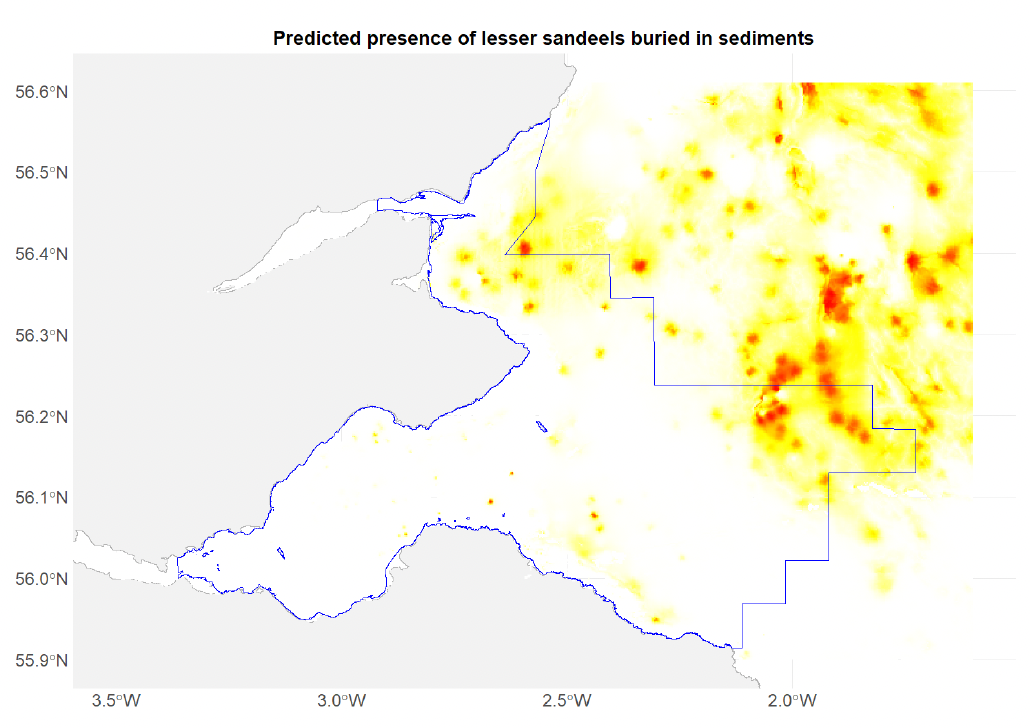
Common terns may forage over the area of sea in which razor clam operations occur, however the major sandeel aggregations are further offshore (Figure 3)(Langton, Boulcott , & Wright, 2021). A significant sandeel fishery principally targeted by the Danish fleet began operations on the east coast of Scotland in 1990. In response to poor breeding success among seabirds, areas were closed to fishing in 2000 (Daunt, et al., 2008), and subsequently fishing for sandeels was prohibited in all Scottish waters following the coming into force of The Sandeel (Prohibition of Fishing) (Scotland) Order 2024. With the exception of scientific surveys and incidental capture by fishing gear of all types including razor clam gear, there is essentially no fishing pressure on sandeels in Scottish waters. Removal of fishing pressure on its own has not consistently resulted in high abundance of sandeels as it has no effect on the natural processes that determine recruitment success (Greenstreet, Fraser, Armstrong, & Gibb, 2010).
Evidence from the razor clam scientific trial and preceding studies indicates that sandeels may be shocked by electric current gear but have been observed to recover soon after and resume swimming (Murray, Copland, Boulcott, Roberston, & Bailey, 2014).
In a study in Largo Bay during the razor clam trial, only a single sandeel was observed in the course of ten tows (Fox, 2021).
Other fish species found in the SPA that Arctic terns forage for are:
- Herring, which will shoal pelagically and are not considered to be impacted by razor clam fishing. The SPA contains spawning grounds for herring, but these do not overlap with razor clam fishing grounds (Frost & Diele, 2022).
- Sprat, which are predicted to occupy much of the SPA (Scottish Government, 2014) but as a pelagic shoaling species are not considered to be affected by razor clam fishing activity.
- Whiting, which use the SPA as a nursery area (Scottish Government, 2014), but the main area they are predicted to occupy does not overlap with razor clam grounds.
- Saithe, which are found throughout the SPA (Scottish Government, 2014).
Razor clam fishing is not expected in interact with pelagic shoaling species. Combined with the minimal physical impact on the seabed and highly localised footprint of the trial fishery relative to known distribution of sandeel habitat and herring spawning grounds, the activity is not considered to be capable of damaging prey-supporting habitats in the SPA to the extent that it adversely affects prey availability for common terns.
Scotland’s Marine Assessment indicates while nutrient inputs and chlorophyll concentrations are high in the Forth and Tay Scottish Marine Region which overlaps with the SPA, this did not amount to eutrophication (Scottish Government, 2020). Razor clam fishing activity may cause localised increases in turbidity at the seabed during fishing operations, but this is not considered likely to contribute to a deterioration in water quality locally or at the water body scale.
Overall assessment in relation to relevant pressures and site-specific advice
Common tern numbers are unfavourable in the outer firth but favourable in the inner firth. The razor clam fishing grounds lie between these two areas. Common terns primarily target prey that are not removed by the fishery. The fishing activity is not considered to constitute a barrier, disturbance or significant risk of injury or death to common terns, nor is it considered capable of adversely affecting prey availability. Razor clam fishing activity does not compromise the integrity of this feature within this SPA.
3.1.13 Atlantic puffin
Site-specific advice 2a
The site-specific advice for puffin is:
- Ensure Atlantic puffins within Outer Firth of Forth and St Andrews Bay Complex SPA are not at significant risk from injury or mortality during the breeding season.
- Ensure Atlantic puffin can move safely between the site and important areas of functionally linked land outwith the site.
Puffins feed in the water column and prey on sandeels which may overlap in habitat with razor clam fishing grounds. Puffins in the Forth Islands SPA breed on the Isle of May, Craigleith, Fidra and the Lamb. Puffins have a wide-ranging foraging habit with a mean maximum range of 119.9 ± 131.2km (Woodward, 2019) (excluding longer foraging ranges of Fair Isle populations), encompassing all of the Firth of Forth razor trial area and shellfish harvesting areas therein. However, puffins mainly utilise habitat to the east of the Isle of May and are therefore not considered to be at significant risk of injury or mortality from interaction with razor clam fishing vessels (Bogdanova, 2022).
Razor clam fishing activity is not considered to present a barrier to Atlantic puffins moving between the functionally connected Forth Islands SPA and other areas within the Outer Firth of Forth and St. Andrews Bay SPA when considered in the context of their known habitat use and wider fishing and non-fishing marine traffic activity.
Site-specific advice 2b
The site-specific advice for puffin is:
- Ensure Atlantic puffins continue to have access to and can utilise all optimal habitats suitable for all relevant aspects of their life cycle associated with the site.
- Avoid significant disturbance to Atlantic puffins and ensure individuals can move safely between these areas within the site.
Puffins are present in the SPA between March and September. 62.5% of fished hours occurred during these months (Figure 4). A seasonal closure is in place in the trial from late April to Late May during which no fishing activity will take place. As noted above, puffins do not tend to make use of habitat where razor clam fishing occurs, so razor clam fishing is not considered to be a significant disturbance risk or obstacle to use of optimal habitat.
Site-specific advice 2c
The site-specific advice for puffin is:
- Maintain the extent and distribution of the supporting habitats for Atlantic puffin within the site. Maintain the variety and abundance of food resources and the condition of supporting habitats and associated processes.
- Existing water quality should be maintained and any increase in nutrients, turbidity or contaminants where this could reduce supporting habitats and/or prey, should be avoided.
Puffins make particular use of sandeels, however the major sandeel aggregations are further offshore (Figure 3; Langton, Boulcott , & Wright, 2021) and this is reflected in their foraging behaviour (Bogdanova, 2022). A significant sandeel fishery principally targeted by the Danish fleet began operations on the east coast of Scotland in 1990. In response to poor breeding success among seabirds, areas were closed to fishing in 2000 (Daunt, et al., 2008), and subsequently fishing for sandeels was prohibited in all Scottish waters following the coming into force of The Sandeel (Prohibition of Fishing) (Scotland) Order 2024. With the exception of scientific surveys and incidental capture by fishing gear of all types including razor clam gear, there is essentially no fishing pressure on sandeels in Scottish waters. Removal of fishing pressure on its own has not consistently resulted in high abundance of sandeels as it has no effect on the natural processes that determine recruitment success (Greenstreet, Fraser, Armstrong, & Gibb, 2010). Evidence from the razor clam scientific trial and preceding studies indicates that sandeels may be shocked by electric current gear but have been observed to recover soon after and resume swimming (Murray, Copland, Boulcott, Roberston, & Bailey, 2014). In a study in Largo Bay during the razor clam trial, only a single sandeel was observed in the course of ten tows (Fox, 2021).
Other fish that may be prey items for puffins are:
- Herring, which will shoal pelagically and are not considered to be impacted by razor clam fishing. The SPA contains spawning grounds for herring, but these do not overlap with razor clam fishing grounds (Frost & Diele, 2022).
- Whiting, which use the SPA as a nursery area, but the main area they are predicted to occupy does not overlap with razor clam grounds.
- Saithe, which are found throughout the SPA.
- Ling, which are found in deeper water at the North Sea margin of the SPA and are not considered to be affected by razor clam fishing activity.
- Cod, which are mainly found in deeper water at the North Sea margin of the SPA and are not considered to be affected by razor clam fishing activity.
- Haddock, which are predicted to occupy areas that do not overlap with razor clam grounds.
- Norway pout, which are mainly found in deeper water at the North Sea margin of the SPA and are not considered to be affected by razor clam fishing activity.
- Sprat, which are predicted to occupy much of the SPA but as a pelagic shoaling species are not considered to be affected by razor clam fishing activity.
Various zooplankton species that have been recorded in puffins diet are found in the SPA (Ostle, et al., 2021), however razor clam fishing is not considered to have any effect on the abundance or variety of zooplankton.
Overall assessment in relation to relevant pressures and site-specific advice
Puffins primarily target prey that are not removed by the fishery and make use of habitat that is separate from areas of razor clam fishing. The fishing activity is not considered to constitute a barrier, disturbance or significant risk of injury or death to puffins, nor is it considered capable of adversely affecting prey availability. Razor clam fishing activity does not compromise the integrity of this feature within this SPA.
3.1.14 Common guillemot
Site-specific advice 2a
The site-specific advice for guillemot is:
- Ensure common guillemots within Outer Firth of Forth and St Andrews Bay Complex SPA are not at significant risk from injury or mortality during the breeding and nonbreeding seasons.
- Ensure common guillemot can move safely between the site and important areas of functionally linked land outwith the site.
Guillemots feed on sandeels and other fish whose habitat may overlap with fishing grounds. Guillemots have a mean maximum foraging range of 55.5 ± 39.7km (Woodward, 2019) (excluding longer foraging ranges of Fair Isle populations) meaning the Forth Islands SPA and St. Abb’s Head to Fast Castle SPA, Fowlsheugh SPAs are all within a foraging distance from Firth of Forth razor clam trial area fishing grounds. Buchan Ness to Collieston Coast SPA is approximately 149km away from Largo Bay and 167km from Gullane Bay areas within the SPA and therefore while functionally linked to the SPA as a whole, it is unlikely that guillemots settled in Buchan Ness to Collieston Coast SPA will make foraging trips to the areas of the SPA in which the razor clam grounds are located.
The speed at which razor clam fishing tows are made and the lack of nets or hooks in the gear means there is unlikely to be a significant risk of injury or death to guillemots.
Razor clam fishing activity is not considered to present a barrier to guillemots moving between the functionally connected Forth Islands SPA, St Abb’s Head to Fast Castle SPA, Fowlsheugh SPA or Buchan Ness to Collieston Coast SPA and other areas within the Outer Firth of Forth and St. Andrews Bay SPA when considered in the context of wider fishing and non-fishing marine traffic activity.
Site-specific advice 2b
The site-specific advice for guillemot is:
- Ensure common guillemots continue to have access to and can utilise all optimal habitats suitable for all relevant aspects of their life cycle associated with the site.
- Avoid significant disturbance to common guillemots and ensure individuals can move safely between these areas within the site.
Guillemots are present year-round, with a flightless moult period between August and October. 29.2% of fished hours occurred between these moult months (Figure 4).
Guillemot foraging distances and dive depths mean they may interact with razor clam vessels at the surface and at the seabed. Tracking data indicate that Gullane Bay is not used significantly, however Largo Bay and the area by Elie and Earlsferry has high utilisation (Bogdanova M. R.-S., 2022). Guillemots appear to avoid shallow areas here when foraging. A seasonal closure is in place in the trial from late April to Late May during which no fishing activity will take place.
Razor clam fishing is not considered to be a barrier to access to habitat, however the evidence of the importance of Largo Bay to this species combined with their moderately high vulnerability to disturbance (Furness, Wade, & Masden, 2013) gives rise to a risk that razor clam fishing activity in Largo Bay may contribute to hindering this species-specific objective.
Site-specific advice 2c
The site-specific advice for guillemot is:
- Maintain the extent and distribution of the supporting habitats for common guillemot within the site.
- Maintain the variety and abundance of food resources and the condition of supporting habitats and associated processes.
- Existing water quality should be maintained and any increase in nutrients, turbidity or contaminants where this could reduce supporting habitats and/or prey, should be avoided.
Guillemots forage for sandeels which may be found in habitat overlapping with razor clam grounds, however the majority of sandeel aggregations are further offshore (Figure 3).
A significant sandeel fishery principally targeted by the Danish fleet began operations on the east coast of Scotland in 1990. In response to poor breeding success among seabirds, areas were closed to fishing in 2000 (Daunt, et al., 2008), and subsequently fishing for sandeels was prohibited in all Scottish waters following the coming into force of The Sandeel (Prohibition of Fishing) (Scotland) Order 2024. With the exception of scientific surveys and incidental capture by fishing gear of all types including razor clam gear, there is essentially no fishing pressure on sandeels in Scottish waters. Removal of fishing pressure on its own has not consistently resulted in high abundance of sandeels as it has no effect on the natural processes that determine recruitment success (Greenstreet, Fraser, Armstrong, & Gibb, 2010). Evidence from the razor clam scientific trial and preceding studies indicates that sandeels may be shocked by electric current gear but have been observed to recover soon after and resume swimming (Murray, Copland, Boulcott, Roberston, & Bailey, 2014). In a study in Largo Bay during the razor clam trial, only a single sandeel was observed in the course of ten tows (Fox, 2021).
Other species of fish that guillemots forage for in the SPA are:
- Herring, which will shoal pelagically and are not considered to be impacted by razor clam fishing. The SPA contains spawning grounds for herring, but these do not overlap with razor clam fishing grounds (Frost & Diele, 2022).
- Cod, which are mainly found in deeper water at the North Sea margin of the SPA and are not considered to be affected by razor clam fishing activity (Scottish Government, 2014).
- Sprat, which are predicted to occupy much of the SPA but as a pelagic shoaling species are not considered to be affected by razor clam fishing activity (Scottish Government, 2014).
Scotland’s Marine Assessment indicates while nutrient inputs and chlorophyll concentrations are high in the Forth and Tay Scottish Marine Region which overlaps with the SPA, this did not amount to eutrophication (Scottish Government, 2020). Razor clam fishing activity may cause localised increases in turbidity at the seabed during fishing operations, but this is not considered likely to contribute to a deterioration in water quality locally or at the water body scale.
The Firth of Forth is a region of freshwater influence with a frontal zone mainly along the southern coast, corresponding with shallower areas and enhanced tidal mixing (Miller, Xu, & Carruthers, 2015). This does not appear to be highly utilised by guillemots in comparison to the waters off the northern coast (Bogdanova, 2022).
Overall assessment in relation to relevant pressures and site-specific advice
Guillemot forage for a wide range of species and are likely to seek to utilise areas where razor clam fishing occurs as optimal habitat for this behaviour. Razor clam fishing is not considered to affect prey supporting habitat to the extent that it affects prey availability, but the importance of Largo Bay to this species, and its sensitivity to disturbance suggests razor clam fishing activity may impair guillemots ability to utilise all optimal habitat and therefore may constitute a risk to the integrity of this feature within this SPA.
3.1.15 European shag
Site-specific advice 2a
The site-specific advice for shag is
- Ensure breeding European shag have the ability to recover at the relevant SPA breeding colonies.
- Ensure European shag within Outer Firth of Forth and St Andrews Bay Complex SPA are not at significant risk from injury or mortality during the breeding and nonbreeding seasons.
- Ensure European shag can move safely between the site and important areas of functionally linked land outwith the site.
European shag in the Forth Islands SPA are in unfavourable status. WeBS peak counts at the Forth Estuary site at Inchcolm suggest higher numbers of birds post-trial compared to pre-trial (Table 12).
| Period | Five-year moving average peak count |
|---|---|
| 2019/20 to 2023/24 | 578 |
| 2018/29 to 2022/23 | 503 |
| 2013/14 to 2017/18 | 421 |
Data from BTO WeBS Programme (Calbrade, et al., 2025).
European shag have a mean maximum foraging range of 13.2 ± 10.5km. Breeding sites are found around the coast with particular densities on the Isle of May, with subordinate breeding sites on Craigleith, Fidra, the Lamb, Inchmickery and the Bass Rock. The Isle of May is within 25.3km of the razor grounds in Gullane bay and 22.7km of the grounds in Largo bay, meaning foraging European shag based here could overlap with razor clam fishing activity in Largo Bay but not Gullane Bay. However, shag appear to make only light use Largo Bay (Nature Scot/JNCC, 2016), favouring the outer Firth of Forth and North Sea (Bogdanova M. W., 2014).
Combined with the slow speed of razor clam vessels when fishing and the seasonal closure from April to May during the breeding season, razor clam fishing activity is not considered to be a significant risk of injury or mortality, or barrier to moving safely between areas of functionally linked land outwith the site.
Site-specific advice 2b
The site-specific advice for shag is:
- Ensure European shags continue to have access to and can utilise all optimal habitats suitable for all relevant aspects of their life cycle associated with the site.
- Avoid significant disturbance to European shags and ensure individuals can move safely between these areas within the site.
A seasonal closure is in place in the trial from late April to Late May during which no fishing activity will take place. This occurs during the breeding season.
As shags do not feed far from land and predominantly occupy the outer Firth of Forth (Bogdanova M. W., 2014), it is unlikely that razor clam fishing constitutes significant disturbance of this species or affects their ability to find food in the SPA and connected areas. While shags do make some light use of Largo Bay, the areas are separated from the razor clam fishing grounds (Nature Scot/JNCC, 2016).
Site-specific advice 2c
The site-specific advice for shag is:
- Maintain the extent and distribution of the supporting habitats for European shag within the site.
- Ensure the variety and abundance of food resources and the condition of supporting habitats and associated processes have the ability to recover.
- Existing water quality should be maintained and any increase in nutrients, turbidity or contaminants where this could reduce supporting habitats and/or prey, should be avoided.
Shags are benthic piscivores with a preference for deep water. Sandeels are potentially important prey during the breeding season. A significant sandeel fishery principally targeted by the Danish fleet began operations on the east coast of Scotland in 1990. In response to poor breeding success among seabirds, areas were closed to fishing in 2000 (Daunt, et al., 2008), and subsequently fishing for sandeels was prohibited in all Scottish waters following the coming into force of The Sandeel (Prohibition of Fishing) (Scotland) Order 2024. With the exception of scientific surveys and incidental capture by fishing gear of all types including razor clam gear, there is essentially no fishing pressure on sandeels in Scottish waters. Removal of fishing pressure on its own has not consistently resulted in high abundance of sandeels as it has no effect on the natural processes that determine recruitment success (Greenstreet, Fraser, Armstrong, & Gibb, 2010). Evidence from the razor clam scientific trial and preceding studies indicates that sandeels may be shocked by electric current gear but have been observed to recover soon after and resume swimming (Murray, Copland, Boulcott, Roberston, & Bailey, 2014). In a study in Largo Bay during the razor clam trial, only a single sandeel was observed in the course of ten tows (Fox, 2021).
Other fish species that shag may forage for in the SPA are (Scottish Government, 2014):
- Whiting, which use the SPA as a nursery area, but the main area they are predicted to occupy does not overlap with razor clam grounds.
- Saithe, which are found throughout the SPA.
- Ling, which are found in deeper water at the North Sea margin of the SPA and are not considered to be affected by razor clam fishing activity.
- Cod, which are mainly found in deeper water at the North Sea margin of the SPA and are not considered to be affected by razor clam fishing activity.
- Haddock, which are predicted to occupy areas that do not overlap with razor clam grounds.
- Norway pout, which are mainly found in deeper water at the North Sea margin of the SPA and are not considered to be affected by razor clam fishing activity.
- Herring, which will shoal pelagically and are not considered to be impacted by razor clam fishing. The SPA contains spawning grounds for herring, but these do not overlap with razor clam fishing grounds.
- Sprat, which are predicted to occupy much of the SPA but as a pelagic shoaling species are not considered to be affected by razor clam fishing activity.
- Mackerel and horse mackerel, which may be found shoaling pelagically and are not considered to be affected by razor clam fishing activity.
Razor clam fishing activity is not expected to interact with shag prey species to the extent that it adversely affects prey availability.
Scotland’s Marine Assessment indicates while nutrient inputs and chlorophyll concentrations are high in the Forth and Tay Scottish Marine Region which overlaps with the SPA, this did not amount to eutrophication (Scottish Government, 2020). Razor clam fishing activity may cause localised increases in turbidity at the seabed during fishing operations, but this is not considered likely to contribute to a deterioration in water quality locally or at the water body scale.
Overall assessment in relation to relevant pressures and site-specific advice
Shag are at unfavourable status, but razor clam fishing activity is not considered to hinder recovery towards favourable status. Razor clam fishing is not considered to affect prey supporting habitat to the extent that it affects prey availability, is separated from main foraging areas and so is not considered to constitute significant disturbance or to be a barrier to movement between optimal habitat areas within and outwith the SPA.
3.1.16 Herring gull
Site-specific advice 2a
The site-specific advice for herring gull is
- Ensure breeding herring gull have the ability to recover at the relevant SPA breeding colonies.
- Ensure herring gull within Outer Firth of Forth and St Andrews Bay Complex SPA are not at significant risk from injury or mortality during the breeding and nonbreeding seasons.
- Ensure herring gull can move safely between the site and important areas of functionally linked land outwith the site.
Herring gull are in unfavourable condition in the SPA. The peak counts at the WeBS Forth Estuary site at Inchcolm indicate higher counts prior to the establishment of the trial, though it should be noted all counts undertaken during these periods were incomplete and are therefore underestimates (Table 13).
| Period | Five-year moving average peak count |
|---|---|
| 2019/20 to 2023/24 | 2652 |
| 2018/29 to 2022/23 | 2595 |
| 2013/14 to 2017/18 | 3668 |
Data from BTO WeBS Programme (Calbrade, et al., 2025).
Herring gulls are vulnerable to bycatch in nets, which are not in use by razor clam vessels. Given the small number of vessels and slow speed while fishing, razor clam fishing activity is not considered to constitute a significant risk of injury or mortality. There is no discarding of offal that typically attracts herring gulls (Camphuysen, 1995), so this fishing activity should not lead to frequent interactions between fishing vessels and gulls.
Razor clam fishing activity is not considered to present a barrier to herring gulls moving between the functionally connected Forth Islands SPA, St Abb’s Head to Fast Castle SPA, Fowlsheugh SPA or Buchan Ness to Collieston Coast SPA and other areas within the Outer Firth of Forth and St. Andrews Bay SPA when considered in the context of wider fishing and non-fishing marine traffic activity.
Site-specific advice 2b
The site-specific advice for herring gull is:
- Ensure herring gulls continue to have access to and can utilise all optimal habitats suitable for all relevant aspects of their life cycle associated with the site.
- Avoid significant disturbance to herring gulls and ensure individuals can move safely between these areas within the site.
The mean maximum foraging distance of herring gulls is 58.8 ± 26.8km. (Woodward, 2019 meaning the Forth Islands SPA and St. Abb’s Head to Fast Castle SPAs, are within foraging distance from Firth of Forth razor clam trial area fishing grounds, consequently gulls that are based in these SPAs may seek to utilise habitat that overlaps with razor clam fishing activity.
Fowlsheugh SPA is approximately 93km from Largo Bay and 114.4km from Gullane Bay razor clam grounds. Buchan Ness to Collieston Coast SPA is approximately 149km from Largo Bay and 167km from Gullane Bay areas within the SPA and therefore while functionally linked to the SPA as a whole, it is unlikely that herring gulls settled in either of these SPAs will make foraging trips to the areas of the SPA in which the razor clam grounds are located.
Herring gulls are generalist feeders, making use of a variety of intertidal and inland areas to forage for a wide range of food sources. Mussel beds can be an important habitat for this species (Clewley, et al., 2021), and are widely distributed in the SPA and separated from razor clam fishing activity (Figure 1).
A seasonal closure is in place in the trial from late April to Late May during which no fishing activity will take place.
Site-specific advice 2c
The site-specific advice for herring gull is
- Maintain the extent and distribution of the supporting habitats for herring gull within the site.
- Ensure the variety and abundance of food resources and the condition of supporting habitats and associated processes have the ability to recover.
- Existing water quality should be maintained and any increase in nutrients, turbidity or contaminants where this could reduce supporting habitats and/or prey, should be avoided.
Razor clam fishing is not expected to affect the extent and distribution of supporting habitats for herring gull, or the variety and abundance of food resources or condition of supporting habitat. This is because gulls exploit a wide variety of food sources in marine, coastal and terrestrial environments. Razor clam fishing does not generate offal waste. Crabs and bivalves are widely distributed in the SPA (Figure 1). Due to the small number of vessels and localised fishing activity, razor clam fishing is not considered to adversely affect relevant prey availability.
Scotland’s Marine Assessment indicates while nutrient inputs and chlorophyll concentrations are high in the Forth and Tay Scottish Marine Region which overlaps with the SPA, this did not amount to eutrophication (Scottish Government, 2020). Razor clam fishing activity may cause localised increases in turbidity at the seabed during fishing operations, but this is not considered likely to contribute to a deterioration in water quality locally or at the water body scale.
Overall assessment in relation to relevant pressures and site-specific advice
Herring gull are at unfavourable status, but razor clam fishing activity is not considered to hinder recovery towards favourable status. Razor clam fishing is not considered to affect prey supporting habitat to the extent that it affects prey availability, is not considered to constitute significant risk of injury or mortality, is not considered to constitute significant disturbance or to be a barrier to movement between optimal habitat areas within and outwith the SPA.
3.1.17 Black-legged kittiwake
Site-specific advice 2a
The site-specific advice for kittiwake is:
- Ensure breeding kittiwake have the ability to recover at the relevant SPA breeding colonies.
- Ensure kittiwake within Outer Firth of Forth and St Andrews Bay Complex SPA are not at significant risk from injury or mortality during the breeding and nonbreeding seasons.
- Ensure kittiwake can move safely between the site and important areas of functionally linked land outwith the site.
Black-legged kittiwakes are at unfavourable status in this SPA.
Kittiwakes are vulnerable to displacement and bycatch in surface gears. Razor clam gear is lightweight and deployed at the sea surface with no nets or hooks. There is unlikely to be a significant injury or mortality risk from entanglement or collision to black legged kittiwakes while fishing operations are underway.
Razor clam fishing activity is not considered to present a barrier to black legged kittiwakes moving between the functionally connected Forth Islands SPA, St Abb’s Head to Fast Castle SPA, Fowlsheugh SPA, Buchan Ness to Collieston Coast SPA or Troup, Pennan and Lion’s Head SPA and other areas within the Outer Firth of Forth and St. Andrews Bay SPA when considered in the context of wider fishing and non-fishing marine traffic activity.
Kittiwake peak counts at the WeBS site Forth Estuary on Inchcolm island have increased compared to prior to the establishment of the trial (Table 14), though this site is distant from kittiwakes main site in the SPA on the Isle of May.
| Period | Five-year moving average peak count |
|---|---|
| 2019/20 to 2023/24 | 130 |
| 2018/29 to 2022/23 | 88 |
| 2013/14 to 2017/18 | 73 |
Data from BTO WeBS Programme (Calbrade, et al., 2025).
Site-specific advice 2b
The site-specific advice for kittiwake is:
- Ensure kittiwakes continue to have access to and can utilise all optimal habitats suitable for all relevant aspects of their life cycle associated with the site.
- Avoid significant disturbance to kittiwakes and ensure individuals can move safely between these areas within the site.
Kittiwakes are present from mid-April to mid-August. 46.1% of fished hours occurred during these months (Figure 4). A seasonal closure is in place in the trial from late April to Late May during which no fishing activity will take place. Kittiwakes maximum foraging range means they may seek to utilise habitat that overlaps with razor clam fishing activity. Razor clam activity is not anticipated to significantly disturb kittiwakes ability to access habitat for non-foraging behaviour as it occurs at distances greater than 1km from the shore.
Kittiwakes appear to principally utilise the outer Firth of Forth and North Sea itself when foraging (Bogdanova M. R.-S., 2022), therefore razor clam activity is not anticipated to significantly displace kittiwakes from foraging habitat.
Site-specific advice 2c
The site-specific advice for kittiwake is
- Maintain the extent and distribution of the supporting habitats for black-legged kittiwake within the site.
- Ensure the variety and abundance of food resources and the condition of supporting habitats and associated processes have the ability to recover.
- Existing water quality should be maintained and any increase in nutrients, turbidity or contaminants where this could reduce supporting habitats and/or prey, should be avoided.
Sandeels are key prey that determine breeding success in kittiwakes (Greenstreet, Fraser, Armstrong, & Gibb, 2010). Kittiwakes appear to principally utilise the outer Firth of Forth and North Sea itself when foraging (Bogdanova M. R.-S., 2022), therefore razor clam activity is not anticipated compromise the extent and distribution of supporting habitats or variety and abundance of food resources. A significant sandeel fishery principally targeted by the Danish fleet began operations on the east coast of Scotland in 1990. In response to poor breeding success among seabirds, areas were closed to fishing in 2000 (Daunt, et al., 2008), and subsequently fishing for sandeels was prohibited in all Scottish waters following the coming into force of The Sandeel (Prohibition of Fishing) (Scotland) Order 2024. With the exception of scientific surveys and incidental capture by fishing gear of all types including razor clam gear, there is essentially no fishing pressure on sandeels in Scottish waters. Removal of fishing pressure on its own has not consistently resulted in high abundance of sandeels as it has no effect on the natural processes that determine recruitment success (Greenstreet, Fraser, Armstrong, & Gibb, 2010). Evidence from the razor clam scientific trial and preceding studies indicates that sandeels may be shocked by electric current gear but have been observed to recover soon after and resume swimming (Murray, Copland, Boulcott, Roberston, & Bailey, 2014). In a study in Largo Bay during the razor clam trial, only a single sandeel was observed in the course of ten tows (Fox, 2021).
Herring are another important prey item. Herring, which will shoal pelagically are not considered to be impacted by razor clam fishing. The SPA contains spawning grounds for herring, but these do not overlap with razor clam fishing grounds (Frost & Diele, 2022).
Scotland’s Marine Assessment indicates while nutrient inputs and chlorophyll concentrations are high in the Forth and Tay Scottish Marine Region which overlaps with the SPA, this did not amount to eutrophication (Scottish Government, 2020). Razor clam fishing activity may cause localised increases in turbidity at the seabed during fishing operations, but this is not considered likely to contribute to a deterioration in water quality locally or at the water body scale.
Overall assessment in relation to relevant pressures and site-specific advice
Kittiwake are at unfavourable status, but razor clam fishing activity is not considered to hinder recovery towards favourable status. Razor clam fishing is not considered to affect prey supporting habitat to the extent that it affects prey availability, is separated from main foraging areas and so is not considered to constitute a significant risk of injury or mortality, nor a risk of significant disturbance or to be a barrier to movement between optimal habitat areas within and outwith the SPA.
3.1.18 Manx shearwater
Site specific advice 2a
The site-specific advice for Manx shearwater is:
- Ensure Manx shearwaters within Outer Firth of Forth and St Andrews Bay Complex SPA are not at significant risk from injury or mortality within the breeding season.
Manx shearwaters are vulnerable to bycatch in longline and gillnet fisheries which are not in use in the razor clam fishing activity. Artificial lights are another hazard for his species. Vessels use artificial lights for normal navigation and safety purposes but otherwise do not emit more light than other equivalent vessels engaged in other forms of fishing, and operate during the day. There is unlikely to be a significant injury or mortality risk from entanglement or collision to Manx shearwaters while fishing operations are underway.
Site-specific advice 2b
The site-specific advice for Manx shearwater is:
- Ensure Manx shearwater continue to have access to and can utilise all optimal habitats suitable for all relevant aspects of their life cycle associated with the site.
- Avoid significant disturbance to Manx shearwater and ensure individuals can move safely between these areas within the site.
Manx shearwater have a mean maximum foraging range of 1346.8 ± 1018.7km (Woodward, 2019) which encompasses all razor trial areas across Scotland’s seas, therefore there is potential for Manx shearwater to interact with razor clams in the Forth trial area. Manx shearwaters tend to make use of habitat in the Firth of Forth in summer months (Stone, Webb, & Tasker, 1994), which will coincide with fishing operations that are particularly concentrated in the Gullane Bay razor grounds (Blackadder, et al., 2024).
A seasonal closure is in place in the trial from late April to Late May during which no fishing activity will take place, this overlaps partly with the breeding period for Manx shearwater.
Razor clam fishing activity is not considered to present a barrier to Manx shearwater moving between areas of optimal habitat or to be a significant disturbance to the species.
Site-specific advice 2c
The site-specific advice for Manx shearwater is:
- Maintain the extent and distribution of the supporting habitats for Manx shearwater within the site.
- Maintain the variety and abundance of food resources and the condition of supporting habitats and associated processes.
- Existing water quality should be maintained and any increase in nutrients, turbidity or contaminants where this could reduce supporting habitats and/or prey, should be avoided.
Sandeel are a prey item, however the major sandeel aggregations are further offshore (Figure 3; Langton, Boulcott , & Wright, 2021). A significant sandeel fishery principally targeted by the Danish fleet began operations on the east coast of Scotland in 1990. In response to poor breeding success among seabirds, areas were closed to fishing in 2000 (Daunt, et al., 2008), and subsequently fishing for sandeels was prohibited in all Scottish waters following the coming into force of The Sandeel (Prohibition of Fishing) (Scotland) Order 2024. With the exception of scientific surveys and incidental capture by fishing gear of all types including razor clam gear, there is essentially no fishing pressure on sandeels in Scottish waters. Removal of fishing pressure on its own has not consistently resulted in high abundance of sandeels as it has no effect on the natural processes that determine recruitment success (Greenstreet, Fraser, Armstrong, & Gibb, 2010). Evidence from the razor clam scientific trial and preceding studies indicates that sandeels may be shocked by electric current gear but have been observed to recover soon after and resume swimming (Murray, Copland, Boulcott, Roberston, & Bailey, 2014). In a study in Largo Bay during the razor clam trial, only a single sandeel was observed in the course of ten tows (Fox, 2021).
Other prey may include shoaling pelagic fish such as herring and sprats. Sprat are predicted to occupy much of the SPA (Scottish Government, 2014) but as a pelagic shoaling species are not considered to be affected by razor clam fishing activity. Herring, which will shoal pelagically are not considered to be impacted by razor clam fishing. The SPA contains spawning grounds for herring, but these do not overlap with razor clam fishing grounds (Frost & Diele, 2022).
Scotland’s Marine Assessment indicates while nutrient inputs and chlorophyll concentrations are high in the Forth and Tay Scottish Marine Region which overlaps with the SPA, this did not amount to eutrophication (Scottish Government, 2020). Razor clam fishing activity may cause localised increases in turbidity at the seabed during fishing operations, but this is not considered likely to contribute to a deterioration in water quality locally or at the water body scale.
Overall assessment in relation to relevant pressures and site-specific advice
Razor clam fishing is not considered to affect prey supporting habitat to the extent that it affects prey availability, is not considered to constitute significant risk of injury or mortality, is not considered to constitute significant disturbance or to be a barrier to movement between optimal habitat areas within and outwith the SPA for Manx shearwater. Razor clam fishing activity does not compromise the integrity of this feature within this SPA.
3.1.19 Northern gannet
Site-specific advice 2a
The site-specific advice for gannet is:
- Ensure gannets within Outer Firth of Forth and St Andrews Bay Complex SPA are not at significant risk from injury or mortality during the breeding season.
- Ensure gannets can move safely between the site and important areas of functionally linked land outwith the site.
Gannets are sensitive to collision and bycatch, however the type of surface and pelagic gear that they are most vulnerable to is not in use in the razor clam trial. Razor clam fishing activity is not considered to present a barrier to northern gannet moving between the functionally connected Forth Islands SPA and other areas within the Outer Firth of Forth and St. Andrews Bay SPA when considered in the context of wider fishing and non-fishing marine traffic activity.
Site-specific advice 2b
The site-specific advice for gannet is:
- Ensure gannets continue to have access to and can utilise all optimal habitats suitable for all relevant aspects of their life cycle associated with the site.
- Avoid significant disturbance to gannets and ensure individuals can move safely between these areas within the site.
Gannets are present from February to September. A seasonal closure is in place from mid April to mid May when no fishing occurs.
Gannets principally embark on foraging journeys into the North Sea (Nature Scot/JNCC, 2016), with smaller numbers foraging in the Firth of Forth (Cleasby, et al., 2015), therefore razor clam fishing activity is not considered to constitute a barrier to use of optimal habitat, or to constitute a significant disturbance risk to gannets or their ability to move between areas of optimal habitat.
Site-specific advice 2c
The site-specific advice for gannet is:
- Maintain the extent and distribution of the supporting habitats for northern gannet within the site.
- Maintain the variety and abundance of food resources and the condition of supporting habitats and associated processes.
- Existing water quality should be maintained and any increase in nutrients, turbidity or contaminants where this could reduce supporting habitats and/or prey, should be avoided.
Razor clam fishing occurs in areas that gannets tend not to utilise in comparison to the North Sea portion of the SPA, therefore the extent and distribution of supporting habitat is not compromised by razor clam fishing activity.
Gannets make particular use of sandeels, however the major sandeel aggregations are further offshore (Figure 3; Langton, Boulcott , & Wright, 2021) and this is reflected in their foraging behaviour (Cleasby, et al., 2015). A significant sandeel fishery principally targeted by the Danish fleet began operations on the east coast of Scotland in 1990. In response to poor breeding success among seabirds, areas were closed to fishing in 2000 (Daunt, et al., 2008), and subsequently fishing for sandeels was prohibited in all Scottish waters following the coming into force of The Sandeel (Prohibition of Fishing) (Scotland) Order 2024. With the exception of scientific surveys and incidental capture by fishing gear of all types including razor clam gear, there is essentially no fishing pressure on sandeels in Scottish waters. Removal of fishing pressure on its own has not consistently resulted in high abundance of sandeels as it has no effect on the natural processes that determine recruitment success (Greenstreet, Fraser, Armstrong, & Gibb, 2010). Evidence from the razor clam scientific trial and preceding studies indicates that sandeels may be shocked by electric current gear but have been observed to recover soon after and resume swimming (Murray, Copland, Boulcott, Roberston, & Bailey, 2014). In a study in Largo Bay during the razor clam trial, only a single sandeel was observed in the course of ten tows (Fox, 2021).
Distribution of other important prey species is summarised (Scottish Government, 2014):
- Cod in the SPA are expected to be found in the St. Andrews Bay/Tay area, with low probability of presence in the areas in which razor clam fishing occurs.
- Haddock have a low probability of presence in the Firth of Forth, with areas of high probability of presence outside the SPA.
- Whiting and Sprat may be found in the Firth of Forth, but to the north of North Berwick rather than in Gullane Bay or Largo Bay.
- Mackerel have low probability of presence in the SPA.
- Saithe and Herring may be found throughout the Firth of Forth. Herring spawning grounds are in the SPA but do not overlap with razor clam grounds (Frost & Diele, 2022).
Razor clam fishing is not considered to affect any prey supporting habitat for these species to the extent that it adversely affects prey availability for gannets.
Overall assessment in relation to relevant pressures and site-specific advice
Gannets primarily target prey that are not removed by the fishery and make use of habitat that is separate from areas of razor clam fishing. The fishing activity is not considered to constitute a barrier, disturbance or significant risk of injury or death to gannets, nor is it considered capable of adversely affecting prey availability. Razor clam fishing activity does not compromise the integrity of this feature within this SPA.
3.1.20 Black-headed gull
Site-specific advice 2a
The site-specific advice for black-headed gulls is:
- Ensure black-headed gulls within Outer Firth of Forth and St Andrews Bay Complex SPA are not at significant risk from injury or mortality during the non-breeding season.
- Ensure black-headed gulls can move safely between the site and important areas of functionally linked land outwith the site.
Black-headed gulls forage in coastal and intertidal areas that do not overlap with razor clam fishing grounds. The vessels in the trial operate out of Methil and Pittenweem ports which are existing built up areas, meaning there is a low risk of vessel movement having a significant impact on black-headed gulls in terms of displacement from their foraging or roosting areas.
The slow speed of fishing operations and lack of nets or hooks in the gear means there is unlikely to be a significant injury or mortality risk from entanglement or collision to black-headed gulls while fishing operations are underway.
WeBS peak counts appear to fluctuate with more gulls in the five year period following the establishment of the trial compared to the period prior or the most recent period (Table 15), however several surveys were incomplete and influence understanding trends based on moving averages by their exclusion.
| Period | Five-year moving average peak count |
|---|---|
| 2019/20 to 2023/24 | 2502 |
| 2018/29 to 2022/23 | 6446 |
| 2013/14 to 2017/18 | 3633 |
Data from BTO WeBS Programme (Calbrade, et al., 2025).
Site-specific advice 2b
The site-specific advice for black-headed gull is:
- Ensure black-headed gulls continue to have access to and can utilise all optimal habitats suitable for all relevant aspects of their life cycle associated with the site.
- Avoid significant disturbance to black-headed gulls and ensure individuals can move safely between these areas within the site.
Black-headed gulls forage in intertidal and terrestrial habitat as well as feeding at the sea surface. These modes of foraging are unlikely to involve significant interaction with razor clam fishing activity; therefore it is not anticipated that razor clam fishing constitutes significant disturbance to black-headed gulls or a significant barrier to their use of optimal habitat.
A seasonal closure in April and May coincides with the breeding season, and no fishing occurs during this period.
Razor clam fishing activity is not considered to present a barrier to black-headed gulls moving between the functionally connected Forth Islands SPA and other areas within the Outer Firth of Forth and St. Andrews Bay SPA when considered in the context of wider fishing and non-fishing marine traffic activity.
Site-specific advice 2c
The site-specific advice for black-headed gull is:
- Maintain the extent and distribution of the supporting habitats for roosting black-headed gulls within the site.
- Maintain the condition of supporting habitats and associated processes.
- Existing water quality should be maintained and any increase in nutrients, turbidity or contaminants where this could reduce supporting habitats should be avoided.
Razor clam fishing activity does not overlap with black-headed gull roosting habitat. Supporting habitats for foraging are not known but given black-headed gull foraging behaviour, it is considered unlikely that razor clam fishing will affect prey supporting habitat to the extent it adversely affects prey availability.
Scotland’s Marine Assessment indicates while nutrient inputs and chlorophyll concentrations are high in the Forth and Tay Scottish Marine Region which overlaps with the SPA, this did not amount to eutrophication (Scottish Government, 2020). Razor clam fishing activity may cause localised increases in turbidity at the seabed during fishing operations, but this is not considered likely to contribute to a deterioration in water quality locally or at the water body scale.
Overall assessment in relation to relevant pressures and site-specific advice
Black-headed gulls make use of habitat that is largely separated from razor clam activity. The fishing activity is not considered to constitute a barrier, disturbance or significant risk of injury or death to black-headed gulls, nor is it considered capable of adversely affecting prey availability. Razor clam fishing activity does not compromise the integrity of this feature within this SPA.
3.1.21 Common gull
Site-specific advice 2a
The site-specific advice for common gull is:
- Ensure common gulls within Outer Firth of Forth and St Andrews Bay Complex SPA are not at significant risk from injury or mortality during the non-breeding season.
- Ensure common gulls can move safely between the site and important areas of functionally linked land outwith the site.
Common gulls feed in the intertidal zone and in terrestrial and freshwater habitat, the likelihood of common gulls interacting with razor clam fishing vessels is considered to be low. There are no nets or hooks, and the slow speed of fishing operations means there is unlikely to be a significant injury or mortality risk from entanglement or collision to little gulls while fishing operations are underway.
Razor clam fishing activity is not considered to present a barrier to common gulls moving between the functionally linked areas outwith the Outer Firth of Forth and St. Andrews Bay SPA when considered in the context of wider fishing and non-fishing marine traffic activity.
WeBS peak count data for the Forth Estuary site on Inchcolm Island indicate more gulls recorded after the establishment of the trial than before, though several surveys were incomplete and excluded from moving average calculations (Table 16).
| Period | Five-year moving average peak count |
|---|---|
| 2019/20 to 2023/24 | 2779 |
| 2018/29 to 2022/23 | 2779 |
| 2013/14 to 2017/18 | 1152 |
Data from BTO WeBS Programme (Calbrade, et al., 2025).
Site-specific advice 2b
The site-specific advice for common gull is:
- Ensure common gull continue to have access to and can utilise all optimal habitats suitable for all relevant aspects of their life cycle associated with the site.
- Avoid significant disturbance to common gulls and ensure individuals can move safely between these areas within the site.
A seasonal closure is in place in the trial from late April to Late May during which no fishing activity will take place, this overlaps with the breeding season.
Common gulls forage in intertidal and terrestrial habitat as well as feeding at the sea surface. These modes of foraging are unlikely to involve significant interaction with razor clam fishing activity; therefore it is not anticipated that razor clam fishing constitutes significant disturbance to common gulls or a significant barrier to their use of optimal habitat.
Razor clam fishing activity is not considered to present a barrier to common gulls moving between the functionally connected Forth Islands SPA and other areas within the Outer Firth of Forth and St. Andrews Bay SPA when considered in the context of wider fishing and non-fishing marine traffic activity.
Site-specific advice 2c
The site-specific advice for common gull is
- Maintain the extent and distribution of the supporting habitats for roosting common gulls within the site.
- Maintain the condition of supporting habitats and associated processes.
- Existing water quality should be maintained and any increase in nutrients, turbidity or contaminants where this could reduce supporting habitats should be avoided.
Razor clam fishing activity does not overlap with common gull roosting habitat. Dot-density mapping in the Wetland Bird Survey indicates occupancy at sites around Musselburgh and the inner Firth of Forth in 2023/24 (Calbrade, et al., 2025).
It is considered unlikely that razor clam fishing will adversely affect prey availability for common gulls given their foraging preferences.
Scotland’s Marine Assessment indicates while nutrient inputs and chlorophyll concentrations are high in the Forth and Tay Scottish Marine Region which overlaps with the SPA, this did not amount to eutrophication (Scottish Government, 2020). Razor clam fishing activity may cause localised increases in turbidity at the seabed during fishing operations, but this is not considered likely to contribute to a deterioration in water quality locally or at the water body scale.
Overall assessment in relation to relevant pressures and site-specific advice
Common gulls make use of habitat that is largely separated from razor clam activity. The fishing activity is not considered to constitute a barrier, disturbance or significant risk of injury or death to common gulls, nor is it considered capable of adversely affecting prey availability. Razor clam fishing activity does not compromise the integrity of this feature within this SPA.
3.1.22 Little gull
Site-specific advice 2a
The site-specific advice for little gull is:
- Ensure little gulls within Outer Firth of Forth and St Andrews Bay Complex SPA are not at significant risk from injury or mortality during the non-breeding season.
- Ensure little gulls can move safely between the site and important areas of functionally linked land outwith the site.
Little gulls feed in the intertidal zone and in terrestrial and freshwater habitat, the likelihood of common gulls interacting with razor clam fishing vessels is considered to be low. There are no nets or hooks, and the slow speed of fishing operations means there is unlikely to be a significant injury or mortality risk from entanglement or collision to little gulls while fishing operations are underway.
Razor clam fishing activity is not considered to present a barrier to little gulls moving between functionally linked areas outwith the Outer Firth of Forth and St. Andrews Bay SPA when considered in the context of wider fishing and non-fishing marine traffic activity.
WeBS peak count data for the Forth Estuary site on Inchcolm Island indicate a fluctuating trend, with more gulls recorded after the establishment of the trial than before (Table 17).
| Period | Five-year moving average peak count |
|---|---|
| 2019/20 to 2023/24 | 80 |
| 2018/29 to 2022/23 | 136 |
| 2013/14 to 2017/18 | 27 |
Data from BTO WeBS Programme (Calbrade, et al., 2025).
Site-specific advice 2b
The site-specific advice for little gull is:
- Ensure little gull continue to have access to and can utilise all optimal habitats suitable for all relevant aspects of their life cycle associated with the site.
- Avoid significant disturbance to little gull and ensure individuals can move safely between these areas within the site.
Little Gulls are present from August to April. 71.3% of fished hours were during these months (Figure 4). Little gulls forage in intertidal and terrestrial habitat as well as feeding at the sea surface. These modes of foraging are unlikely to involve significant interaction with razor clam fishing activity; therefore it is not anticipated that razor clam fishing constitutes significant disturbance to little gulls or a significant barrier to their use of optimal habitat. Little gull distribution is mainly concentrated to the west of Largo Bay and Gullane Bay (Nature Scot/JNCC, 2016).
Razor clam fishing activity is not considered to present a barrier to little gulls moving between the functionally connected areas within and outwith the Outer Firth of Forth and St. Andrews Bay SPA when considered in the context of wider fishing and non-fishing marine traffic activity.
Site-specific advice 2c
The site-specific advice for little gull is:
- Maintain the extent and distribution of the supporting habitats for little gulls within the site.
- Maintain the condition of supporting habitats and associated processes.
- Existing water quality should be maintained and any increase in nutrients, turbidity or contaminants where this could reduce supporting habitats should be avoided.
Little gulls feed on small fish, marine invertebrates and zooplankton. Razor clam fishing does not have a significant adverse effect on processes relating to zooplankton and small fish abundance in SPA, which are driven by primary productivity, the tidal cycle and weather patterns. Tows on the seabed have a minimal impact and given their concentration over razor grounds are not considered to affect prey supporting habitat such as sandeels to the extent that it adversely affects prey availability.
Fronts are particularly important for this species. There is a chlorophyll front along the southern part of the SPA (Miller, Xu, & Carruthers, 2015), but this does not appear to coincide with the area of expected highest density of little gulls.
Scotland’s Marine Assessment indicates while nutrient inputs and chlorophyll concentrations are high in the Forth and Tay Scottish Marine Region which overlaps with the SPA, this did not amount to eutrophication (Scottish Government, 2020). Razor clam fishing activity may cause localised increases in turbidity at the seabed during fishing operations, but this is not considered likely to contribute to a deterioration in water quality locally or at the water body scale.
Overall assessment in relation to relevant pressures and site-specific advice
Little gulls make use of habitat that is largely separated from razor clam activity, or otherwise is not affected by razor clam fishing. The fishing activity is not considered to constitute a barrier, disturbance or significant risk of injury or death to little gulls, nor is it considered capable of adversely affecting prey availability. Razor clam fishing activity does not compromise the integrity of this feature within this SPA.
3.1.23 Razorbill
Site-specific advice 2a
The site-specific advice for razorbill is:
- Ensure razorbills within Outer Firth of Forth and St Andrews Bay Complex SPA are not at significant risk from injury or mortality during the non-breeding season.
- Ensure razorbills can move safely between the site and important areas of functionally linked land outwith the site.
The small number of vessels, slow speed while fishing and lack of hooks or nets mean there is unlikely to be a significant injury or mortality risk from entanglement or collision to razorbills while fishing operations are underway.
Razor clam fishing activity is not considered to present a barrier to razorbills moving between functionally linked areas outwith the Outer Firth of Forth and St. Andrews Bay SPA when considered in the context of wider fishing and non-fishing marine traffic activity.
Site-specific advice 2b
The site-specific advice for razorbill is:
- Ensure razorbill continue to have access to and can utilise all optimal habitats suitable for all relevant aspects of their life cycle associated with the site.
- Avoid significant disturbance to razorbill and ensure individuals can move safely between these areas within the site.
Razorbills are present year-round with a flightless moult period from August to October. 29.2% of fished hours occurred during these moult months (Figure 4).
Data on razorbill habitat use indicates there is unlikely to be any overlap with fishing operations in Gullane Bay, but there is likely to be overlap with fishing operations in Largo Bay, which razorbills use for resting and foraging (Bogdanova M. R.-S., 2022). Razorbills are moderately sensitive to disturbance (Furness, Wade, & Masden, 2013). There is therefore potential for razor clam fishing vessels and activity to constitute a risk of disturbance to this species.
Roosting is not expected to be disturbed as razor clam fishing activity occurs during the day.
Site-specific advice 2c
The site-specific advice for razorbill is:
- Maintain the extent and distribution of the supporting habitats for razorbill within the site.
- Maintain the variety and abundance of food resources and the condition of supporting habitats and associated processes.
- Existing water quality should be maintained and any increase in nutrients, turbidity or contaminants where this could reduce supporting habitats and/or prey, should be avoided.
Razorbills feed primarily on sandeels and other fish. Sandeels are mainly distributed in the North Sea and St. Andrews bay (Langton, Boulcott , & Wright, 2021). A significant sandeel fishery principally targeted by the Danish fleet began operations on the east coast of Scotland in 1990. In response to poor breeding success among seabirds, areas were closed to fishing in 2000 (Daunt, et al., 2008), and subsequently fishing for sandeels was prohibited in all Scottish waters following the coming into force of The Sandeel (Prohibition of Fishing) (Scotland) Order 2024. With the exception of scientific surveys and incidental capture by fishing gear of all types including razor clam gear, there is essentially no fishing pressure on sandeels in Scottish waters. Removal of fishing pressure on its own has not consistently resulted in high abundance of sandeels as it has no effect on the natural processes that determine recruitment success (Greenstreet, Fraser, Armstrong, & Gibb, 2010). Evidence from the razor clam scientific trial and preceding studies indicates that sandeels may be shocked by electric current gear but have been observed to recover soon after and resume swimming (Murray, Copland, Boulcott, Roberston, & Bailey, 2014). In a study in Largo Bay during the razor clam trial, only a single sandeel was observed in the course of ten tows (Fox, 2021).
Herring spawning grounds are present in the SPA though they do not currently overlap with razor clam grounds (Frost & Diele, 2022).
Sprat may be found throughout the SPA, though their probability of presence is low in Largo Bay (Scottish Government, 2014).
Sprat and herring form shoals and occupy a pelagic niche and therefore are not anticipated have their extent or distribution affected by razor clam fishing to the extent that it adversely affects their availability as prey items.
Juvenile cod are mainly found in deeper water at the North Sea margin of the SPA and are not considered to be affected by razor clam fishing activity (Scottish Government, 2014).
Scotland’s Marine Assessment indicates while nutrient inputs and chlorophyll concentrations are high in the Forth and Tay Scottish Marine Region which overlaps with the SPA, this did not amount to eutrophication (Scottish Government, 2020). Razor clam fishing activity may cause localised increases in turbidity at the seabed during fishing operations, but this is not considered likely to contribute to a deterioration in water quality locally or at the water body scale.
Razor clam fishing is not expected to affect prey supporting habitat to the extent that it adversely affects prey availability for razorbills.
Overall assessment in relation to relevant pressures and site-specific advice
Razorbills forage for a wide range of species and are likely to seek to utilise areas where razor clam fishing occurs as optimal habitat for this behaviour, in particular, they appear to make frequent use of Largo Bay for foraging and resting. Razor clam fishing is not considered to affect prey supporting habitat to the extent that it affects prey availability, but the importance of Largo Bay to this species, and its sensitivity to disturbance suggests razor clam fishing activity may impair razorbills ability to utilise all optimal habitat and therefore may constitute a risk to the integrity of this feature within this SPA.
3.2 Solway Firth SPA
The following figures and information are referred to against the relevant features in relation to site-specific advice and information.
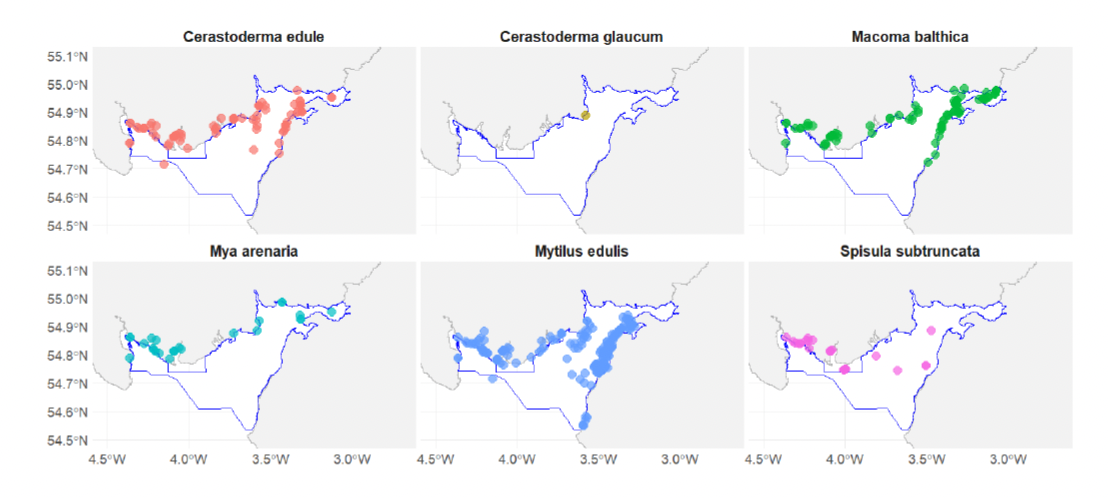
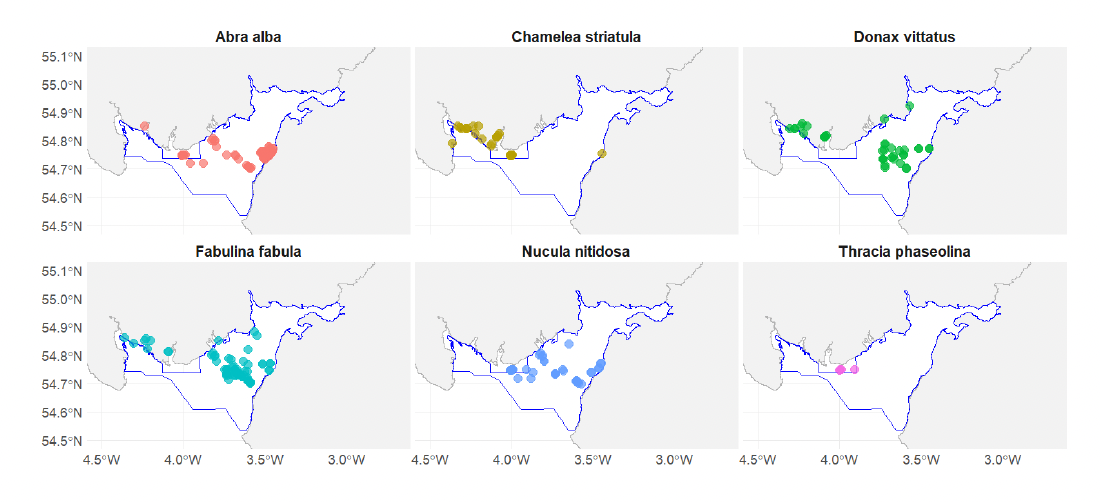
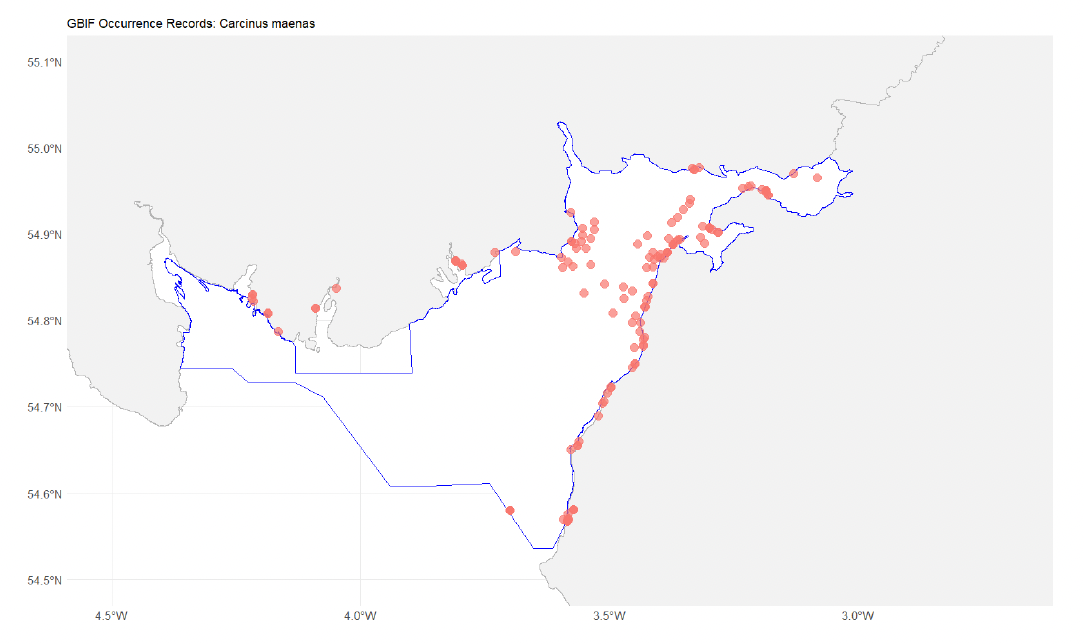
Data from GBIF are presence records, not records of abundance and are derived from a data portal that combines many different datasets, so these records do not constitute a comprehensive census of prey species distribution in the area. Instead, they are indicative of the best available knowledge of the occurrence of these species.
The BTO carries out its WeBS surveys at three locations in the Solway estuary: Fleet Estuary, Solway Estuary and Wigtown Bay. Kirkcudbright Bay is occasionally included but this is only for some species, mainly waders. Solway Estuary is in the inner firth and is separated from razor clam activity. Wigtown Bay is a survey location at the intertidal flats by Wigtown. The Fleet Estuary site is within Fleet Bay. Both are outside the authorised razor clam trial area but are the closest sites to razor clam activity and peak counts are discussed below where they were available. In comparison to aerial surveys these counts may underestimate abundance, however WeBS is a useful resource for examining trends. Trends and peak counts are determined from records that exclude incomplete surveys.
3.2.1 Razor clam fishing activity
There are 2 participating vessels active in this trial area, compared to a total of 102 fishing or fishing-associated vessels operating from ports in Ayr district (Scottish Government, 2025). Ayr is a large district encompassing the Solway and Clyde firths. Other vessel activity is summarised in 3.2.2. Vessel activity in the trial involves travel from the port of Kirkcudbright and Ayrshire ports to razor clam grounds in Wigtown Bay, Fleet Bay and Kirkcudbright Bay (Blackadder, 2024). The annual average number of fishing days is 91.4 with a range of 43 to 144. Vessel activity is highest in summer (Figure 8). The fishing gear in use on razor clam vessels is a lightweight electric current device towed at approximately 3 metres per minute, followed by divers (Blackadder, 2024). Individual fishing tows are limited by divers air supply, typically less than one hour. Electrodes leave a slight indent in the seabed, less than 1cm deep (Murray, Copland, Boulcott, Roberston, & Bailey, 2014).
Beginning in 2024, a seasonal closure was introduced to the trial, with fishing suspended between mid April and mid May. This closure was informed by knowledge gained in the trial of razor clam spawning activity.
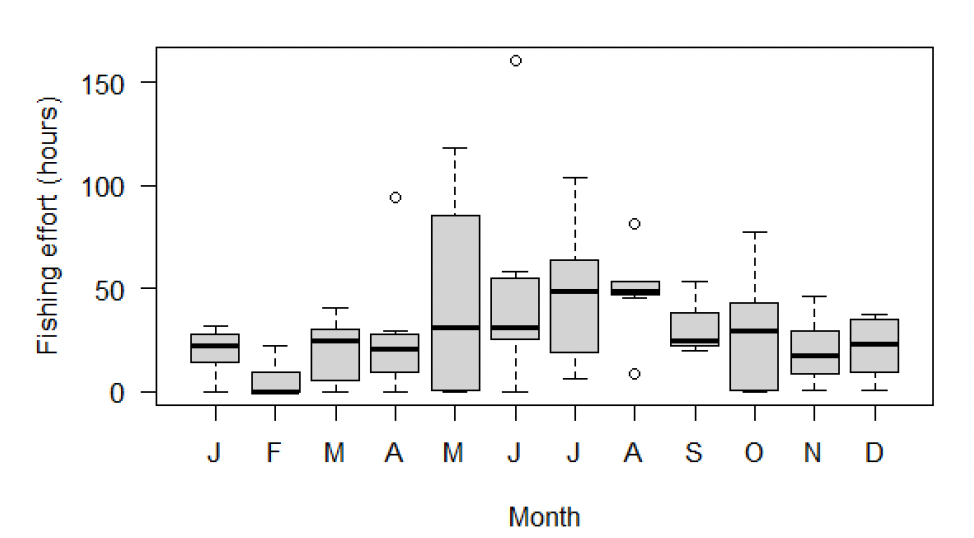
3.2.2 Non-razor clam vessel activity
Most ports in the SPA are based in the English portion. The most significantly used port in the Scottish portion is Kirkcudbright, with smaller hot spots associated with the River Nith and Urr Water. The highest vessel density is associated with fishing vessels operating out of Kirkcudright (EMODnet, 2024).
- Fishing vessels activity is mainly centred on Kirkcudbright, with vessels trawling for Nephrops and dredging for scallops further out into the main channel of the firth (Table 18). Fishing vessel activity overlaps with razor clam grounds in Kirkcudbright bay. Additionally, fishing with creels pots and traps and a small amount of set netting occurs in Wigtown Bay, however there is no overlap between fishing with these gears and razor clam grounds in Wigtown Bay or Fleet Bay.
- Cargo vessels use the main channel to Workington and do not enter razor clam ground areas.
- Tanker vessels make light use of the main channel of the firth while underway towards Liverpool and do not enter razor clam ground areas.
- There is no passenger craft activity to speak of in the SPA.
- There is some tug and towing activity in Wigtown Bay, but this does not overlap with razor clam grounds in the area.
- High speed craft activity associated with the offshore wind sector does not overlap with razor clam grounds.
- There is no military and law enforcement vessel activity to speak of in the SPA.
- Pleasure and sailing craft operate out of Kirkcudbright and Kippford, with some overlap with razor clam grounds in Kirkcudbright Bay. There is no overlap with razor clam grounds in Wigtown Bay or Fleet Bay.
- Dredging (in connection with harbour maintenance rather than fishing) and underwater operations vessels operate out of several ports in the English portion of the firth. There is light overlap with Kirkcudbright bay where undersea cables exist.
- Service vessels operate out of several ports in the firth, with no overlap with razor clam grounds.
- Other and unknown vessel types have some activity in Kirkcudbright bay that overlaps with razor clam grounds, otherwise there is no overlap with grounds in Wigtown Bay or Fleet Bay.
| Activity | Annual Average Fishing Effort (Days) | Swept seabed area (km2) | Footprint (c-squares) |
|---|---|---|---|
| Razor clam trial | 91.4 | No data | 4 |
| Nephrops and crustacean bottom trawls >12m | 14 | 15.1 | 13 |
| Dredges >12m | 2.7 | 2.5 | 11 |
| Pots and traps <12m | 21.3 | no data | 25 |
| Set nets <12m | no data* | no data | 4 |
| Bottom trawls <12m | no data* | no data | 2 |
Note: Under 12m data from Scottish Sea Fisheries Statistics spatial data. Over 12m data from ICES. ICES data are reported in hours and were converted to days by dividing by 12. * redacted due to number of vessels. C-square resolution: 0.05x0.05°.
3.2.3 Red-throated diver
Site-specific advice 2a:
The site-specific advice for red-throated diver is:
- Maintain the population of nonbreeding red-throated diver at a stable or increasing trend relative to the site reference population.
Wetland Bird Survey data for red-throated diver at this SPA up to winter of 2021/22 shows a fluctuating trend (Caulfield, Feather, Smith, Frost, & Woodward, 2025). At Wigtown Bay there were more birds in the period prior to the establishment of the trial, but at Fleet Bay there were more birds after the establishment of the trial (Table 19).
| WeBS site | Period | Five-year moving average peak count |
|---|---|---|
| Wigtown Bay | 2019/20 to 2023/24 | 6 |
| Wigtown Bay | 2018/29 to 2022/23 | 9 |
| Wigtown Bay | 2013/14 to 2017/18 | 13 |
| Fleet Estuary | 2019/20 to 2023/24 | 12 |
| Fleet Estuary | 2018/29 to 2022/23 | 14 |
| Fleet Estuary | 2013/14 to 2017/18 | 2 |
Data from BTO WeBS Programme (Calbrade, et al., 2025).
Site-specific advice 2b
The site-specific advice for red-throated diver is:
- Ensure red-throated divers continue to have access to and can utilise all optimal habitats suitable for all relevant aspects of their life cycle associated with the site.
- Avoid significant disturbance to red-throated divers and ensure individuals can move safely between these areas within the site.
Wigtown Bay is an area with high density of red-throated divers, which does overlap with razor clam fishing vessel activity in Wigtown Bay itself and adjacent Fleet Bay. Occupancy is low in Kirkcudbright bay (NatureScot/Natural England, 2016).
The non-breeding season is over winter from September to March, with most birds arriving in October and numbers declining from January and February. 26% of fishing hours in this SPA have been between October and February.
Red-throated divers are highly sensitive to disturbance (Furness, Wade, & Masden, 2013). The area of habitat in the inner firth that they frequently utilise is distant from razor clam fishing operations, but the area in Wigtown Bay and Fleet Bay does overlap with the main areas of fishing. Higher peak counts post-establishment of the trial suggest a lower risk of significant disturbance in Fleet Bay, but lower counts in Wigtown Bay indicate there may be a higher risk. A possible reason for this difference is that the footprint of the fishing activity in Wigtown Bay, when a 1000m buffer is applied (NatureScot, 2022), leaves less than 1000m of sea for red-throated divers to move between the intertidal flats at the head of the bay and the open water at the mouth of the bay.
There is therefore a potential risk of disturbance of red-throated divers in this razor clam trial area.
Site-specific advice 2c
The site-specific advice for red-throated diver is:
- Maintain the extent and distribution of the supporting habitats for redthroated diver within the site.
- Maintain the variety and abundance of food resources and the condition of supporting habitats and associated processes.
- Existing water quality should be maintained, or where appropriate improved, and any increase in nutrients, turbidity or contaminants where this could reduce supporting habitats and/or prey, should be avoided.
Red-throated divers eat a variety of species and forage according to local availability.
The main predicted areas of sandeels within the Solway Firth are in Luce Bay and in the main channel, outside the SPA some distance from the razor clam grounds (Langton, Boulcott , & Wright, 2021).
Young herring may be found at high density in the Solway Firth main channel (Scottish Government, 2014). There are not thought to be any spawning grounds for herring within the SPA (Frost & Diele, 2022). The main channel is some distance from razor clam operations in Wigtown Bay. Furthermore, herring is a pelagic species and therefore razor clam fishing operations are not considered to affect supporting habitat to the extent that it adversely affects prey availability.
Red-throated divers follow frontal zones, which do intersect areas of razor clam fishing, with a chlorophyll-a front that runs from Wigtown Bay towards the inner firth (Miller, Xu, & Carruthers, 2015).
Scotland’s Marine Assessment found a stable trend for nutrient concentrations and chlorophyll in the Solway Scottish Marine Region (Scottish Government, 2020). Razor clam fishing activity may cause localised increases in turbidity at the seabed during fishing operations, but this is not considered likely to contribute to a deterioration in water quality locally or at the water body scale.
Overall assessment in relation to relevant pressures and site-specific advice
High variation in numbers from one year to the next make interpretation of underlying trends difficult. There are opposite trends in Wigtown Bay and Fleet Bay. Red-throated divers primarily forage for species that do not overlap to a great extent with razor clam grounds, and are not expected to be affected to the extent that their availability as prey is adversely affected. Given red-throated divers sensitivity to disturbance and the low vessel traffic in Wigtown Bay and Fleet Bay, there is a possibility razor clam fishing in this area impairs red-throated divers ability to utilise optimal habitat and therefore may constitute a risk to the integrity of this feature within this SPA.
3.2.4 Common scoter
Site-specific advice 2a
The site-specific advice for common scoter is:
- Maintain the population of nonbreeding common scoter at a stable or increasing trend relative to the site reference population.
Wetland Bird Survey data for common scoter at this SPA up to winter of 2021/22 shows a fluctuating trend (Caulfield, Feather, Smith, Frost, & Woodward, 2025). Peak counts in Wigtown Bay were small but more birds were recorded in the period prior to the establishment of the trial. In comparison many more birds are recorded in Fleet Bay, with more birds recorded after the trial began, though this fluctuates (Table 20).
| WeBS site | Period | Five-year moving average peak count |
|---|---|---|
| Wigtown Bay | 2019/20 to 2023/24 | 2 |
| Wigtown Bay | 2018/29 to 2022/23 | 0 |
| Wigtown Bay | 2013/14 to 2017/18 | 10 |
| Fleet Estuary | 2019/20 to 2023/24 | 317 |
| Fleet Estuary | 2018/29 to 2022/23 | 463 |
| Fleet Estuary | 2013/14 to 2017/18 | 291 |
Data from BTO WeBS Programme (Calbrade, et al., 2025).
Site-specific advice 2b
The site-specific advice for common scoter is:
- Ensure common scoter continue to have access to and can utilise all optimal habitats suitable for all relevant aspects of their life cycle associated with the site.
- Avoid significant disturbance to common scoter and ensure individuals can move safely between these areas within the site.
Common scoter are present in the SPA between July and April, with a flightless moult period from July to October, with males moulting earlier and females moulting later. Fishing effort declines from July into winter in Wigtown Bay (Figure 8).
Common scoter mainly make use of habitat in the inner firth, though there is a subordinate area of occupancy in Wigtown Bay and Fleet Bay (NatureScot/Natural England, 2016). A seasonal closure is in place in the trial from late April to Late May during which no fishing activity will take place, this overlaps with the tail end of their presence in the SPA.
Common scoter are highly sensitive to disturbance by boats and infrastructure (Kaiser, et al., 2006), (Furness, Wade, & Masden, 2013) but tend to seek out less disturbed areas away from heavy marine traffic. Wigtown Bay and Fleet Bay are both areas of light marine traffic, other than razor clam fishing vessels and other fishing vessels. They show high site fidelity, so where they are present is indicative of optimal habitat.
The two vessels active in the trial in this area have engaged in alternating years of relatively light fishing effort of between 43 and 67 combined fishing days with years of more intensive effort of between 139 and 144 combined fishing days. There has also been a change in effort from primarily fishing grounds in Wigtown Bay to reducing effort here and spending more time fishing grounds in Fleet Bay and Kirkcudbright Bay.
The importance of Fleet Bay to common scoter gives rise to concern razor clam vessels may be capable of disturbing ducks, and may also constitute a barrier to ducks ability to move safely between areas within the SPA, this is because the razor ground at Fleet Bay is in shallow water of between 1 and 7 metres depth around the Islands of Fleet and if a vessel is working this area it may not be possible to maintain the recommended non-breeding buffer distance of 300-500m from common scoter (NatureScot, 2022).
Site-specific advice 2a
The site-specific advice for common scoter is:
- Maintain the extent and distribution of supporting habitats for common scoter within the site.
- Maintain the variety and abundance of food resources and the condition of supporting habitats and associated processes.
- Existing water quality should be maintained, or where appropriate improved, and any increase in nutrients, turbidity or contaminants where this could reduce supporting habitats and/or prey, should be avoided.
Common scoters are likely to make use of habitat that overlaps with the locus of razor clam fishing effort. Several studies have identified bivalve molluscs including razor clams as a key component of their diet, however their preference is for prey in the range of 5-40mm shell length, far below the 100mm minimum conservation reference size in operation in the trial (Kaiser, et al., 2006). Evidence in the Celtic Sea in relation to the Irish razor clam fishery suggests common scoter distribution is not affected by this activity; distribution and availability of surficial bivalve prey was the main predictor of scoter habitat occupancy (Breen, Clarke, & Tully, 2022). The Irish fishery uses hydraulic dredging rather than electric current fishing gear, which is a method associated with greater seabed impact and removes more clams per unit effort than electric current fishing (Hauton, Howell, Atkinson, & Moore, 2007) (Fox, 2023). Therefore, targeted removal of clams by the razor clam fishery is not considered to affect razor clams to the extent that it adversely affects prey availability to common scoter.
The distribution of bivalve species known to be important prey for common scoter is illustrated in Figure 5. These are summarised below:
- Common cockles Cerastoderma edule are widely distributed in the SPA with records in Wigtown Bay, Fleet Bay and Kirkcudbright Bay. Occurrence records overlap partly with razor clam fishing activity.
- Cerastoderma glaucum is represented by a single record in the inner firth and does not overlap with razor clam activity.
- Baltic clams Macoma balthica are widely distributed in the SPA with records in the inner firth, Wigtown Bay, Fleet Bay and Kirkcudbright Bay. The Fleet Bay records overlap partly with razor clam fishing activity.
- Soft shell clam Mya arenaria are distributed mainly on the Scottish side of the SPA, with records in the inner firth, Wigtown Bay, Fleet Bay and Kirkcudbright Bay. The Fleet Bay records overlap partly with razor clam fishing activity.
- Blue mussels Mytilus edulis are widely distributed in the SPA. These are mostly intertidal records on rocky shores, with subtidal beds present in the inner firth. Neither type overlaps with razor clam activity.
- The surf clam Spisula subtruncata is mostly recorded in Wigtown Bay and Fleet Bay. Occurrence records partly overlap with razor clam fishing activity.
In the Irish fishery, key bivalve fauna that appeared to be important determinants of scoter habitat use were Abra alba, Chamelea striatula, Fabulina fabula, Nucula nitidosa and Donax vittatus (Breen, Clarke, & Tully, 2022). The authors further noted that Thracia phaseolina, while not reported to be a prey species for scoters, was a component of most surficial bivalve assemblages that was a significant predictor of scoter habitat use.
All of these species have been recorded in the SPA or nearby. Occurrence records in from 2000 to 2024 in the Global Biodiversity Information Facility (GBIF) are presented in Figure 6 and summarised below:
- Abra alba records appear to mainly be in the inner firth and around Kirkcudbright bay. They do not overlap with razor clam fishing activity.
- Chamelea striatula is found mainly in Wigtown Bay and Fleet Bay, and occurrence records overlap partly with razor clam fishing activity.
- Fabulina fabula is present in Wigtown Bay, Fleet Bay, Kirkcudbright Bay and in the inner firth. Occurrence records partly overlap with razor clam fishing activity.
- Donax vittatus is present in Wigtown Bay, Fleet Bay, Kirkcudbright Bay and in the inner firth. Occurrence records partly overlap with razor clam fishing activity.
- Nucula nitidosa is not reported in Wigtown Bay but is present off Kirkcudbright Bay and the inner firth. Occurrence records do not overlap with razor clam fishing activity.
- Thracia phaseolina is recorded at only a few locations in the military exclusion area. Occurrence records do not overlap with razor clam fishing activity.
It is not known which sediment types contain high abundances of prey species, but the type of sediment that predominates in the SPA extends far beyond the loci of razor clam fishing. Razor clam grounds in Wigtown Bay are located over slightly gravelly muddy sand, which extends out into the outer firth, while substrates in the inner firth are predominantly sand and muddy sand (British Geological Survey, 2025). This points to there being a significant area of prey supporting habitat that common scoter may seek to utilise.
From known occurrence records, the locations where common scoter are found in the greatest densities appear to overlay the periods with the greatest number of occurrence records of the various prey species summarised above. Fleet Bay in particular appears to contain a wide range of bivalve species of importance to common scoter (Figure 5).
Evidence gathered before and during the trial points to only short term and recoverable effects of electric current on crabs (Blackman, Fox, & Albalat, 2024) and bivalves (Murray, Copland, Boulcott, Roberston, & Bailey, 2014). Combined with the minimal physical impact on the seabed and highly localised footprint of the trial fishery, the activity is not considered to be capable of damaging benthic habitats in the SPA to the extent that it adversely affects prey availability for common scoter.
Overall assessment in relation to relevant pressures and site-specific advice
The common scoter population is fluctuating in the SPA. Common scoter target a wide range of benthic bivalve species that appear to be widely distributed within the SPA. The fishing activity is not considered capable of adversely affecting prey availability. Because of where razor clam beds are located, there is potential, particularly for Fleet Bay, for razor clams vessels to be a barrier to common scoters use of optimal habitat and they may constitute a risk of disturbance. This may therefore constitute a risk to the integrity of this feature in the SPA.
3.2.5 Goosander
Site-specific advice 2a
The site-specific advice for goosander is:
- Maintain the population of nonbreeding goosander at a stable or increasing trend relative to the site reference population.
- Ensure goosander can move safely between the site and important areas of functionally linked land and freshwater bodies outwith the site.
Wetland Bird Survey data for goosander at this SPA up to winter of 2021/22 shows a fluctuating trend (Caulfield, Feather, Smith, Frost, & Woodward, 2025). Individual peak counts at relevant WeBS sites show low occupancy with 1 or 2 birds recorded in all periods examined (Table 21).
| WeBS site | Period | Five-year moving average peak count |
|---|---|---|
| Wigtown Bay | 2019/20 to 2023/24 | 1 |
| Wigtown Bay | 2018/29 to 2022/23 | 1 |
| Wigtown Bay | 2013/14 to 2017/18 | 1 |
| Fleet Estuary | 2019/20 to 2023/24 | 1 |
| Fleet Estuary | 2018/29 to 2022/23 | 1 |
| Fleet Estuary | 2013/14 to 2017/18 | 2 |
Data from BTO WeBS Programme (Calbrade, et al., 2025).
Goosander mainly occupy the inner Solway firth (Calbrade, et al., 2025) and the small number of birds that have been recorded in the area where razor clam fishing activity happens are not considered to be prevented from moving safely between site and important areas of habitat outwith the site.
Site-specific advice 2b
The site-specific advice for Goosander is:
- Ensure goosander continue to have access to and can utilise all optimal habitats suitable for all relevant aspects of their life cycle associated with the site.
- Avoid significant disturbance to goosander and ensure individuals can move safely between these areas within the site.
Goosander are present year-round but appear not to make significant use of Wigtown Bay. Fishing effort is low in November to January when overwintering migrants are present.
The concentrations of goosander in the site-specific information are separated from razor clam grounds which are not considered to be optimal habitat for goosanders. Vessel traffic data for the Solway Firth indicates relatively light route density in the Firth, including the Wigtown Bay trial area. Vessel density is low in comparison to Kirkcudbright Bay and Workington on the southern side of the firth (Scottish Government, 2016).
Razor clam fishing is not considered to constitute a risk of significant disturbance to this species, or a barrier to goosanders ability to move between areas of optimal habitat within the site.
Site-specific advice 2c
The site-specific advice for goosander is:
- Maintain the extent and distribution of supporting habitats for goosander within the site.
- Maintain the variety and abundance of food resources and the condition of supporting habitats and associated processes.
- Existing water quality should be maintained, or where appropriate improved, and any increase in nutrients, turbidity or contaminants where this could reduce supporting habitats and/or prey, should be avoided
Goosander mainly forage for fish. Razor clam fishing is known to temporarily stun sandeels that come into contact with the fishing gear, however the areas predicted to be the main locations for sandeels in the SPA are into the main channel of the firth and therefore razor clam fishing activity is not considered to be likely to affect the extent or distribution of sandeel supporting habitat. Razor clam fishing activity is not considered likely to affect the variety and abundance of food resources that goosanders utilise.
Herring is a particularly important prey item for this species. The areas where herring are predicted to be present are principally in the main channel of the firth, with sparser records in Wigtown Bay (Scottish Government, 2014). Razor clam fishing is not considered likely to have an effect on the distribution or abundance of herring or herring supporting habitat.
Cod records are found in Wigtown Bay, but not in an area that overlaps with razor clam fishing activity (Scottish Government, 2014).
The main areas where plaice are predicted to be present are in the main channel and do not overlap with razor clam fishing activity (Scottish Government, 2014).
Few eel records exist in the area and do not overlap with razor clam fishing activity (Scottish Government, 2014).
No information on distribution or abundance of other species listed in the site-specific information was found as relating to loci of razor clam fishing activity.
Overall assessment in relation to relevant pressures and site-specific advice
Goosanders mainly occupy areas separate from where razor clam fishing occurs. No trend can be determined from the small number of birds observed in individual WeBS site data. Goosander prey on fish species that razor clam fishing is not considered to affect to the extent it adversely affects prey availability. Razor clam fishing activity is not considered to be a barrier to movement within or outwith the site, or to constitute a risk of significant disturbance. Razor clam fishing activity does not compromise the integrity of this feature within this SPA.
3.2.6 Great cormorant
Site-specific advice 2a
The site-specific advice for great cormorant is:
- Maintain the population of nonbreeding cormorant at a stable or increasing trend relative to the site reference population.
- Ensure cormorant can move safely between the site and important areas of functionally linked land and freshwater bodies outwith the site.
Wetland Bird Survey data for cormorant at this SPA up to winter of 2021/22 shows a fluctuating trend (Caulfield, Feather, Smith, Frost, & Woodward, 2025). Individual peak counts at relevant WeBS sites show higher numbers of birds recorded after the establishment of the trial compared to prior to the trial (Table 22).
| WeBS site | Period | Five-year moving average peak count |
|---|---|---|
| Wigtown Bay | 2019/20 to 2023/24 | 100 |
| Wigtown Bay | 2018/29 to 2022/23 | 41 |
| Wigtown Bay | 2013/14 to 2017/18 | 39 |
| Fleet Estuary | 2019/20 to 2023/24 | 38 |
| Fleet Estuary | 2018/29 to 2022/23 | 38 |
| Fleet Estuary | 2013/14 to 2017/18 | 10 |
Data from BTO WeBS Programme (Calbrade, et al., 2025).
The level of razor clam fishing activity in this SPA is not considered to constitute a barrier to cormorants ability to move between the SPA and functionally linked land and freshwater bodies outwith the SPA.
Site-specific advice 2b
The site-specific advice for great cormorant is:
- Ensure cormorant continue to have access to and can utilise all optimal habitats suitable for all relevant aspects of their life cycle associated with the site.
- Avoid significant disturbance to cormorant and ensure individuals can move safely between these areas within the site.
Vessel traffic data for the Solway Firth indicates relatively light route density in the Firth, including the Wigtown Bay trial area. Vessel density is low in comparison to Kirkcudbright Bay and Workington on the southern side of the firth (Scottish Government, 2016).
A seasonal closure is in place in the trial from late April to Late May during which no fishing activity will take place.
Cormorants dive in search of fish and may utilise habitat the overlaps with razor clam grounds. In the context of wider fishing activity and non-fishing activity and separation of razor clam fishing from roosts, razor clam fishing is not considered to constitute a risk of significant disturbance to cormorants use of optimal habitat.
Site-specific advice 2c
The site-specific advice for cormorant is:
- Maintain the extent and distribution of supporting habitats for cormorant within the site.
- Maintain the variety and abundance of food resources and the condition of supporting habitats and associated processes.
- Existing water quality should be maintained, or where appropriate improved, and any increase in nutrients, turbidity or contaminants where this could reduce supporting habitats and/or prey, should be avoided.
Cormorants feed preferentially on bottom dwelling fish in marine waters so razor clam fishing activity may have an effect on the extent and distribution of supporting habitats, where these support populations of demersal fish.
Razor clam grounds in Wigtown Bay are located over slightly gravelly muddy sand, which extends out into the outer firth, while substrates in the inner firth are predominantly sand and muddy sand (British Geological Survey, 2025). These substrates may be occupied by flatfish in particular, which were the main fish type incidentally observed in video tows in Wigtown Bay during the trial (Fox, 2025).
The main areas where plaice are predicted to be present are in the main channel and do not overlap with razor clam fishing activity (Scottish Government, 2014).
Dover sole may be present in the area, though the probability of presence is low and further out into the main channel of the firth, not overlapping with razor clam activity (Scottish Government, 2014).
Gadoids found in or near the SPA (Scottish Government, 2014) are:
- Whiting, which are most likely to be present in the main channel of the firth, but records do exist for Wigtown Bay. These do not overlap with razor clam activity.
- Ling, found in the outer portion of Wigtown Bay and Luce Bay, not overlapping with razor clam activity.
- Saithe, though records are mainly in Luce Bay.
- Norway Pout, which is most likely to be found in the North Channel area.
- Hake, which is most likely to be found in the North Channel area.
Razor clam fishing activity is not considered to affect any of these prey supporting habitats or prey species to the extent that it adversely affects prey availability.
Scotland’s Marine Assessment found a stable trend for nutrient concentrations and chlorophyll in the Solway Scottish Marine Region (Scottish Government, 2020). Razor clam fishing activity may cause localised increases in turbidity at the seabed during fishing operations, but this is not considered likely to contribute to a deterioration in water quality locally or at the water body scale.
Overall assessment in relation to relevant pressures and site-specific advice
Cormorant numbers are fluctuating at the site level but appear to be higher at the nearby WeBS sites when comparing before and after the establishment of the trial. Cormorants prey on fish species that razor clam fishing is not considered to affect to the extent it adversely affects prey availability. Razor clam fishing activity is not considered to be a barrier to movement within or outwith the site, or to constitute a risk of significant disturbance. Razor clam fishing activity does not compromise the integrity of this feature within this SPA.
3.2.7 Greater scaup
Site-specific advice 2a
- Ensure the population of nonbreeding scaup has the ability to recover to the site reference population.
- Ensure non-breeding scaup are not at significant risk from injury or mortality.
Wetland Bird Survey data for scaup at this SPA up to winter of 2021/22 shows a declining trend from 2014/15 (Caulfield, Feather, Smith, Frost, & Woodward, 2025). The authors suggest site-specific pressures may be worsening this decline compared to the UK-wide trend. Scaup mostly inhabit the inner firth, but there are smaller numbers of ducks recorded in Wigtown Bay and Fleet Bay. Numbers are higher in Wigtown Bay in the period after the establishment of the trial compared to before. Numbers in Fleet Bay have declined in the period before the establishment of the trial compared to after (Table 23). It is noted that occupancy varies considerably between years in this species: in the period 2013-14 to 2017-18, scaup were not recorded in 2014/15, 2015/16 and 2016/17 in Wigtown Bay and in 2013/14, 2014/14 and 2015/16 in Fleet Estuary.
| WeBS site | Period | Five-year moving average peak count |
|---|---|---|
| Wigtown Bay | 2019/20 to 2023/24 | 16 |
| Wigtown Bay | 2018/29 to 2022/23 | 16 |
| Wigtown Bay | 2013/14 to 2017/18 | 6 |
| Fleet Estuary | 2019/20 to 2023/24 | 2 |
| Fleet Estuary | 2018/29 to 2022/23 | 25 |
| Fleet Estuary | 2013/14 to 2017/18 | 94 |
Data from BTO WeBS Programme (Calbrade, et al., 2025).
Site-specific advice 2b
The site-specific advice for scaup is:
- Ensure scaup continue to have access to and can utilise all optimal habitats suitable for all relevant aspects of their life cycle associated with the site.
- Avoid significant disturbance to scaup and ensure individuals can move safely between these areas within the site.
Scaup will be present in the SPA from September to April. 47.3% of fishing hours have occurred during this period. The seasonal closure begins in April and will coincide with the end of this period.
Vessel traffic data for the Solway Firth indicates relatively light route density in the Firth, including the Wigtown Bay trial area. Vessel density is low in comparison to Kirkcudbright Bay and Workington on the southern side of the firth (Scottish Government, 2016).
Scaup are a diving duck and therefore may utilise habitat that overlaps with razor clam fishing grounds. Their favoured foraging habitat is bivalve beds – subtidal blue mussel beds are concentrated in the inner firth and in adjacent Luce Bay which is closed to razor clam fishing. Fishing for cockles by any method is prohibited in the Scottish administered portion by SSI 2011/319 and razor clam fishing does not land any cockles or blue mussels. Some razor clam activity close to the Islands of Fleet does overlap with records of cockles.
Scaup feed nocturnally so there is a separation between razor clam activity and foraging behaviour, as razor clam fishing is carried out during the day. Scaup roost at sea during the day but are thought to prefer flocking away from the coast (RBBP, 2013).
Razor clam fishing activity is not considered to constitute a barrier to accessing optimal habitat, nor is it considered to constitute a risk of significant disturbance to scaup.
Site-specific advice 2c
The site-specific advice for scaup is:
- Maintain the extent and distribution of the supporting habitats for scaup within the site.
- Ensure the variety and abundance of food resources and the condition of supporting habitats and associated processes have the ability to recover.
- Existing water quality should be maintained, or where appropriate improved, and any increase in nutrients, turbidity or contaminants where this could reduce supporting habitats and/or prey, should be avoided.
The distribution of bivalve species known to be important prey for common scoter is illustrated in Figure 4. These are summarised below:
- Common cockles Cerastoderma edule are widely distributed in the SPA with records in Wigtown Bay, Fleet Bay and Kirkcudbright Bay. Occurrence records overlap partly with razor clam fishing activity.
- Blue mussels Mytilus edulis are widely distributed in the SPA. These are mostly intertidal records on rocky shores, with subtidal beds present in the inner firth. Neither type overlaps with razor clam activity.
Razor clam fishing is not considered to affect prey-supporting habitat to the extent it adversely affects availability for scaup.
Scotland’s Marine Assessment found a stable trend for nutrient concentrations and chlorophyll in the Solway Scottish Marine Region (Scottish Government, 2020). Razor clam fishing activity may cause localised increases in turbidity at the seabed during fishing operations, but this is not considered likely to contribute to a deterioration in water quality locally or at the water body scale.
Overall assessment in relation to relevant pressures and site-specific advice
Scaup numbers are in long-term decline in the site. There are different trends in WeBS sites when comparing before and after the establishment of the trial, with more ducks in Wigtown Bay and fewer ducks in Fleet Bay, however it is noted there are often years with no ducks recorded. The fishing activity is not considered capable of adversely affecting prey availability. Razor clam fishing activity is not considered to be a barrier to movement within or outwith the site, or to constitute a risk of significant disturbance. Razor clam fishing activity does not compromise the integrity of this feature within this SPA.
3.2.8 Common goldeneye
Site-specific advice 2a
The site-specific advice for goldeneye is:
- Ensure the population of nonbreeding goldeneye has the ability to recover to the site reference population.
- Ensure non-breeding goldeneye are not at significant risk from injury or mortality.
Goldeneye are at unfavourable status in this SPA. Wetland Bird Survey data for goldeneye at this SPA up to winter of 2021/22 shows a declining trend (Caulfield, Feather, Smith, Frost, & Woodward, 2025). The report indicates the decline is likely to have been exacerbated by site-specific pressures. At Wigtown Bay, few ducks have been recorded in the period examined. At Fleet Estuary, the moving average peak count was high before the start of the trial compared to after (Table 24). Kirkcudbright Bay is occasionally surveyed, recording 7 ducks in 2022/23, after the start of the trial and 4 ducks in 2014/15, before the start of the trial.
| WeBS site | Period | Five-year moving average peak count |
|---|---|---|
| Wigtown Bay | 2019/20 to 2023/24 | 2 |
| Wigtown Bay | 2018/29 to 2022/23 | 2 |
| Wigtown Bay | 2013/14 to 2017/18 | 1 |
| Fleet Estuary | 2019/20 to 2023/24 | 2 |
| Fleet Estuary | 2018/29 to 2022/23 | 2 |
| Fleet Estuary | 2013/14 to 2017/18 | 9 |
Data from BTO WeBS Programme (Calbrade, et al., 2025).
Given the small number of vessels, low speed while fishing and lack of nets or hooks in fishing gear or reports of encounters with divers during the trial, there is unlikely to be a significant collision or entanglement risk to goldeneye.
Site-specific advice 2b
The site-specific advice for goldeneye is:
- Ensure goldeneye continue to have access to and can utilise all optimal habitats suitable for all relevant aspects of their life cycle associated with the site.
- Avoid significant disturbance to goldeneye and ensure individuals can move safely between these areas within the site.
Goldeneye are present from September to April. 47.3% of fishing hours have occurred during these months.
A seasonal closure is in place in the trial from late April to Late May during which no fishing activity will take place, this may overlap with the end of the period when goldeneye are present in the SPA. Goldeneye are capable of diving to depths in which razor clam beds are found, and may use marine waters, however the site-specific information states goldeneye at the site are reported to mainly occupy river channels and are therefore expected to be separated from razor clam fishing activity.
Razor clam fishing activity is not considered to be a barrier to goldeneye maintaining access to optimal habitat, or to constitute a risk of significant disturbance.
Site-specific advice 2c
The site-specific advice for goldeneye is:
- Maintain the extent and distribution of supporting habitats for common goldeneye within the site.
- Ensure the variety and abundance of food resources and the condition of supporting habitats and associated processes have the ability to recover.
- Existing water quality should be maintained, or where appropriate improved, and any increase in nutrients, turbidity or contaminants where this could reduce supporting habitats and/or prey, should be avoided.
Goldeneye prey on a wide variety of species, with the site-specific information highlighting blue mussels, shore crabs and gastropod species. Subtidal blue mussel beds are located in other parts of the SPA and adjoining areas, and intertidal mussels will be found on rocky substrate that does not overlap with razor clam fishing activity (Figure 5). Shore crabs are likely to be widely distributed in the SPA, however it is noted that records from GBIF do not overlap with razor clam fishing areas (Figure 7).
Of gastropods identified as important prey for goldeneye in site-specific information, neither Rissoa membranacea (National Biodiversity Network Atlas, 2025) or Bittium reticulatum (Marine Biological Association, 2025) have been recorded in the Solway Firth, so razor clam fishing activity is not considered to be capable of affecting these species with reference to goldeneye foraging.
Scotland’s Marine Assessment found a stable trend for nutrient concentrations and chlorophyll in the Solway Scottish Marine Region (Scottish Government, 2020). Razor clam fishing activity may cause localised increases in turbidity at the seabed during fishing operations, but this is not considered likely to contribute to a deterioration in water quality locally or at the water body scale.
Overall assessment in relation to relevant pressures and site-specific advice
Goldeneye are at unfavourable status in the SPA. Numbers at the WeBS site in the Fleet Estuary are lower in the period after the trial started. Site-specific information suggests goldeneye would not be expected to frequently encounter razor clam fishing vessels as they favour occupying river channels and estuaries, therefore razor clam fishing is not considered to constitute a significant risk of injury, mortality or risk of significant disturbance. Goldeneye prey on a wide variety of species and razor clam fishing is not expected to affect any of these to the extent it adversely affects availability. Razor clam fishing is not considered to hinder recovery of this species to favourable status.
3.2.9 Black-headed gull
Site-specific advice 2a
The site-specific advice for black-headed gull is:
- Ensure the population of nonbreeding black-headed gulls are not at significant risk from injury or mortality.
- Ensure black-headed gulls can move safely between the site and important areas of functionally linked land outwith the site.
There is no site-level trend information for this species in WeBS alerts, but there are peak count records for Wigtown Bay and Fleet Estuary, and one survey in Kirkcudbright Bay during the period examined. More gulls were recorded in the period after the start of the razor clam trial compared to before in both Wigtown Bay and Fleet Estuary (Table 25). 22 birds were recorded at Kirkcudbright Bay in 2022/23 but otherwise this site has not been regularly surveyed in the period examined.
| WeBS site | Period | Five-year moving average peak count |
|---|---|---|
| Wigtown Bay | 2019/20 to 2023/24 | 1193 |
| Wigtown Bay | 2018/29 to 2022/23 | 1436 |
| Wigtown Bay | 2013/14 to 2017/18 | 858 |
| Fleet Estuary | 2019/20 to 2023/24 | 468 |
| Fleet Estuary | 2018/29 to 2022/23 | 561 |
| Fleet Estuary | 2013/14 to 2017/18 | 189 |
Data from BTO WeBS Programme (Calbrade, et al., 2025).
Black-headed gulls forage in coastal and intertidal areas that do not overlap with razor clam fishing grounds. There is a low risk of vessel movement having a significant impact on black-headed gulls in terms of displacement from their foraging or roosting areas. The small number of vessels, slow speed, lack of hooks and nets means there is unlikely to be a significant injury or mortality risk from entanglement or collision to black-headed gulls while fishing operations are underway.
Site-specific advice 2b
The site-specific advice for black-headed gull is:
- Ensure black-headed gull continue to have access to and can utilise all optimal habitats suitable for all relevant aspects of their life cycle associated with the site.
- Avoid significant disturbance to blackheaded gull and ensure individuals can move safely between these areas within the site.
Black-headed gulls forage in intertidal and terrestrial habitat as well as feeding at the sea surface. These modes of foraging are unlikely to involve significant interaction with razor clam fishing activity; therefore it is not anticipated that razor clam fishing constitutes significant disturbance to black-headed gulls or a significant barrier to their use of optimal habitat.
Razor clam fishing occurs during the day and is not a barrier to use of these areas for nighttime roosting flocks.
Site-specific advice 2c
The site-specific advice for black-headed gull is:
- Maintain the extent and distribution of supporting habitats for blackheaded gull within the site.
- Maintain the variety and abundance of food resources and the condition of supporting habitats and associated processes.
- Existing water quality should be maintained, or where appropriate improved, and any increase in nutrients, turbidity or contaminants where this could reduce supporting habitats and/or prey, should be avoided.
Razor clam fishing activity does not overlap with black-headed gull roosting habitat.
Supporting habitats for foraging are not known but given black-headed gull foraging behaviour, it is considered unlikely that razor clam fishing will negatively affect prey availability.
Scotland’s Marine Assessment found a stable trend for nutrient concentrations and chlorophyll in the Solway Scottish Marine Region (Scottish Government, 2020). Razor clam fishing activity may cause localised increases in turbidity at the seabed during fishing operations, but this is not considered likely to contribute to a deterioration in water quality locally or at the water body scale.
Overall assessment in relation to relevant pressures and site-specific advice
Black-headed gull numbers appear to be higher in the area compared to before the razor clam trial started. Razor clam fishing activity is not considered to constitute a risk of injury or mortality, a barrier to movement within and outwith the site or to constitute a risk of significant disturbance. Although prey-supporting processes are not well understood for this species in this SPA, the mode of foraging and use of habitat suggests there is a low risk of razor clam activity affecting prey supporting benthic habitat to the extent that it adversely affects prey availability. Razor clam fishing activity does not compromise the integrity of this feature within this SPA.
3.2.10 Common gull
Site-specific advice 2a
The site-specific advice for common gull is:
- Ensure the population of nonbreeding common gulls are not at significant risk from injury or mortality.
- Ensure common gull can move safely between the site and important areas of functionally linked land outwith the site.
There is no site-level trend information for this species in WeBS alerts, but there are peak count records for Wigtown Bay and Fleet Estuary. In both cases more gulls were recorded in the period after the trial started compared to before (Table 26).
| WeBS site | Period | Five-year moving average peak count |
|---|---|---|
| Wigtown Bay | 2019/20 to 2023/24 | 1335 |
| Wigtown Bay | 2018/29 to 2022/23 | 1282 |
| Wigtown Bay | 2013/14 to 2017/18 | 795 |
| Fleet Estuary | 2019/20 to 2023/24 | 344 |
| Fleet Estuary | 2018/29 to 2022/23 | 369 |
| Fleet Estuary | 2013/14 to 2017/18 | 130 |
Data from BTO WeBS Programme (Calbrade, et al., 2025).
Common gulls feed in the intertidal zone and in terrestrial and freshwater habitat, the likelihood of common gulls interacting with razor clam fishing vessels is considered to be low. The small number of vessels, slow speed, lack of hooks and nets means there is unlikely to be a significant injury or mortality risk from entanglement or collision to common gulls while fishing operations are underway.
Site-specific advice 2b
The site-specific advice for common gull is:
- Ensure common gull continue to have access to and can utilise all optimal habitats suitable for all relevant aspects of their life cycle associated with the site.
- Avoid significant disturbance to common gull and ensure individuals can move safely between these areas within the site.
Razor clam fishing grounds are separated from the major roosting site in Allonby Bay.
Common gulls forage in intertidal and terrestrial habitat as well as feeding at the sea surface. These modes of foraging are unlikely to involve significant interaction with razor clam fishing activity; therefore it is not anticipated that razor clam fishing constitutes significant disturbance to common gulls or a significant barrier to their use of optimal habitat.
Site-specific advice 2c
The site-specific advice for common gull is:
- Maintain the extent and distribution of supporting habitats for common gull within the site.
- Maintain the variety and abundance of food resources and the condition of supporting habitats and associated processes.
- Existing water quality should be maintained, or where appropriate improved, and any increase in nutrients, turbidity or contaminants where this could reduce supporting habitats and/or prey, should be avoided.
Razor clam fishing activity does not overlap with common gull roosting habitat.
It is considered unlikely that razor clam fishing will negatively affect prey availability for common gulls given their foraging preferences.
Scotland’s Marine Assessment found a stable trend for nutrient concentrations and chlorophyll in the Solway Scottish Marine Region (Scottish Government, 2020). Razor clam fishing activity may cause localised increases in turbidity at the seabed during fishing operations, but this is not considered likely to contribute to a deterioration in water quality locally or at the water body scale.
Overall assessment in relation to relevant pressures and site-specific advice
Common gull numbers appear to be higher in the area compared to before the razor clam trial started. Razor clam fishing activity is not considered to constitute a risk of injury or mortality, a barrier to movement within and outwith the site or to constitute a risk of significant disturbance. The mode of foraging and use of habitat suggests there is a low risk of razor clam activity affecting prey supporting benthic habitat to the extent that it adversely affects prey availability. Razor clam fishing activity does not compromise the integrity of this feature within this SPA.
3.2.11 Herring Gull
Site-specific advice 2a
The site-specific advice for herring gull is:
- Ensure the population of nonbreeding herring gulls are not at significant risk from injury or mortality.
- Ensure herring gulls can move safely between the site and important areas of functionally linked land outwith the site.
There is no site-level trend information for this species in WeBS alerts, but there are peak count records for Wigtown Bay and Fleet Estuary. A single survey in Kirkcudbright Bay in 2022/23 recorded 16 birds. Peak counts recorded after the start of the trial were higher than before the start of the trial in both Wigtown Bay and Fleet Bay (Table 27).
| WeBS site | Period | Five-year moving average peak count |
|---|---|---|
| Wigtown Bay | 2019/20 to 2023/24 | 1761 |
| Wigtown Bay | 2018/29 to 2022/23 | 1447 |
| Wigtown Bay | 2013/14 to 2017/18 | 957 |
| Fleet Estuary | 2019/20 to 2023/24 | 277 |
| Fleet Estuary | 2018/29 to 2022/23 | 377 |
| Fleet Estuary | 2013/14 to 2017/18 | 214 |
Data from BTO WeBS Programme (Calbrade, et al., 2025).
Herring gulls are vulnerable to bycatch in nets, which are not in use by razor clam vessels. They can be attracted to offal (Camphuysen, 1995), however offal is not discarded in this fishing method. There is unlikely to be a significant injury or mortality risk from entanglement or collision to herring gulls while fishing operations are underway.
The level of razor clam fishing activity in this SPA is not considered to constitute a barrier to herring gulls ability to move between the SPA and functionally linked land and water bodies outwith the SPA.
Site-specific advice 2b
Site-specific advice for herring gull is:
- Ensure herring gull continue to have access to and can utilise all optimal habitats suitable for all relevant aspects of their life cycle associated with the site.
- Avoid significant disturbance to herring gull and ensure individuals can move safely between these areas within the site.
A seasonal closure is in place in the trial from late April to Late May during which no fishing activity will take place, which occurs during the breeding season.
Razor clam fishing grounds are separated from the major roosting site in Allonby Bay.
Herring gulls cannot dive to depths that razor clams are found at, so would not use this for foraging habitat, though they may use areas for general foraging at the sea surface.
Razor clam fishing is not considered to be a barrier to free movement within the SPA to access and use optimal habitat, nor is it considered to constitute a risk of significant disturbance.
Site-specific advice 2c
Site-specific advice for herring gull is:
- Maintain the extent and distribution of supporting habitats for herring gull within the site.
- Maintain the variety and abundance of food resources and the condition of supporting habitats and associated processes.
- Existing water quality should be maintained, or where appropriate improved, and any increase in nutrients, turbidity or contaminants where this could reduce supporting habitats and/or prey, should be avoided.
Razor clam fishing is not expected to affect the extent and distribution of supporting habitats for herring gull, or the variety and abundance of food resources or condition of supporting habitat. This is because gulls exploit a wide variety of food sources in marine, coastal and terrestrial environments. Razor clam fishing does not generate offal waste.
Mussel beds can be an important habitat for this species (Clewley, et al., 2021) and there is no overlap between razor clam fishing and intertidal mussels.
Scotland’s Marine Assessment found a stable trend for nutrient concentrations and chlorophyll in the Solway Scottish Marine Region (Scottish Government, 2020). Razor clam fishing activity may cause localised increases in turbidity at the seabed during fishing operations, but this is not considered likely to contribute to a deterioration in water quality locally or at the water body scale.
Overall assessment in relation to relevant pressures and site-specific advice
Herring gull numbers appear to be higher in the area compared to before the razor clam trial started. Razor clam fishing activity is not considered to constitute a risk of injury or mortality, a barrier to movement within and outwith the site or to constitute a risk of significant disturbance. The mode of foraging and use of habitat suggests there is a low risk of razor clam activity affecting prey supporting benthic habitat to the extent that it adversely affects prey availability. Razor clam fishing activity does not compromise the integrity of this feature within this SPA.
3.3 North Colonsay and Western Cliffs SPA
The following figures and information are referred to against the relevant features in relation to site-specific advice and information.
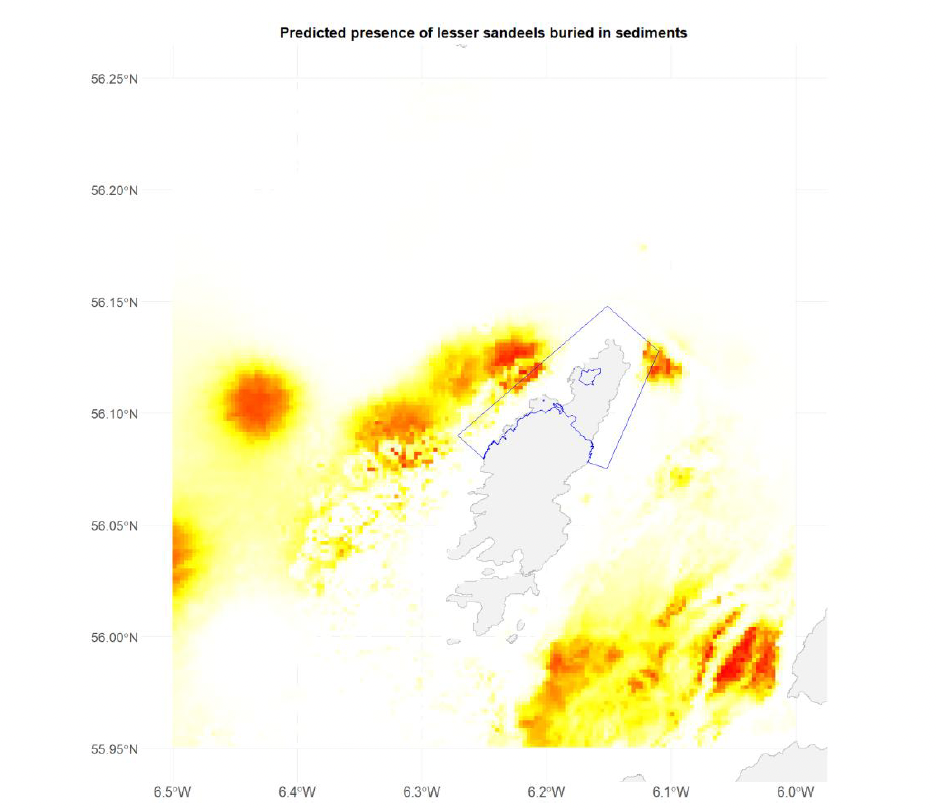
3.3.1 Razor clam fishing activity
Between 3 and 7 participating vessels are active in this trial area, compared to a total of 96 fishing or fishing-associated vessels operating from ports in Oban district (Scottish Government, 2025). Other vessel activity is summarised in 3.3.2. Vessel activity in the trial involves travel from Oban to razor clam grounds on the east cost of Colonsay, and offshore at the Tarbert Bank (Blackadder, 2024). The annual average number of fishing days is 171.4 days with a range of 27 to 357. Fishing effort increased substantially when the Tarbert Bank area was classified for shellfish harvesting. The fishing gear in use on razor clam vessels is a lightweight electric current device towed at approximately 3 metres per minute, followed by divers (Blackadder, 2024). Individual fishing tows are limited by divers air supply, typically less than one hour. Electrodes leave a slight indent in the seabed, less than 1cm deep (Murray, Copland, Boulcott, Roberston, & Bailey, 2014).
Beginning in 2024, a seasonal closure was introduced to the trial, with fishing suspended between mid April and mid May. This closure was informed by knowledge gained in the trial of razor clam spawning activity.
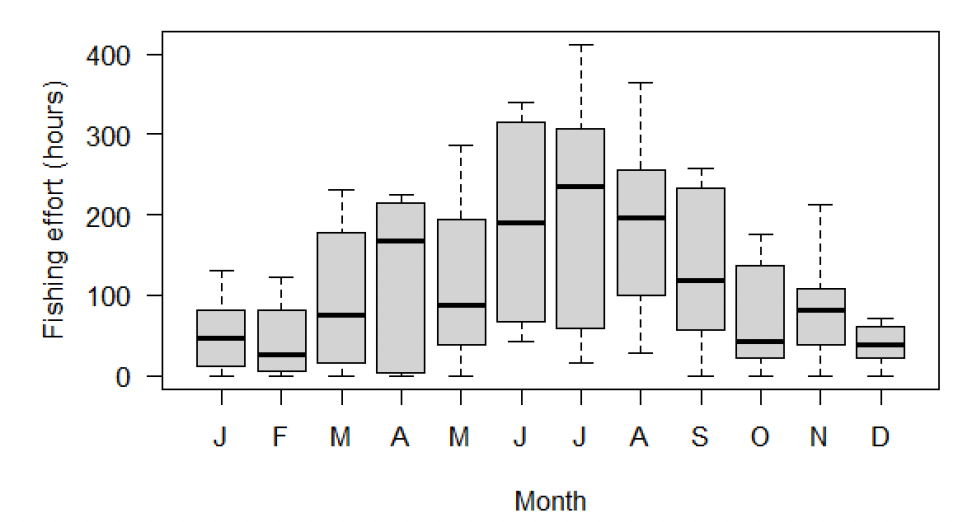
3.3.2 Non-razor clam vessel activity
Generally speaking, there is light vessel traffic in the SPA, with some hot spots of activity on the northeastern coast of Colonsay within the SPA, and similar patterns on the east coast of the portion of waters around the island that are not in the SPA. The vessel classes with significant presence in the area are passenger vessels, cargo vessels, fishing vessels and pleasure and sailing craft (EMODnet, 2024).
- Passenger vessels work routes between Colonsay and Oban and Port Askaig. These overlap with the SPA to a small degree but do not overlap with razor clam fishing activity.
- Fishing vessels are active in the SPA and nearby. This is mostly trawling and dredging for Nephrops and shellfish (Table 28). There is light effort associated with diving for scallops in the vicinity as well. This overlaps with areas of razor clam fishing.
| Activity | Annual Average Fishing Effort (Days) | Swept seabed area (km2) | Footprint (c-squares) |
|---|---|---|---|
| Razor clam trial | 171.4 | No data | 5 |
| Nephrops and crustacean bottom trawls >12m | 8.2 | 9.1 | 2 |
| Dredges >12m | 6.9 | 4.1 | 3 |
| Pots and traps <12m | No data* | No data | 7 |
| Bottom trawls <12m | No data* | No data | 3 |
| Diving/gathering <12m | No data* | No data | 2 |
| Dredges <12m | No data* | No data | 4 |
Note: Under 12m data from Scottish Sea Fisheries Statistics spatial data. Over 12m data from ICES. ICES data are reported in hours and were converted to days by dividing by 12. * redacted due to number of vessels. C-square resolution: 0.05x0.05°.
- Cargo vessels ferry goods from Oban and substantially overlap with passenger vessel traffic.
- There is no tanker vessel traffic to speak of in the SPA or nearby.
- Tug and towing vessels are active around Colonsay ferry terminal and in Loch Staosnaig, this does not overlap with razor clam fishing activity.
- High speed craft are associated with transport between Colonsay and Oban and do not overlap with razor clam fishing activity.
- There is no military or law enforcement vessel traffic to speak of in the SPA or nearby.
- Pleasure and sailing craft are active in the SPA and nearby, with traffic present on much of the east coast of Colonsay and spots on the west coast. This overlaps with some razor clam areas closer to the shore but does not overlap with the main Tarbert Bank ground.
- There is no dredging vessel traffic to speak of in the SPA or nearby.
- There are a few areas where service vessel traffic exists, mainly in connection with Colonsay ferry terminal. This does not overlap with razor clam fishing activity.
- Other and unknown vessel types operate mainly on the east coast of the island; this overlaps with razor clam grounds closer to the shore but not the main Tarbert Bank ground.
3.3.3 Black-legged kittiwake
Site-specific advice 2a
The site-specific advice for kittiwake is:
- Ensure the breeding population of kittiwake have the ability to recover to the site reference population.
- Ensure kittiwakes are not at significant risk from injury or mortality.
- Ensure kittiwakes can move safely between the site and important areas of functionally linked sea outwith the site.
Kittiwakes are in unfavourable condition at this SPA.
Kittiwakes are vulnerable to bycatch in surface gears, however razor clam gear is not a surface gear. The light weight of the gear, short time it is at the surface before being deployed to the seabed, slow speed of towing, lack of evidence of encounters with divers and lack of nets or hooks means kittiwakes are not considered to be at significant risk from injury or mortality by this activity.
Razor clam fishing is not considered to be a barrier to kittiwakes ability to move between the site and functionally linked areas outwith the SPA.
Site-specific advice 2b
The site-specific advice for kittiwake is:
- Ensure kittiwakes continue to have access to and can utilise all optimal habitats suitable for all relevant aspects of their life cycle associated with the site.
- Avoid significant disturbance to kittiwakes and ensure individuals can move safely between these areas within the site.
Kittiwakes are present from April to August, which coincides with the period of highest fishing activity (Figure 10). The seasonal closure means from 2024 onwards there is no fishing between late April and late May.
Razor clam activity is not anticipated to significantly disturb kittiwakes ability to access habitat for non-foraging behaviour as this is localised within 1km of home cliffs that are located on the north and west of Colonsay. Tarbert Bank is more than 1km from the island of Colonsay.
Kittiwakes maximum foraging range means they may interact with razor clam fishing activity.
Knowledge of the large-scale distribution of kittiwakes in the area indicates they mainly make use of the sea to the west of Colonsay (Wakefield, et al., 2017), separate from razor clam grounds. Limited tracking data from the BirdLife International seabird tracking database indicates confirms kittiwakes do not tend to forage as intensively in areas to the east of Colonsay, though there is some overlap with fishing activity to the east of Oronsay (BirdLife International, 2014). Fishing activity in the vicinity of Oronsay has declined since 2018 and most activity now focuses on Tarbert Bank (Blackadder, et al., 2024).
Kittiwakes prey heavily on sandeels, which are not predicted to overlap with razor clam grounds in comparison to predicted presence in other areas (Langton, Boulcott , & Wright, 2021).
Razor clam fishing is not considered to be a hindrance to access and use of optimal habitat within the site, or to constitute a risk of significant disturbance to kittiwakes.
Site-specific advice 2c
Site-specific advice for kittiwake is:
- Maintain or enhance the extent and distribution of the supporting habitats for kittiwakes within the site.
- Ensure the variety and abundance of food resources and the condition of supporting habitats and associated processes have the ability to recover.
- Existing water quality should be maintained any increase in nutrients, turbidity or contaminants where this could reduce supporting habitats and/or prey, should be avoided.
Razor clam fishing activity does not affect nesting habitat, and is greater than 1km from the cliffs in the SPA, so is not considered to affect habitat that kittiwakes use for loafing, preening or
Kittiwake venture further while foraging. other maintenance behaviours.
Kittiwake have a strong preference to forage for sandeels. Figure 7 shows the distribution of predicted habitat of sandeels in the area and while they appear to preferentially make foraging trips to the west of the island, they do appear to make use of the sea around Oronsay, which does overlap with razor clam fishing activity.
This is not an area that overlaps with high probability of presence of sandeels (Langton, Boulcott , & Wright, 2021), however it may be important habitat for sprats and cod (Scottish Government, 2014).
By comparison to the Oronsay ground, sandeels were frequently observed in video transects taken at the Tarbert Bank ground during the trial (Fox, 2023), though this does not appear to be an area that kittiwakes forage over, potentially because of water depth. Gadoids and sprat were not observed. Given the slow speed of razor clam hauls and lack of a burrowing lifestyle among these species, they are possibly more capable of moving away from razor clam gear and divers. Razor clam fishing activity is not considered to affect habitat supporting these prey species to the extent that it adversely affects prey availability.
Evidence from the razor clam scientific trial and preceding studies indicates that sandeels may be shocked by electric current gear but have been observed to recover soon after and resume swimming (Murray, Copland, Boulcott, Roberston, & Bailey, 2014).
Fishing for sandeels was prohibited in all Scottish waters following the coming into force of The Sandeel (Prohibition of Fishing) (Scotland) Order 2024. With the exception of scientific surveys and incidental capture by fishing gear of all types including razor clam gear, there is essentially no fishing pressure on sandeels in Scottish waters. Removal of fishing pressure on its own has not consistently resulted in high abundance of sandeels as it has no effect on the natural processes that determine recruitment success (Greenstreet, Fraser, Armstrong, & Gibb, 2010).
Scotland’s Marine Assessment indicated a stable trend for nutrients and chlorophyll in the Argyll Scottish Marine Region (Scottish Government, 2020). Razor clam fishing activity may cause localised increases in turbidity at the seabed during fishing operations, but this is not considered likely to contribute to a deterioration in water quality locally or at the water body scale.
Overall assessment in relation to relevant pressures and site-specific advice
Kittiwake are at unfavourable status in this SPA. Razor clam fishing activity is not considered to constitute a risk of injury or mortality, a barrier to movement within and outwith the site or to constitute a risk of significant disturbance. The use of habitat primarily to the west of Colonsay suggests there is a low risk of razor clam activity affecting prey supporting sandeel and other fish habitat to the extent that it adversely affects prey availability.
3.3.4 Common guillemot
Site-specific advice 2a
The site-specific advice for guillemot is:
- Maintain the breeding population of guillemots at a stable or increasing trend relative to the current site reference population.
- Ensure guillemots are not at significant risk from injury or mortality
- Ensure guillemots can move safely between the site and important areas of functionally linked sea outwith the site.
Due to the slow speed, lack of nets or hooks and lack of evidence of encounters, there is unlikely to be a significant injury or mortality risk from entanglement or collision to guillemots while fishing operations are underway. There may be greater risk of potential collision with vessels during flightless moult period.
Razor clam fishing activity is not considered to be a barrier to guillemots ability to move safely between the site and areas outwith the site.
Site-specific advice 2b
The site-specific advice for guillemot is:
- Ensure guillemots continue to have access to and can utilise all optimal habitats suitable for all relevant aspects of their life cycle associated with the site.
- Avoid significant disturbance to guillemots and ensure individuals can move safely between these areas within the site.
The guillemot breeding season is from April to August. The seasonal closure from April to May coincides with this period. There is no fishing during this period from 2024 onwards. The flightless moult period from August to October coincides with declining fishing activity (Figure 10).
Guillemot foraging distances and dive depths mean they may interact with razor clam vessels at the surface and at the seabed. The seasonal closure period overlaps with the guillemot breeding season. No fishing occurs during this period. Guillemot mainly make use of areas to the north and west of Colonsay (Wakefield, et al., 2017). Limited seabird tracks confirm this pattern, though they have been recorded in the vicinity of the Tarbert Bank ground (BirdLife International, 2014).
Guillemot prey heavily on sandeels which are present on the Tarbert Bank ground and in surrounding areas, as well as herring which are predicted to be present further north into the Firth of Lorn.
Razor clam fishing activity is not considered to constitute a barrier to access to optimal habitat, or to constitute a risk of significant disturbance or guillemots ability to move safely between areas within the site.
Site-specific advice 2c
Site-specific advice for guillemot is:
- Maintain the extent and distribution of the supporting habitats for guillemots within the site.
- Maintain the variety and abundance of food resources and the condition of supporting habitats and associated processes.
- Existing water quality should be maintained any increase in nutrients, turbidity or contaminants where this could reduce supporting habitats and/or prey, should be avoided.
Guillemots appear to preferentially forage to the west and north of the island (Wakefield, et al., 2017), however there is evidence of foraging near the Tarbert Bank ground (BirdLife International, 2014). While sandeels are predicted to be present on the bank itself (Figure 9), greater densities are predicted in the channel to the east of the bank, and to the west of Colonsay (Langton, Boulcott , & Wright, 2021). There is a strong chlorophyll front to the west and north of Colonsay (Miller, Xu, & Carruthers, 2015). Frontal zones are areas of high productivity and attract planktivorous fish such as sandeels and herring. Given guillemots association with fronts, this may explain the evidence from bird tracking that they preferentially forage to the west and north of the island. Razor clam fishing to the east of the islands is not considered to affect this habitat.
Sandeels were frequently observed in video transects taken at the Tarbert Bank ground during the trial (Fox, 2023). Cod and sprat were not observed. Given the slow speed of razor clam hauls and lack of a burrowing lifestyle among these species, they are possibly more capable of moving away from razor clam gear and divers.
Evidence from the razor clam scientific trial and preceding studies indicates that sandeels may be shocked by electric current gear but have been observed to recover soon after and resume swimming (Murray, Copland, Boulcott, Roberston, & Bailey, 2014).
Fishing for sandeels was prohibited in all Scottish waters following the coming into force of The Sandeel (Prohibition of Fishing) (Scotland) Order 2024. With the exception of scientific surveys and incidental capture by fishing gear of all types including razor clam gear, there is essentially no fishing pressure on sandeels in Scottish waters. Removal of fishing pressure on its own has not consistently resulted in high abundance of sandeels as it has no effect on the natural processes that determine recruitment success (Greenstreet, Fraser, Armstrong, & Gibb, 2010).
Juvenile herring are predicted to be present around the Tarbert Bank and further north into the Firth of Lorn. Juvenile cod are predicted to be present around Oronsay and in the Firth of Lorn (Scottish Government, 2014).
Razor clam fishing is not considered to affect supporting habitat to the extent that it adversely affects prey availability for guillemots.
Scotland’s Marine Assessment indicated a stable trend for nutrients and chlorophyll in the Argyll Scottish Marine Region (Scottish Government, 2020). Razor clam fishing activity may cause localised increases in turbidity at the seabed during fishing operations, but this is not considered likely to contribute to a deterioration in water quality locally or at the water body scale.
Overall assessment in relation to relevant pressures and site-specific advice
Razor clam fishing activity mainly focuses on the area close to the eastern shore of Oronsay, and since 2020, mainly the Tarbert Bank ground. This is to the east of Colonsay, while guillemot preferentially forage to the north and west. Razor clam fishing is not considered to be a barrier to movement within and outwith the site, is not considered to constitute a risk of injury or mortality, or a risk of significant disturbance. While sandeels are found on the Tarbert Bank, razor clam activity is not considered to affect sandeels or other fish species habitat to the extent that it adversely affects prey availability for guillemots. Razor clam fishing activity does not compromise the integrity of this feature within this SPA.
3.4 Sound of Gigha SPA
The following figures and information are referred to against the relevant features in relation to site-specific advice and information.
The BTO carries out its WeBS surveys at four locations in the Sound of Gigha: Sound of Gigha and Rhunahaorine, West Loch Tarbert, Loch Caolisport and Port na Carraigh on Gigha itself. The closest site to razor clam fishing activity is Sound of Gigha and Rhunahaorine.
In comparison to aerial surveys these counts may underestimate abundance, however WeBS is a useful resource for examining trends. Adverse weather or other issues can disrupt counting efforts and where this has occurred it is noted in the following text. Trends and peak counts are determined from records that exclude incomplete surveys.
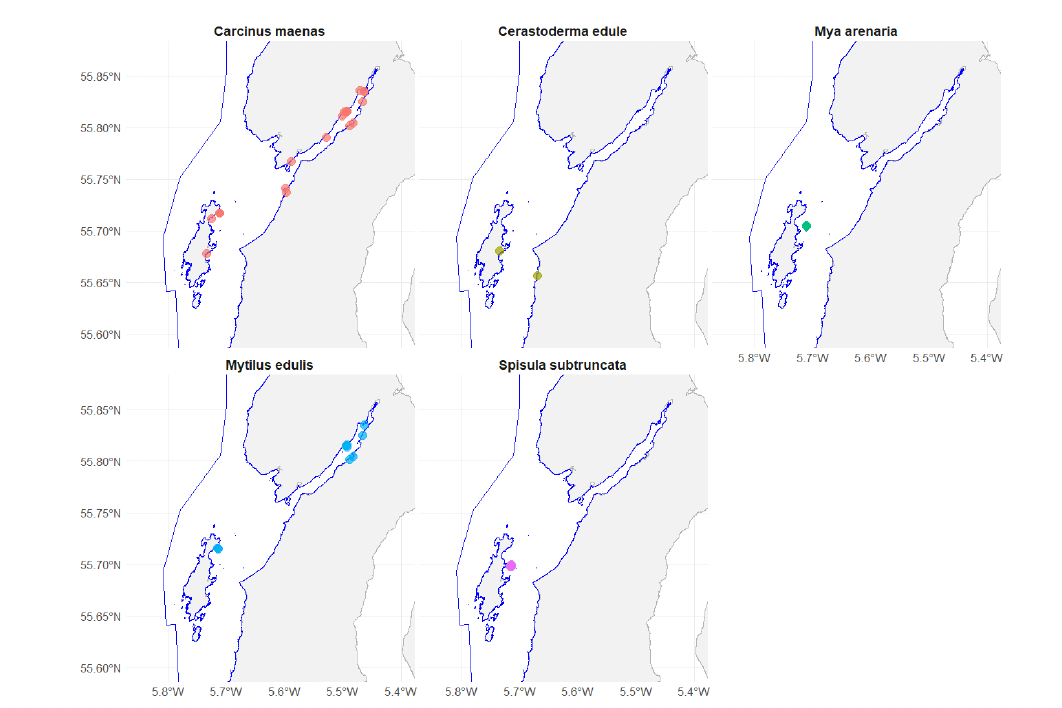
Data from GBIF are presence records, not records of abundance and are derived from a data portal that combines many different datasets, so these records do not constitute a comprehensive census of prey species distribution in the area. Instead they are indicative of the best available knowledge of the occurrence of these species.
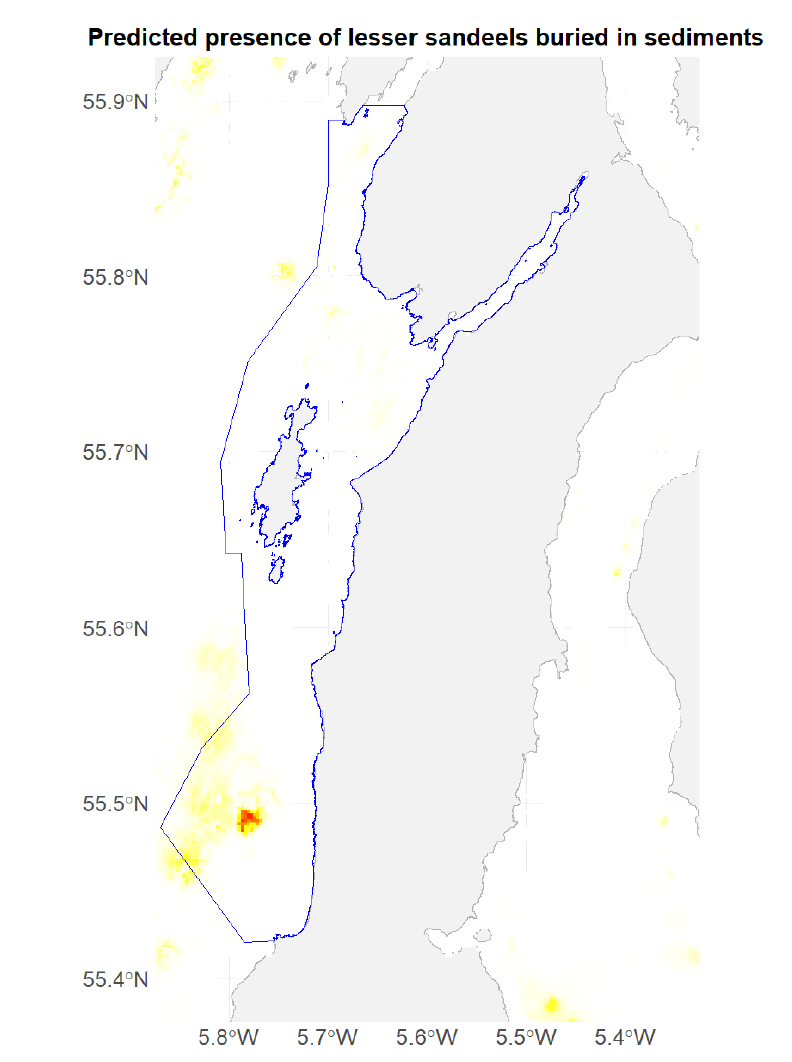
3.4.1 Razor clam fishing activity
Between 1 and 2 participating vessels are active in this trial area, compared to a total of 137 fishing or fishing-associated vessels operating from ports in Campbeltown district (Scottish Government, 2025). The annual average number of fishing days is 64 days. Fishing effort has been highest in winter (Figure 13). Fishing effort has fluctuated in this area from a maximum of 192 days effort in 2019/20 to 0 days in 2022/23. Other vessel activity is summarised in 3.4.2. Vessel activity in the trial involves travel from Gigha, Tarbert, Port Askaig, Crinan and West Loch Tarbert to razor clam grounds in the sound. The fishing gear in use on razor clam vessels is a lightweight electric current device towed at approximately 3 metres per minute, followed by divers (Blackadder, 2024). Individual fishing tows are limited by divers air supply, typically less than one hour. Electrodes leave a slight indent in the seabed, less than 1cm deep (Murray, Copland, Boulcott, Roberston, & Bailey, 2014).
Beginning in 2024, a seasonal closure was introduced to the trial, with fishing suspended between mid April and mid May. This closure was informed by knowledge gained in the trial of razor clam spawning activity.
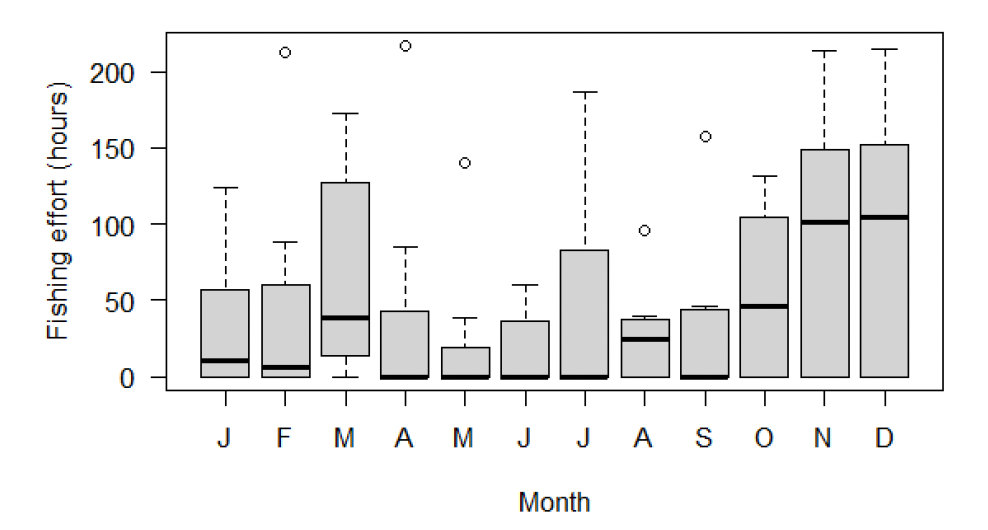
3.4.2 Non-razor clam vessel activity
The SPA contains the Isle of Gigha and connects to the mainland. Gigha has ports and harbours including the main Ardminish ferry terminal and Gallochoille pier, used by ferries and yachts, and a smaller fishing and commercial facility at the Gigha South Pier. Ardminish is on the east coast and is the main arrival point for the ferry from Tayinloan on the Kintyre peninsula, while Gallochoille services local fishermen. The main vessel types that have a presence in the Sound of Gigha are fishing vessels, cargo vessels, high-speed vessels, passenger vessels, tug and towing vessels, pleasure vessels, sailing craft and other vessels (EMODnet, 2024).
- Passenger vessel activity is concentrated between the two ports of Ardminish and Tayinloan, on the main ferry route. There will be considerable overlap with razor grounds. Other passenger activity is from Gigha to Clara and this will not overlap with razor grounds.
- Fishing vessel activity is prevalent in many areas of the SPA, with particular vessel density in waters to the west and south of Gigha (Table 29). The main activity to the west of Gigha is mobile gear using bottom trawls for Nephrops. The main activity to the south of Gigha is dredging. In the sound, the main fishing activity is static gear fishing targeting Nephrops and shellfish with pots and traps. There is some overlap between razor clam grounds and non-razor fishing activity.
- Pleasure craft vessels are activity across the SPA, they are most common along the East coast of Gigha with large concentrations in Ardminish Bay and at Tayinloan. There is slight overlap with razor grounds.
- High speed vessel activity is generally from Tayinloan to Druimyeon and East Tarbet Bay. These are largely private tours using high-speed RIBs for specific purposes such as wildlife watching. There is some overlap with razor grounds.
- Sailing activity is most prevalent on the east coast of Gigha with a concentration in Ardminish Bay. There is minimal overlap with razor grounds.
- Tug and towing vessels have a presence in East Tarbert Bay and Druimyeon Bay. There is no overlap with razor grounds.
- Dredging activity is planned January 2026 for Gigha (Ardminish Bay) and Tayinloan’s ferry infrastructure to accommodate new hybrid vessels but preliminary ground works have already been conducted. There may be a slight overlap with razor grounds due to survey activity and travel between the two sites. There has also been underwater activity at Gigha South Pier. This will not overlap razor grounds.
- Cargo vessels have a significant presence in the Tayinloan area and at Port Mohr. There will be some overlap with razor grounds in the Tayinloan area.
- Other vessel activity is concentrated in the bays around Gigha, such as Ardminish Bay, Druimyeon Bay and East Tarbert Bay. There will be no overlap with razor grounds.
| Activity | Annual Average Fishing Effort (Days) | Swept seabed area (km2) | Footprint (c-squares) |
|---|---|---|---|
| Razor clam trial | 64 | No data | 5 |
| Nephrops and crustacean bottom trawls >12m | 95.8 | 111.5 | 16 |
| Dredges >12m | 139.5 | 76.8 | 25 |
| Pots and traps <12m | 81.9 | no data | 45 |
| Dredges <12m | No data* | no data | 30 |
| Bottom trawls <12m | No data* | no data | 18 |
| Diving/gathering <12m | No data* | no data | 17 |
| Rods and Lines <12m | No data* | no data | 5 |
| Set Nets <12m | No data* | no data | 1 |
Note: Under 12m data from Scottish Sea Fisheries Statistics spatial data. Over 12m data from ICES. ICES data are reported in hours and were converted to days by dividing by 12. * redacted due to number of vessels. C-square resolution: 0.05x0.05°.
3.4.3 Eider
Site-specific advice 2a
Site specific advice for eider is:
- Maintain the population of non-breeding common eider at a stable or increasing trend relative to the site reference population.
- Ensure common eider can move safely between the site and important areas of functionally linked land outwith the site.
There is no trend information for the SPA as a whole. Peak counts recorded at WeBS site Sound of Gigha and Rhunahaorine were higher after the trial started compared to before (Table 30). A single special survey at Loch Caolisport in 2023/24 counted 247 ducks. A single special survey at West Loch Tarbert in 2022/23 counted 27 ducks.
| Period | Five-year moving average peak count |
|---|---|
| 2019/20 to 2023/24 | 340 |
| 2018/19 to 2022/23 | 290 |
| 2013/14 to 2017/18 | 225 |
Data from BTO WeBS Programme (Calbrade, et al., 2025).
The small number of razor clam vessels and their slow speed means they are not considered to constitute a barrier to eider being able to move safely between the site and important areas outwith the site.
Site-specific advice 2b
Site-specific advice for eider is:
- Ensure eider continue to have access to and can utilise all optimal habitats suitable for all relevant aspects of their life cycle associated with the site.
- Avoid significant disturbance to eider and ensure individuals can move safely between these areas within the site.
Fishing occurs from depths of 2-8 metres, which is within the range of depths at which eider can forage. Eider are predicted to occupy the area of the sound of Gigha to the north of Rhunahaorine Point (NatureScot, 2014), which overlaps with one razor ground in the trial area that was mainly fished in trial years 1-3 from 2018 to 2020.
The seasonal closure is during the end of the non-breeding season and into the breeding season but before the flightless moult period. Fishing effort has tended to be light in the breeding seaso and the July to September period of the flightless moult (Figure 13). Unlike in the Firth of Forth, eider are not reported to follow razor clam vessels, perhaps because fishing effort has fluctuated to a greater extent between years.
Eider are moderately sensitive to vessel disturbance (Furness, Wade, & Masden, 2013) however the small number of vessels and slow speed while fishing, considered in the wider context of fishing and non-fishing activity in the area and increasing counts in WeBS data indicates that razor clam fishing activity does not constitute a risk of significant disturbance.
Razor clam fishing activity is not considered to be a barrier to access to optimal habitat or to constitute a risk of significant disturbance. If fishing effort was to increase, this would need to be reappraised.
Site-specific advice 2c
Site-specific advice for eider:
- Maintain the extent and distribution of the supporting habitats for common eider within the site.
- Maintain the variety and abundance of food resources and the condition of supporting habitats and associated processes.
- Existing water quality should be maintained and any increase in nutrients, turbidity or contaminants where this could reduce supporting habitats and/or prey, should be avoided.
Eider feed on razor clams and other organisms that may inhabit razor clam fishing grounds. The spatial footprint of the fishery has decreased as has the reduction in effort and intensity (Blackadder, et al., 2024).
Eiders have a preference for small prey, with a maximum prey size of 80mm in length (Larsen & Guillemette, 2000). Razor clam harvesting is limited to a minimum conservation reference size of 100mm and a strong market preference for clams of 150mm or greater means that small numbers of small clams and negligible numbers of undersized clams are harvested across the trial (Blackadder, et al., 2024). Important subtidal mussel beds are present in West Loch Tarbert (NatureScot, 2025), but intertidal mussels on rocky substrates are poorly sampled for this location (Figure 11). As noted in site-specific information, benthic habitats that support eiders are likely to be extensive in the area and the relative lack of records for Gigha is likely a result of low sampling effort.
The sample lengths of landed razor clams for Gigha since the trial began until 2023, were between 100-220.50mm (Blackadder, 2024), therefore removals by trial participants are not removing items that would otherwise be prey for eiders.
Eider in Scotland roost during the night and therefore this behaviour does not interact with day-time razor clam fishing activity.
Scotland’s Marine Assessment indicated a stable trend for nutrients and chlorophyll in the Argyll Scottish Marine Region (Scottish Government, 2020). Razor clam fishing activity may cause localised increases in turbidity at the seabed during fishing operations, but this is not considered likely to contribute to a deterioration in water quality locally or at the water body scale.
Sandy and muddy sediments that support razor clams are evidently present in the area, but the extent to which these extend beyond the fished area is currently not known (EMODnet, 2023). Generally, these areas are restricted to the portions of the trial areas that are fished (Blackadder, et al., 2024). The small number of vessels active in the area and fluctuating effort means razor clam fishing is not considered to affect benthic habitats to the extent that it adversely affects prey availability.
Overall assessment in relation to relevant pressures and site-specific advice
Peak counts of eider appear to be higher after the start of the trial compared to before. The fishing activity is not considered capable of adversely affecting prey availability. Because of where razor clam beds are located, there is potential, for razor clam vessels to be a barrier to eiders use of optimal habitat for foraging and they may constitute a risk of disturbance. The lack of consistent effort in this area complicates understanding the degree to which this risk has translated into an actual impact. Razor clam fishing activity does not compromise the integrity of this species in this SPA. A change to consistent high fishing effort may constitute a risk to the integrity of this feature in the SPA.
3.4.4 Great Northern diver
Site-specific advice 2a
The site-specific advice for great Northern diver is:
- Maintain the population of non-breeding great northern divers at a stable or increasing trend relative to the site reference population.
There is no WeBS alert trend analysis for this species in this SPA. The WeBS site peak counts at Sound of Gigha and Rhunahaorine are higher after the trial started compared to before (Table 31).
| Period | Five-year moving average peak count |
|---|---|
| 2019/20 to 2023/24 | 131 |
| 2018/19 to 2022/23 | 99 |
| 2013/14 to 2017/18 | 30 |
Data from BTO WeBS Programme (Calbrade, et al., 2025).
Site-specific advice 2b
The site-specific advice for great Northern diver is:
- Ensure great northern divers continue to have access to and can utilise all optimal habitats suitable for all relevant aspects of their life cycle associated within the site.
- Avoid significant disturbance to great northern divers and ensure individuals can move safely between these areas within the site.
Great Northern Divers are diving wildfowl and may therefore seek to access habitat in the vicinity of razor clam vessels. As a species highly sensitive to vessel movements (Furness, Wade, & Masden, 2013), there is a risk that the activity may constitute a risk to access and utilisation of habitat, and disturbance.
The seasonal closure means no fishing activity occurs for a period that overlaps with their presence in the SPA, and may overlap with the end of their flightless moult period.
While fishing effort is highest in winter, during great Northern divers presence in the SPA, this does not appear to affect foraging activity. During survey work in 2018-21, overlapping with the period of high fishing effort in this SPA, the proportion of dives by great Northern divers resulting in prey being brought to the surface in the Sound of Gigha was comparable to observations in Loch Caolisport, Loch Beag, Loch Craignish and other locations (Jardine, 2024), this indicates that razor clam fishing does not constitute a barrier to access to optimal habitat, or a risk of significant disturbance.
Site-specific advice 2c
The site-specific advice for great Northern diver is:
- Maintain the extent and distribution of supporting habitats for great northern diver within the site.
- Maintain the variety and abundance of food resources and the condition of supporting habitats and associated processes.
- Existing water quality should be maintained and any increase in nutrients, turbidity or contaminants where this could reduce supporting habitats and/or prey, should be avoided.
Sandy and muddy sediments that support razor clams are evidently present in the area, but the extent to which these extend beyond the fished area is currently not known (EMODnet, 2023). Generally, these areas are restricted to the portions of the trial areas that are fished (Blackadder, 2024).
Great Northern divers in the sound of Gigha have been observed mainly feeding on crabs (60% of identified prey items) and flatfish (23% of prey items). While a smaller number of prey items, flatfish have been estimated to constitute a larger mass per item than crabs (Jardine, 2024). Crabs are mobile epifauna and were mostly observed being taken by birds feeding over rocky or cobbly substrate that would not overlap with razor clam beds. Flatfish were observed being taken over sandy or muddy substrates (Jardine, 2024). The sediments in the immediate vicinity of Gigha itself are coarse or rocky sediment, which razor clam fishing is not considered capable of affecting. Predicted presence of juvenile plaice overlaps with areas of sandy sediment to the west of Gigha (Scottish Government, 2014) (British Geological Survey, 2025). The CMA makes particular reference to effects on sandeel supporting habitat, however these are mainly predicted to be located in the south of the SPA, away from razor clam fishing activity (Figure 12).
Great Norther divers are widespread throughout the SPA, with a focus on the north of the SPA (NatureScot, WMS) . The majority of razor fishing occurs between Gigha and Kintyre (Blackadder, 2024).
The small footprint of razor clam fishing and low impact on the seabed means this activity is not considered to affect prey supporting habitat to the extent it adversely affects prey availability.
Scotland’s Marine Assessment indicated a stable trend for nutrients and chlorophyll in the Argyll Scottish Marine Region (Scottish Government, 2020). Razor clam fishing activity may cause localised increases in turbidity at the seabed during fishing operations, but this is not considered likely to contribute to a deterioration in water quality locally or at the water body scale.
Overall assessment in relation to relevant pressures and site-specific advice
Peak counts of great Northern diver close to the area of razor clam fishing activity are higher post-trial establishment. Razor clam fishing activity is not considered to be a barrier to access or use of optimal habitat, or to constitute a risk of significant disturbance. Razor clam fishing is not considered to affect prey-supporting habitat to the extent that it adversely affects prey availability. Razor clam fishing activity does not compromise the integrity of this feature within this SPA.
3.4.5 Red-breasted merganser
Site-specific advice 2a
The site-specific advice for red-breasted merganser is:
- Maintain the population of non-breeding red-breasted merganser at a stable or increasing trend relative to the site reference population.
- Ensure red-breasted mergansers can move safely between the site and important areas of functionally linked land outwith the site.
There is no WeBS alert trend analysis for this species. The WeBS site at Sound of Gigha and Rhunahaorine recorded larger peak counts after the establishment of the trial compared to before (Table 32).
| Period | Five-year moving average peak count |
|---|---|
| 2019/20 to 2023/24 | 293 |
| 2018/19 to 2022/23 | 332 |
| 2013/14 to 2017/18 | 86 |
Data from BTO WeBS Programme (Calbrade, et al., 2025).
Red-breasted mergansers are known to be sensitive to vessel movements, however the small number of vessels operating in the trial and the localised area of fishing operations are not considered to constitute a barrier to red-breasted mergansers ability to move safely between the site and areas outwith the site.
Site-specific advice 2b
The site-specific advice for red-breasted merganser is:
- Ensure red-breasted merganser continue to have access to and can utilise all optimal habitats suitable for all relevant aspects of their life cycle associated within the site.
- Avoid significant disturbance to red-breasted merganser and ensure individuals can move safely between these areas within the site.
Red-breasted mergansers breed from April to May, so the razor clam seasonal closure would not inhibit this aspect of the life-cycle (Kear, 2005) : the seasonal closure overlaps with the breeding season for red-breasted mergansers but not the flightless moult period. Fishing effort in this SPA has been lower during these months (Figure 13).
Red-breasted mergansers may roost further offshore in waters up to 12m deep (Craik et al. 2011). In addition to being separated in time (razor fishing proceeds during daylight hours), this suggests there is little possibility of razor clam fishing interrupting use of habitat for this behaviour.
Red-breasted Mergansers have a wide distribution with a particular concentration in West Loch Tarbert, and to the south of Gigha (NatureScot, 2014). The 2 razor boats do not fish in these areas, so fishing activity is not considered to constitute a risk of significant disturbance.
Site-specific advice 2c
The site-specific advice for red-breasted merganser is:
- Maintain the extent and distribution of supporting habitats for red-breasted merganser within the site.
- Maintain the variety and abundance of food resources and the condition of supporting habitats and associated processes.
- Existing water quality should be maintained and any increase in nutrients, turbidity or contaminants where this could reduce supporting habitats and/or prey, should be avoided.
Site-specific information indicates various species of importance to red-breasted merganser. Distribution maps indicate herring and saithe (coalfish) to be present in the SPA, though predicted presence maps of herring and sprat do not extend into the Sound of Gigha area. These are pelagic shoaling fish and are not expected to be affected by razor clam fishing. Herring spawning grounds are not thought to be present in the area (Frost & Diele, 2022). Sandeels are predicted to be present in the south of the SPA, separate from razor clam fishing (Figure 12). Shore crabs may for part of the diet and are present in the SPA (Figure 11).
The small number of vessels, localised footprint and minimal physical impact on the seabed means razor clam fishing is not considered to affect prey supporting habitat to the extent it adversely affects prey availability.
Scotland’s Marine Assessment indicated a stable trend for nutrients and chlorophyll in the Argyll Scottish Marine Region (Scottish Government, 2020). Razor clam fishing activity may cause localised increases in turbidity at the seabed during fishing operations, but this is not considered likely to contribute to a deterioration in water quality locally or at the water body scale.
Overall assessment in relation to relevant pressures and site-specific advice
Peak counts of red-breasted merganser close to the area of razor clam fishing activity are higher post-trial establishment. Razor clam fishing activity is not considered to be a barrier to access or use of optimal habitat, or to constitute a risk of significant disturbance. Razor clam fishing is not considered to affect prey-supporting habitat to the extent that it adversely affects prey availability. Razor clam fishing activity does not compromise the integrity of this feature within this SPA.
3.4.6 Slavonian grebe
Site-specific advice 2a
The site-specific advice for Slavonian grebe is:
- Maintain the population of non-breeding Slavonian grebe at a stable or increasing trend relative to the site reference population.
There is no WeBS alert trend analysis for this species in this SPA. WeBS peak counts at Sound of Gigha and Rhunahaorine are higher after the start of the trial compared to the period before (Table 33).
| Period | Five-year moving average peak count |
|---|---|
| 2019/20 to 2023/24 | 42 |
| 2018/19 to 2022/23 | 35 |
| 2013/14 to 2017/18 | 21 |
Data from BTO WeBS Programme (Calbrade, et al., 2025).
Site-specific advice 2b
The site-specific advice for Slavonian grebe is:
- Ensure Slavonian grebes continue to have access to and can utilise all optimal habitats suitable for all relevant aspects of their life cycle associated within the site.
- Avoid significant disturbance to Slavonian grebes and ensure individuals can move safely between these areas within the site.
Slavonian grebes are present for part of the period of the seasonal closure. Shore-based counts of Slavonian grebe have been recorded in West Loch Tarbert and at Rhunahaorine point, overlapping with the location of razor clam fishing activity (NatureScot, 2014).
Razor clam fishing is highest in winter, during Slavonian grebes presence in the SPA. Razor clam fishing fluctuates from year to year but given increasing peak counts in WeBS data, at current levels does not appear to prevent access to optimal habitat or to constitute a risk of significant disturbance. An increase to more regular fishing may mean the activity could become a barrier or risk of significant disturbance.
Site-specific advice 2c
The site-specific advice for Slavonian grebe is:
- Maintain the extent and distribution of supporting habitats for red-breasted merganser within the site.
- Maintain the variety and abundance of food resources and the condition of supporting habitats and associated processes.
- Existing water quality should be maintained and any increase in nutrients, turbidity or contaminants where this could reduce supporting habitats and/or prey, should be avoided.
Slavonian Grebe primarily catch fish, insects (such as mayflies or damselflies) crustaceans, molluscs and marine worms, with fish and crustaceans being more important components of the diet during winter when the species is at sea (del Hoyo et al, 1992). Sandeels are present further south in the SPA, separate from the area of razor clam fishing activity (Figure 12).
Razor clam fishing is not considered to affect prey-supporting habitat to the extent it adversely affects prey availability, though it is acknowledged that knowledge on prey-supporting processes are not well known for this species in this SPA.
Scotland’s Marine Assessment indicated a stable trend for nutrients and chlorophyll in the Argyll Scottish Marine Region (Scottish Government, 2020). Razor clam fishing activity may cause localised increases in turbidity at the seabed during fishing operations, but this is not considered likely to contribute to a deterioration in water quality locally or at the water body scale.
Overall assessment in relation to relevant pressures and site-specific advice
Peak counts of Slavonian grebe close to the area of razor clam fishing activity are higher post-trial establishment. Razor clam fishing activity is not considered to be a barrier to access or use of optimal habitat, or to constitute a risk of significant disturbance, however if more consistent fishing effort began to occur in the area, this may need to be reassessed. Razor clam fishing is not considered to affect prey-supporting habitat to the extent that it adversely affects prey availability. Razor clam fishing is not considered to constitute a barrier or risk of significant disturbance at the level currently fished, though if this increased this would need to be reappraised.
3.5 Coll and Tiree SPA
The following figures and information are referred to against the relevant features in relation to site-specific advice and information.
3.5.1 Razor clam fishing activity
Between 2 and 6 participating vessels have active in this trial area, compared to a total of 96 fishing or fishing-associated vessels operating from ports in Oban district (Scottish Government, 2025). The annual average number of days fishing is 35.2. Fishing effort has fluctuated in this area from a maximum of 137 days effort in 2019/20 to 0 days in 2021 to 2024. Fishing has resumed at a low level in 2025. Fishing is almost exclusively in summer months with little to no fishing in winter months (Figure 14). Other vessel activity is summarised in 3.5.2. Vessel activity in the trial involves travel from Oban to razor clam grounds in the sound. The fishing gear in use on razor clam vessels is a lightweight electric current device towed at approximately 3 metres per minute, followed by divers (Blackadder, 2024). Individual fishing tows are limited by divers air supply, typically less than one hour. Electrodes leave a slight indent in the seabed, less than 1cm deep (Murray, Copland, Boulcott, Roberston, & Bailey, 2014).
Beginning in 2024, a seasonal closure was introduced to the trial, with fishing suspended between mid April and mid May. This closure was informed by knowledge gained in the trial of razor clam spawning activity.
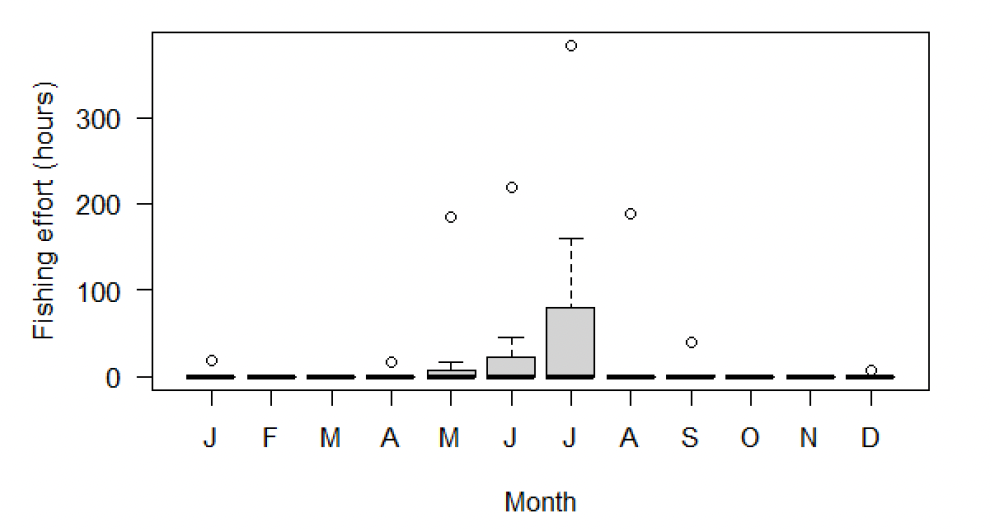
3.5.2 Non-razor clam vessel activity
The SPA is home to Tiree harbour which is at Scarinish in Gott Bay, a pier and a linkspan that is the westernmost port of the Inner Hebrides and serves the daily ferry service to Oban. The main vessel types that have a presence in Gott Bay, Rhuba Phuirt Bhig, Rhuba Laith and Loch Breachacha are fishing vessels, pleasure craft, high speed vessels and passenger vessels (EMODnet, 2024). Vessel activity is summarised below.
- While the main port is at Scarinish, Tiree also has sandy anchorages and mooring areas within bays like Gott Bay and further east.
- Fishing activity is mainly on the southwestern side of Coll and Tiree. Trawling for Nephrops and shellfish and dredging are the main activities (Table 34). Under 12m activity in the SPA is light, however there is significant pot and trap fishing around Mull, outside the SPA.
| Activity | Annual Average Fishing Effort (Days) | Swept seabed area (km2) | Footprint (c-squares) |
|---|---|---|---|
| Razor clam trial | 35.2 | No data | 2 |
| Nephrops and crustacean bottom trawls >12m | 59.7 | 81.5 | 17 |
| Dredges >12m | 98.1 | 62.5 | 20 |
| Pots and traps | No data* | No data | 40 |
| Diving/gathering | No data* | No data | 5 |
| Bottom trawls | No data* | No data | 1 |
Note: Under 12m data from Scottish Sea Fisheries Statistics spatial data. Over 12m data from ICES. ICES data are reported in hours and were converted to days by dividing by 12. * redacted due to number of vessels. C-square resolution: 0.05x0.05°.
- Pleasure craft and sailing vessels have a presence in a variety of areas of the SPA. Hot spots include Gott Bay, Rhuba Phuirt Bhig, Rhuba Laith, Hynish Bay, Balephetrish Bay, Cean Mor and Loch Breachacha. There is also a concentration travelling in the waters directly between the two islands, Gunna Sound. There is significant overlap with the razor clam grounds in Gott Bay.
- Passenger vessel activity is focused on Scarinish, with the ferry link to Oban and lesser so to Barra. There is little overlap with razor grounds in Gott Bay.
- High speed vessels activity is focused in the waters directly between the two islands, Gunna Sound. There is no overlap with razor grounds. These are largely private tours using high-speed RIBs for specific purposes such as wildlife watching.
- Dredging (in connection with kelp harvesting) vessels have a presence at Loch Breachacha and Rubha Duhb. There is no overlap with razor grounds.
- Other type vessel activity is focused in Hynish Bay. There is no overlap with razor grounds.
3.5.3 Eider
Site-specific advice 2a
The site-specific advice for eider is:
- Maintain the population of non-breeding common eider at a stable or increasing trend relative to the site reference population.
- Ensure common eider can move safely between the site and important areas of functionally linked land outwith the site.
There is no WeBS alert trend analysis for this species in this SPA, and no peak count information for coastal sites on Tiree, where most razor clam fishing has occurred.
Given the level of effort in Coll and Tiree, fishing activity is not considered to be a barrier to eider moving safely between the site and important areas of functionally linked land outwith the site.
Site-specific advice 2b
The site-specific advice for eider is:
- Ensure eider continue to have access to and can utilise all optimal habitats suitable for all relevant aspects of their life cycle associated with the site.
- Avoid significant disturbance to eider and ensure individuals can move safely between these areas within the site.
Eider are predicted to make most use of the western and northern side of Tiree, with lower utilisation of eastern and southern Tiree, including Gott Bay where razor clam fishing has principally occurred (NatureScot, 2014).
A seasonal closure overlaps with part of the non-breeding season into the breeding season. Unlike in the Firth of Forth, eider are not reported to follow razor clam vessels, perhaps because fishing effort has fluctuated to a greater extent between years.
Eider are moderately sensitive to vessel disturbance (Furness, Wade, & Masden, 2013) however the small number of vessels and slow speed while fishing, the restricted period in summer when they are active, considered in the wider context of fishing and non-fishing activity in the area and increasing counts in WeBS data indicates that razor clam fishing activity does not constitute a risk of significant disturbance. If vessel activity were to increase, this would need to be reappraised.
Site-specific advice 2c
The site-specific advice for eider is:
- Maintain the extent and distribution of the supporting habitats for common eider within the site.
- Maintain the variety and abundance of food resources and the condition of supporting habitats and associated processes.
- Existing water quality should be maintained and any increase in nutrients, turbidity or contaminants where this could reduce supporting habitats and/or prey, should be avoided.
Eider feed on razor clams and other organisms that may inhabit razor clam fishing grounds.
Eiders have a preference for small prey, with a maximum prey size of 80mm in length (Larsen & Guillemette, 2000). Razor clam harvesting is limited to a minimum conservation reference size of 100mm and a strong market preference for clams of 150mm or greater means that small numbers of small clams and negligible numbers of undersized clams are harvested across the trial (Blackadder, et al., 2024).
The sample lengths of landed razor clams for Coll and Tiree since the trial began until 2023, were between 110-220.50mm (Blackadder, 2024), therefore removals by trial participants are not removing items that would otherwise be prey for eiders.
Blue mussels are another important prey item for eiders. While intertidal mussels are likely to be widespread on rocky coastlines, discrete mussel beds are located to the north of Coll, separate from razor clam fishing activity (Scottish Government, 2018). No subtidal mussel beds are present in the area (NatureScot, 2025).
Scotland’s Marine Assessment indicated a stable trend for nutrients and chlorophyll in the Argyll Scottish Marine Region (Scottish Government, 2020). Razor clam fishing activity may cause localised increases in turbidity at the seabed during fishing operations, but this is not considered likely to contribute to a deterioration in water quality locally or at the water body scale.
Overall assessment in relation to relevant pressures and site-specific advice
The lack of sustained fishing effort in this SPA means razor fishing activity is not considered to be a barrier or constitute a risk of significant disturbance. It is not considered capable of affecting benthic habitat to the extent it adversely affects prey availability. Were fishing to increase and be more consistent between years, this may need to be reappraised. Razor clam fishing activity does not compromise the integrity of this feature within this SPA.
3.5.4 Great Northern diver
Site-specific advice 2a
The site-specific advice for great Northern diver is:
- Maintain the population of non-breeding great northern divers at a stable or increasing trend relative to the site reference population.
There is no WeBS alert trend analysis for this species in this SPA, and no peak count information for coastal sites on Tiree, where most razor clam fishing has occurred.
Site-specific advice 2b
The site-specific advice for great Northern diver is:
- Ensure great northern divers continue to have access to and can utilise all optimal habitats suitable for all relevant aspects of their life cycle associated within the site.
- Avoid significant disturbance to great northern divers and ensure individuals can move safely between these areas within the site.
Great Northern divers are present from October until Mid-May. As razor clam fishing occurs almost exclusively in the summer at this site, and a seasonal closure is in place from April until May, the activity does not constitute a barrier to accessing optimal habitat or a risk of significant disturbance. If the pattern of fishing was to change, this would need to be reappraised.
Site-specific advice 2c
The site-specific advice for great Northern diver is:
- Maintain the extent and distribution of supporting habitats for great northern diver within the site.
- Maintain the variety and abundance of food resources and the condition of supporting habitats and associated processes.
- Existing water quality should be maintained and any increase in nutrients, turbidity or contaminants where this could reduce supporting habitats and/or prey, should be avoided.
Great northern diver are present in the SPA during a period when there has been only a few fishing trips. Fishing activity is otherwise restricted to the summer months, when Great northern divers will not be present (Figure 14).
Predicted presence of sandeels indicates the sea on the western coast of Coll and Tiree is an important area, but Gott Bay and nearby is not (Langton, Boulcott , & Wright, 2021). The coast around all islands may be important habitat for juvenile cod, however the SPA and Gott Bay in particular does not appear to be an area of importance to juvenile herring, haddock, plaice, sole, or sprats (Scottish Government, 2014).
The separation in time of current fishing practice in this SPA combined with the minimal physical impact on the seabed and lack of evidence of significant occupancy of Gott Bay by relevant prey species means razor clam fishing is not considered to affect prey-supporting habitat to the extent it adversely affects prey availability.
Scotland’s Marine Assessment indicated a stable trend for nutrients and chlorophyll in the Argyll Scottish Marine Region (Scottish Government, 2020). Razor clam fishing activity may cause localised increases in turbidity at the seabed during fishing operations, but this is not considered likely to contribute to a deterioration in water quality locally or at the water body scale.
Overall assessment in relation to relevant pressures and site-specific advice
The lack of sustained fishing effort in this SPA and limited overlap with the period when great Northern divers are present means razor fishing activity is not considered to be a barrier or constitute a risk of significant disturbance. It is not considered capable of affecting benthic habitat to the extent it adversely affects prey availability. Were fishing to increase and be more consistent between years, this may need to be reappraised. Razor clam fishing activity does not compromise the integrity of this feature within this SPA.
3.6 West Coast of the Outer Hebrides
The following figures and information are referred to against the relevant features in relation to site-specific advice and information.
3.6.1 Razor clam fishing activity
While this is a trial area, no vessel has engaged in fishing here to date. 0 participating vessels have been active in this trial area, compared to a total of 224 fishing or fishing-associated vessels operating from ports Stornoway district (Scottish Government, 2025) The annual number of days fishing is 0. Other vessel activity is summarised in 2.6.2.
3.6.2 Non-razor clam vessel activity
The Sound of Harris is a channel between the islands of North Uist and Harris in the West Coast of the Outer Hebrides SPA. It’s known for its complex navigation due to rocks, reefs, and shifting sands, but it also hosts several small ports and harbours that serve local communities and fishing vessels. On Harris (East side of the Sound) is the main port, Leverburgh Harbour, which serves the CalMac ferry route to Berneray and facilitates for fishing boats and small craft. On Berneray and North Uist (West side of the Sound) is Berneray Pier, which is located on the island of Bernary which is connected to North Uist by a causeway. It is the terminal for the ferry to Leverburgh and for small-scale fishing and leisure craft use. Lochmaddy Harbour is the main port on North Uist, it has larger scale facilities and includes the ferry service to Uig, Skye. Commercial and leisure vessels operate out of this harbour. There is also Otternish Pier, near the Berneray causeway which has been used historically by small boats. The main vessel types that have a presence in the Sound of Harris are fishing vessels, passenger vessels, sailing vessels, tug and towing vessels, high-speed craft, cargo vessels, other vessels and dredging vessels (EMODnet, 2024).
- The Sound of Harris has significant vessel activity thoughout but particular concentrations of marine traffic along the main ferry routes, at the terminals and the islets of Groay and Lingay due to the large aquaculture project there.
- Fishing vessel activity is prevalent in many areas of the Sound. There are particular concentrations around Berneray and to the east of the island.
- Passenger vessels activity is concentrated between the two ports of Leverburgh and Bernerary, on the main ferry route.
- High-speed craft activity is concentrated along the coast of Harris, Berneray Pier and along the main ferry route.
- Sailing craft activities are located around Berneray Pier and the along the coast of Harris.
- Tog and towing vessel activity is concentrated between Berneray Pier, along the main ferry route and at islets Groay and Lingay. There is significant aquaculture activity in this area, Loch Duart Ltd operate a salmon farm. The area includes 20 square cages for Atlantic Salmon and 6 longlines for shellfish and seaweed cultivation. Therefore it is unlikely there would be potential for overlap with future razor fishing.
- Dredging vessel activity is concentrated at the islets of Groay and Lingay. It is unlikely that future razor fishing would occur in the same area that dredging occurs.
- Other vessel activity in the Sound is concentrated around Bernarey Pier, Leverburgh Harbour and in the National Scenic Area. Vessel activity here is associated with wildlife and ecotourism.
- Cargo vessel activity is concentrated around islets Groay and Lingay, Berneray Pier and along the coast of Harris.
- Pleasure craft activities are located around Berneray Pier and the along the coast of Harris.
- Military vessel activity is off the coast of Strond, but this is limited.
- Service vessel activity is off the coast of Strond, but this is limited.
3.6.3 Black-throated Diver
Site-specific advice 2a
The site-specific advice for black-throated diver is:
- Maintain the population of non-breeding black-throated divers at a stable or increasing trend relative to the site reference population.
Black-throated diver population is in favourable condition at this site. No fishing for razor clams has occurred in this area therefore the activity is not considered to hinder this site-specific advice.
Site-specific advice 2b
The sire-specific advice for black-throated diver is:
- Ensure black-throated divers continue to have access to and can utilise all optimal habitats suitable for all relevant aspects of their life cycle associated within the site.
- Avoid significant disturbance to black-throated divers and ensure individuals can move safely between these areas within the site.
Black-throated divers wintering at the West Coast of the Outer Hebrides SPA are present from early August until late April and undergo a flightless moult sometime between mid-September and end of December (Robbins, 2017).
Black-throated divers have a concentrated presence in the Sound of Barra and a smaller presence in the Sound of Harris. In the Sound of Harris, the diver presence marginally overlaps the razor clam trial area (NatureScot, 2014).
No razor clam fishing has occurred, so razor clam fishing is not considered to constitute a risk of significant disturbance to this species, or a barrier to black-throated diver ability to move between areas of optimal habitat within the site.
Site-specific advice 2c
The site-specific advice for black-throated diver is:
- Maintain the extent and distribution of supporting habitats for black-throated diver within the site.
- Maintain the variety and abundance of food resources and the condition of supporting habitats and associated processes.
- Existing water quality should be maintained and any increase in nutrients, turbidity or contaminants where this could reduce supporting habitats and/or prey, should be avoided.
Black-throated diver are almost entirely dependent on small fish including gobies, sticklebacks, herrings, sandeels but also takes larger fish such as cod (Collinge 1924–7; Madsen, 1957). Razor clam fishing is known to temporarily stun sandeels that come into contact with the fishing gear. Sandeels are not commonly distributed in the Sound of Harris but there is a large presence in the Sound of Barra (Langton, Boulcott , & Wright, 2021), which is closed to razor clam fishing..
Black-throated divers require suitable habitat within the SPA for foraging, loafing, moulting and roosting. Information on habitat use and preferences of black-throated divers in the marine environment is very limited (Woodward & Humphreys, 2018).
Scotland’s Marine Assessment indicates nutrient inputs and chlorophyll concentrations are stable in the Western Isles Scottish Marine Region which overlaps with the SPA, there is no evidence of eutrophication (Scottish Government, 2020).
Overall assessment in relation to relevant pressures and site-specific advice
Black-throated divers mainly occupy areas separate from where razor clam fishing might occur. No trend can be determined from the small number of birds observed in individual WeBS site data. Black-throated diver prey on fish species that razor clam fishing is not considered to affect to the extent it adversely affects prey availability. Razor clam fishing activity has not occurred in this site and is not considered to be a barrier to movement within or outwith the site, or to constitute a risk of significant disturbance. Razor clam fishing activity has not occurred at this site and therefore does not compromise the integrity of this feature within this SPA.
3.6.4 Common Eider
Site-specific advice 2a
Site-specific advice for common eider is:
- Maintain the population of non-breeding common eider at a stable or increasing trend relative to the site reference population.
- Ensure common eider can move safely between the site and important areas of functionally linked land outwith the site
No fishing for razor clams has occurred in this area therefore the activity is not considered to hinder this site-specific advice.
Site-specific advice 2b
The site-specific advice for eider is:
- Ensure common eiders continue to have access to and can utilise all optimal habitats suitable for all relevant aspects of their life cycle associated within the site.
- Avoid significant disturbance to common eiders and ensure individuals can move safely between these areas within the site.
No fishing for razor clams has occurred in this area therefore the activity is not considered to hinder this site-specific advice.
Common Eiders are widely concentrated in the Sound of Harris and in the Sound of Barra. Both Sounds have significant vessel activity density, it is unlikely an additional razor vessel would greatly add to disturbance. Most vessel activity in these areas is on the public ferry route and related to fishing and cargo (EMODnet, 2024).
Site-specific advice 2c
The site-specific advice for eider is:
- Maintain the extent and distribution of the supporting habitats for common eider within the site.
- Maintain the variety and abundance of food resources and the condition of supporting habitats and associated processes.
- Existing water quality should be maintained and any increase in nutrients, turbidity or contaminants where this could reduce supporting habitats and/or prey, should be avoided.
Eiders feed on a wide variety of prey items, diving from the surface to take them from the seabed, typically in depths of under 10m. Their principal food resource is benthic bivalves, in particular blue mussels, and other species such as the common cockles, razor clams and clams. They also take shore crabs other marine invertebrates, including gastropods, and fish (Woodward & Humphreys, 2018; Waltho & Coulson, 2015). Eiders have a preference for small prey, with a maximum prey size of 80mm in length (Larsen & Guillemette, 2000). Razor clam harvesting is limited to a minimum conservation reference size of 100mm and a strong market preference for clams of 150mm or greater means that small numbers of small clams and negligible numbers of undersized clams are harvested across the trial (Blackadder et al., 2024).
Blue mussel beds are present in this SPA but in narrow inlets that are unlikely to be explored for razor clam fishing opportunities (NatureScot, 2025). Intertidal mussels inhabit rocky substrates that do not overlap with razor clam habitiat.
Eider nest on the ground in loose colonies usually in areas free of mammalian predators (Waltho & Coulson, 2015), including coastal islands and islets along low-lying rocky coasts, on coastal shores and spits, on islets in brackish and freshwater lagoons, coastal lakes and rivers or on tundra pools (BirdLife International, 2019). Razor clam fishing is not considered to hinder use of habitat for this behaviour.
Scotland’s Marine Assessment indicates nutrient inputs and chlorophyll concentrations are stable in the Western Isles Scottish Marine Region which overlaps with the SPA, there is no evidence of eutrophication (Scottish Government, 2020).
Overall assessment in relation to relevant pressures and site-specific advice
The eider population is in decline in the SPA. Razor clam fishing has not occurred in his SPA and is therefore not considered to constitute a barrier or disturbance to eiders, nor is it considered capable of adversely affecting prey availability. Because there has been no activity, this does not compromise the integrity of this feature within this SPA. Were activity to begin within this SPA, this would need to be re-evaluated.
3.6.5 Great Northern Diver
Site-specific advice 2a
The site-specific advice for Great Northern Diver is:
- Maintain the population of non-breeding great northern divers at a stable or increasing trend relative to the site reference population.
Great Northern divers are widespread throughout the SPA, with concentrations in the Sound of Harris, East coast of Harris and the Sound of Barra. No fishing for razor clams has occurred in this area therefore the activity is not considered to hinder this site-specific advice.
Site-specific advice 2b
The site-specific advice for Great Northern Diver is:
- Ensure great northern divers continue to have access to and can utilise all optimal habitats suitable for all relevant aspects of their life cycle associated within the site.
- Avoid significant disturbance to great northern divers and ensure individuals can move safely between these areas within the site.
Great northern divers are long distant migrants, moving annually between northern breeding grounds in Iceland, Greenland or Baffin island, and more southerly wintering grounds such as the West Coast of Outer Hebrides SPA. They are present at the West Coast of Outer Hebrides SPA from October until mid-May, with a flightless moult period from February until mid-April.
Great-northern divers are widely concentrated in the Sound of Harris and in the Sound of Barra. Both Sounds have significant vessel activity density, it is unlikely an additional razor vessel would greatly add to disturbance. Most vessel activity in these areas is on the public ferry route and related to fishing and cargo (EMODnet, 2024).
No fishing for razor clams has occurred in this area therefore the activity is not considered to hinder this site-specific advice.
Site-specific advice 2c
The sites-specific advice for Great Northern Diver is:
- Maintain the extent and distribution of supporting habitats for great northern diver within the site.
- Maintain the variety and abundance of food resources and the condition of supporting habitats and associated processes.
- Existing water quality should be maintained and any increase in nutrients, turbidity or contaminants where this could reduce supporting habitats and/or prey, should be avoided.
The limited data available on non-breeding season diet show the principal food resource of great northern divers is fish, including both pelagic and benthic species. Fish species taken will be influenced by what is locally and most readily available, but can include haddock, cod, herring, sprats and gurnard, eels, along with smaller species such as sandeels, pipefish, gobies, flatfish and butterfish. They also feed opportunistically on crustaceans, including crabs (Woodward & Humphreys, 2018). It is unlikely the commencement of razor fishing will negatively impact food resources of Great-northern divers.
Great Norther divers are widespread throughout the SPA, with a focus on the Sound of Harris and the Sound of Barra (NatureScot, 2014). There has been no active razor fishing in these trial areas as yet, optimal razor bed locations are currently unknown.
Sandeels are not commonly distributed in the Sound of Harris but there is a large presence in the Sound of Barra (Langton, Boulcott , & Wright, 2021). Fishing for razor clams is not permitted in the Sound of Barra.
Scotland’s Marine Assessment indicates nutrient inputs and chlorophyll concentrations are stable in the Western Isles Scottish Marine Region which overlaps with the SPA, there is no evidence of eutrophication (Scottish Government, 2020).
Overall assessment in relation to relevant pressures and site-specific advice
The fishing activity is not considered to constitute a barrier or disturbance to great Northern diver, nor is it considered capable of adversely affecting prey availability. Razor clam fishing activity has not occurred in this SPA and therefore does not compromise the integrity of this feature within this SPA.
3.6.6 Long-tailed Duck
Site-specific advice 2a
The site-specific advice for long-tailed duck is:
- Maintain the population of non-breeding long-tailed ducks at a stable or increasing trend relative to the site reference population.
No fishing for razor clams has occurred in this area therefore the activity is not considered to hinder this site-specific advice.
Site-specific advice 2b
This site-specific advice for long-tailed duck is:
- Ensure long-tailed ducks continue to have access to and can utilise all optimal habitats suitable for all relevant aspects of their life cycle associated within the site.
- Avoid significant disturbance to long-tailed ducks and ensure individuals can move safely between these areas within the site.
Long-tailed ducks are present across the SPA but have a particular concentration in the Sound of Harris (NatureScot, 2014). Long-tailed ducks wintering at the West Coast of the Outer Hebrides SPA are present from mid-September until late April. This species rarely summers in Scotland, so birds are not thought to become flightless (during their late summer moult) in Scottish waters. Long-tailed ducks are widely distributed across much of the West Coast of the Outer Hebrides SPA, with high concentrations recorded in the Sound of Harris, around the Monach Isles, off the coasts of Benbecula and South Uist, and in the outer Sound of Barra. The waters are used for foraging, socialising, roosting and maintenance activities. Long-tailed ducks appear to prefer open coast habitats and can also be found to frequent far offshore (Heinänen et al. 2017).
Long-tailed ducks are widely concentrated in the Sound of Harris and in the Sound of Barra, with a heavier concentration in the Sound of Harris. Both Sounds have significant vessel activity density, it is unlikely an additional razor vessel would greatly add to disturbance. Most vessel activity in these areas is on the public ferry route and related to fishing and cargo (EMODnet, 2024).
No fishing for razor clams has occurred in this area therefore the activity is not considered to hinder this site-specific advice.
Site-specific advice 2c
The site-specific advice for long-tailed duck is:
- Maintain the extent and distribution of supporting habitats for long-tailed duck within the site.
- Maintain the variety and abundance of food resources and the condition of supporting habitats and associated processes.
- Existing water quality should be maintained and any increase in nutrients, turbidity or contaminants where this could reduce supporting habitats and/or prey, should be avoided.
Minimum landing size of razor clams is 100mm and Long-tailed ducks prefer much smaller prey (typically less than 10mm) (Holm & Burger, 2002). Razor fishing would not remove prey items that would be available to long-tailed ducks.
Scotland’s Marine Assessment indicates nutrient inputs and chlorophyll concentrations are stable in the Western Isles Scottish Marine Region which overlaps with the SPA, there is no evidence of eutrophication (Scottish Government, 2020).
No fishing for razor clams has occurred in this area therefore the activity is not considered to hinder this site-specific advice.
Overall assessment in relation to relevant pressures and site-specific advice
No fishing for razor clams has occurred in this area therefore the activity does not compromise the integrity of this feature within this SPA.
3.6.7 Red-breasted Merganser
Site-specific advice 2a
The site-specific advice for Red-breasted Merganser is:
- Maintain the population of non-breeding red-breasted merganser at a stable or increasing trend relative to the site reference population.
- Ensure red-breasted mergansers can move safely between the site and important areas of functionally linked land outwith the site.
No fishing for razor clams has occurred in this area therefore the activity is not considered to hinder this site-specific advice.
Site-specific advice 2b
This site-specific advice for red-breasted merganser is:
- Ensure red-breasted merganser continue to have access to and can utilise all optimal habitats suitable for all relevant aspects of their life cycle associated within the site.
- Avoid significant disturbance to red-breasted merganser and ensure individuals can move safely between these areas within the site.
Red-breasted mergansers are widely concentrated in the Sound of Harris and in the Sound of Barra (NatureScot, 2014), with a heavier concentration in the Sound of Harris. Both Sounds have significant vessel activity density, it is unlikely an additional razor vessel would greatly add to disturbance. Most vessel activity in these areas is on the public ferry route and related to fishing and cargo (EMODnet, 2024).
No fishing for razor clams has occurred in this area therefore the activity is not considered to hinder this site-specific advice.
Site-specific advice 2c
This site-specific advice for red-breasted merganser is:
- Maintain the extent and distribution of supporting habitats for red-breasted merganser within the site.
- Maintain the variety and abundance of food resources and the condition of supporting habitats and associated processes.
- Existing water quality should be maintained and any increase in nutrients, turbidity or contaminants where this could reduce supporting habitats and/or prey, should be avoided.
Red-breasted mergansers main food source is small fish (Woodward & Humphreys, 2018; Cramp & Simmons, 2004). Razor fishing is unlikely to have an adverse effect on this main food source.
Scotland’s Marine Assessment indicates nutrient inputs and chlorophyll concentrations are stable in the Western Isles Scottish Marine Region which overlaps with the SPA, there is no evidence of eutrophication (Scottish Government, 2020).
Nests are constructed within 25 m of water (Kear 2005) in a variety of locations such as natural cavities on the ground (Johnsgard 1978, del Hoyo et al. 1992, Kear 2005), burrows (del Hoyo et al. 1992, Kear 2005), under boulders (Madge and Burn 1988), amongst tree or scrub roots (Snow and Perrins 1998), in tree cavities, artificial nestboxes (Madge and Burn 1988), amongst reeds, or on floating reed mats (Flint et al. 1984). Razor fishing occurs in open water.
Sandeels are not commonly distributed in the Sound of Harris but there is a large presence in the Sound of Barra (Langton, Boulcott , & Wright, 2021).
No fishing for razor clams has occurred in this area therefore the activity is not considered to hinder this site-specific advice.
Overall assessment in relation to relevant pressures and site-specific advice
Razor clam fishing has not occurred at trial sites in this SPA, therefore activity does not compromise the integrity of this feature within this SPA.
3.6.8 Red-throated Diver
Site-specific advice 2a
The site-specific advice for Red-throated Diver is:
- Maintain the population of red-throated divers using the SPA during the breeding season at a stable or increasing trend relative to the site reference population.
- Ensure red-throated divers can move safely between the site and important areas of functionally linked land outwith the site.
No fishing for razor clams has occurred in this area therefore the activity is not considered to hinder this site-specific advice.
Site-specific advice 2b
This site-specific advice for red-throated diver is:
- Ensure red-throated divers continue to have access to and can utilise all optimal habitats suitable for all relevant aspects of their life cycle associated within the site.
- Avoid significant disturbance to red-throated divers and ensure individuals can move safely between these areas within the site.
Red-throated divers have a high site fidelity in breeding areas (Okill, 1992). There is a crossover with a trial area off of North Uist, on both sides of the Udal Peninsula, Traigh Udal, and Traigh Lar. There is a high presence of Red-throated divers on both sides of the peninsula, particularly in Traigh Udal (NatureScot, 2014).
Strong avoidance of offshore wind farm areas has been observed in Red-throated divers (Mendel et al, 2019). An offshore wind development is planned for the west coast of the Isle of Lewis approximately 5-13 km offshore with up to 65 fixed bottom turbines (Northland Power, Spiorad na Mara – Northland Power ScotWind). The construction of this will likely have a significant impact on the Red-throated diver that may compound with any future razor clam fishing activity.
No fishing for razor clams has occurred in this area therefore the activity is not considered to hinder this site-specific advice.
Site-specific advice 2c
The site-specific advice for red-throated diver is:
- Maintain the extent and distribution of supporting habitats for red-throated diver within the site.
- Maintain the variety and abundance of food resources and the condition of supporting habitats and associated processes.
- Existing water quality should be maintained and any increase in nutrients, turbidity or contaminants where this could reduce supporting habitats and/or prey, should be avoided.
Red-throated diver chick diet in Scotland comprises small marine fish, in particular gadoids (including saithe), sandeels and clupeids. Adults seize prey with their bill in underwater pursuit, typically diving less than 9m, with a maximum dive depth of around 21m (McCluskie et al. 2012; Robbins, 2017). Prey species composition varies among locations, over time and among pairs. There is limited site-specific data on red-throated diver diets within the West Coast of the Outer Hebrides SPA.
Sandeels are not commonly distributed in the Sound of Harris but there is a large presence in the Sound of Barra (Langton, Boulcott , & Wright, 2021).
Scotland’s Marine Assessment indicates nutrient inputs and chlorophyll concentrations are stable in the Western Isles Scottish Marine Region which overlaps with the SPA, there is no evidence of eutrophication (Scottish Government, 2020).
No fishing for razor clams has occurred in this area therefore the activity is not considered to hinder this site-specific advice.
Overall assessment in relation to relevant pressures and site-specific advice
No fishing for razor clams has occurred in this area therefore the activity is not considered compromise the integrity of this feature within this SPA. Because of the potential for cumulative effects in relation to offshore renewable energy development, this would need to be re-evaluated if any razor clam fishing was to commence in the SPA.
3.6.9 Slavonian Grebe
Site-specific advice 2a
The site-specific advice for Slavonian Grebe is:
- Maintain the population of non-breeding Slavonian grebe at a stable or increasing trend relative to the site reference population.
No fishing for razor clams has occurred in this area therefore the activity is not considered to hinder this site-specific advice.
Site-specific advice 2b
This site-specific advice for Slavonian Grebe is:
- Ensure Slavonian grebes continue to have access to and can utilise all optimal habitats suitable for all relevant aspects of their life cycle associated within the site.
- Avoid significant disturbance to Slavonian grebes and ensure individuals can move safely between these areas within the site.
Slavonian grebes from the north-west Europe (large-billed) biogeographic population are migrants which move from their breeding ground in Iceland, Faeroes, Scotland and northern Norway to more southerly wintering grounds such as the West Coast of Outer Hebrides SPA. They are present at West Coast of the Outer Hebrides SPA from mid-September until late April.
Slavonian Grebes are concentrated in the Sound of Harris and in the Sound of Barra, with a heavier concentration in the Sound of Harris (NatureScot, 2014). Some of the concentrations are out with the trial boundaries in the Sound of Harris. Both Sounds have significant vessel activity density, it is unlikely an additional razor vessel would greatly add to disturbance. Most vessel activity in these areas is on the public ferry route and related to fishing and cargo (EMODnet, 2024).
No fishing for razor clams has occurred in this area therefore the activity is not considered to hinder this site-specific advice.
Site-specific advice 2c
This site-specific advice for Slavonian Grebe is:
- Maintain the extent and distribution of supporting habitats for Slavonian grebe within the site.
- Maintain the variety and abundance of food resources and the condition of supporting habitats and associated processes.
- Existing water quality should be maintained and any increase in nutrients, turbidity or contaminants where this could reduce supporting habitats and/or prey, should be avoided.
Slavonian Grebe primarily catch fish, insects (such as mayflies or damselflies) crustaceans, molluscs and marine worms, with fish and crustaceans being more important components of the diet during winter when the species is at sea (del Hoyo et al, 1992). Winter razor fishing should not inhibit their winter diet.
In Scotland, Slavonian grebes occur in sheltered inshore marine areas with sandy substrates associated with their main prey items (Woodward & Humphreys, 2018).
Sandeels are not commonly distributed in the Sound of Harris but there is a large presence in the Sound of Barra (Langton, Boulcott , & Wright, 2021).
Scotland’s Marine Assessment indicates nutrient inputs and chlorophyll concentrations are stable in the Western Isles Scottish Marine Region which overlaps with the SPA, there is no evidence of eutrophication (Scottish Government, 2020).
No fishing for razor clams has occurred in this area therefore the activity is not considered to hinder this site-specific advice.
Overall assessment in relation to relevant pressures and site-specific advice
No fishing for razor clams has occurred in this area therefore the activity does not compromise the integrity of this feature within this SPA.
3.7 Assessment of cumulative and in combination effects of razor clam fishing activities with other plans or projects – all SPAs
In all SPAs, there is other fishing activity, though the degree to which this overlaps with razor clam fishing varies between areas. The principal pressure of concern in each SPA is mobile demersal gear, so while there may be significant static gear activity in some areas, this is not considered to act in combination with razor clam fishing.
As noted, razor clam fishing has a minimal physical impact on the seabed, so when considered alongside areas of overlap with benthic trawls and dredges, the cumulative effect of razor clam fishing on top of this activity is considered to be negligible.
While razor clam fishing can be intensive in terms of days of activity in comparison to other fishing methods, the footprint of the activity is small (Table 35). North Colonsay and Western Cliffs SPA is one site with proportionally more razor clam fishing, however this does not overlap to a significant extent with other fishing activity.
In the Outer Firth of Forth and St Andrews Bay Complex SPA, major works to install the offshore export cable connecting the Inch Cape offshore windfarm to Cockenzie is affecting the Gullane Bay razor clam grounds and associated habitat. This involves cable laying, jet trenching, detonations of unexploded ordnance and other activity that requires other mariners to maintain a distance from work vessels. Therefore while this other project is likely to have significant impacts on seabed, habitat availability and prey availability in the short term, razor clam vessels are to a large extent unable to fish this ground while those works are going on, and are not considered to together form a cumulative impact that is materially different to the impact if razor clam fishing was not authorised in this area.
As those installation works complete and access to fishing vessels is restored, the effects appraised in this document will be reviewed.
| SPA | Razor clam activity % |
|---|---|
| Outer Firth of Forth and St. Andrews Bay Complex | 1.7 |
| Solway Firth | 6.8 |
| North Colonsay and Western Cliffs | 19.2 |
| Sound of Gigha | 3.1 |
| Coll and Tiree | 2.4 |
| West Coast of the Outer Hebrides | 0 |
3.8 Do the current and/or proposed management measures within the fishery allow it to be ascertained that there will be no adverse effect on the integrity of the site? – all SPAs
The status of each SPA is summarised in Table 36. In the following section the proposed changes to management measures are set out in relation to the relevant features.
| SPA | Current Measures | Proposed Measures | Relevant features |
|---|---|---|---|
| Outer Firth of Forth and St. Andrews Bay Complex | No | Yes | Slavonian grebe, Common scoter, Guillemot, Razorbill |
| Solway Firth SPA | No | Yes | Red-throated diver, Common scoter |
| North Colonsay and Western Cliffs SPA | Yes | n/a | n/a |
| Sound of Gigha SPA | Yes | n/a | n/a |
| Coll and Tiree SPA | Yes | n/a | n/a |
| West Coast of the Outer Hebrides SPA | Yes | n/a | n/a |
3.9 Conclusion – all SPAs
The following changes to management in the trial will be introduced from February 2026.
All SPAs
It will now be a formal condition of participating in the razor clam trial that vessels observe the Scottish Marine Wildlife Watching Code. This will be added to the terms and conditions that must be kept on board at all times.
The key aspect of this code is that vessels reduce speed to less than 6 knots if crew spot a raft of seabirds or a marine mammal. This will apply at all times of year and is particularly important during seabird flightless moult periods, which can be referenced in this document or in the conservation and management advice for the relevant SPA. Further details can be found in the code.
Outer Firth of Forth and St. Andrews Bay Complex SPA
It is proposed that the Forth trial area will be modified as set out in this section.
To reduce the risk of disturbance to guillemots and razorbills:
- Adoption of the Scottish Marine Wildlife Watching Code and in particular the vessel speed reductions in the presence of rafting seabirds is considered appropriate to reduce this risk.
To reduce the risk of disturbance of Slavonian grebe:
- Between September and April, a buffer zone of 350 metres will be introduced at the low water mark in the eastern portion of Largo Bay (Figure 15).
To reduce the risk of disturbance of common scoter:
- Between July and October, a buffer zone of 300 metres will be introduced at the low water mark at the mouth of Aberlady Bay (Figure 15).
No fishing will be permitted inside these areas.
It is estimated from REM data gathered in the trial so far on footprint and seasonal fishing effort, that the Aberlady Bay buffer zone could reduce fishing effort in the trial area by 1.1% and the Largo Bay buffer zone could reduce fishing effort by 18.6%. It should be noted that these estimates are based on any 0.01x0.01° C-square that is intersected by these buffer zones. In practice, only some C-squares are totally covered, and therefore the impact on fishing effort in practice is likely to be lower. This also assumes that effort will not displace to other parts of the trial area.
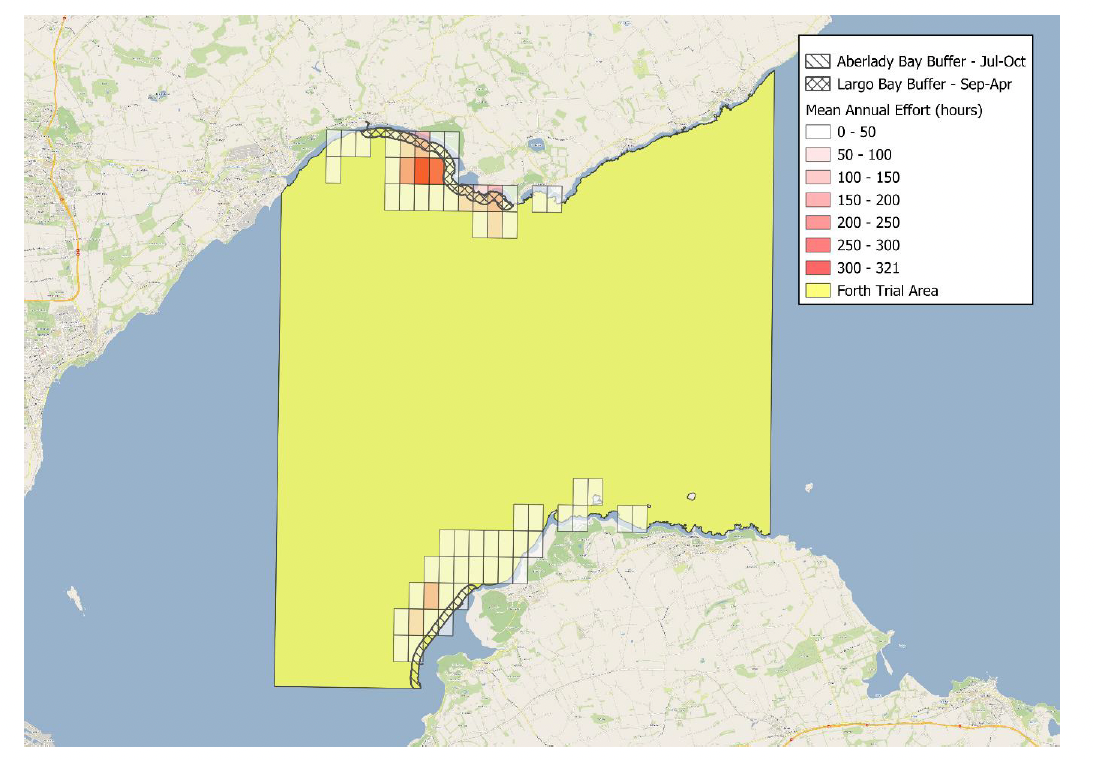
Solway Firth SPA
The Wigtown Bay trial area will be modified as set out in this section.
To reduce the risk of disturbance to red-throated diver:
- An area of Wigtown Bay will be closed to fishing between October and February (Figure 16).
To reduce the risk of disturbance to common scoter:
- An area at the mouth of Fleet Bay will be closed to fishing between July and October (Figure 16).
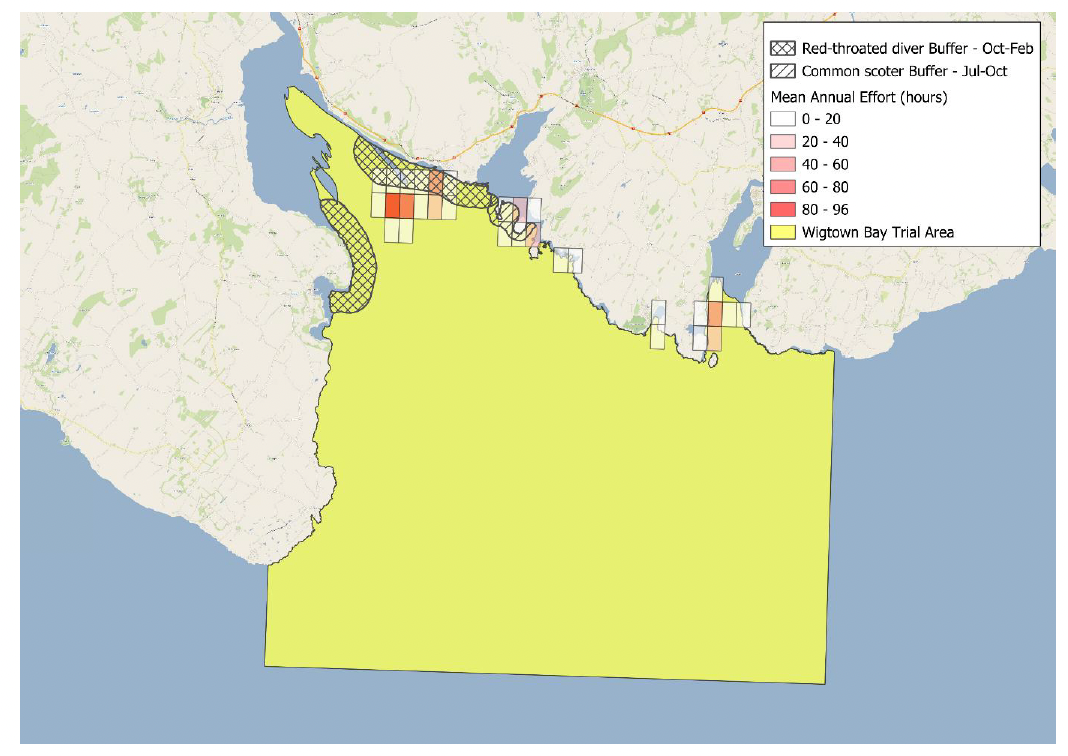
It is estimated from REM data gathered in the trial so far on footprint and seasonal fishing effort, that the Wigtown Bay buffer zones could reduce fishing effort in the trial area by 5.9% and the Fleet Bay buffer zone could reduce fishing effort by 7.4%. It should be noted that these estimates are based on any 0.01x0.01° C-square that is intersected by these buffer zones. In practice, only some C-squares are totally covered, and therefore the impact on fishing effort in practice is likely to be lower. This also assumes that effort will not displace to other parts of the trial area.
3.10 Monitoring and Review – all SPAs
These management changes will be introduced from February 2026. The razor clam trial is scheduled to close in 2027. Scottish Ministers will review this assessment as required, in response to any new advice or information relevant to the conservation and management advice of the SPAs considered, or any change in razor clam fisheries management.