
West Coast of Scotland Nephrops: proposed Fisheries Management Plan
The West Coast of Scotland Nephrops (Nephrops norvegicus) Fisheries Management Plan (FMP) is one of 43 FMPs set out in the Joint Fisheries Statement (JFS). This FMP sets out the policies and actions to continue to maintain the West Coast of Scotland Nephrops stocks at sustainable levels.
Background
Stock
Nephrops are a small decapod crustacean ranging in total body length from 8-24cm (including the tail, carapace and clawed legs). Females will reach maturity at around three years of age although growth is difficult to assess in Nephrops, and it varies geographically, often dependent on food supply[6]. Mating takes place in early summer following moulting and females will carry the eggs for up to nine months before they hatch. During this period berried (egg carrying) female Nephrops will remain mostly hidden in their burrows.[7]
Therefore, throughout this period males are more heavily exploited in the Fisheries compared with other times of the year. Since a significant proportion of Nephrops are fished using demersal trawls and because animals are protected from trawls when in their burrows, the emergence patterns significantly influence catch rates.[8] The timing of Nephrops emergence to feed appears to be related to light levels, amongst other factors, and greatest catches are often taken at dawn and dusk, although this may vary with water depth and clarity.
Location
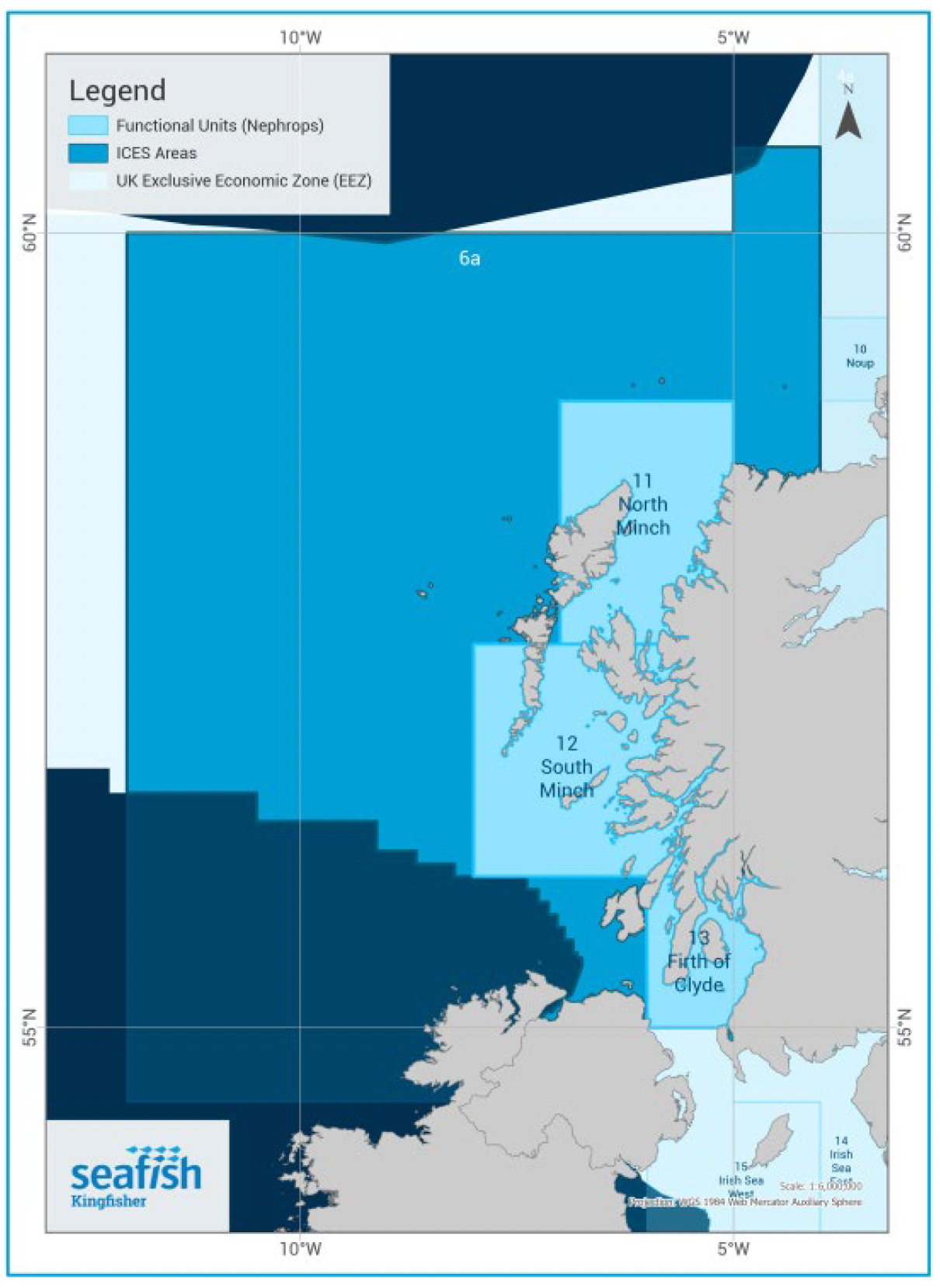
Across the Northeast Atlantic, Nephrops are assessed as individual stocks across 34 Functional Units (FUs), which are geographically distinct areas of sediment containing suitable habitat for Nephrops. These are based on discrete patches of mud which they inhabit. In the West of Scotland there are three FUs: the North Minch (FU11), South Minch (FU12), and the Firth of Clyde (FU13), the latter FU includes the Sound of Jura (Figure 1). Most fishing for Nephrops occurs within these areas, however some very small volumes are caught within the area outside FUs.
This FMP is only intended to apply to fishing activity within UK waters in the West of Scotland (ICES Subarea 6), although in some cases (for example, in relation to our approach to international negotiations with other countries), actions may apply more broadly to the wider biological stock. It is worth noting that while Nephrops stocks are assessed at a FU level, due to the complexity of the advice and management arrangements, the UK sets an overall West of Scotland Nephrops Total Allowable Catches (TAC) for ICES areas division 5b-c and subarea 6. (This FMP covers UK waters of subarea 6 only.)
Nephrops are found across the West of Scotland although their distribution directly correlates to the mud patches they inhabit. As a result, Nephrops fleet activity is confined to certain areas of suitable habitat around the West of Scotland where the mud patches are accessible. Unlike in the North Sea where some FUs such as the Fladen grounds are found offshore, the FUs on the West Coast are generally inshore fisheries. By area, the two largest FUs, the North Minch and South Minch cover an area from the northern tip of the Outer Hebrides down to the Isle of Jura.
Fisheries
Presently the Nephrops stock size of all functional units in the West of Scotland are above their biological reference points. However, these stocks and fisheries may still be vulnerable to over-exploitation because of the high dependency on Nephrops as high-value stocks of remote coastal communities/economies. There are two distinct fisheries for Nephrops. Nephrops targeted in the West Coast of Scotland are caught using mobile gears, predominantly demersal trawls, and pots (creels).
Most fishing for Nephrops in UK waters takes place as part of targeted fisheries. However, bycatch of non-targeted fish does occur, and it is often the case that when fishing for Nephrops, bycatch of both quota and non-quota species can form part of the overall catch. The extent to which this is an issue depends on the type of gear and areas in which fishing occurs, along with considerations of available quota and the type of business model followed.
Creel fisheries
In 2022, the West of Scotland Nephrops fleet was composed of mostly Scottish vessels (324 out of 347) 233 of these vessels catch Nephrops using creels. Vessels that target Nephrops with creels are more diverse in size and range from under 5m to over 12m in length.
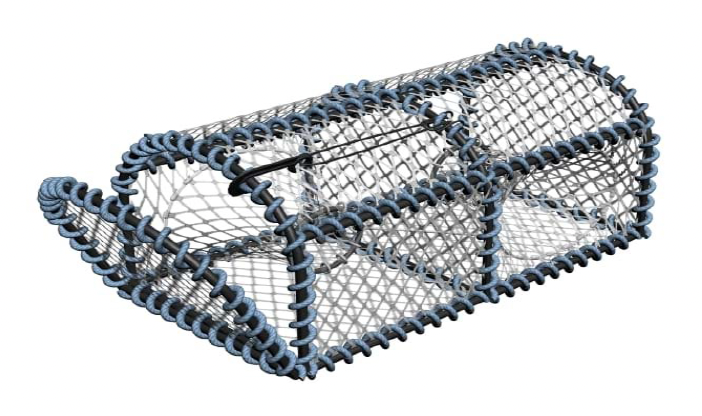
Creels are of the basic D pot design but of much lighter construction than that of a lobster or crab pot (Figure 2). They usually have two entrances in the side and almost always have plastic rings (known as ‘hard eyes) fitted to the entrances to keep the entrance open to make entry into the creel easy for the Nephrops. Depending on the size of the vessel and crew, vessels may deploy and work between 50 to 2500 creels in the West of Scotland, however the total number of creels deployed by vessels in the FMP area is uncertain.
Trawl fisheries:
In 2022, the West of Scotland Nephrops fleet was composed of mostly Scottish vessels (324 out of 347) 91 of these vessels were trawlers. Most of the Nephrops caught in trawls are fished by vessels over 10m and will often fish multi-day trips, whilst the smaller vessels under 10m are usually restricted to inshore waters. In recent years there has been a decline in the number of trawl vessels operating in the West of Scotland Nephrops fisheries. This is despite the fact that there has generally been a relatively buoyant TAC that has typically not had full uptake and overall fishing activity is below the advised TAC.
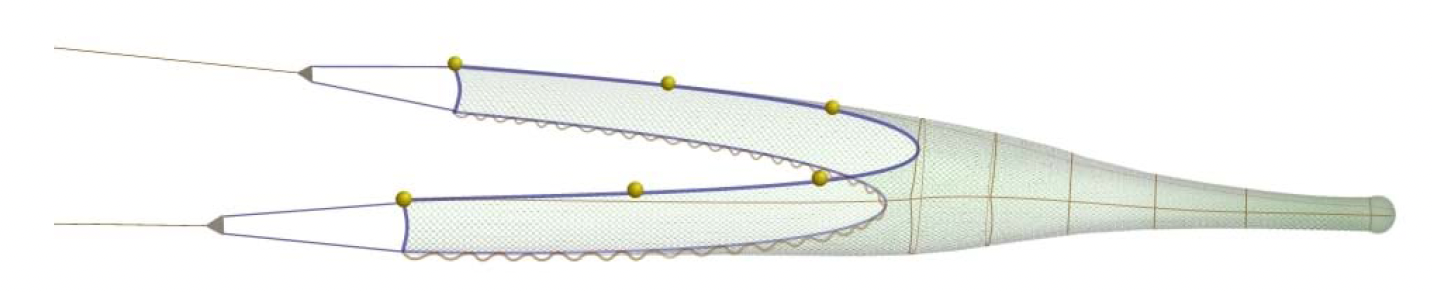
The most common trawl used in the Nephrops fleet in the West Coast of Scotland is the demersal trawl (80% of landings). These trawls are characterised by having long winged low nets, with lightweight ground gear for towing over the soft, muddy areas where Nephrops are found. A pair of otter boards or trawl doors are used to keep the mouth of the net open (Figure 3). Nephrops trawls are designed to skim over the soft mud and have little interaction with the seabed. This is due to carefully balanced footropes and headlines, in conjunction with towing speeds.
Target and non-target bycatch in Nephrops trawl fisheries
Whilst Nephrops is the target species for Nephrops fishing vessels, they may also take a bycatch of other fish species. In some cases this can be in small numbers, and significant steps have been taken to reduce this over the years, however, there can be a cumulative effect, meaning that whilst bycatch at individual vessel level is often small, when scaled up across the number of vessels in the Fisheries, it can be large. This is further demonstrated later in this FMP when we discuss technical measures. There is also a distinction between wanted and unwanted bycatch of fish – some vessels will rely on a mixed Fisheries as part of their business model.
Competition for Space
The vast majority of Nephrops commercial fishing vessels operating in the area covered by this FMP are predominantly reliant on fishing in inshore waters. Within this area competition for space between sectors – for example Nephrops trawlers and Nephrops creelers – is intense. In addition to this, pressures exerted by offshore renewables and other marine activities mean that commercial fishers have less ground than ever to work in. These issues are relevant both to marine spatial planning and to fisheries management measures.
Nephrops landings profile
In 2022 total landings by creels were 1,429 tonnes compared to 7,372 tonnes landed by vessels using trawls. Catch from creels is significantly more valuable per tonne than trawl caught Nephrops (+70%), however volumes landed by mobile gears are significantly higher. In 2022, west coast ports such as Mallaig (976.3 t, 11.04%), Troon and Saltcoats (968t, 10.94%), Stornoway (864.1 t, 9.78%), Campbeltown (680t, 7.69%) made up four out of the top five landing ports by volume.
There are also landings made into Northern Ireland, primarily Portavogie (3,904 tonnes) and Ardglass (1,544 tonnes). Of the key landing ports Gairloch, Campbeltown, Stornoway, and Tarbert were more than 80% reliant on Nephrops. Additionally, more than 50 smaller ports are reliant on Nephrops for more than 50% of their landings.
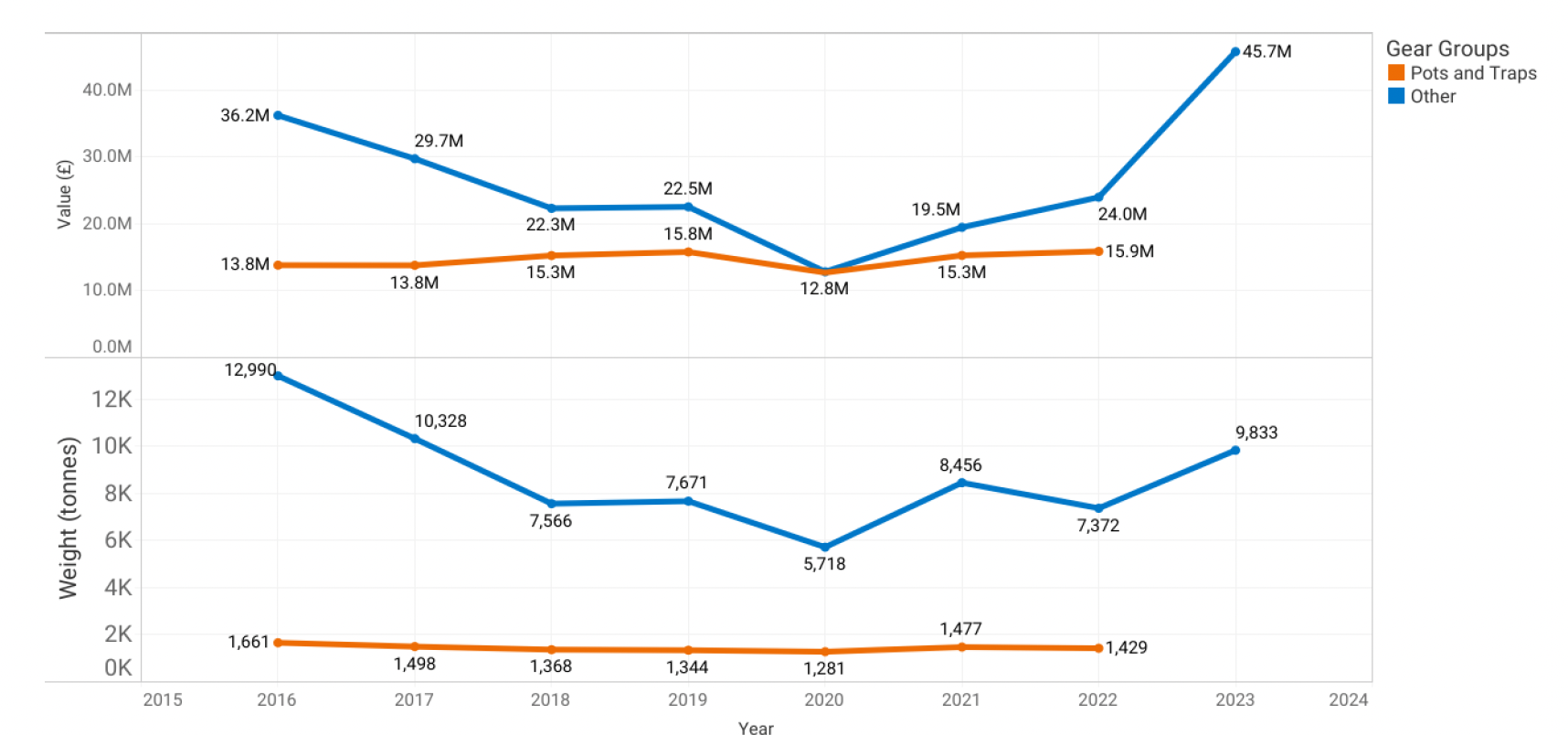
In 2022, ICES rectangles 39E4FU13 (1,824 tonnes) and 40E4FU13 (1,212 tonnes) contributed over 36% of the total Nephrops landings from the FMP area. 45E3FU11, 43E3FU12, 44E4FU11 and 40E5FU13 all contributed over 500 tonnes in 2022. FUs 11,12 and 13 are the functional units fished within the FMP area. Landings have decreased since 2016 by 38%,45% and 39% respectively (possibly due to a reduction in fishing pressure). There has been a small increase in landings outside of functional units but landings in 2022 were just 208 tonnes, compared with 2,198 tonnes, 2477 tonnes, and 3,916 tonnes landed from FU11,12 and 13 respectively. All areas show mixed activity between static and mobile gears, mostly dominated by trawl caught Nephrops, except for 41E4FU12 where 203 tonnes out of 342 tonnes were landed by creelers.
The main landing sites for West of Scotland Nephrops based on value, are Mallaig, Stornoway, and Campbeltown. The value of Nephrops landings into Mallaig is almost double that of the second most valuable port on the West Coast.
Furthermore, many smaller ports on the west coast show a high economic reliance on Nephrops. This is not necessarily the case in areas covered by other FMPs, including east coast ports like Fraserburgh (which is part of the North Sea Nephrops FMP) which show a low economic reliance.
In 2022 Nephrops fisheries in Scotland landed 19,249 tonnes with a first sale value of nearly £83 million, much of which was landed into Peterhead and Fraserburgh. English vessels also landed £5.9 million worth of Nephrops in 2022, predominantly into North Shields and Blyth.
The Nephrops fisheries around the UK support many coastal communities and provide substantial employment both offshore and onshore. Between 2016 and 2022, roughly 30% of employment in the West Coast of Scotland Nephrops fisheries can be attributed to the potting sector, with the remaining ~70% attributed to Nephrops landed from other gear types (mostly demersal trawl fisheries).
Employment in UK Nephrops fisheries generally declined between 2016 and 2020, from a total of 1,008 Full Time Equivalent roles (FTE) to 478 FTE (-53%). Across this timeframe, employment in creels fisheries declined from 301 FTE to 183 FTE (-39%) and employment in fisheries using other gear types (mostly demersal trawls) showed more of a decline from 708 FTE to 295 FTE (-58%). It should be noted that these figures represent the catching sector only. There was an uplift in employment in 2021, reaching 191 FTE for pot fisheries and 530 FTE for other gear types, however this dropped slightly in 2022 (179 for creels, and 661 for other gears).
Nephrops export figures
The volume of UK Nephrops exports generally ranged from 22,600-26,600 tonnes between 2016 and 2022, except for 2016 and 2020 when exports dropped to 19,795 and 17,091 tonnes respectively. Between 2016 and 2021, Nephrops export values (not adjusted for inflation) ranged from £107.9 to £119.7 million, except for 2020 when the value of exports dropped to £80.6 million. This was likely related to the impacts of the Covid-19 pandemic on global markets.
Export values then rose by 13% in 2022 reaching £124.9 million, associated with a lower export volume and a higher price per kilo (£10.43/kg in 2022 compared to £7.81-£8.97/kg between 2016-21). The majority of Nephrops exports are frozen (77% on average) with a smaller amount of live/fresh (23% on average), however in terms of export value, the split between the two presentation formats is more even. Frozen Nephrops constitutes 55% of the total export value on average, and live / fresh Nephrops constitutes 45% on average.
Contact
Email: fmps@gov.scot