
Preventing sexual exploitation: evidence summary
This paper is part of series of evidence reviews which aim to explore current understanding of prevention strategies and interventions in relation to human trafficking and exploitation in the UK. This paper focuses on the prevention of sexual exploitation of adults and children.
Findings
Prevalence
The prevalence of human trafficking (globally as well in the UK and Scotland) has been the subject of much debate (UNODC (2018) in Rigby et al., 2020). In the UK the primary data source for victims of trafficking is the National Referral Mechanism (NRM) statistics. However, due to the hidden nature of exploitation, NRM statistics are very likely to be an under representation of the true prevalence of trafficking and exploitation and especially sexual exploitation (ONS, 2020).
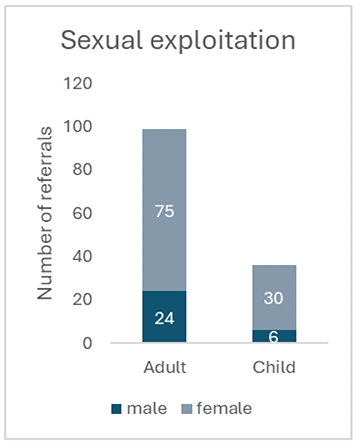
| Adult Female | Adult Male | Total (adults) | Child Female | Child Male | Total (children) | Total (all) | |
|---|---|---|---|---|---|---|---|
| Sexual Exploitation (only) | 33 | 6 | 39 | 20 | 3 | 23 | 62 |
| Sexual Exploitation Combined (all types that include sexual) | 75 | 24 | 99 | 30 | 6 | 36 | 135 |
Source: Modern Slavery: National Referral Mechanism and Duty to Notify statistics UK, end of year summary 2024: data tables (Table 4)
Although the NRM statistics for Scotland report lower levels of sexual exploitation compared to other forms of exploitation, globally sex trafficking has traditionally been reported as the most commonly detected form of human trafficking (OSCE, 2021). However, that picture appears to changing. According to the United Nations Office On Drugs And Crime’s (UNODC) Global Report on Trafficking in Persons (2022), 2020 was the first time detection of trafficking for forced labour was equal to that of trafficking for sexual exploitation. This trend has continued with the total number of detected victims trafficked for forced labour having overtaken that of trafficking for sexual exploitation in 2022 (UNODC, 2024). The UNODC 2024 Global Report on Trafficking in Persons report found that women and girls continue to account for the majority of victims of trafficking detected worldwide (61% in 2022) and that the majority of girl victims (60%) detected continue to be trafficked for the purpose of sexual exploitation. The global data suggests that the majority of sexual exploitation victim/survivors are women and girls (UNODC, 2022, 2024), which is reflected in the Scottish NRM statistics. However, the literature suggests that male victims may be overlooked and under-identified (Humphreys, 2023; Cockbain & Bowers, 2019).
Contextual and situational prevention approaches
The literature reviewed suggests that contextual and situational prevention approaches provide useful frameworks for understanding and preventing sexual exploitation by disrupting the environments and contexts in which sexual exploitation occurs. For example, Hopkins et al. (2024) describes commercial sexual exploitation as an “ecosystem” that involves four main groups: the perpetrators/organised crime groups who supply people for sexual exploitation; the “marketers”, who advertise sexual acts and connect those who are exploited with “purchasers” (e.g. Adult Services Websites); people (“the exploited”) who are transported, sold for sex and; the “purchasers/buyers” (the demand) of sexual acts (Hopkins et al., 2024). Within this ecosystem, the groups are interconnected and dependent on each other for the crime to occur. By understanding who the key actors are and how they operate, the ecosystem can be disrupted to prevent sexual exploitation (Hopkins et al., 2024).
The evidence on child sexual exploitation highlights the importance of addressing the connection between individual vulnerability and broader environmental or contextual factors. Contextual Safeguarding seeks to address the risk and experiences of abuse/harm that children and young people may encounter outwith the home and family; for example in peer, school, and neighbourhood contexts (Firmin, 2020; Contextual Safeguarding Network; NSPCC, 2019).
Similarly, ‘situational crime prevention’ goes beyond the characteristics of individuals involved in a crime to address the wider contexts in which crime occurs (Lucy Faithfull Foundation, 2024). Both approaches highlight that a place (physical or digital) is required for harm to take place (Henderson et al., 2020). They aim to assess and address risk in the environments and encourage partnership and involvement of agencies, communities and bystanders in solutions (PHE, 2019). However, to date, there has been a lack of evaluation into the implementation and effectiveness of situational prevention for child sexual abuse and exploitation.
Prevention through criminal justice
Much of the literature on prevention of sex trafficking is centered within debates around the overlap of human trafficking for sexual exploitation and prostitution; and whether the criminalisation and/or legalisation of prostitution helps to prevent trafficking and sexual exploitation. Internationally, there are four broad legal frameworks to prostitution[6]. These include challenging demand, also referred to as “abolitionism/neo-abolitionism”, “the Sex Buyer law” or the “Nordic Model” which criminalises the purchase of sex whilst simultaneously decriminalising the selling of sex[7]; “Prohibitionism”, which bans all activities related to the selling and purchasing of sex[8]; “Regulationism” which legalises and regulates purchasing, selling and brothel keeping[9]; and “Decriminalisation”, which removes laws on voluntary prostitution and related offences[10] (Scottish Government, 2022a; UN, 2024).
Challenging demand was the main framework discussed in the literature reviewed in relation to prevention of trafficking and sexual exploitation, with comparatively little literature on the other models. The evidence reviewed suggests that demand for prostitution and/or sexual acts is one of the conditions that fosters trafficking for sexual exploitation (Jones, 2017; UN, 2024). The criminalisation of the purchase of sex is a key feature of the challenging demand framework and calls continue for governments to consider such legislation in the UK (Cross-Party Group on Commercial Sexual Exploitation in Scotland, 2021; UK All-Party Parliamentary Group on Commercial Sexual Exploitation, 2021; UK Home Affairs Committee Enquiry into Modern Slavery, 2023).
Evidence remains limited, however, on the implementation and impact of challenging demand approaches. The Scottish Government’s Challenging demand for prostitution: international evidence review (2022a) found notable evidence gaps on “what works" with regards to the implementation of challenging demand approaches. Similarly, Malloch et al.’s (2017) evidence assessment on the impact of the criminalisation of the purchase of sex found existing evidence to be inconclusive in terms of the relationship between human trafficking and demand for prostitution.
More recent evidence has reported issues with the implementation of challenging demand approaches through criminal justice measures. A paper by the Organisation for Security and Co-operation in Europe (OSCE)[11] on discouraging the demand that fosters trafficking for the purpose of sexual exploitation found that even where laws criminalising demand exist[12], implementation was found to be limited by a lack of resources, political will, and limited knowledge and/or prosecution of offences by criminal justice partners (OSCE, 2021).
This is evident in countries which criminalise the purchase of sex only where there is proof that the person is a victim of trafficking (O’Connor, 2018). For example, in England and Wales it is an offence to purchase sex with a person in prostitution who has been coerced or exploited by a third party. However, the UK Home Affairs Committee (2024) inquiry into human trafficking highlighted low numbers of prosecutions and convictions as well as low penalties and fines related with this offence. The inquiry referenced the law’s limited impact in relation to disruption and deterrence against trafficking and exploitation (HoC, HC 124, 2023). Similarly, small scale qualitative research with police officers in England found limited knowledge and awareness of the offence, and little to no training on the links between prostitution and trafficking generally (Matolcsi, 2022).
In Scotland it is legal to pay for sex and to sell sex, though there are a number of specific offences which make certain activities associated with prostitution illegal.[13] It is not a criminal offence in Scotland to buy sex with a person in prostitution who has been trafficked or exploited (OSCE, 2021). For recent policy and research related to commercial sexual exploitation, please see the Scottish Government’s strategic approach to challenging men’s demand for prostitution.
Changes in technology
Technology has impacted on how human trafficking and sexual exploitation operates (OSCE, 2023). Traffickers may use technology to plan the crime; profile, recruit and coerce victims/survivors; transport and track them, “advertise” them and connect them to potential buyers across wide geographical spaces; distribute illicit material; and, hide/move the proceeds of crime (OSCE, 2022; Ofcom, 2023; GRETA, 2022). This has increased the scale, scope, speed and profitability of human trafficking for the purpose of commercial sexual exploitation and has implications for prevention.
There is a small but growing body of UK research highlighting the role of adult services websites (ASWs) in facilitating human trafficking and sexual exploitation (OSCE, 2023). ASWs are legal, online, open-access websites through which the majority of sexual ‘services' in the UK are advertised (Keighley and Sanders, 2023). The Home Office and Police Scotland have both described ASWs as the most significant enabler of commercial sexual exploitation in the UK (HoC, HC 124, 2023; Cross-Party Group on Commercial Sexual Exploitation, 2021). ASWs enable organised crime groups to rotate victim/survivors across cities and websites, adding complexity for police detection, investigation and prosecution (Greta, 2022; Keighley and Sanders, 2023; Cross-Party Group on Commercial Sexual Exploitation, 2021; Hopkins et al., 2024; APPG, 2021).
At the time of writing[14], ASWs are “relatively unregulated”, meaning there is no requirement on operators to moderate content, verify users or put safeguarding measures in place (Keighley and Sanders, 2023). Overall, the research reviewed suggests a lack of safeguarding, proactive crime reporting or compliance with information requests by police across the platforms (Keighley and Sanders, 2023). The UK Online Safety Act 2023 aims to address some of these challenges, whereby human trafficking and elements of prostitution are priority offences and ASWs will have a duty to conduct risk assessments, put safety measures in place and to remove illegal content.[15]
However, the evidence reviewed cites varied understandings of the role of ASWs in the identification and prevention of human trafficking and exploitation. Keighley and Sanders (2023) argue that ASWs can play an important role through greater regulation, collaboration and responsibility, for example, through safety/verification processes, reporting tools, mandatory and proactive data sharing, safeguarding policies and proactive content moderation. Conversely, others have criticised collaboration between law enforcement and ASWs arguing that they should be held legally accountable for facilitating and profiting from sexual exploitation (The Cross-Party Group on Commercial Sexual Exploitation in Scotland (2021), the UK All-Party Parliamentary Group on Commercial Sexual Exploitation (2021) and Home Affairs Committee enquiry into Modern Slavery (2023)). OSCE (2023) recommend proactive monitoring and investigation by law enforcement, particularly for websites with known risk of trafficking and exploitation, and policies and legislation which incentivise platforms to prevent exploitation, and prosecute them for failing to do so.
There are also diverse understandings of the role of sex buyers and technology more generally in terms of reporting and deterrence in the literature. Some commentators advocate for engaging with and providing support and advice to buyers, referencing examples of interventions which encourage buyers to report concerns anonymously to ASWs and the police through pop-up reporting mechanisms (Keighley and Sanders, 2024). Other evidence points to disruption or deterrence initiatives which engage with buyers to disrupt individual ‘transactions’. In Europe, examples of deterrence messaging, though limited, include targeting potential buyers at the point of searching online and highlighting the threat of legal consequences (in states where prostitution is criminalised), potential consequences to employment status or public reputation, and redirecting them to information on the harms associated with purchasing sex and the risks of trafficking (OSCE, 2021).
There is emerging evidence on potential indicators or risk markers of sexual exploitation on ASW adverts. These may include key word phrases or phone numbers used across multiple profiles and/or locations (L'Hoiry et al., 2021; Giommoni and Ikwu, 2021) amongst other ‘red flags’ (OSCE, 2023). An example of using indicators to prevent and disrupt exploitation is L’Hoiry et al.’s (2021) Sexual Trafficking Identification Matrix (STIM), which is an analytical tool that can be used alongside other risk assessment measures to identify ASW profiles that are more likely to have been posted by traffickers.
There is also growing acknowledgement of the role of technology in facilitating child sexual exploitation, which likewise presents challenges for detection and disruption (Brown, 2023; NSPCC, 2023; WHO, 2022; IWF, 2023). Similar deterrence and/or safety by design strategies exist, such as limiting potential perpetrators’ ability to search for child sexual abuse materials; posting warnings to searchers about illegal content and the traceable nature of IP addresses; and, signposting to support websites (WHO, 2022; Brown et al., 2023). The Lucy Faithfull Foundation has coordinated online deterrence and warning messaging, including chatbot technology which targets people searching/viewing sexual images of children online, and signposts them to the helpline and resources such as their Stop it Now! confidential helpline and online self-directed learning guides. Though these have reported early promising evaluation results, as a whole perpetrator interventions require further research and evaluation (CELCIS, 2024; Quayle, 2020). It is clear that the evidence base for deterrence/safety by design strategies is still developing (WHO, 2022; Brown et al., 2023).
As noted, the UK Online Safety Act 2023 places a duty on online services to use a range of measures to tackle illegal content online – including child sexual abuse material and grooming. The changing context of child sexual abuse and exploitation facilitated by technology, particularly under the new online safety regime, requires further research, evaluation and preventative strategies. Nevertheless, the literature reviewed emphasises the importance of a holistic approach to prevention which addresses the overlaps between both online and offline forms of violence (WHO, 2022).
Other methods of prevention
The evidence reviewed suggests that non-criminal justice prevention initiatives (e.g. awareness campaigns, education/training) have been limited and little attention has been given to measuring their impact. The Organisation for Security and Co-operation in Europe (OSCE, 2021) review of addressing the demand that fosters sex trafficking found evidence of non-criminal justice prevention initiatives in only half (27) of the OSCE European states. The majority of such initiatives were run by civil society organisations, for short periods and with limited funding.
Awareness raising and education
This review found that public awareness-raising campaigns were the most common non-criminal justice prevention method. These campaigns have been used to target specific groups of people or sectors, to influence potential sex buyers and to raise general public awareness about the consequences of sexual exploitation. They have also tended to focus on the introduction or existence of laws criminalising the purchase of sex (OSCE, 2021).
Child sexual exploitation prevention initiatives have largely focused on educating children about potential risks, with an emphasis on awareness and resilience to help them recognise and avoid exploitative situations (Kewley et al., 2023). Awareness raising tends to be based in education; however, the UK evidence for education-based approaches with children and young people in preventing child sexual exploitation is inconclusive (CELCIS, 2024). The literature nevertheless emphasises the importance of children and young people having the knowledge and skills to recognise and report sexual exploitation. Best practice in raising awareness in education includes ongoing, age appropriate education and additional targeted work with groups who are known to be at heightened risk of experiencing or perpetrating sexual exploitation (CELCIS 2024; Wurtele and Miller-Perrin, 2017; WHO, 2022). The review by the WHO (2022) on preventing online child sexual exploitation found that single exposure education was unlikely to be effective, and that prevention programmes are more successful if they involve multiple and varied educational tools such as videos, games, readings, posters and infographics, and guided discussions.
In addition to educational initiatives, the evidence suggests that prevention strategies should also focus more broadly on inappropriate behaviours by both peers and acquaintances, as well as strangers (WHO, 2022). As noted, there is the need for more evidence and interventions involving perpetrators and those at risk of engaging in child sexual exploitation, including peer on peer abuse (Henderson et al., 2020).
Moreover, the evidence notes the potential importance of parents/carers in the prevention of child sexual exploitation, for example, noticing changes in child behaviour, developing healthy attitudes to sex and relationships and identifying concerns. To do so, parents/carers require an understanding of the risks of child sexual exploitation, internet safety, and need to have access to educational resources which complement those delivered to children (PHE, 2019; Wurtele and Miller‐Perrin, 2017). Although research into community awareness-raising is at an early stage (PHE, 2019) the available evidence notes that wider communities can play a role in preventing child sexual exploitation, particularly in terms of identification and reporting of risk (PHE, 2019, Benavente et al., 2022). Contextual safeguarding for example, highlights that consideration should be given to community-agency partnership work, ensuring interventions are relevant to the local context and providing effective reporting mechanisms within communities.
Staff training and practice
Another key theme in the child exploitation literature is the need for continued training of professionals working with children and young people in order to identify and support those at risk of or experiencing sexual exploitation. Evidence suggests that emphasis should be placed on safeguarding, local multi-agency working practices/information sharing; recognition of the need to proactively and consistently assess risk and the different forms that child exploitation can take; as well as practical skills in facilitating sensitive conversations with children and young people (PHE, 2019; CELCIS 2024).
However, research suggests a lack of clarity and differing understandings of risk and thresholds for protection amongst practitioners responsible for identifying child sexual exploitation (CELCIS, 2024; Mythen and West, 2023; Henderson et al., 2020). Varying and shifting definitions and methods of identification, inconsistencies in recording data locally, and a lack of awareness by some professionals working with children, can result in inconsistent operational responses to child sexual exploitation, alongside under-recognition and under-reporting (CELCIS, 2024; Barnardo’s, 2023). Under recognition is particularly challenging for men and boys due to a tendency for a gendered response to sexual exploitation (Humphreys, 2023). For example, research in Scotland found that 80% of boys (compared with 25% of girls) who were identified by the research team as likely victims of sexual exploitation had not been identified as such in official reports (Henderson et al., 2020).
Evidence on the use of child sexual exploitation screening tools to identify children who may be at risk, or are showing signs of, child sexual exploitation is mixed and highlights a lack of consistent, evidence based validated risk assessment tools (Franklin et al., 2018; Henderson et al., 2020). Information on how such tools have been developed, are used in practice, as well as evaluation/validation of these, is limited. Franklin et al.’s (2018) research on child sexual exploitation risk indicators found a large number of tools in use, and significant variation in language/definitions, indicators included, methods of scoring and suggested action for different risk levels. This variation means that children with similar vulnerabilities may be assessed and therefore responded to differently.
Supporting victim/survivors of trafficking and sexual exploitation
Evidence on preventing re-trafficking and re-exploitation is limited. People who have been sexually exploited may experience multiple harms, including being trafficked, non-consensual sex and additional violence during sex (OSCE, 2021). This can affect victim/survivors’ physical health (infections, gynecological problems, substance and alcohol abuse and long-term physical injury); and mental health (anxiety, depression, self-harm and post-traumatic stress disorder) (Ofcom, 2023). Support services for victim/survivors of human trafficking and exploitation have out-paced the evaluation of such interventions (Kim et al., 2024). This means there are gaps in knowledge regarding the effectiveness of such services (Graham et al., 2019; Barrow et al., 2021). Available research emphasises the need for long term support, trauma informed approaches, and the development of safety and trusting relationships by practitioners (Paphitis et al. 2023; Modern Slavery and Human Rights Policy and Evidence Centre Policy Brief, 2023; Grant et al.’s, 2023; Hynes et al., 2022). Barrow et al.’s (2021) research with nine young people with experience of sexual exploitation and nine frontline professionals identified three areas of importance for recovery: ‘physical and psychological safety’, ‘managing trauma and mental health difficulties’, and ‘family, normality, and a relaxed approach’.
Looking forward – A public health approach to preventing sexual exploitation
Human trafficking and exploitation, including sexual exploitation, are significant public health issues (Greenbaum, 2020; Such et al.., 2020; Such et al.., 2022; Weston and Mythen, 2023). Recent literature highlights the importance of a whole system, public health response to sexual exploitation which addresses primary (before), secondary (early) and tertiary (treat) prevention. OSCE (2021) notes that all factors contributing to demand that fosters trafficking for sexual exploitation should be addressed across multiple sectors, and that greater attention should be given to primary prevention interventions. The Scottish Government’s violence against women and girls strategy, Equally Safe, which recognises commercial sexual exploitation as a form of VAWG, takes a public health approach. Similarly, the Scottish Government’s Strategic Approach to Challenging and Deterring Men’s Demand for Prostitution recognises that prostitution cannot be viewed in isolation and its intersection with a range of wider inequalities. It also highlights the need for policy cohesion across government and the wider public sector (Scottish Government, 2022b) .
CELCIS’s (2024) international summary analysis of prevention of child sexual exploitation and child sexual abuse examined 11 research publications[16], which consistently described child sexual exploitation as a public health problem. However, there is currently limited evidence on the practical efficacy of a public health response to preventing child sexual exploitation (PHE, 2019; CELCIS, 2024). The literature review conducted for Public Health England’s (2019) public health framework for prevention and intervention of child sexual exploitation identified the following key principles for an effective response:
- It is collaborative and multi-agency, with clear roles and responsibilities and clear lines of communication and accountability within this
- It takes learning from the national context but is locally informed and based on an up-to-date understanding of the local profile
- It is contextual, both in terms of locating child sexual exploitation within a wider context of risk and harm and moving beyond a case by case response;
- It straddles both the preventative and responsive agendas;
- and it focuses on both victims and perpetrators.
A number of reports emphasise the importance of effective multi-agency and partnership working in improving responses to child sexual abuse and child sexual exploitation (PHE, 2019; CELCIS, 2024). However, research has highlighted some of the gaps between policy and practice in relation to multi agency working (Usubillaga et al., 2022). For example, research in Scotland with young people with experiences of trafficking has found that the competing priorities of different services, particularly between immigration, criminal justice and child protection, create challenges for multi-agency working (Grant et al., 2024; Rigby et al., 2020).
The overall relevance and benefits of a public health approach to preventing (all forms of) human trafficking and exploitation are covered in a separate evidence review produced as part of this series[17].
How to access background or source data
The data collected for this
☒ cannot be made available by Scottish Government for further analysis as Scottish Government is not the data controller.
Contact
Email: justice_analysts@gov.scot