
Pathways to Employment: supporting people with lived and living experience of substance use in to work
This toolkit brings together best practice and support into one place to provide employers and employment support providers advice on how to attract, recruit and support staff with lived experience of substance use.
Disclosure Scotland process and previous convictions
This section will help you to understand that:
- Disclosure Scotland want to support people into work and will help you decide if a person is suitable for a role.
- The Protecting Vulnerable Groups (PVG) scheme helps identify whether someone is suitable for regulated work with children and/or protected adults.
- Disclosure Scotland will consider a range of factors to determine if someone with convictions is suitable for regulated work.
- Even if a person is barred from regulated work they are not unemployable, they are just unsuitable for specific work with children and/or protected adults.
Understanding the disclosure process
Many organisations will require their employees to undergo a disclosure check before beginning work. This process can sometimes be daunting for both.
Disclosure Scotland do not want to stop people from gaining employment. They seek to support organisations during the recruitment process, ensuring convictions are not automatically regarded as a barrier to employment.
NHS Scotland’s Employment Checks Policy provides a useful framework for reviewing the suitability of candidates within NHS Scotland.
Employing people with convictions
Past convictions are not automatic barriers to employment. If convictions arise during the PVG process, then it can be helpful to:
- Have open, non-stigmatising conversations.
- Consider conditional employment while awaiting PVG results.
- Use risk assessments to guide decisions.
When Disclosure Scotland checks a criminal record and an individual has a conviction which bars them from regulated work, then they will not be able to join the PVG scheme.
From 01 April 2025, there are four types of disclosure checks, including the PVG scheme. These are detailed below, and further information is available on the Disclosure Scotland website.
Level 1: These will show unspent convictions and any notification requirements.
Level 2: These will show information on unspent and certain spent convictions and other relevant information held by the police.
Level 2(with barred list check): Some roles will require additional checks to show if you are barred from working with children or protected adults. For most of these roles you will need PVG scheme membership.
But for certain activities, such as adopting a child, you will need a Level 2 with barred list check instead. This will replace most enhanced disclosures.
PVG Scheme: The PVG scheme will be a mandatory for people in a regulated role with children or protecting adults.
Details of the previous disclosure levels up until 31 March 2025 can be found here on the Scottish Government website.
PVG scheme
1. What is the PVG scheme?
The PVG scheme is one type of disclosure. PVG is the highest level of disclosure available to employers that carry out Regulated Work in Scotland. Disclosure Scotland carries out criminal record checks and shares the results with the person and organisation. Organisations use this information to help decide if the person is right for the role.
2. Why do employees need to be on the PVG scheme?
If you are recruiting for a role that is defined as a regulated activity with children or protected adults, it is important that you check the barred status of your employees. The Adult Support and Protection Scotland Act (2007): Code of Practice defines an ‘‘adult at risk’’, or in other words a “protected adult”, as someone who meets all the following three-point criteria:
a) They are unable to safeguard their own wellbeing, property, rights or other interests.
b) They are at risk of harm.
c) Because they are affected by disability, mental disorder, illness or physical or mental infirmity they are more vulnerable to being harmed than adults who are not affected.
If your organisation carries out regulated work, you can register with Disclosure Scotland to get PVG checks for your employees.
3. What convictions need to be disclosed to employers?
Employers can ask candidates about their convictions, but what they need to disclose depends on how the conviction is classed (see Question 5 below for definition).
Basic Disclosure (Level 1 from 01 April 2025)
- Employers can ask about any unspent convictions.
- They cannot ask about spent convictions - unless the job is exempt from the Rehabilitation of Offenders Act 1974 (some specific jobs are listed here).
Standard, Enhanced and PVG Disclosure (Level 2 from 01 April 2025)
- Works similarly to Level 1/Basic Disclosure, but some spent convictions must also be disclosed. For convictions that must be disclosed, you can refer to List A and List B.
- Some spent convictions are always disclosed unless a court (Sheriff) decides otherwise.
Essentially, for most jobs, only unspent convictions need to be disclosed. However, for certain roles, even spent convictions may need to be disclosed.
4. How are convictions disclosed?
Most organisations recommend using a ‘letter of disclosure’. In this letter the employee may explain:
- The nature and circumstances of the convictions.
- Changes they’ve made since.
- Their suitability for the role.
Page 40 of the Scotland Works for You guidance shows examples of disclosure letters.
People may also disclose their convictions:
- On a CV.
- On a job application form.
- At an interview.
- When they are offered a job.
5. Why should I consider someone with a conviction?
People with lived experience often have previous convictions, but this does not automatically make them unsuitable for employment. Many employers, including those in health, social care, and legal fields, have successfully hired people with previous convictions. It is vital to evaluate candidates based on their skills and experience.
Disclosure Scotland’s video highlights the benefits of hiring people with past convictions.
There are three main types of convictions that are important to understand: spent, unspent and protected, details of each are below.
a) Spent Conviction – once the disclosure period has passed, the conviction becomes ‘spent’ and is no longer shown on a basic disclosure. However, some spent convictions must be disclosed on higher level disclosures. Lists A and B below set these out.
b) Unspent Conviction – a conviction still within its disclosure period. These must be disclosed but do not automatically disqualify a candidate.
c) Protected Conviction – a spent conviction that is not disclosed on basic or higher-level disclosures.
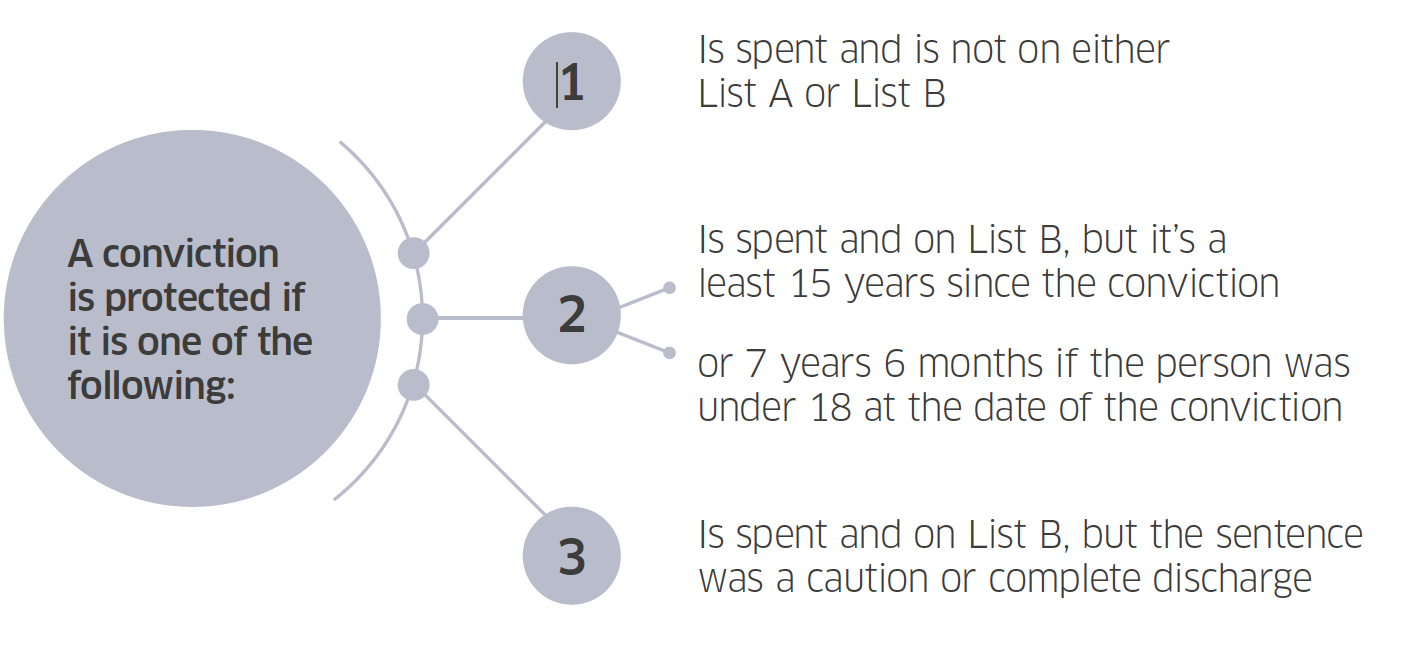
A conviction is protected if it is one of the following:
- 1: Is spent and is not on either List A or List B
- 2: Is spent and on List B, but it's at least 15 years since the conviction
- 2: or 7 years 6 months if the person was under 18 at the date of conviction
- 3: Is spent and on List B, but the sentence was a caution or complete discharge
The List A offences and List B offences can be used to check if that would apply to any potential candidates.
6. How can I discuss convictions that are flagged on a PVG?
Convictions on a PVG do not necessarily prevent employment. Employers should:
- Discuss convictions openly and understand the candidate’s background.
- Use resources such as the Scotland Works For You guidance.
Consideration for listing
7. What does it mean if someone is “considered for listing”?
When Disclosure Scotland assesses if someone is unsuitable for regulated work, they undertake a “consideration for listing” process. Employers should support candidates during this period and reassure them about the process.
Being “considered for listing” does not mean automatic disqualification. Disclosure Scotland’s assessment ensures a fair and balanced approach. If additional information is needed, candidates have 28 days to provide it, including representations, testimonies, or references.
If Disclosure Scotland receives information that might mean the person is unsuitable for regulated work, they do an assessment to decide whether to list them. This is called a “consideration for listing assessment”.
8. What if they are listed as barred?
If listed as barred, a person cannot work in regulated roles with the specified vulnerable group. For example, those barred from working with children can still work with protected adults and vice versa. Employers may explore alternative roles during this time.
9. Can a person appeal against a listing decision?
Candidates can appeal listing decisions to a sheriff within three months. They remain barred from regulated work until the appeal is resolved. Further information is available on the appeal against a listing decision page.
10. Is there anything else I need to consider about the disclosure process?
- Approach – engage in non-stigmatising, person-centred conversations while balancing regulatory requirements. Employers should be supportive, open, and knowledgeable about the issues around disclosure.
- Employment Offers – where ever possible, seek to avoid withdrawing offers prematurely if someone is under consideration for listing. Instead, try to support candidates by adjusting roles. Employers can consider additional risk assessment to determine what level of employment, restrictions and additional supervision might be offered.
- Emotional Impact – recognise the stress and emotional challenges candidates may face during this process.
- Representation Support – assist candidates in submitting representations within 28 days, including organising discussions and gathering supportive statements. Further information is detailed below.
11. What representation support should I provide candidates?
Meet with candidate – have a discussion regarding their PVG, ask them to talk about their convictions and the circumstances. Seek to understand any steps they have taken to move forward with their life.
During the meeting – it is good practice to take notes of discussions and utilise these in a summary of the conversation. This would then be shared with the applicant to ensure that everything noted is an accurate representation of what they have described. A general reminder of the 28-day timeframe could be given and advised that they can seek extensions directly from Disclosure Scotland.
Statements of support - candidates can seek statements of support from those who can support their suitability. This can include support workers, social workers, and colleagues, for example. The person supplying a reference needs to know what they are doing it for.
Further support and advice
- Refer to the Scotland Works For You Guide for detailed advice.
- Participate in free Disclosure Scotland training webinars. You can sign up on the Disclosure Scotland events page or email dsworkshop@disclosurescotland.gov.scot.
- Explore Volunteer Scotland’s resources for additional guidance.