
Northern Shelf Blue Whiting: Fisheries Management Plan
This Fisheries Management Plan (FMP) relates to Northern Shelf blue whiting (Micromesistius poutassou) and is one of 43 FMPs set out in the Joint Fisheries Statement (JFS).This FMP sets out the policies and actions to manage the Northern Shelf blue whiting stock at sustainable levels.
Background
Stock
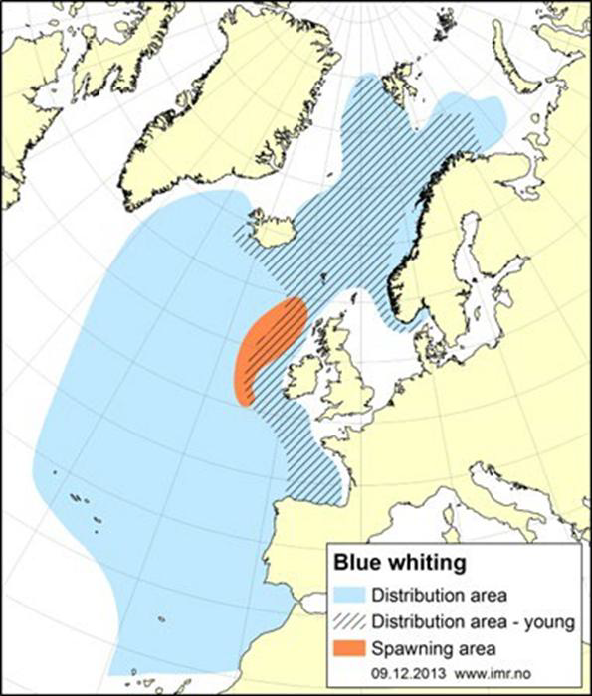
Blue whiting is an abundant small benthopelagic gadoid that is widely distributed in the eastern part of the North Atlantic. Individuals inhabit the continental slope and shelf typically from a depth of 150 m to more than 1000 m, although the species are most common at 100 – 600 m. The highest concentrations of individuals are found along the edge of the continental shelf in areas west of the British Isles and on the Rockall Bank plateau although the stock is also present in almost all other management areas between the Barents Sea and the Strait of Gibraltar and west to the Irminger Sea. Blue whiting reaches maturity at 2–3 years of age and can reach a maximum length of 50 cm.
Blue whiting are primarily carnivorous, feeding on crustaceans such as euphausiids and krill, cephalopods, and smaller fish (mainly other gadoids such as cod). Blue whiting are in turn a crucial prey species in North Atlantic food webs and form an important part of the diet of commercial stock such as hake, cod, mackerel and bluefin tuna.
Adults undertake long annual migrations between the feeding and spawning grounds. Blue whiting gathers to spawn in deep waters to the west of the UK, Ireland and Faroes during winter and spring. Most spawning activity takes place between March and April, along the shelf edge and banks west of the British Isles. Juveniles are abundant in many areas, with the main nursery area believed to be the Norwegian Sea.
The UK pelagic trawl fishery targets blue whiting during spawning time off the continental shelf from Ireland and northwards.
Stock identity of the blue whiting stock (ICES Subareas 1–9, 12, and 14) is an ongoing topic of discussion as morphological, physiological, and genetic studies suggests the existence of two stocks that co-occur in the spawning area west of the British Isles (ICES, 2012). However, for the purpose of the stock assessment, the blue whiting population is currently treated as a single stock by ICES.
Location
The biological stock is found in ICES subareas 1–9, 12, and 14 (Northeast Atlantic and adjacent waters). This FMP only applies to UK waters in the ICES divisions 2.a, 4, 5.b, 6, 7.a, 7d-h, 7.j, and 12.b. For management purposes, there is one Total Allowable Catch (TAC) area within UK waters, denoted by ICES code WHB/1X14.
Figure 1: General map of ICES areas
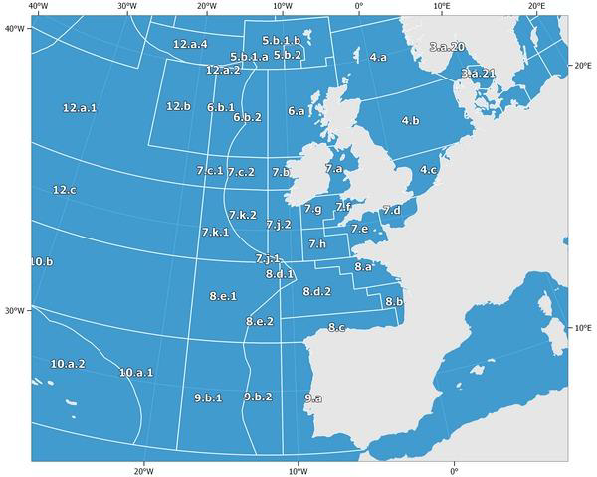
Figure 2: Distribution of blue whiting in the Northern Atlantic. (Source: www.imr.no)
Fishery
Exploitation of blue whiting started in the 1970s with the species becoming increasingly important to the fishing industries of northern European countries, including Russia, with total catches exceeding 1 million tonnes from 1998 to 2008. The UK pelagic trawl fishery targets blue whiting during spawning and post spawning off the continental shelf from Ireland and northwards. The figures within this FMP primarily focus on UK fishing vessels, as these are the vessels for which we have accurate data.
Fishing for blue whiting in UK waters mainly takes place as part of a directed pelagic fishery which targets spawning and post-spawning fish. Around 87% of the total catches in 2024 were taken in the first two quarters, with the majority taken along the slopes of the Western European shelf and around the Faroes. Smaller quantities were taken in the Norwegian Sea, in the Norwegian Trench, in the Rockall Trough and along the coast of Spain and Portugal.
In the UK, blue whiting are largely targeted by the Scottish pelagic fleet, which comprises 21 large pelagic vessels utilising pelagic trawls, but around half of these are involved in the fishery trawls when targeting blue whiting. In 2024, Scottish vessels accounted for 95% of the catch, whilst Northern Irish vessels accounted for the remaining 5%. English vessels caught a nominal amount in area 7.j. No catch /nominal amount was attributable to Welsh-registered vessels. trawlers. Vessels may catch more than 1,000 tonnes of fish per trip. Analysis of UK fisheries data shows that almost all blue whiting is caught using trawls, with less than 0.001% landed using other methods each year.
Given the seasonality of pelagic fisheries, with different stocks being targeted at different points in the year, vessels targeting blue whiting will generally also target other pelagic stocks at other points in the year, which are themselves subject to separate FMPs. Whilst the pelagic stocks are different, the method of fishing is generally the same, with many of the same characteristics, and so many of the policies and actions within the FMPs will also be similar.
Use of the blue whiting caught by UK vessels is split between human consumption and industrial purposes. A significant portion of the blue whiting catch goes towards fishmeal and oil.
Between 2018 and 2024, blue whiting was almost exclusively caught by pelagic-targeting vessels, who averaged over 99% of the total catch within areas covered by this FMP.
Between 2018 and 2024, 78% of UK vessel landings of blue whiting was caught in ICES area 6.a, with the remaining 22% caught in area 6.b.[5] Negligible amounts were caught in the other ICES areas covered by this FMP.
| Landings | 2018 | 2019 | 2020 | 2021 | 2022 | 2023 | 2024 |
|---|---|---|---|---|---|---|---|
| Landed Value (£ thousand) | 6,820 | 6,570 | 8,680 | 14,010 | 3,620 | 15,760 | 25,070 |
| Tonnage | 31,717 | 30,897 | 19,716 | 47,813 | 21,671 | 69,619 | 66,870 |
| Price per tonne (£) | 215 | 213 | 440 | 293 | 167 | 226 | 375 |
The landed value, tonnage, and price per tonne of blue whiting by UK vessels was consistent in 2018 and 2019, with around 31,000 tonnes landed for a value of around £6.7 million and a price per tonne (PPT) of around £214. In 2020, a drop in the tonnage, to 19,700 tonnes, and a PPT increase to £440, saw value climb to £8.7 million. 2021 saw a further increase in landed value, up to £14 million, fuelled by an increase in tonnage landed (47,800 tonnes). 2022 saw a decrease in the tonnage (21,600 tonnes) and landed value (£3.6 million) and PPT (£167). Since then, tonnage, landed value and the PPT has increased, with 2024 seeing 66,900 tonnes landed for a value of £25 million at a price of £375 per tonne.
Most UK-caught blue whiting is landed outside the UK. Peterhead, the only UK district that saw any notable tonnage between 2015 and 2024, saw an average of 27% of the total tonnage caught by the UK fleet. Despite landing 98% of the blue whiting value landed into the UK, Peterhead represented only 1% of the port’s total landed value.
Denmark was the most popular landing destination outside of UK, seeing 37% of the blue whiting catch. Ireland saw an average of 23%, whilst the Netherlands saw 10%. Smaller amounts were landed into Norway, Iceland and the Faroe Islands.
For the Seafish fleet segments[6] that catch blue whiting, the stock makes up around 3% of the segment’s total landed value. 99% of blue whiting value is caught by the pelagic over 40m fleet segment.
Pelagic fisheries are, in the main, classed as a relatively ‘clean’ fishery, meaning that issues with discarding and bycatch are deemed to be minimal. However, given the capability of pelagic trawl vessels to take large tonnage hauls, the impact of any discarding, misreporting or slipping of catch, should it take place, would be considered high. The introduction of Remote Electronic Monitoring (REM) in Scottish waters, where the majority of pelagic fishing takes place in the UK, provides an enhanced level of confidence and ensure that effective tools are in place to deter and detect any illegal activity. Defra is also working towards introducing REM in this fishery.
Contact
Email: fmps@gov.scot