
International review of approaches to tackling child poverty: Croatia
A historical review of evidence on Croatia's approach to tackling child poverty, drawing out the key lessons for Scotland.
The factors and wider context for child poverty reduction in Croatia
Croatia's approaches to poverty reduction and economic development have transitioned over time. This moved from post-war emergency aid in the 1990s to social safety nets and labour market reforms in the 2000s, economic resilience in the 2010s, and EU-driven social inclusion in the 2020s.
The key chronological periods that this case study focuses on are 1996-2018 - where there was high emphasis on social welfare policies - and 2013-2022, which involved several labour market reforms and specific child poverty measures driven by EU accession.
Social welfare-driven policy in the post-war period (1996 – 2018)
The decentralised nature of Croatia's administration means that the country’s social security system operates at national, county, and city levels. In 2016, approximately 130 social policies were administered by the national government, while around 3,000 services were managed by various levels of local government (cities, municipalities, and counties).[46] Social security spending was higher in the period from 1995 to 2003 than in the past two decades as illustrated in Figure 8,[47] suggesting a pro-welfare approach immediately after independence. Croatia spends a lower proportion of GDP on social security as compared to the EU average.

Source: Eurostat, General government expenditure by function (gov_10a_exp), 2025
Croatia’s social protection programmes consist of three main components – social assistance (non-contributory transfers in cash, vouchers, or in-kind[48]), social insurance (contributory schemes providing compensatory support in the event of contingencies[49]); and labour market programmes. Each category comprises the following programmes and benefits:[50]
1. Social assistance
- Child allowance[51]
- Disability benefits
- Education allowance
- Guaranteed Minimum Benefit
2. Social insurance
- Old-age pensions[52]
- Family pensions[53]
- Disability pensions
- Unemployment benefit
- Sickness and health benefit
- Parental leave
3. Labour market programmes aimed at improving:
- Labour market functioning - through employment services
- Labour supply - through training
- Labour demand - through subsidies or public work programmes
Croatia’s social protection programmes have had a significant impact on poverty and inequality.[54] As of 2014, 71% of Croatia's population benefited from at least one social protection programme. 34% received old-age pensions, 22% received family benefits such as child allowance or maternity leave, and 13% received disability pensions. Notably, 96% of the poorest 20% of the population benefited from at least one programme. The main interventions for the poorest quintile were old-age pensions (received by 43%), family benefits (41%), and disability pensions (21%). For the overall population, the value of the social protection benefits as a share of beneficiary household consumption increased from 2008 to 2014, out of which social insurance provided the biggest share. This was observed across all households, with social insurance in the form of old-age and family pensions being the biggest driver of increase due to a rise in ageing population.[55]
When examining relative child poverty, the impact is notable. This significance arises because social transfers through various social protection programmes in Croatia constitute a substantial portion of household per capita income. In 2023, the at-risk-of-poverty rate for children before social transfers at 26.5%[56] was 10.4 percentage points higher than the rate after social transfers at 16.1%,[57] as depicted in Figure 9. However, the at-risk-of-poverty rate before social transfers also shows a downward trend, having reduced by 13.2 percentage points from 2015 to 2023. This suggests that while social transfers contribute to household incomes and reduce baseline poverty rates, they do not have a central role in driving down the overall trend. Wider factors such as economic growth and growing labour market participation may be bigger contributing factors to this.

Source: Eurostat, At-risk-of-poverty rate before social transfers (pensions included in social transfers) by poverty threshold, age and sex (ilc_li09), 2025 and At-risk-of-poverty rate by poverty threshold, age and sex (ilc_li02), 2025
While there is no current data on this, World Bank research from 2014 finds that the most impactful social benefits when it comes to reducing poverty are old-age pensions and disability pensions, while family benefits (including child allowance and maternity benefits) and family pensions have a medium impact. The least impactful were unemployment and sick leave benefits.[58]
Public policies for families with children, which provide various cash and in-kind benefits, are crucial tools to address child poverty and social exclusion. While they are not necessarily aimed at reducing child poverty, they contribute to poverty reduction by providing families various forms of support aimed at adults and children. In Croatia, the main policy providing cash support to families with children is the child benefit policy.[59] Other programmes that contribute to reducing child poverty - though not specifically designed for the purpose - are maternity leave and parental leave benefits, one-time grants for each newborn, and benefits for adoptive and foster parents.[60]
The section below discusses various social welfare policies that have been directly and indirectly targeted towards poverty reduction in Croatia. Specifically, the case study unpacks the Guaranteed Minimum Benefit scheme and the reasons behind its low uptake and therefore low impact on reducing child poverty; and child support mechanisms and their role in poverty reduction.
Guaranteed Minimum Benefit (GMB)
Guaranteed Minimum Benefit is the country’s basic minimum income scheme which came into effect from 2014. It is a means-tested benefit for various vulnerable groups in the form of direct transfers. It is nationally based and under the authority of the Ministry of Labour, Pension System, Family and Social Policy. Anyone may be entitled to Guaranteed Minimum Benefit if their income is not sufficient to guarantee their subsistence. For those capable of work, receipt of Guaranteed Minimum Benefit is conditional on being available for, and actively seeking, work.[61] As of 2024, the benefit is calculated as a percentage of the fixed monthly base of €150, which has increased from €104.69[62] since its inception. Current benefits are calculated as discussed in Tables 1 and 2.
| Beneficiary group | Proportion of base amount of €150 | Benefit due |
|---|---|---|
| Working-age single person | 100% | €150 |
| Elderly persons (over 65) | 130% | €195 |
| Beneficiary group | Proportion of base amount of €150 | Benefit due |
|---|---|---|
| Working-age adults | 70% | €105 |
| Elderly persons (over 65) | 95% | €142.50 |
| Single-parent, working-age | 120% | €180 |
| Children | 70% | €105 |
| Maternity period and up to six months after delivery | 120% | €180 |
The base amount is supposed to be revisited and reset annually, and it was last increased from €132.72 to €150 in January 2024 following a public consultation in 2023. [65] The Croatian Anti-Poverty Network argues that the base amount is arbitrarily set and does not take into account any poverty line, reference budgets or consumer basket, nor does it relate to median incomes.[66] The Ombudsperson’s Office noted that there was no change for two years prior to 2023, and stated that the baseline increase was not in line with the increase in the cost of living and inflation. It added that the parameters upon which the by €17.28 increase in 2024 was based were unclear and that they should be made public. The Ombudsperson regularly receives complaints on the low benefit amount which prevents the beneficiaries from being lifted out of poverty. The Office also cited research that found the inflation rate does not have the same effect on all citizens. A survey by the Institute of Economics in Zagreb showed that inflation affects the poorest households more severely. It found that the price of a consumer basket for 10% of the poorest households is as much as 10.8% higher than for 10% of the wealthiest households. Therefore, while the Guaranteed Minimum Benefit helps to address some of the most basic needs, the Ombudsperson’s Office maintains that it does not allow for exiting poverty.[67]
Outcomes
In June 2015, there were 103,729 people receiving GMB, 50,362 of whom were deemed capable of work.[68] By 2023, this number of beneficiaries had fallen to 51,454, or 1.2% of the population.[69] The Croatian Anti-Poverty Network states that the decline may be due to the low base amount and decreased unemployment rates. [70] They maintain that the scheme did not serve its intended purpose as the allowance itself was inadequate and the scheme had low coverage. Although there were some reforms in the 2018-2020 period, these were mainly focused on the scheme’s technical functioning and not on further reducing poverty by increasing the allowance base or recalculating it on the basis of poverty lines or median income.[71]
Child support
The child support system in Croatia consists of a social assistance component – child allowance, which is a state-funded cash transfer to households with children, and a personal child tax allowance that is part of the Income Tax system.[72]
The child benefit policy, first introduced in 1945 when Croatia was part of Yugoslavia, was funded by employees' contributions and only for employees' children, subject to means-testing. In 1999, a more modern system was introduced, and was not dependent on contribution history. From 1999 to 2001, benefits were based on average net salaries, with two means-tested brackets. Since January 2002, under the Child Allowance Act, the benefit is tied to a “budgetary base" with an upper threshold at 40%. In 2007, the threshold increased to 50%, adding a supplement for a household’s third and fourth child. Additionally, a third bracket was introduced, and the child benefit was determined for each bracket at the rates of 9%, 7.5% and 6% of the base respectively. No further changes occurred until July 2018, when the upper threshold rose to 70%, expanding the third bracket.[73]
Child allowance is a redistributive benefit delivered through the Child Allowance Act. Beneficiaries include parents or carers, for children. This means-tested benefit is paid monthly, is calculated at a base amount of €441.44 and is granted either until the child reaches age 15 or until the end of the school year when they turn 15.[74] Currently, there are five brackets and the qualifying threshold amount is set at an average monthly income per household member of €618.02. Therefore, a two-adult, two-child family drawing an income less than €618.02 per adult would receive a monthly child allowance amounting to 9% of the base of €441.11 per child. This would mean €39.73 per child or a total of €79.46. Details of other brackets and allowance calculations are illustrated in Table 3.
| Average monthly income per member of the household (% of upper threshold of €618.02) | Proportion of base amount of €441.11 per month | Monthly allowance granted per child |
|---|---|---|
| 20% of threshold | 14% | €61.80 |
| 40% of threshold | 12.5% | € 55.18 |
| 60% of threshold | 11% | €48.56 |
| 100% of threshold | 9% | €39.73 |
| 140% of threshold | 7% | €30.90 |
Supplements are also given for children in single-parent homes and children with health issues.[76] Beneficiaries also receive a monthly baby bonus of €66.36 for the third and fourth child.[77] Applications are administered by the Croatian Pension Insurance Institute (HZMO) and regulated by the Ministry for Demography, Family, Youth and Social Policy (MDFYSP).
In addition, there is a personal child tax allowance in the Croatian income tax system whereby the tax base of a taxpayer with dependent children is lowered. The deduction for the first and second children is €280 and €392 respectively and is €560 for the third child.[78]
In contrast to child allowance, which is more generous for lower-income households, the tax allowance policy for dependent children provides higher tax reductions for high-income households, and these tax reductions exceed the amount of the child benefit.[79]
Economic and political context shaping the trajectory of the policy beyond 2013
Net national income (NNI)[80] in Croatia, as per constant 2015 prices, grew from US$ 17.62bn in 2000 to US$ 56.45bn in 2021, marking a per capita increase from US$ 3,943 to US$ 14,553.[81] Meanwhile, the budgetary base for calculating child allowance remained unchanged since 2002, leading to a continuous decline in child benefit recipients. This was because net salaries and, consequently, household income levels were steadily increasing and the set base amount did not take relative poverty under consideration. As a result, the number of children receiving benefits fell from 500,000 in 2002 to 300,000 in 2018, leaving many households without government support for child-rearing costs. In this period, overall poverty levels decreased, including child poverty, but the number of beneficiaries qualifying for child allowance also decreased as their incomes no longer fell under the maximum income threshold. However, that does not mean that they did not require assistance. It simply means that the threshold no longer reflected the country’s economic growth and the corresponding rise in household incomes.
In early 2018, the Croatian Government announced an increase in the upper means-test threshold from 1,663 Croatian Kuna (HRK – the currency before Croatia adopted the Euro in 2023) to HRK 2,328.20[82], or from €224 to €314.[83]
The increase in the income threshold was significant. For instance, prior to this upper means-test threshold changing, a four-member household's total net monthly income had to be below HRK 6,652 (€897) to qualify for child benefits. However, with the policy change on 1 July 2018, this threshold was raised by 40% to HRK 9,312.80 (€1,255). Consequently, all four-member households with a net monthly income between HRK 6,652 and HRK 9,312.80 became eligible for child benefits.[84] This was welcomed by the public because it was expected to increase the number of child benefit recipients by 150,000, and an amendment to the Child Benefit Act came into effect on 1 July 2018. However, it soon became clear that these expectations were not met, as the number of beneficiaries and children increased only slightly in practice – by 19,000 families, which amounted to 40,000 children.[85] This led to public disappointment and prompted questions about why the measure had such limited success. There were several reasons for this, such as the growth in average salaries by almost 25% which disqualified many families from being able to apply, emigration and fewer families with children, as well as potential beneficiaries not being aware of the change and their eligibility.[86]
Outcomes
The child benefit policy in Croatia has two policy intents; it offers more substantial benefits to lower-income households and ha s a pronatalist[87] inclination. Croatia’s social protection programs have a very large impact on poverty and inequality. [88] This can be observed with child poverty rates as well. A s shown in Figure 3, there has been a downward surge in child poverty levels since 2018[89] when the biggest reform to child benefits was introduced - an increase in the upper means-test threshold from HRK 1,663 to HRK 2,328.20[90], or from €224 to €314.[91]
Labour market reforms to increase women’s workforce participation (2013 – 2022)
In Croatia, as in many other countries, women continue to perform less favourably than men on several labour market indicators.[92] Women's economic inactivity is primarily influenced by traditional gender role attitudes in Croatia and a shortage of out-of-home care facilities such as nurseries and nursing homes. A study found that 58.6% of economically inactive women cited family or caring responsibilities as their main reason for inactivity, compared to only 13.1% of men.[93]
However, the situation has been steadily improving. From 1995 to 2022, Croatia undertook numerous reforms in parental leave policies aimed at promoting gender equality and supporting families. These initiatives have played a role in poverty alleviation by allowing parents, particularly women, to continue their employment while managing child-raising responsibilities. This was emphasised in the stakeholder interviews as a key reform area to drive economic growth and reduce poverty.
This section examines maternity, paternity and parental leave to assess their impact on driving up women’s labour force participation in Croatia.
Maternity and paternity leave
After 1995, demographic renewal was a key social goal and family policies at that time tended to “re-traditionalise women and deviated from the earlier socialist period before independence.” Efforts to increase the birth rate included measures such as the institution of mother-educators and a three-year maternity leave in the Labour Law. However, these measures were not fully implemented due to financial limitations. In July 2008, the Law on Maternity and Parental Benefits was adopted to centralise the rights of parents relating to childbirth, which had been previously covered by two separate laws.
This law has been amended several times, with a new version adopted in 2022.[94] According to the latest version, employees who have made social security contributions for at least nine consecutive months (or 12 months within two years with interruptions) are entitled to their full pay during maternity leave. Those who do not meet these requirements are entitled to a reduced maternity pay of 70% of the full payment for the entire duration of the leave. Pregnant employees are granted 28 days of maternity leave before the birth of the child (45 days in case of complications). They also receive 70 days after birth or until the child turns six months old, as well as additional accommodations for childcare, such as daily breaks for breastfeeding and shorter working hours. A female employee can take additional maternity leave of up to six months after birth, and she has the option to return to work within that period and transfer the remaining leave to the father. An employer is prohibited from terminating a female employee’s contract during her pregnancy or within the first six months after birth. [95] Fathers are entitled to 15 working days of fully paid paternity leave for one child and 30 working days in case of multiple births. The duration of paternity leave was increased from 10 to 15 days for the former, and from 20 to 30 days for the latter, in November 2024.[96]
Parental leave
After the initial six months following birth, which are covered by maternity leave, parents are eligible for parental leave. Each parent is entitled to four months per child for the first two children and 15 months for any additional children or twins. This leave must be taken before the child reaches eight years of age. Two months can be transferred from one parent to the other. If only one parent opts for the leave, it can last six or 30 months, depending on whether it is the first two children or any subsequent ones.
Parental leave can be used all at once or split into parts, but no more than twice annually, with each segment lasting a minimum of 30 days. The first six months (or eight if both parents take the leave) of parental leave are fully paid - up to 120% of the monthly budget base (€750). After this period, compensation is provided at 70% of the budget base (€309). [97]
There is no data on the uptake of parental leave or the split between parents. With regards to maternity leave, although there is a possibility for fathers to use part of it, data from 2015 showed that fathers only used the transferred right in 0.3% of cases.[98]
Outcomes
These reforms indicate a slight shift away from the pro-natalist approach take to family policies of the 1990s towards creating a more inclusive labour market aimed at increasing workforce productivity that drives economic growth. However, recent reforms to these policies such as increasing the quantum of leave for the third child onwards indicate a renewed pro-natalist focus. There has not been a tremendous growth in women’s workforce participation, which has remained almost constant from 44.4% in 2000 to 47.1% in 2023.[99] According to a World Bank study, 61% of Croatian women start out at comparable employment levels with men but their labour force participation reduces with age. This could be due to a variety of factors such as prevailing traditional gender roles that necessitate women taking up the bulk of household unpaid work, caring responsibilities and lack of childcare arrangements.[100]
However, there have been improvements in other aspects of workforce inclusion for women. The rate of women in ‘vulnerable employment’ has decreased from 20.3% in 2004 to 6.6% in 2022.[101] Those in vulnerable employment are less likely to have formal work arrangements, and they are therefore more likely to lack decent working conditions, adequate social security and ‘voice’ through effective representation by trade unions and similar organisations. Vulnerable employment is often characterised by inadequate earnings, low productivity and difficult conditions of work that undermine workers’ fundamental rights.[102]
While not always a factor for poverty reduction, a World Bank study found that economic growth from 2013 to 2016 resulted in significant poverty reduction.[103] The study found that broad-based, labour-utilising growth had a stronger impact on poverty reduction than economic growth alone. Croatia's growth trajectory and poverty reduction trend highlights the importance of increasing labour income and improving employment outcomes. Productive employment is a crucial tool for sustainable and inclusive growth. Growth policies must be combined with inequality-reducing measures to ensure equitable, ‘pro-poor’[104] growth. In contrast, high inequality diminishes growth's impact on poverty reduction. Therefore, by increasing labour force participation among previously excluded groups, Croatia has reduced income inequality to a significant degree.[105]
A key indicator of success in this period was the decrease in unemployment from 19.8% in 2013 to 5.6% in 2023,[106] which is one of the lowest rates in the history of post-Yugoslav, independent Croatia. Although it is to be noted that the decrease over the decade can be attributed not only to the positive economic conditions but also to negative demographic trends, such as an increasing ageing population and workforce emigration,[107] which shrank both the available pool of workers and, therefore, the competition for jobs.
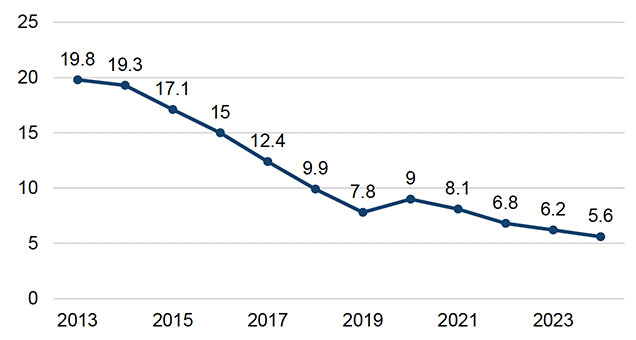
Source: International Monetary Fund, Country Data Profile, Croatia, Unemployment rate, 2025
Targeted measures following EU accession (2013 – present)
Croatia joined the EU during the aftermath of the 2008 financial crisis and the recession that followed. Membership of the EU has resulted in economic benefits for Croatia, including stable economic growth, a gradual increase in living standards, and lower unemployment. Access to the single market and EU funds enabled stable growth, although not at very high levels, with GDP growth averaging 2–3% from 2015 to 2020. This resulted in an increase in GDP per capita (in purchasing power parity relative to the EU average), rising from 61% in 2013 to 73% in 2022.[108]
However, challenges such as inadequate absorption of EU funds, inefficiencies within state institutions, and structural issues in the national economy have limited the full realisation of these benefits.[109]
Croatia faces challenges with low absorption of EU funds, having utilised only 54% of the €10.7 billion available from 2013 to 2022 through the European Structural and Investment Funds (ESI). The European Court of Auditors highlighted Croatia as the lowest performer in using ESI funds for 2014–2022, citing inefficient state administration, poor public-private cooperation, corruption, and procurement irregularities.[110] Performance improved after a 2019 corruption scandal was brought to light and there was a change of administration. Since then, Croatia has increased its fund absorption to 72% and has made significant progress in its goals.[111]
The European Social Fund Plus (ESF+) is one of the ESI funds, and it is dedicated to improving social cohesion and economic wellbeing across EU members. The ESF+ brings together four funding instruments that were separate in the programming period 2014-20: the European Social Fund (ESF); the Fund for European Aid to the most Deprived (FEAD); the Youth Employment Initiative; and the European Programme for Employment and Social Innovation (EaSI). It has a budget of €142.7 billion for the period 2021-2027. Furthermore, Member States with child poverty and social exclusion rates higher than the EU average from 2017 to 2019 were required to allocate 5% of the EU ESF+ funds to address child poverty or social exclusion. Croatia was one of the countries required to do so.[112] ESF+ directly supports the European Child Guarantee which is discussed in the following section.
European Child Guarantee
In 2015, the European Parliament urged the European Commission and EU Member States to implement a European Child Guarantee (ECG) to provide children in poverty with free healthcare, education, childcare, decent housing and adequate nutrition as part of a European integrated plan to combat child poverty. The European Commission's proposal for the Child Guarantee was adopted by the European Union’s Employment, Social Policy, Health and Consumer Affairs Council (EPSCO) in June 2021. This initiative aims to ensure children's access to quality services in Early Childhood Education and Care (ECEC), healthcare, nutrition, and housing, addressing their socio-economic vulnerabilities through national and European action plans.[113]
UNICEF has identified children as a group at increased risk of poverty or social exclusion in Croatia. The country, in collaboration with UNICEF, implemented a pilot project to develop a model of new services and best practice for children and their families. The aim of the pilot was to improve access to integrated multidisciplinary and adequately funded community services. The broader purpose was to test evidence-based and sustainable models of services and interventions for children from disadvantaged backgrounds for replicability over a period of two years. These models ultimately aim to inform how children who are at risk and affected by poverty and social exclusion can be reached, and these models are linked to key European Child Guarantee services.[114]
Learnings from this programme informed and guided the development of Croatia’s Child Guarantee National Plan 2022 and the National Plan for the Development of Social Services 2021-2027.[115]
The pilot was implemented in Međimurje County – which has the highest rate of beneficiaries of Guaranteed Minimum Benefit and low access to child protection and family support services. It had three key interventions:
- Integrated child protection and family support services to promote accessible, high-quality, timely and appropriate family support and child protection interventions.
- Early Childhood Intervention Services (ECI) for children with developmental delays and disability.
- Access to quality pre-primary education to prevent social exclusion and early school-drop out.
The key target groups were: children with disabilities; children in precarious housing; children at risk of poverty; and children with a minority racial or ethnic background (particularly Roma). These groups face specific disadvantages, for which the pilot project considered that early intervention was crucial to break the cycle of disadvantage and provide them with opportunities for developing at their maximum potential.[116]
The programme was implemented by the Programme Implementation Committee for Međimurje County. It was chaired by the Prefect of the county and consisted of 12 members, including representatives of the relevant municipalities, the Roma Council, and the County.
Outcomes
As a next step after achieving upper-middle income status and implementing labour market reforms, Croatia is now focusing on targeted reforms for child poverty reduction, with EU backing. The pilot project marks the starting point to implementing targeted interventions aimed at reducing child poverty. While the impact of the pilot did not quantify the exact improvement in economic outcomes for households and children, it did qualify its indirect impact on child poverty.[117]
Contact
Email: TCPU@gov.scot