
International review of approaches to tackling child poverty: Croatia
A historical review of evidence on Croatia's approach to tackling child poverty, drawing out the key lessons for Scotland.
The historical trajectory of key metrics
Economic and demographic data
After transitioning to a free market economy, Croatia's nominal GDP increased significantly, growing from US$0.58 billion in 1992 to US$89.67 billion in 2024. Additionally, nominal GDP per capita rose sharply from US$120 to US$23,380 in the same period.[18] By comparison, Scotland’s GDP is around two and a half times greater than Croatia’s ($200.8 billion[19] compared to $82.71 billion in 2023) and Scotland’s GDP per capita is nearly twice of Croatia’s GDP per capita ($36,582[20] compared to $21,521 in 2023).
Croatia’s population declined from 4.73 million in 1992 to 3.8 million in 2024, which is linked to an increase in the population over 65 years old and a decrease in the population under 18 years old. Croatia’s total age dependency ratio (the proportion of people in a population considered to be dependent, typically children or people over retirement age, compared to the working age population) was 59% in 2023.[21] The ratio for people older than 64 showed an increase from 17.9% in 1992 to 36.2% in 2023. Meanwhile, the equivalent ratio for children under 15 decreased from 28% to 22.4% in the same time frame.[22] For Scotland, while there is no direct comparator, 20.1% of the population was over 65 in 2022 while 15.3% was under the age of 15.[23]
Poverty and inequality trends
Child poverty levels in Croatia have declined rapidly over the past decade, exhibiting a reduction of five percentage points in the decade leading up to 2023.[24] As of 2023, 16.1% of children in the country were at risk of relative poverty, living in a household with equivalised income that is less than 60% of the country’s median income before housing costs. In comparison, 19.4% of children live in relative poverty, before housing costs, in Scotland in 2023-24.[25]
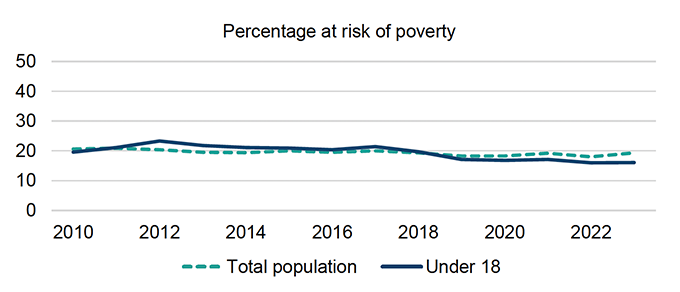
Source : Eurostat, At-risk-of-poverty rate by poverty threshold, age and sex (ilc_li02), 2025
In 2024, 20.3% of Croatia’s total population were at risk of poverty, a rate that is higher than the EU average of 16.2%[26] and of Scotland (16.1% in 2023-24).[27] The most vulnerable group is single-person households with an at-risk-of-poverty rate of 51.8% in 2024 - nearly triple the national average. Single person households with dependent children have higher at-risk-of-poverty rate at 26.9% as compared to all households with dependent children with a 15.4% rate.[28]

Source: Eurostat, At-risk-of-poverty rate by poverty threshold and household type (ilc_li03), 2025
Income inequality within the country has shown a steady decline over the past decade as illustrated in Figure 5.[29] Croatia falls in the middle range of EU countries based on the level of income inequality, with a Gini coefficient of 29.7 in 2023 which is roughly equal to the EU average of 29.6.[30] In comparison, Scotland has slightly higher levels of wealth inequality with a Gini coefficient of 30 before housing costs in 2023-24.[31] The ratio of household income at the 80th percentile to that at the 20th percentile, or the 80:20 ratio, is 4.91 in 2023.

Source: Eurostat, Income quintile share ratio S80/S20 for disposable income by sex and age group (ilc_di11), 2025 and Eurostat, Gini coefficient of equivalised disposable income (ilc_di12), 2025
Labour market trends
Unemployment rates steadily declined after the end of the war, with a notable decrease from 19.8% of the workforce in 2013 to 5.6% in 2024.[32] In comparison, Scotland exhibited a lower unemployment rate of 4% in 2024.[33] The percentage of children living in workless households has also declined - from 11.9% in 2013 to 4.6% in 2023.[34] Scotland has a higher rate of children living in workless households at 10.7% in 2023.[35]

Source: International Monetary Fund, Country Data Profile, Croatia, Unemployment rate, 2025; Eurostat, Population in jobless households (lfsi_jhh_a), 2024 and Eurostat, In-work at-risk-of-poverty rate by household type (ilc_iw02), 2025
Croatia’s in-work at-risk-of-poverty rate for all households with dependent children was at 10.2% in 2024, which was higher than the EU average of 9.6%. This figure is much lower for households without dependent children, at 6.4% in 2024 - lower than the EU average of 7%. The highest in-work at-risk-of-poverty rates are for single-parent households with dependent children, at 22% in 2024.[36] Directly comparable statistics are not available for Scotland, although 75% of children and 61% of working-age adults in poverty lived in working households in 2021-24.[37]
The in-work at-risk-of-poverty rate for employed women in Croatia is 7.9%, which is less than that of men at 8.8% in 2024. The trends for men and women show an increase after 2021, as illustrated in Figure 6.[38]
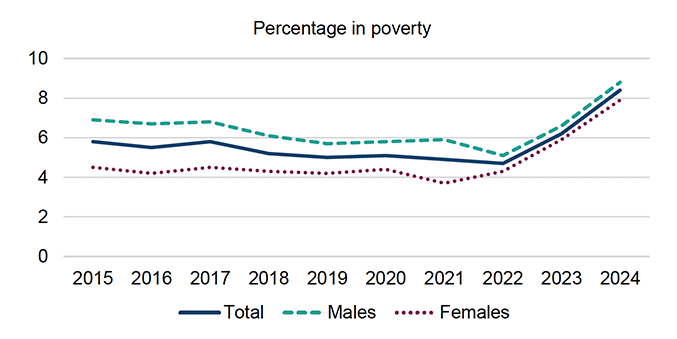
Source: Eurostat, In-work at-risk-of-poverty rate by age and sex (ilc_iw01), 2025
The monthly minimum wage, based on a 40-hour work week, is €970 in 2025, which increased by 15.5% from the previous year.[39] The monthly minimum wage as a proportion of average monthly earnings has increased from 41.9% in 2016 to 46.3% in 2023.[40]
Most significantly, the overall employment rate has increased by 11.7 percentage points from 2014 to 2023, as illustrated in Figure 7. The overall trend for men and women remains similar, but there is a difference of 7.7 percentage points, with male employment higher at 74.6% and female employment at 66.9% in 2023.[41] While female employment is lower than the EU average of 70.2%, the male employment rate is also lower than the EU average of 80.4%.[42]
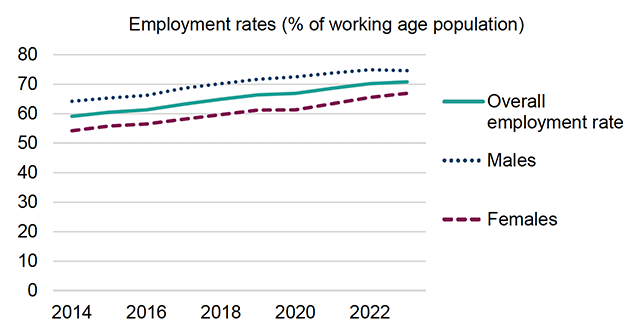
Source: Eurostat, Employment and activity by sex and age - annual data (lfsi_emp_a), 2025
There has been a widening gap in employment rates among the ages of 25-29 pointing to the impact of career interruptions among women. Additionally, the gender gaps in employment rate are largest among people with education below the tertiary level. Differences in employment rates between genders highlight the impact of unequal domestic and caregiving responsibilities on women's participation in the labour market.[43] However, the gender pay gap has been decreasing in Croatia, which at 7.4% in 2023 is below EU average of 12%.[44] In comparison, Scotland shows a much lower gender pay gap for full-time employees at 2.2% in 2024.[45]
Contact
Email: TCPU@gov.scot