
Natural capital: marine and terrestrial economic reliance analysis
This paper summarises further analysis that expands the methodology developed in the “Importance of Natural Capital to the Scottish Economy” analysis. It proposes a methodology to assess natural capital economic reliance by output and employment across two core distinctions: marine and terrestrial.
1. Summary
This report is a follow up analysis to the “Importance of Natural Capital to the Scottish Economy” report, published by the Scottish Government in 2024 [1]. The aim of the original study was to determine the sectors that rely on high-quality natural capital, and to quantify the economic value of this reliance. The research developed a novel methodology and economic model to identify nature-dependent industrial sectors and jobs in Scotland. This reveals the often hidden dependency of our economy and wellbeing on nature, using the economic concept of natural capital.
This paper summarises supplementary research and analysis undertaken utilising the original economic model. The objective was to build on the previous analysis and explore a further breakdown of the results into output and employment supported by two core distinctions: marine and terrestrial natural capital. Developing this methodology offers a clear distinction of ecosystem services by land and sea in Scotland - both crucial to supporting our economy.
The purpose of this follow-up report is to explore whether it is possible to adapt the existing methodology. As such, this report is primarily an investigation of the current methodology and its possibilities and limitations, which in the future can be used to further inform an update of the modelling of natural capital reliance of the economy.
Natural capital refers to the world's stock of natural assets (like land, water, air, plants, animals) that provide essential benefits (ecosystem services) for people, encompassing both living (biotic) and non-living (abiotic) elements. Marine natural capital specifically refers to these assets within oceans and coastal zones (e.g., fish, estuaries, energy). Terrestrial natural capital involves land-based assets but also includes freshwater habitats and ecosystem services[2].
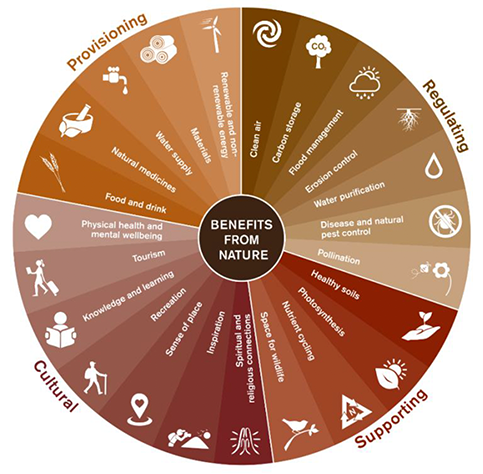
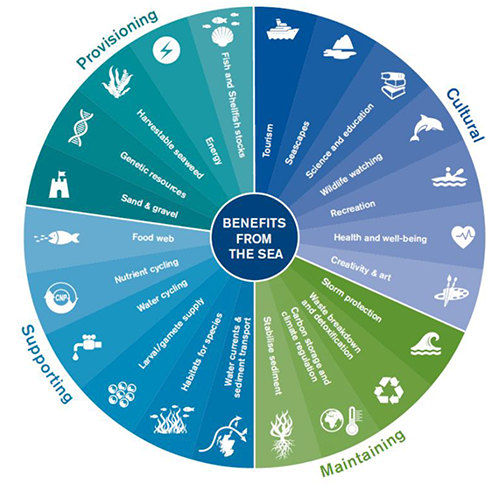
The graphics below show the main ecosystem services provided by terrestrial and marine natural capital, respectively[3].
The key results show:
- Scotland has an estimated £40 billion of direct and indirect output supported by natural capital - around 16% is estimated to be reliant on marine natural capital, and consequently 84% is estimated to be terrestrial natural capital reliant.
- Marine natural capital is estimated to support at least £6.5 billion in economic output and around 38,700 jobs with Aquaculture, Fish and Fruit Processing, and Electricity (specifically offshore wind) being the most dependent sectors.
- Terrestrial natural capital is estimated to support at least £33.6 billion in economic output and around 222,900 jobs with Electricity (excluding non-renewable), Agriculture, and Water and Sewerage being the most dependent sectors.
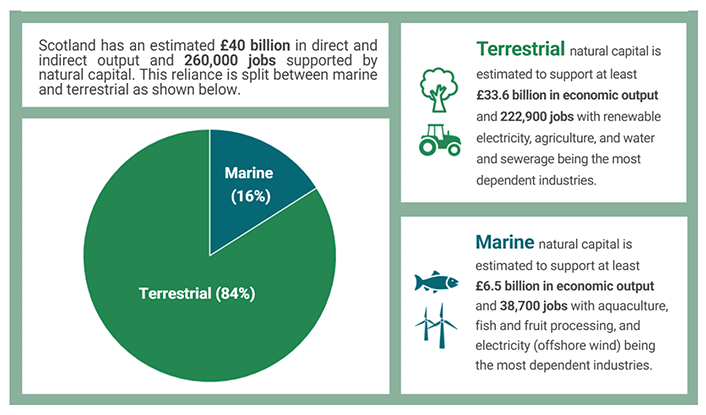
Figure 3 plain text version:
Scotland has an estimated £40 billion in direct and indirect output and 260,000 jobs supported by natural capital. This reliance is split between marine and terrestrial as shown below:
Terrestrial 84%
Marine 16%
Terrestrial natural capital is estimated to support at least £33.6 billion in economic output and 222,900 jobs with renewable electricity, agriculture, and water and sewage being the most dependent industries.
Marine natural capital is estimated to support at least £6.5 billion in economic output and 38,700 jobs with aquaculture fish and fruit processing, and electricity (offshore wind) being the most dependent industries.
Contact
Email: EnvironmentAnalysis@gov.scot