
Homicide in Scotland 2025-26
Statistical bulletin on crimes of homicide recorded by the police in Scotland in 2025-26.
Part of

Main findings
Victims of homicide
In 2025-26, there were 56 victims of homicide, nine more than in 2024-25. This is the fourth lowest number of recorded homicide victims since comparable records began in 1976. The number of homicide victims has shown an overall downward trend since 2006-07.
Figure 1. Homicide victims have fallen long term.
Total number of victims and victims by sex, Scotland, 2006-07 to 2025-26.
As can be seen from Figure 1, the reduction in victim numbers since 2006-07 has primarily been driven by a reduction in male victims. For the five years from 2021-22 to 2025-26, there were 196 male victims of homicide – a 51% decrease compared to 398 for the five year period from 2006-07 to 2010-11. Over those same periods, the number of female victims decreased by 39% from 120 to 73.
Age, sex and ethnicity of victims
In 2025-26, there were 41 male victims, representing 73% of all homicide victims. Since 2024-25, the number of male victims increased by eight from 33 to 41, whilst the number of female victims increased by one from 14 to 15.
Males are more likely to be victims of homicide than females, with an overall rate of 15 victims per million population in 2025-26. The equivalent rate for females was five victims per million population.
The median age of a victim of homicide in 2025-26 was 40 years old, two years higher than in 2024-25 when the median age of a victim was 38 years old (Table 1).
Figure 2 shows the victimisation rate by age group and sex for homicides since 2021-22 (i.e. for the past 5 years – representing 269 victims). For most age groups, the rate is higher for males than for females, though rates were very similar for those aged between 1 and 4 years old and 5 and 15 years old. Females aged 75 and over also had a slightly higher victimisation rate than males. The rate for males peaks in the 35 to 44 years old age group. For females, the highest rate was for those aged under 1 year as a result of two victims in this age group from 2021-22 to 2025-26.
Figure 2. The majority of homicide victims are male.
Age profile of homicide victimisation rate by sex, Scotland, 2021-22 to 2025-26.
There has been a reduction in homicides over the last 20 years across all age groups under 65. The greatest reduction has been amongst victims aged 16 to 24. In the five year period from 2006-07 to 2010-11, there were 113 victims in this age range. This fell to 28 across the latest five year period from 2021-22 to 2025-26.
Figure 3. In the last 20 years, those aged 16 to 34 have seen the most substantial decrease in homicide rates.
Age profile of homicide victimisation rate by 5 year period, Scotland, 2006-07 to 2025-26.
In 2025-26, the large majority (48 or 86%) of homicide victims were from the White British ethnic group. There were four victims (7%) from the Other White ethnic group and three victims (5%) from the African, African Scottish, African British, Caribbean or Black ethnic group. (Worksheet 19)
This is the first time these statistics have included an ethnicity breakdown. It should be noted that as homicide is a relatively rare event (with an average of 54 victims per year since 2021-22), a small number of cases can have a significant impact when comparing victimisation rates between different population groups. Future publications of these statistics will add additional years of ethnicity data, which will further increase the value of such comparisons.
Over the five years of 2021-22 to 2025-26, the average number of homicide victims each year equated to 10 per million population. Those from African, African Scottish, African British, Caribbean or Black ethnic group had the highest rates of victimisation (at 24 per million population). Those from the White British ethnic group had the same rate as the national average (10 per million population). All other groups were below the national average.
Location of homicides
In 2025-26, Glasgow City had the highest number of homicide victims (12) (Table 2). In Glasgow City, the share of national homicide victims was higher than it’s share of Scotland’s population, 21% versus 12%. Population estimates are as at mid-year 2025 from the National Records of Scotland Mid-2025 Population Estimates Scotland.
It is important to note however that victims may not necessarily reside in the local authority where the homicide took place.
Glasgow City has witnessed a relatively larger fall in homicides than Scotland as a whole in the last 20 years. Over the latest five year period from 2021-22 to 2025-26, there have been 52 homicides in Glasgow, a 62% decrease compared to 136 for the five year period from 2006-07 to 2010-11. This compares to a 48% decrease in Scotland as a whole between these periods.
In 2025-26, 73% of homicides occurred within a residential location (dwelling and other residential) and 27% in outdoor public places (street, footpath and open outdoor area). There were no homicides in indoor public places (Figure 4).
Figure 4. Most homicides are located in residential dwellings.
Location of homicides (where known), Scotland, 2016-17 to 2025-26.
Persons accused of homicide
In 2025-26, there were 81 persons accused of homicide, 21 more than in 2024-25. The number of people accused of homicide has shown an overall downward trend since 2006-07.
The clear majority of persons accused of homicide are male, making up 93% of all accused in 2025-26.
For all of the 56 homicide victims recorded in 2025-26, the associated case was solved.
In 2025-26, the total number of individuals accused of homicide equated to 15 per million population. The rates for those accused of homicide were highest for those aged 35 to 44 (40 per million population), 25 to 34 (29 per million population) and 16 to 24 (22 per million population).
Figure 5 shows the rate for accused by age group and sex for homicides since 2021-22 (i.e. for the past 5 years – representing 367 accused). The rates for males accused of homicide per million population were considerably higher across all age groups than for females.
Figure 5. The highest rates for persons accused of homicide are for men aged 16 to 44.
Age and sex profile of persons accused of homicide per million population, Scotland, 2021-22 to 2025-26.
In 2025-26, the median age of a person accused of homicide was 36 years old, three years higher than in 2024-25. Over the past 10 years, the median age of a person accused of homicide ranged between 30 and 36 years old. This is generally older than the preceding ten years, which ranged between 24 and 31 years old.
The median age of a person accused of homicide has been lower than the median age of victims of homicide in each of the last twenty years.
Over the last twenty years, there has been a large decrease in the number of people accused of homicide, with the rate per million population falling from 27 for the five year period from 2006-07 to 2010-11 to 13 for the five year period from 2021-22 to 2025-26. Figure 6 shows that the largest decrease has been amongst persons aged 16-24, which has fallen from 94 per million population to 23 per million population across the same period.
Figure 6. Over the last 20 years the largest reduction in those accused of homicide has been amongst persons aged 16-24.
Age profile of persons accused of homicide per million population, by 5 year period, Scotland, 2006-07 to 2025-26.
In 2025-26, the large majority (69 or 85%) of homicide accused were from the White British ethnic group. There were ten accused (12%) from the Other White ethnic group and two accused (2%) from the African, African Scottish, African British, Caribbean or Black ethnic group. (Worksheet 19)
As with victims of homicide, this is the first time these statistics have included an ethnicity breakdown for persons accused of homicide. The same caveat applies that a small number of cases can have a significant impact when comparing rates between different population groups.
Over the five years of 2021-22 to 2025-26, the average number of individuals accused of homicide equated to 13 per million population. This rate was slightly higher for those from the African, African Scottish, African British, Caribbean or Black ethnic group (18 per million population) and the White British ethnic group (14 per million population). All other groups were below the national average.
Methods of homicide
The most common main method of killing in each of the last 10 years was with a sharp instrument. This includes 52% (29) of homicide victims in 2025-26, 28 of which involved a knife. The next most common main method was hitting and kicking, accounting for 27% (15) of homicide victims in 2025-26.
Figure 7. Sharp instruments are the most common main method of killing.
Victims of homicide by selected main method of killing, Scotland, 2016-17 to 2025-26.
Homicide by shooting is relatively rare in Scotland. In 2025-26, there was one victim recorded. Since 2016-17, there have been 17 recorded victims of shooting, accounting for 3% of all homicide victims over this period.
Relationship of main accused to victim
The victim and main accused were known to each other in a majority of cases, representing 51 (91%) of homicides solved in 2025-26. The accused and victim were not known to each other in four homicides (7%). The relationship to the main accused was unknown in the one remaining homicide (2%).
For those 51 homicides where the victim and accused were known to each other, 28 (55%) were acquaintances, 12 (24%) were partners or ex-partners and five (10%) were relatives.
Figure 8 shows the number of homicides for male and female victims by their relationship to the main accused for all victims since 2016-17. Over the past 10 years, most male victims were killed by an acquaintance (59%). In comparison, over the same period, female victims were most likely to be killed by a partner or ex-partner (47%).
Figure 8. In the past 10 years, most male victims were killed by an acquaintance, while female victims were most likely to be killed by a partner or ex-partner.
Relationship of main accused to victim, by victim sex, Scotland, ten year period, 2016-17 to 2025-26.
For the latest year of 2025-26, 66% (27 victims) of the 41 male victims were killed by an acquaintance. Of the 15 female victims, 67% (10 victims) were killed by a partner or ex-partner.
Table 9 shows that for the last five years, between 2021-22 and 2025-26, a total of 10 children under the age of 16 years were victims of homicide (where there was an accused person). Eight were killed by one of their parents and two were killed by a stranger.
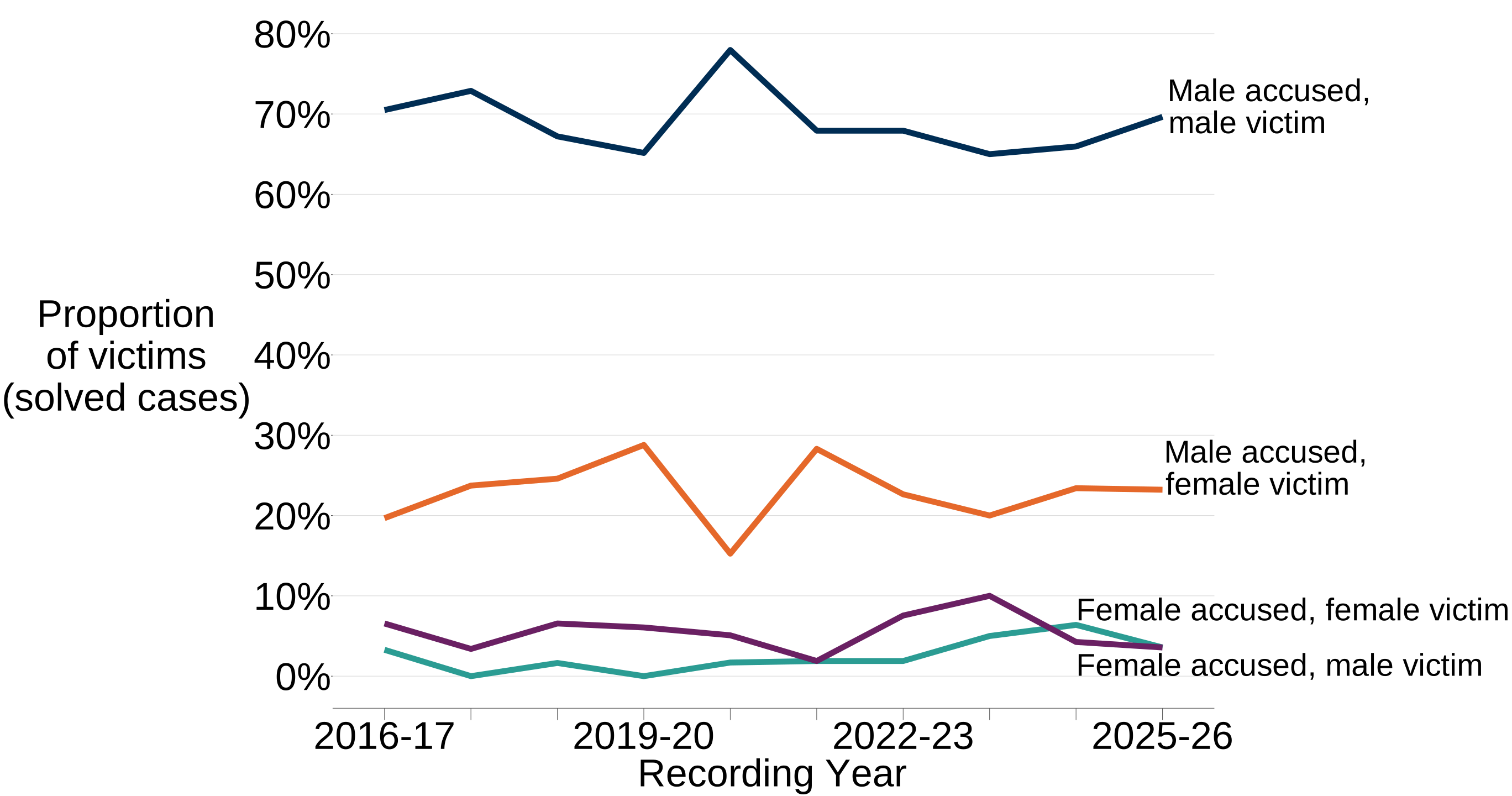
Figure 9 shows that over two-thirds of victims in solved homicide cases (69%) recorded between 2016-17 and 2025-26 were males with a male main accused. A further 23% of victims in solved cases were females with a male main accused, 6% were males with a female main accused and 2% of victims were female with a female main accused.
Figure 9. Between 2016-17 and 2025-26, over two thirds of victims in solved homicide cases were males with a male main accused.
Proportion of victims in solved homicide cases by sex of main accused and victim, Scotland, 2016-17 to 2025-26.
 Main motive
For the five-year period between 2021-22 and 2025-26, the main motive for committing homicide was known for 71% (192) of the 269 homicide victims where the homicide was solved. Of these 192 victims, the most common reasons for committing homicide were ‘fight or quarrel’ and ‘rage or fury’, with 57% (109) of all victims where the motive was known killed in such circumstances. For a further 18% (35) of homicides where the motive was known, ‘feud or faction rivalry’ was the main motive (Table 11).
In 2025-26, 64% (36) of victims were reported to have been killed in drug-related homicide cases, of which 30 were male (Table 13). This is an increase of six victims on the 30 reported in 2024-25. The number of drug-related homicide cases is higher over the past 10 years than in preceding years, though Police Scotland advise that this may be due at least in part to an improvement in recording practice (i.e., better identification of where motives can include a drug-related element). Given this, users are advised to exercise some caution when comparing this variable with years prior to 2016-17.
One of the 56 homicides recorded in 2025-26 were reported to have a homophobic or racial motivation. For all solved homicides in the 10 years leading up to 2025-26, 1% had a homophobic or racist motivation (Table 14).
Use of alcohol and drugs
Over the last 10 years, from 2016-17 to 2025-26 the alcohol and drug status of persons accused of homicide has been unknown for 59% of accused persons. Of the remaining 313 persons where the drug and alcohol status was known.
- 46% (144) were under the influence of alcohol.
- 13% (40) were under the influence of drugs.
- 31% (97) were under the influence of alcohol and drugs.
- 10% (32) were not under the influence of alcohol or drugs.
Homicide incidents
A single incident of homicide is counted for each crime involving Murder or Culpable homicide (common law), irrespective of the number of victims or accused. Whilst most recorded incidents of homicide in these statistics have one victim and one accused, some incidents can have multiple victims and/or accused.
The number of homicide incidents recorded by the police in Scotland increased by 19% (or nine incidents) between 2024-25 and 2025-26 from 47 to 56.
Homicide incidents involving more than one victim are relatively rare. In 2025-26, there were no incidents with more than one victim.
Contact
Email: Justice_Analysts@gov.scot