
Compulsory purchase reform in Scotland: consultation
We are seeking views on how to make the compulsory purchase system simpler, more streamlined, and fairer for all, to help deliver development and new homes. This consultation also includes questions on the possible benefits of introducing compulsory sale orders and compulsory lease orders.
Closed
This consultation closed 19 December 2025.
View this consultation on consult.gov.scot, including responses once published.
Consultation analysis
7. Implementation
Overview
7.1 Once a CPO has been confirmed, a separate process is required for the acquiring authority to enter and take ownership of the land. This is known as implementation of the CPO.
7.2 This chapter looks at the legal procedures for implementation and their timing, including the options for landowners to object if only part of their land is to be taken (‘objection to severance’). It also considers the effect of compulsory purchase on the title of the land and on rights subordinate to ownership, whether they are existing rights or new rights being created.
7.3 The acquiring authority does not have to take ownership of all the land authorised to be taken by the CPO, nor to take all the land they intend to acquire at once. Changes to the planned development may mean that not all the land included in the CPO is ultimately required, and the development may be phased so that it is more appropriate to acquire the land in parcels. In this chapter, therefore, “the land” means only the area(s) of land the acquiring authority wants to acquire at that point in time.
Procedure
7.4 There are currently several different options for implementing a CPO, which are interlinked and very complex.
7.5 The original procedure set out in the 1845 Act requires the acquiring authority to serve a notice to treat (NTT) on each person with an interest in the land, and invite them to respond with a statement of their claim for compensation. If no claim is made, or compensation is not agreed, within 21 days, the dispute can be referred to the Lands Tribunal for Scotland. Under this procedure, the authority cannot register their title to the land until compensation has been determined and paid.
7.6 A separate process is required for the authority to take title to the land after a NTT, and there are various ways of doing this in different circumstances. In addition, the acquiring authority can serve a notice of entry, at any time after the notice to treat, giving the landowner a minimum of 14 days notice of their intention to enter and take possession of the land. This is separate from taking title, and can be done before compensation is agreed.
7.7 The other main procedure for implementing a CPO is a general vesting declaration (GVD). This is a single document which covers all the land the authority intend to acquire at one time, and may include multiple landowners. The provisions for GVD are now set out in schedule 15 of the 1997 Act, having been first introduced in 1945. It should be noted that when a GVD is used, the provisions of various other legislation apply as if a NTT had been served (a ‘deemed NTT’), for example in relation to rights to compensation. However, the main advantage of a GVD for the acquiring authority is that compensation is settled after title is transferred.
7.8 The acquiring authority must give notice of their intention to make a GVD, and invite all persons who consider they are entitled to compensation to submit information. The authority must allow at least two months after the notice before making the GVD (unless all landowners agree), and then at least 28 days from making the GVD until it takes effect. When it takes effect, it vests (transfers title of) all the land described in it in the acquiring authority, including the right to enter and take possession of it. Because of this, the GVD must describe the land in conveyancing terms (unlike a NTT). No separate procedure is needed to take title, although the GVD needs to be registered in the Land Register in order to deliver a real right of ownership.
Options and proposals
7.9 Almost all CPOs are now implemented by GVD, including those for a single property. We therefore propose that new legislation should provide for a single procedure, broadly based on the GVD approach. For the purposes of this paper we will call the new procedure a Compulsory Purchase Vesting Declaration (CPVD). This would have the following features:
i. the declaration could apply to the whole or part of the land covered by the CPO, including multiple landowners
ii. the declaration would require to describe the land in conveyancing terms
iii. after an appropriate period of notice, the declaration would operate as a registrable transfer of the land described in it to the acquiring authority
iv. all questions of compensation would be left to be settled at a later stage
7.10 Further details, including timing, objection to severance and the effects on title, are addressed in the rest of this chapter.
Question 50: Do you agree that there should be a single procedure for implementing compulsory purchase, similar to GVD? If not, what problems do you see with this approach?
Notification
7.11 The first stage in making a GVD is for the acquiring authority to provide a notice that they intend to do so. This notice must invite any person who would be entitled to claim compensation to contact the acquiring authority with details of their name and address and the nature of their interest in the land. This notice is to be served on the same people and in the same way as for the original notification of the making of the CPO, which excludes tenants for a month or less.
7.12 After making the GVD, the acquiring authority must serve a notice stating its effect, on every person who responded to the original notice, and every occupier of the land, other than those with “a short tenancy, or a long tenancy which is about to expire”. These are defined as tenancies for a year or less, or with a year or less to run.
7.13 Questions around the list of persons to be notified of a CPO are dealt with in chapter 5 (see paragraphs 5.17 to 5.26). To avoid any discrepancies, we would suggest that the list of people to be notified should be set out once in the legislation and applied to implementation of a CPO as well as to its making and confirmation.
Persons enabled to sell
7.14 Notices are required to be served on “all the parties interested in such lands, or to the parties enabled by this or the special Act to sell and convey the same”. Sections 7 and 8 of the 1845 Act enable people to sell an interest in land to the acquiring authority, and to exercise other powers relating to the land, even if they could not normally do so. Those enabled include liferenters, trustees, executors and administrators, and legal representatives of children or of people suffering from “mental disorder” within the meaning of the Mental Health (Scotland) Act 1960[24].
7.15 These provisions ensure that the acquiring authority can obtain the land it needs even if the current owner would not normally be able to sell it. We consider that provisions similar to sections 7 and 8 of the 1845 Act should be included in new legislation for this purpose. However, they will need to be modernised to reflect current law on capacity, guardianship etc.
Objection to severance
7.16 Where a GVD or NTT includes only part of a piece of land, and losing that part has a negative impact on the remainder, the landowner can serve a notice requiring the authority to acquire the whole of the land. This is known as a ‘counter-notice’ or ‘notice of objection to severance’, depending on the circumstances. The acquiring authority can either accept and acquire the additional land, in which case it is treated as if it was originally included in the NTT or GVD, or withdraw the NTT (or deemed NTT created by the GVD) and not acquire any of that piece of land. Or the Lands Tribunal for Scotland (LTS) may determine that there is no negative impact, and the acquisition of part of the land goes ahead as planned.
7.17 The details of the process depend on the type of land involved and the procedure used. There are different tests as to whether there is a negative impact on the land which is not included in the NTT or GVD:
- for a “house, building or manufactory” the question is whether the part to be acquired can be taken “without material detriment” to the rest
- for “the park or garden of a house”, the question is whether it can be taken “without seriously affecting the amenity or convenience of the house”
- for agricultural land, the test is whether the land “is not reasonably capable of being farmed, either by itself or in conjunction with other relevant land, as a separate agricultural unit”
7.18 For houses etc served with a NTT, there is no time limit for serving a counter-notice, but there is debate over whether it must be served before the acquiring authority take entry. Since compensation must be agreed before title can be acquired under a NTT, the counter-notice does not affect the operation of the NTT.
7.19 For houses etc included in a GVD, the notice of objection to severance must be served within 28 days of the notice that the GVD has been made, which means it is before the earliest date the GVD can have effect. The notice prevents the land vesting in the acquiring authority or the authority entering on the land until the issue has been resolved. The authority has three months in which to either withdraw the deemed NTT for that land, accept the notice of severance and acquire the whole of the land, or refer the notice to the LTS for determination. If the authority fail to take action, the deemed NTT is deemed to be withdrawn.
7.20 For agricultural land, the counter-notice must be served within two months of the NTT (or deemed NTT, i.e. notice that the GVD has been made). The acquiring authority have two months to accept the notice, after which it may be referred to the LTS. Where a GVD has been used it is not clear whether this counter-notice prevents the land vesting in the acquiring authority, as a notice of objection to severance would. It is also unclear how the timescales fit together, since the GVD could take effect after 28 days, before the deadline for serving a counter-notice.
Options and proposals
7.21 The current categories of land in relation to objection to severance do not necessarily cover all modern land uses, and the difference in the language of the tests is unhelpful. We are interested in views as to whether there should be a single test for all types of land, or a different categorisation – for example having different tests for commercial versus residential land. We deal with timings in the following section.
Question 51: Should there be a single test for objection to severance, or a different categorisation? If you propose different categories, please explain what they would be.
7.22 Some stakeholders have suggested that a notice of objection to severance should not prevent the land included in the CPO from vesting in the acquiring authority. They highlight that confirmation of the CPO means it has been shown that the land is needed for the development, and it is in the public interest for the authority to acquire it. In the current system, in some cases the authority may feel it has to agree to acquire the whole of the objector’s land to avoid delaying the development, rather than referring the question to the LTS. To remedy this, new legislation could provide that the land included in the CPO vests in the acquiring authority as usual, and negotiation over the remaining land is dealt with afterwards, alongside compensation.
Question 52: Under the new CPVD, should a notice of objection to severance prevent the land included in the CPO from vesting in the acquiring authority?
Timing
7.23 At all stages of a CPO there is a tension between the acquiring authority being able to press on with the project, and allowing enough time for persons with an interest in the land to decide whether they want to challenge the action. Occupiers also need time to find other accommodation, premises or land and to move. Occupiers of agricultural land may need additional time to manage crop cycles. However, there is also a balance between allowing enough time while minimising uncertainty. Engaging with the people affected will help the acquiring authority to understand and address people’s concerns, and the acquiring authority should give as much notice as possible of when they intend to take forward each stage of the process.
Time limit for implementation
7.24 At present, an acquiring authority has three years within which to implement a CPO (see section 116 of the 1845 Act and Schedule 2 to the 1947 Act). Before considering whether this is an appropriate time limit, it is important to first clarify when the clock starts on the three-year period.
Starting the clock
7.25 As outlined in paragraph 5.36, a CPO becomes ‘operative’ when the acquiring authority publishes notices of the confirmation of the order: not the date on which the Scottish Ministers agree to confirm the order. This marks the start of the period within which the CPO may be implemented as well as the period within which the validity of the CPO can be challenged in the Court of Session.
7.26 It is notable that there is no fixed period within which notices of confirmation must be published: per paragraph 6 of Schedule 1 to the 1947 Act, these must be published “as soon as may be after the order has been confirmed”. This seems unhelpfully open-ended.
7.27 We consider that a time limit on the service of confirmation notices could provide certainty for affected parties and help to streamline the process. In England and Wales, notices of confirmation must be served within 6 weeks. We would welcome views on whether a similar time limit would be helpful.
Question 53: Should confirmation notices be required to be published within 6 weeks of the date on which the order is confirmed? If you disagree, what timing would you prefer, and why?
Longer or Shorter Implementation Period
7.28 Responses to the Scottish Law Commission’s review indicated that there are a range of concerns about whether the current three-year period is reasonable. Some suggested that a longer period is needed for complex projects, while others felt it should be shorter to reduce uncertainty for landowners.
7.29 In light of this, a compromise position could be to give the confirming authority the power to set either a longer or a shorter time limit when a CPO is confirmed. Potentially an updated Circular could provide guidance on exercising this power; clearly, the scale and complexity of the scheme would have a key bearing on the appropriateness of an alternative time limit.
Question 54: Do you agree that the standard implementation period should remain at three years?
Question 55: Should confirming authorities be able to specify a longer or shorter implementation period?
Stopping the Implementation Clock
7.30 At present, the implementation period of a confirmed CPO is not affected by any challenge to the validity of the Order. A court challenge can therefore significantly reduce the actual time available for the acquiring authority to implement the CPO. To provide additional flexibility, we propose that the time limit should be suspended pending the conclusion of any court action.
Question 56: Do you agree that the time limit should be suspended during any court challenge to the validity of the CPO?
Question 57: Please add any comments on the time limit for implementation, if you wish to expand on your answers to questions 53 to 56.
Implementation procedures
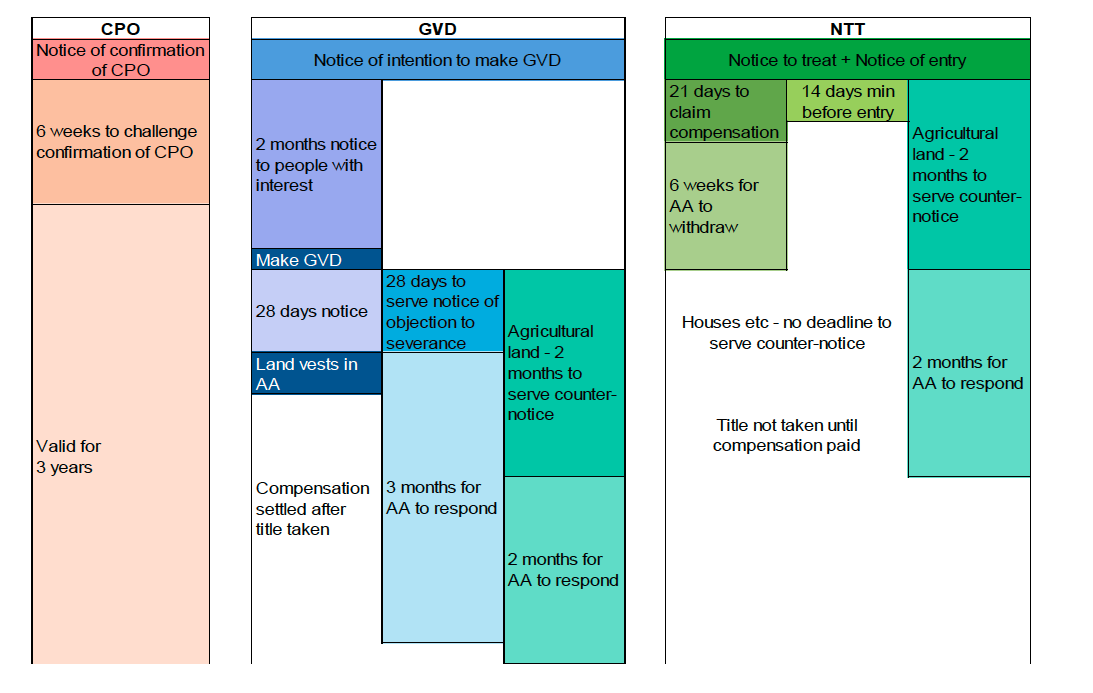
7.31 As set out above, GVD is a quicker way of taking title to the land, since it is not necessary to wait for compensation to be agreed, but NTT and a notice of entry provides a quicker way of gaining entry, in as little as two weeks. In developing a new single procedure (CPVD), we need to strike a balance between the two.
7.32 A GVD takes a minimum of 3 months from confirmation of the CPO to transfer of ownership. The notice of intention to make a GVD can be issued with the notice of confirmation. Two months is then required before making the GVD, unless all occupiers agree to a shorter period. Twenty-eight days is then required between the GVD being made and the land and right of entry vesting in the acquiring authority. This period cannot be shortened. Persons with an interest in the land have those 28 days to serve a notice of objection to severance, which prevents the land vesting in the authority and prevents them gaining the right of entry, until the notice is resolved.
7.33 The timings for a NTT and notice of entry overlap significantly, meaning there is more risk to the acquiring authority if they choose to act quickly. The NTT can be served with the confirmation notice. After the NTT is served, those with an interest in the land have 21 days to provide a statement of their claim for compensation, and the authority has six weeks after that, or after compensation has been determined, to withdraw the NTT (if, for example, they decide the compensation is too high).
7.34 Owners of agricultural land where only part of the land is to be acquired have two months from service of the NTT to serve a counter-notice, requiring the authority to purchase the whole of the land, and the authority has two months to respond (there is no timescale for other types of land). However, a Notice of Entry can be served at the same time as the NTT, and entry can be taken no less than two weeks after that – before the deadline for any of the other actions.
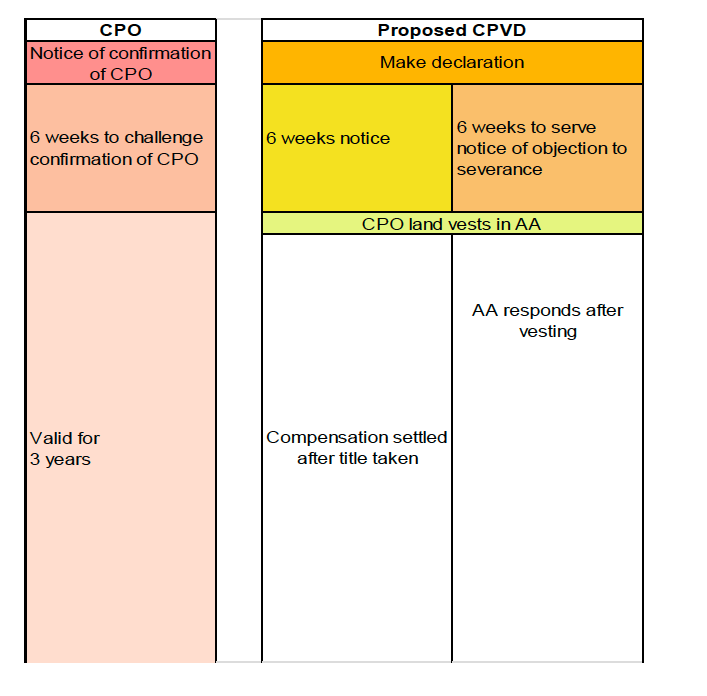
7.35 The figures below set out these timings graphically. Note that these show the minimum possible timings for each element, assuming that the initial notices are served, or CPVD is made, at the same time as the notice of confirmation of the CPO.
Options and proposals
7.36 As set out in paragraph 7.32, for a GVD a period of two months is required between serving a notice of intention to make the GVD and actually making it. For the CPVD, we do not feel it is necessary to have this statutory period in which people with an interest in the land are notified and required to respond with their details. The acquiring authority should have these people’s details following the procedures for making and confirmation of the CPO. They would need to check for any changes, particularly if there is a lengthy gap between notifying confirmation of the CPO and implementing it, but this can be done concurrently with other preparations for implementation. Procedure for claiming compensation is dealt with in chapter 9.
7.37 We propose that the period for a CPVD to take effect should be six weeks, starting from the date when people with an interest in the land have been notified that it has been made. Any notice of objection to severance (for any type of land) would need to be served within that six week period. At the end of the six weeks, the CPVD would act as a registrable transfer of the land to the acquiring authority.
7.38 This six-week period for the CPVD to take effect is the same amount of time as interested parties would have to challenge the confirmation of the CPO. It therefore removes the risk of the CPO being challenged after the acquiring authority has obtained title to the land, even if the CPVD is made immediately after confirmation.
Question 58: Do you agree that the new CPVD should take effect six weeks after notification that it has been made? If not, what should the period be, and why?
Question 59: Is there a need for a separate stage to notify people with an interest in the land and seek information from them?
Effect on title
7.39 There are various potential issues with the title of land which could cause problems to an acquiring authority in its future use of the land. All of these have at least partial remedies in the existing legislation, but it is often unclear whether they cover all circumstances. We propose that these issues should be made clear and universal. A key point is that anyone whose property rights are affected by these actions would still have a right to compensation when it was discovered, even if they were not identified and notified at the time.
Defects
7.40 We propose that the new single procedure should remove any defects in the title of the land acquired, providing the acquiring authority with a clear, valid title.
Real burdens and servitudes
7.41 Section 106 of the Title Conditions (Scotland) Act 2003 (‘the Title Conditions Act’) provides that when land is acquired compulsorily under a CPO, then any real burdens or servitudes over the land are extinguished and any development management scheme applying to the land is disapplied, unless the CPO or the GVD (or other form of conveyance) specifies they are not to be extinguished/disapplied. Section 194 of the 1997 Act makes similar provision in relation to “all private rights of way and rights of laying down, erecting, continuing or maintaining any apparatus on, under or over the land and all other rights or servitudes in or relating to that land”, for CPOs made by local authorities for planning purposes. It does not affect real burdens, and excludes rights and apparatus belonging to statutory undertakers or for electronic communications.
7.42 We propose that the CPVD should combine these provisions so that in all cases, the effect of a CPO is to extinguish all real burdens, servitudes and other rights, unless the CPO specifically states otherwise.
Acquisition by agreement
7.43 Section 107 of the Title Conditions Act provides that when land is acquired by agreement, but could have been acquired compulsorily, it has the same effect of extinguishing real burdens and servitudes and disapplying any development management scheme. There is some doubt whether it is sufficient for the acquiring authority to simply have relevant compulsory purchase powers, or it if must show that it could have obtained a confirmed CPO in the specific circumstances. We propose that s.107 should be amended to clarify that it is only necessary for the authority to have relevant powers, otherwise a separate process would be required to show that a confirmed CPO could have been obtained.
Securities
7.44 Where land is subject to a security (mortgage), there are different provisions about how it is to be paid off and whether a separate deed of discharge is required, depending whether an NTT is used or a GVD. Our view is that a separate discharge is not required, if the CPO extinguishes all “incumbrances”. The security holder will be entitled to compensation, if the debtor is not required to pay off the loan either when the CPO is proposed or from their own compensation. Paragraphs 5.25 and 5.26 discuss notifying heritable creditors of CPOs.
Land owned by the acquiring authority
7.45 It is a general conveyancing rule that a person cannot grant a disposition of land which they own to themselves, and therefore an acquiring authority cannot at present compulsorily acquire land it already owns. However, we appreciate that there could be circumstances where it would be useful to do so, and cases where the acquiring authority is genuinely unsure whether it owns a part of a parcel of land. This may, for example, be a particular issue in built-up areas where land is still in the Register of Sasines and therefore boundaries may be less clear. We propose that the acquiring authority should be able to include the whole parcel of land in a CPVD and register it in the Land Register, thus ensuring they have valid title to the whole area. Compensation would be available to anyone later found to have had rights in the land.
Notice in Land Register
7.46 The Land Register does not provide information on how the land has been conveyed, and therefore it may not be clear what has happened to previous servitudes, securities etc. The proposed solution is that the Keeper should be required to add a note on the title sheet stating that the title was acquired by compulsory purchase. They should also be required to remove any standard security from the title. Anyone checking the register would then be able to conclude that any rights, securities or defects in title which no longer appear have been removed by the compulsory purchase.
Question 60: Should the new CPVD provide the acquiring authority with a valid title, removing all defects, real burdens, servitudes etc and securities? If not, please explain your reasons.
Question 61: In relation to section 107 of the Title Conditions Act, should the legislation be amended to clarify that the acquiring authority simply has to have relevant compulsory purchase powers? If not, please explain your reasons.
Question 62: Should acquiring authorities be able to include land in a CPVD which belongs to them, or where they are unsure if it does? If not, please explain your reasons.
Question 63: Should a note be added to the title sheet in the Land Register stating that the title was acquired by compulsory purchase? If not, please explain your reasons.
Rights subordinate to ownership
Leases
7.47 The current law on the effect of compulsory purchase on leases is complex. Under current procedures:
- for leases longer than a year, or from year to year, under the NTT procedure, the authority may acquire the landlord’s right and wait for the lease to expire, or they may serve a NTT on the tenant to acquire their right, in return for compensation
- tenants with short leases or long leases about to expire (see paragraph 7.12) have no right to a NTT. Their lease is simply extinguished when the acquiring authority takes entry, but they are entitled to compensation, under section 114 of the 1845 Act
- under the GVD procedure, tenants with long leases are required to be served with the relevant notices, their lease is extinguished when the GVD takes effect and they are entitled to compensation
- But a GVD has no effect on a short lease or long lease about to expire. When the land vests in the acquiring authority, it is still subject to the lease until it ends. If the authority wishes to take entry earlier, under paragraph 8 of schedule 15 to the 1997 Act, they may serve a NTT and Notice of Entry on the tenant. This is the only case in which a Notice of Entry can be served in combination with a GVD
7.48 If only part of the land subject to a lease is included in the CPO, section 112 of the 1845 Act makes provision for apportionment of the rent, and the tenant is entitled to compensation for severance in the same way as an owner would be. The lease continues to have effect in relation to the remainder of the land in the same terms as before.
Liferents
7.49 There are two types of liferent:
- a proper liferent, in which the liferenter has a real right of liferent, and
- an improper liferent, which is a beneficial interest under a trust which has the real right of ownership
7.50 Improper liferents are more common and relatively simple for compulsory purchase, as the acquiring authority would acquire the interest of the trustee and pay compensation to the trust. A proper liferenter’s real right cannot normally be transmitted to any other person, but section 7 of the 1845 Act allows them to sell and convey their interest to the acquiring authority.
Options and proposals
7.51 We would propose that the new procedure should enable the acquiring authority to end or extinguish any lease or liferent when they acquire ownership of the land, and the tenant / liferenter will be entitled to compensation. It seems unnecessary to retain a separate notice to treat / notice of entry process for this situation. Provisions about apportionment of rent etc, if only part of the leased land is acquired, should remain.
Question 64: Would there be any difficulties in including all leases and liferents in a CPVD, extinguishing them in return for compensation?
New rights subordinate to ownership
7.52 Section 63 of the 1973 Act provides that the provisions of the 1845 and the 1947 Act apply, with necessary modifications, to the creation of new rights over land as they apply to the compulsory acquisition of land. We propose that this should continue and a single CPVD should be able to cover both acquisition of physical land and the creation of new rights over neighbouring land, for example.
Contact
Email: CPO.reform@gov.scot