
Maternity and neonatal care - Best Start five-year plan 2017–2024: report
This report provides insight into the key actions and achievements that have been delivered during the lifetime of the Best Start.
Governance, Communication and Monitoring
Following the publication of the Best Start report in 2017, the Minister for Public Health asked Jane Grant, the report author and Chief Executive of NHS Greater Glasgow and Clyde (NHS GGC) to chair the Best Start Implementation Programme Board (IPB).
Following Jane’s acceptance, members of the IPB were appointed, bringing together lead NHS professionals from across Scotland, service user representatives, professional bodies, academics, and the Scottish Government. Members changed over the lifetime of the Programme. For example, in 2019 two representatives of the National Staffside were invited to join the IPB in line with staff governance standards and partnership working and joined in 2020. The Chair also appointed two vice-chairs, Scottish Government Senior Medical Officer Corinne Love and Chief Midwife Ann Holmes, (succeeded by Justine Craig). A full list of Programme Board members and subgroup members can be found in Annexes B and C.
The IPB held its first meeting on 9 June 2017 and has met quarterly since that date, except during the height of the Covid-19 pandemic. The terms of reference for the IPB set out its aim to ‘drive forward the implementation of the ‘Best Start.’
From the start the IPB recognised the scale of the task in delivering 76 recommendations, and the need to identify delivery partners, to provide further guidance to inform delivery, and to establish programme governance, monitoring and reporting infrastructure to inform their work.
The IPB agreed to subdivide the delivery programme, grouped as follows:
- national linked projects – led by national partners such as the Scottish Government, NHS Education for Scotland (NES), and Public Health Scotland (PHS).
- local delivery of recommendations – 23 recommendations were identified from the outset as being deliverable by territorial Health Boards.
- continuity of carer early adopters – 5 Health Boards were identified as continuity of carer early adopter Boards who would lead the change in practice, and capture and share learning as they progressed.
- subgroup delivery – 4 subgroups were established to lead on bundles of recommendations.
- an Executive Group was also established to manage the detail of implementation.
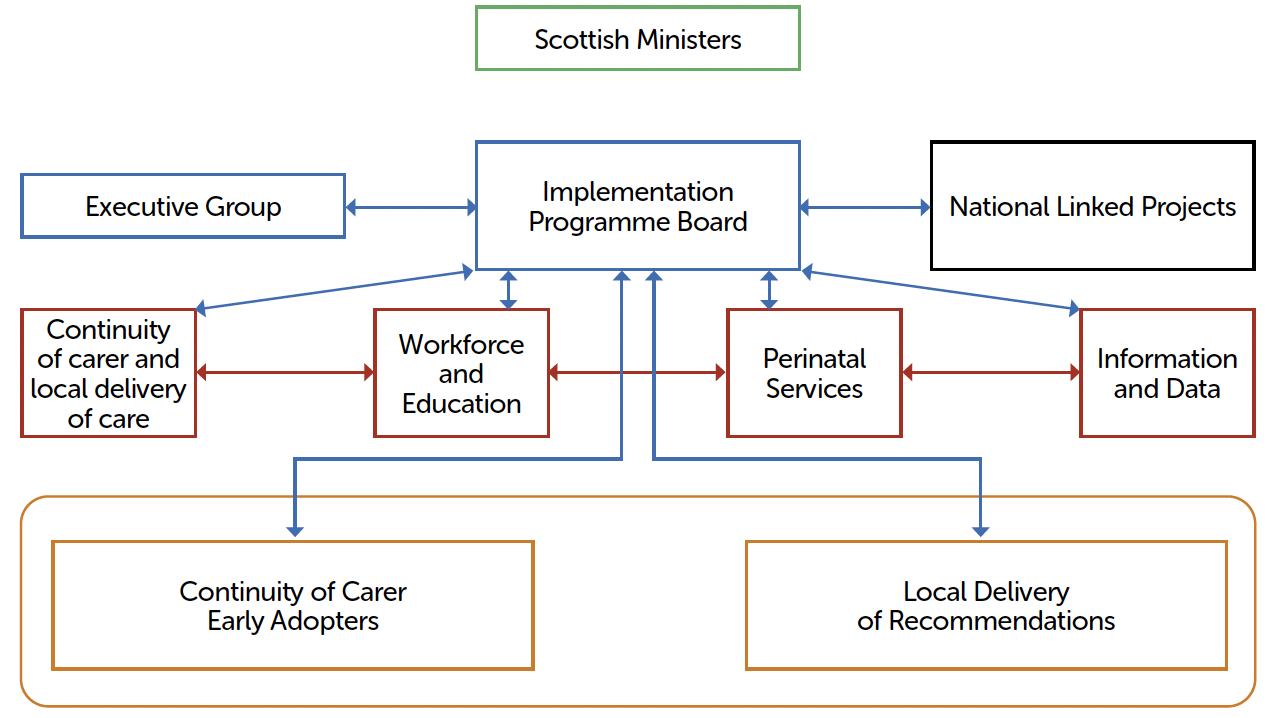
Further details of the four subgroups established is provided below. The titles of Chairs are the titles held at the time the individual chaired the subgroup.
Continuity of Carer and Local Delivery of Care
- Chaired by Gillian Morton (General Manager, NHS Forth Valley) and Hazel Boreland (Nursing Midwifery and Allied Health Professionals (NMAHP) Director, NHS Ayrshire and Arran).
- The subgroup was tasked with delivering definitions and guidance for the community midwifery continuity of carer model, transitional care, community hubs and operation of freestanding midwifery units.
Perinatal
- Initially chaired by Heather Knox (Chief Operating Officer, NHS Lanarkshire) and Rod Harvey (Medical Director, NHS Highland).
- Subsequently chaired by Jim Crombie (Deputy Chief Executive, NHS Lothian), Jonathan Best (Chief Operating Officer, NHS GGC) and Andrew Murray (Medical Director, NHS Forth Valley).
- The subgroup is responsible for delivering perinatal recommendations, including on maternal and fetal medicine, neonatal care (including neonatal intensive care) and transport.
Workforce and Education
- Initially chaired by Sharon Adamson (Regional Planning Director for the West of Scotland) and Susan Key (Associate Director, NMAHP, NHS Education for Scotland).
- Subsequently chaired by Sharon Adamson and Maria Pollard (Deputy Director NMAHP/Lead Midwife, NHS Education for Scotland).
- The subgroup was tasked with delivery of Best Start recommendations relating to workforce and education, for midwives, nurses and medical staff, including training, planning and career progression.
Information and Data (later known as Evidence and Data)
- Chaired by Professor Mary Renfrew (Professor of Mother and Infant Health at the University of Dundee) and Professor Alan Cameron (Maternity Clinical Lead, MCQIC, and Lead for Each Baby Counts, Royal College of Obstetricians (RCOG)).
- The subgroup is responsible for delivering related recommendations such as dashboards, telemedicine and evaluation.
Local Delivery
- Chaired by Professor Ann Holmes (Chief Midwifery Officer, Scottish Government).
- Subsequently chaired by Professor Justine Craig (Chief Midwifery Officer, Scottish Government).
- 23 recommendations were identified that would be led locally and each Board was asked to identify a Best Start Lead. These leads were brought together regularly in the Local Delivery of Care Subgroup. The group developed a set of definitions and measures for local recommendations, and the local reporting mechanism which were agreed by the IPB and then adopted (with some refinements as the programme developed).
The Implementation Programme Board: Oversight and Monitoring
Programme monitoring infrastructure was established to support the IPB in its oversight of implementation. Regular reports were received from the subgroups, and the 14 territorial health boards on progress with the recommendations that they were tasked with delivering. The majority of the 14 territorial Health Boards established local internal governance structures focused on implementation of the Best Start and they signed off the 6-monthly local delivery monitoring returns to the IPB. Reports were compiled from these returns and presented to the IPB. Much of the content of this report is drawn from these reports.
The Implementation Programme Board: Communication and Learning
The IPB oversaw communications activity in relation to ‘Best Start.’ In the early stages of the programme this was focused on awareness raising around the programme. Three Regional Roadshows were held in 2017 to discuss the findings of the report with NHS staff, and the IPB Chair issued a series of Blogs. In 2018 and 2019 national staff events were held to highlight progress and learning across a range of recommendations and were attended by hundreds of maternity and neonatal staff both in person and online. Post-pandemic, a relaunch event was held in 2022, and a further learning event in 2023, again with wide in-person and online attendance. In addition, a range of local events, network events and a social media account were supported by Best Start secretariat and members of the IPB.
The Implementation Programme Board: Supporting Delivery of Continuity of Carer
The IPB has overseen delivery of a number of recommendations and some of the key headlines are noted on the timeline of implementation.
Recommendation 1, that every woman will have continuity of carer, is a cornerstone recommendation of the Best Start and is undoubtedly the recommendation that has required the most substantial change in care delivery. To support Boards with implementation, the IPB appointed 5 Early Adopter Boards (EABs) in 2017 to lead a package of change in practice (NHS Lothian, NHS GGC, NHS Lanarkshire, NHS Forth Valley and NHS Highland). Representatives from these Boards contributed learning to the Continuity of Carer and Local Delivery of Care subgroup to ensure that practical guidance on implementation was gathered and shared, and guidance was published in January 2020.
In 2019, in light of some concerns from midwives about implementation, the Royal College of Midwives (RCM) and the IPB Executive group undertook a stock take of implementation of continuity of carer. Key issues identified during the stock take included the importance of clear communication with staff, planning for change and ensuring staff are prepared and supported during transition. IPB acted on the findings by removing targets for implementation and by extending the timeline for delivery (with ministerial approval) to mid-2026. Following the stock take, the Chief Midwifery Officer, Ann Holmes, also Vice Chair of the IPB, visited every Board in Scotland to speak directly with midwives and leaders in the Board to highlight successes and uncover challenges with implementation. In addition, the Workforce and Education subgroup completed a deep-dive into implications of continuity for the midwifery workforce which was shared with Best Start leads in Boards. Post-pandemic, a series of continuity of carer learning events has focused on sharing learning on practical implementation, and a further round of Chief Midwifery Officer visits by Justine Craig has continued to maintain the focus on implementation.
A summary of progress for each recommendation is provided at the end of the relevant section. Full details of each recommendation are provided in a table in Annex A.
Key
Blue: action is complete.
Green: recommendation is achievable within programme (June 2024, by 2026 for Recommendation 45, and mid-2026 for Recommendation 1).
Amber: work underway, achievable within the programme with additional support required or partially achievable or achievable in longer timescale.
Red: challenging to deliver within the programme or work paused.