
Vaping and smoking among Scottish adolescents: ASH SmokeFree GB Youth survey 2026 results
This report presents findings for Scotland from the 2026 ASH Smokefree GB Youth survey on: use of vapes, cigarettes and other nicotine products; awareness, main source, and type of products used; and experiences and views of users, including reasons for vaping and perceptions of harm.
Key findings - Use of vapes, cigarettes and other nicotine products
Vaping and smoking prevalence
Current and ever use of vapes and cigarettes in 2026 did not differ significantly from 2025 or 2024.
In 2026, 5.6% of 11 to 17-year-olds in Scotland reported currently vaping (compared with 7.3% in 2025 and 7.4% in 2024), while 18.0% reported having tried a vape (compared with 19.5% in 2025 and 18.8% in 2024). 3.0% identified as current smokers (compared with 4.8% in 2025 and 4.4% in 2024), while 15.2% reported ever having tried smoking (compared with 18.1% in 2025 and 16.6% in 2024).
Ever use of both vapes and cigarettes generally increased with age, and current use also tended to be higher among older adolescents, despite some fluctuations in smoking (see Table 1 and Figure 1).
In 2026, ever smoking was more common among boys than girls, with 18.7% of boys reporting having ever smoked compared with 11.5% of girls.
Among current vapers (N=46), 14 were also current smokers (dual users) and 12 had never tried a cigarette.
| Status | All % | 11 % | 12 % | 13 % | 14 % | 15 % | 16 % | 17 % |
|---|---|---|---|---|---|---|---|---|
| Ever vaper | 18.0 | 5.9* | 10.1* | 9.8* | 14.3 | 20.0 | 38.3* | 28.9* |
| Current vaper | 5.6 | 2.0 | 2.1* | 2.4 | 3.7 | 4.7 | 14.1* | 11.1* |
| Ever smoker | 15.2 | 7.8 | 11.0 | 7.4* | 15.2 | 17.6 | 22.3* | 23.9* |
| Current smoker | 3.0 | 3.9 | 2.1 | 0.8 | 3.0 | 2.4 | 5.0 | 4.5 |
| Unweighted base (count) | 767 | 52 | 100 | 124 | 132 | 125 | 99 | 135 |
Percentages marked with an asterisk indicate statistically significant differences from the overall average.
Note small base for 11-year-olds (N=52).
Figure 1: Proportion of current vapers and smokers, by age (N = 767)
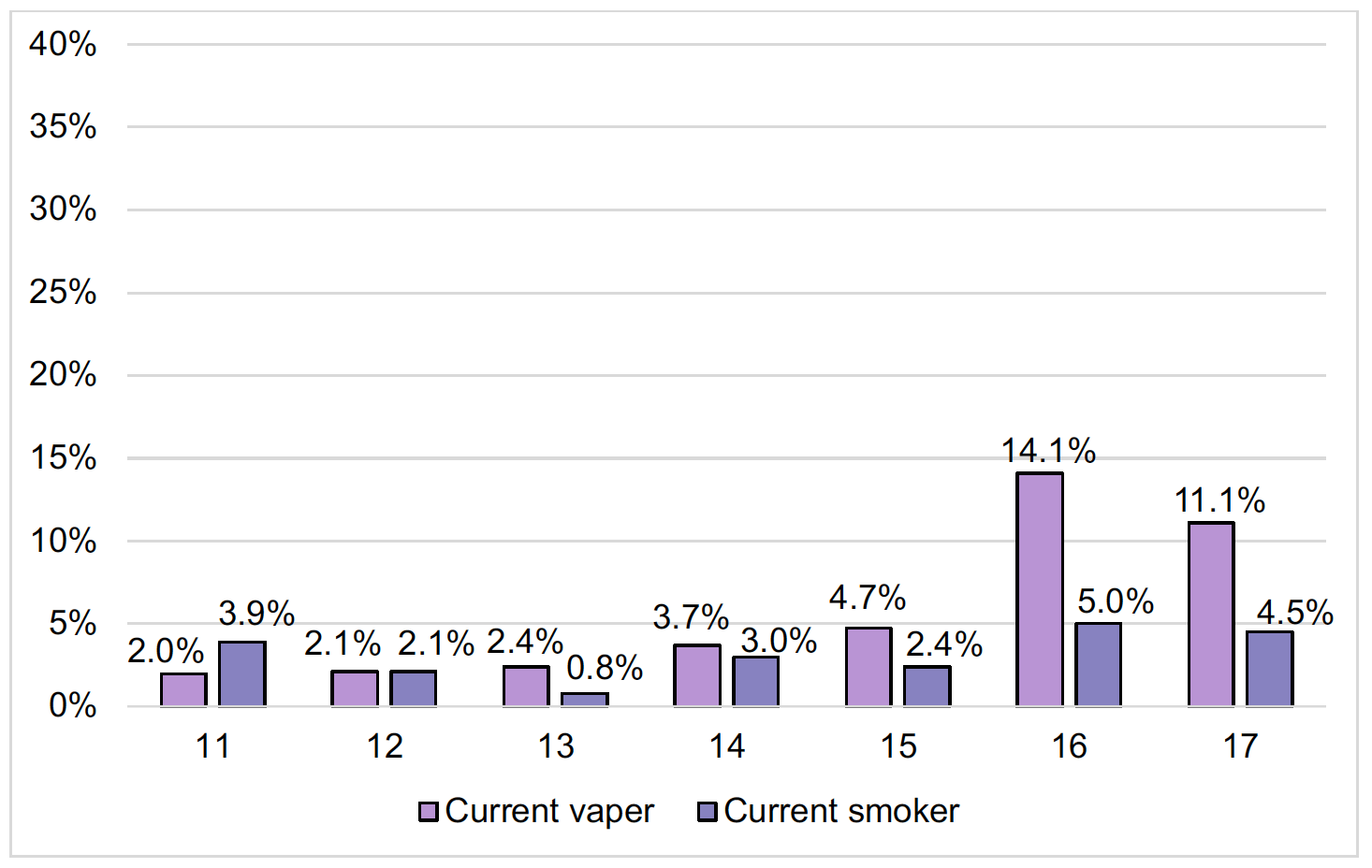
Findings for 11-year-olds should be interpreted with caution given the small base (N=52).
Age at first vape and cigarette use
Adolescents who were ever vapers and smokers were asked about the age at which they first tried vapes and cigarettes.
Similar to 2025, most reported trying their first vape between the ages of 12 and 15, while first use of a cigarette was most commonly reported between the ages of 12 and 14 (see Table 2).
It is important to note that these figures do not represent the average age of initiation across the broader population. Rather, they reflect the age at which current adolescents first experimented with these products.
| Age (count) | <11 | 11 | 12 | 13 | 14 | 15 | 16 | 17 |
|---|---|---|---|---|---|---|---|---|
| First vape | 5 | 6 | 21 | 25 | 38 | 24 | 13 | 6 |
| First cigarette | 6 | 8 | 21 | 17 | 27 | 14 | 11 | 6 |
There were 8 ever vapers and 10 ever smokers who selected “Don’t want to say” and are not included in the table.
Order of use
Ever vapers were asked about the order in which they first tried vapes and cigarettes. Overall, 24.4% reported smoking a cigarette before vaping, while 20.2% said they tried a vape before a cigarette. Around half (49.0%) reported never having tried a cigarette. These findings are consistent with the 2025 results.
Use of other nicotine products
A small percentage (3.5%) of 11–17-year-olds reported ever using nicotine pouches (i.e. tobacco-free oral products to be placed between lip and gum for nicotine absorption). This is similar to the proportions reported in 2024 and 2025 (both 3.0%).
Similarly, 3.3% of respondents reported ever using shisha (i.e. water pipe used to heat tobacco usually mixed with herbs or flavourings). This is broadly consistent with to 2024 (5.1%) and 2025 (4.3%).
Ever use of heated tobacco products (i.e. devices that heat, rather than burn, a cigarette-like stick of specially treated tobacco) was reported by 0.8% of respondents in 2026, similar to 1.5% in 2025.
Awareness of products
Among all respondents, awareness of vapes was very high (96.3%), while fewer adolescents reported having heard of nicotine pouches (46.6%), shisha (39.6%), and heated tobacco products (13.6%). Among current smokers, the majority had heard of cigarillos (15 out of 23).
Figure 2 shows changes in awareness over time, with awareness of vapes and nicotine pouches significantly higher in 2026 compared with both 2024 and 2025.
Figure 2: Percentage of adolescents aware of vapes, nicotine pouches, shisha and heated tobacco products, by year
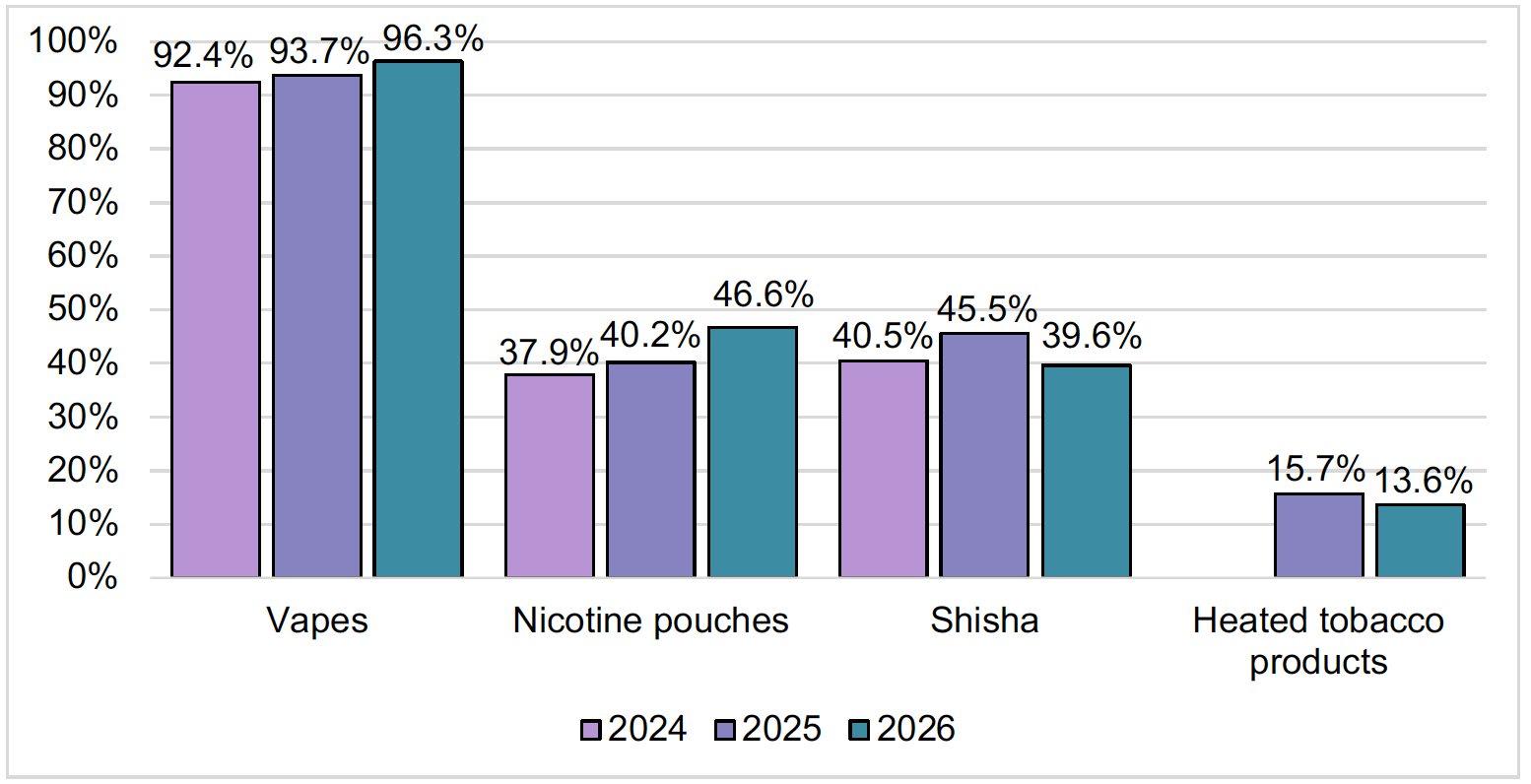
Unweighted base: N=677 (2024), N=755 (2025), N=767 (2026). The question on heated tobacco products was not asked in 2024.
Source of products
Similar to 2025, the findings show that access to products among ever vapers and smokers is primarily through informal routes rather than purchases from retail outlets.
Among ever vapers, 76.1% said their first vape was given to them by someone they know (74.1% by a friend and 1.9% by a relative). A further 11.9% purchased the vape (6.9% from a shop, 3.3% from another person and 1.7% online), while 8.2% reported taking the vape without permission (including 6.0% from someone and 2.2% from a shop).
Among ever smokers, 74.6% said their first cigarette was given to them by someone they know, most commonly by a friend (71.0%) and less often by a relative (3.6%). In addition, 5.3% purchased the cigarettes (2.2% from a shop and 3.1% from another person), while 8.3% took the cigarette from someone.
These findings are presented in Figure 3 below.
Figure 3: Main first source of vapes or cigarettes for all adolescents who have tried vaping (N=146) or smoking (N=120)
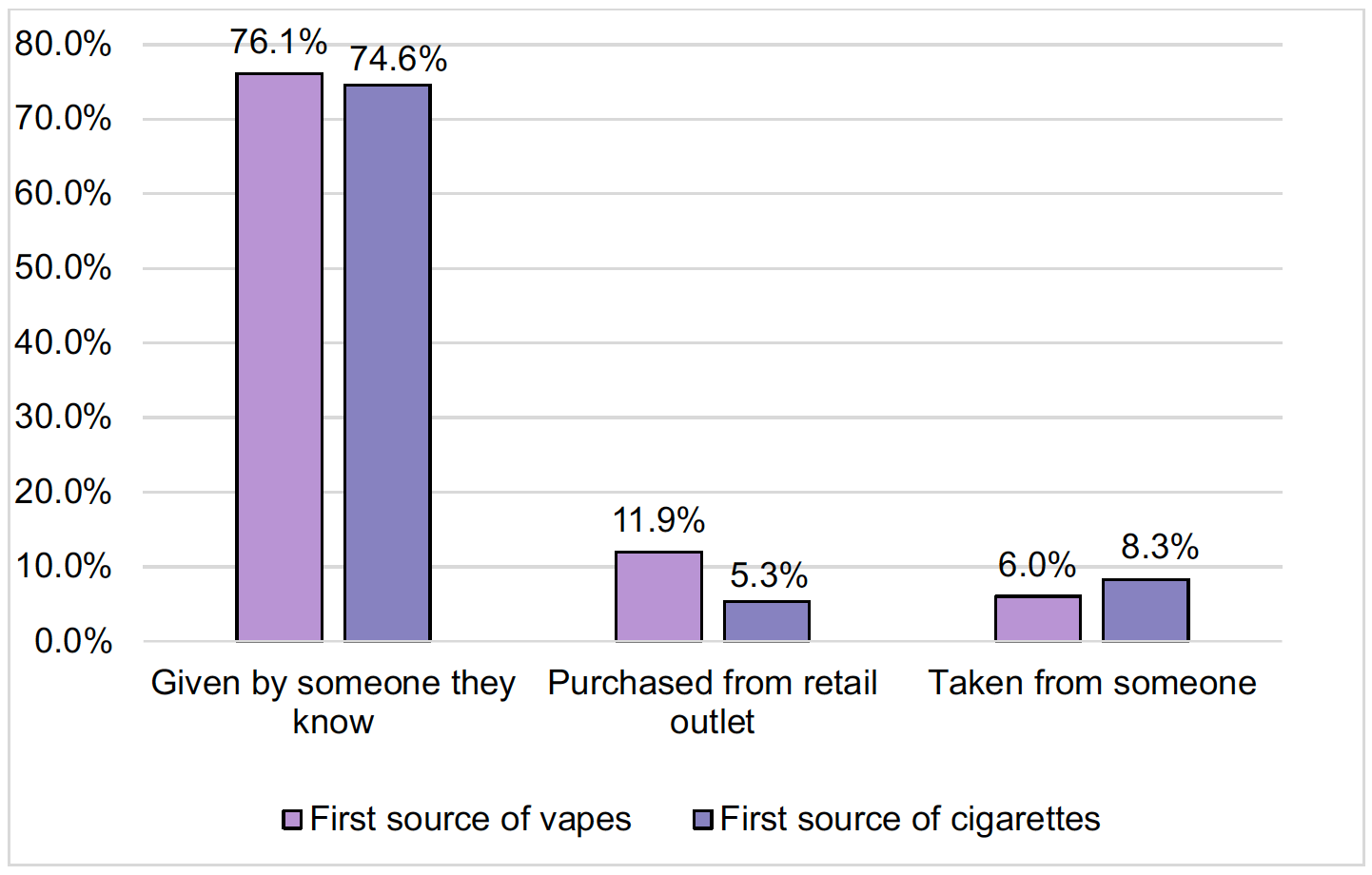
A higher proportion of current vapers and smokers reported obtaining their products from retail outlets compared with ever users. These findings align with the 2025 results; however, they should be interpreted with caution due to the small base sizes.
Thirty-four out of 46 current vapers and 14 out of 23 current smokers reported usually purchasing their products from a regulated outlet (such as a supermarket; newsagent, tobacconist or off-licence; petrol station or garage shop; street market; vape or other type of shop; vending machine; or online, either from formal retailers or informal sources).
Nineteen out of 46 current vapers and 12 out of 23 current smokers said they usually obtained vapes or cigarettes from someone else, either by being given them or by purchasing them.
Two current vapers reported taking vapes without permission and a further two reported obtaining them in some other way.
Current vapers and smokers were asked how easy it was to get vapes and cigarettes. Thirty-two out of 46 current vapers reported that it was easy to get vapes, compared with only one who said it was difficult. Similarly, 15 out of 23 current smokers said that it was easy to obtain cigarettes/tobacco, while only 3 reported difficulty. Among those who still use disposable vapes following the introduction of the ban on disposable vapes in June 2025 (N=10), 6 reported that they are still able to obtain them, 2 said they discard vapes that could be reused, 1 reported continuing to use disposable vapes they had collected before the ban, and 1 selected “I don’t want to say”.
Type of products
Although the base sizes are small and findings should be interpreted with caution, the data suggest a change over time in the type of vapes used among current vapers following the introduction of the ban on disposable vapes in June 2025.
Disposable vapes were the most commonly used type in 2024 (34 of 54 respondents, 61.8%). In 2025, use was broadly evenly split between disposable (29 of 59, 47.2%) and rechargeable vapes (25 of 59, 43.6%). By 2026, the pattern had reversed and rechargeable vapes became the most commonly used type, reported by 31 of 46 current vapers (69.0%), compared with 10 of 46 using disposable vapes (20.6%).
This pattern is mirrored among ever vapers, with a decline in the use of disposable vapes from 74.5% in 2024 to 61.6% in 2026.
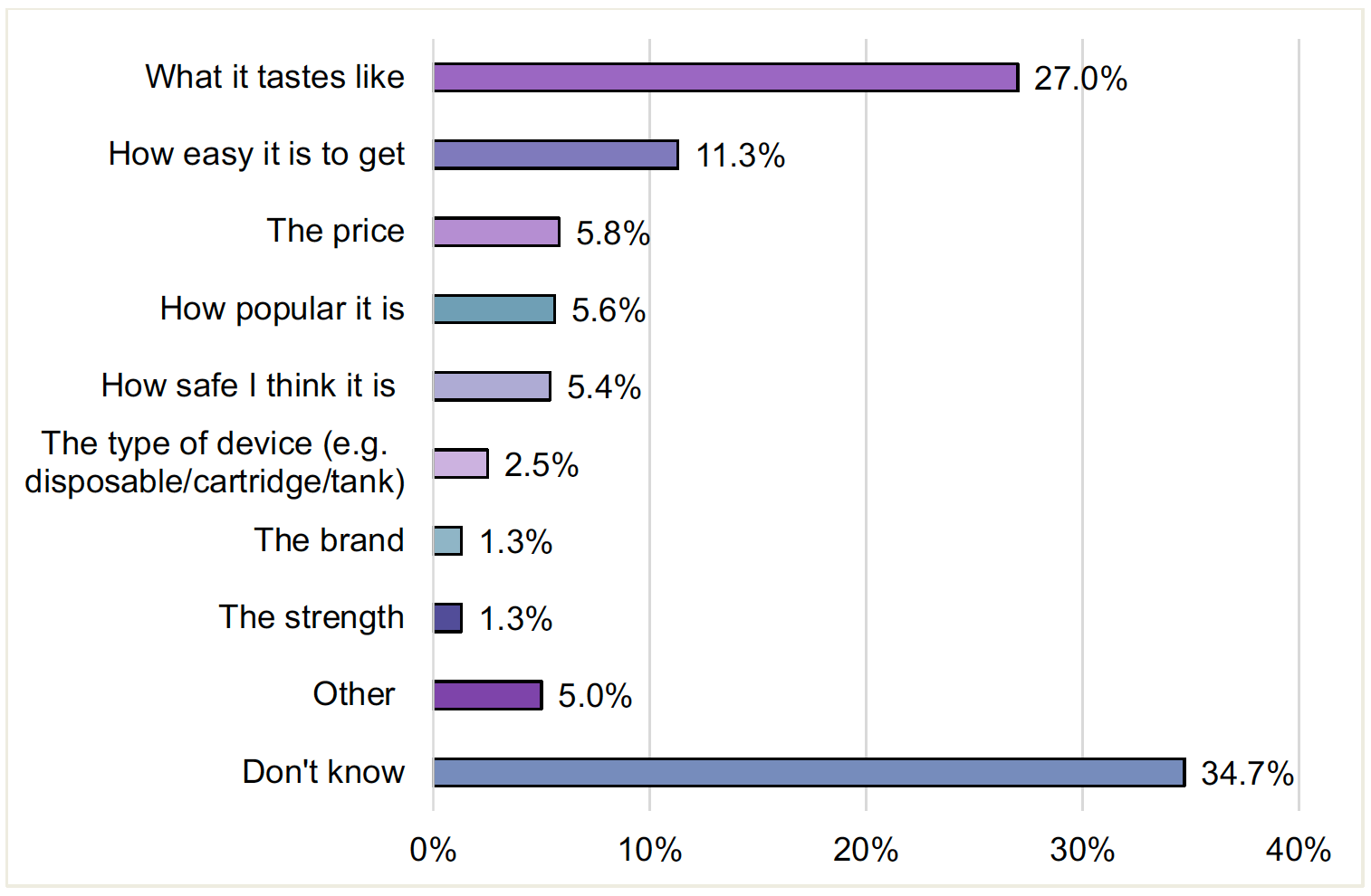
When asked about the most important factor in choosing a vape, taste was rated highest by ever vapers, with 27.0% selecting it. This was followed by ease of access (11.3%) and price (5.8%). These were also the three most commonly cited factors in 2025. Figure 4 below presents all the factors considered in the decision-making process.
Similar to 2024 and 2025, when asked which flavour they use most often, the majority of current vapers selected fruit flavours (33 out of 46). Other flavours selected included chocolate, desserts, sweet, or candy flavour (n=3), menthol/mint (n=3), and vanilla (n=2). Additionally, 18 respondents reported using ice e-liquids.
Among current and former vapers (N=60), a nicotine strength between 10 and 20 mg/ml remained the most commonly used, consistent with 2025. 28.9% reported 20 mg/ml as their most commonly used strength, while 16.4% reported using strengths between 10 and 19 mg/ml. A substantial proportion of respondents (38.8%) reported that they didn’t know/didn’t want to say.
Figure 4: Factors influencing vape choice among ever vapers, 2026 (N=146)
Advertising
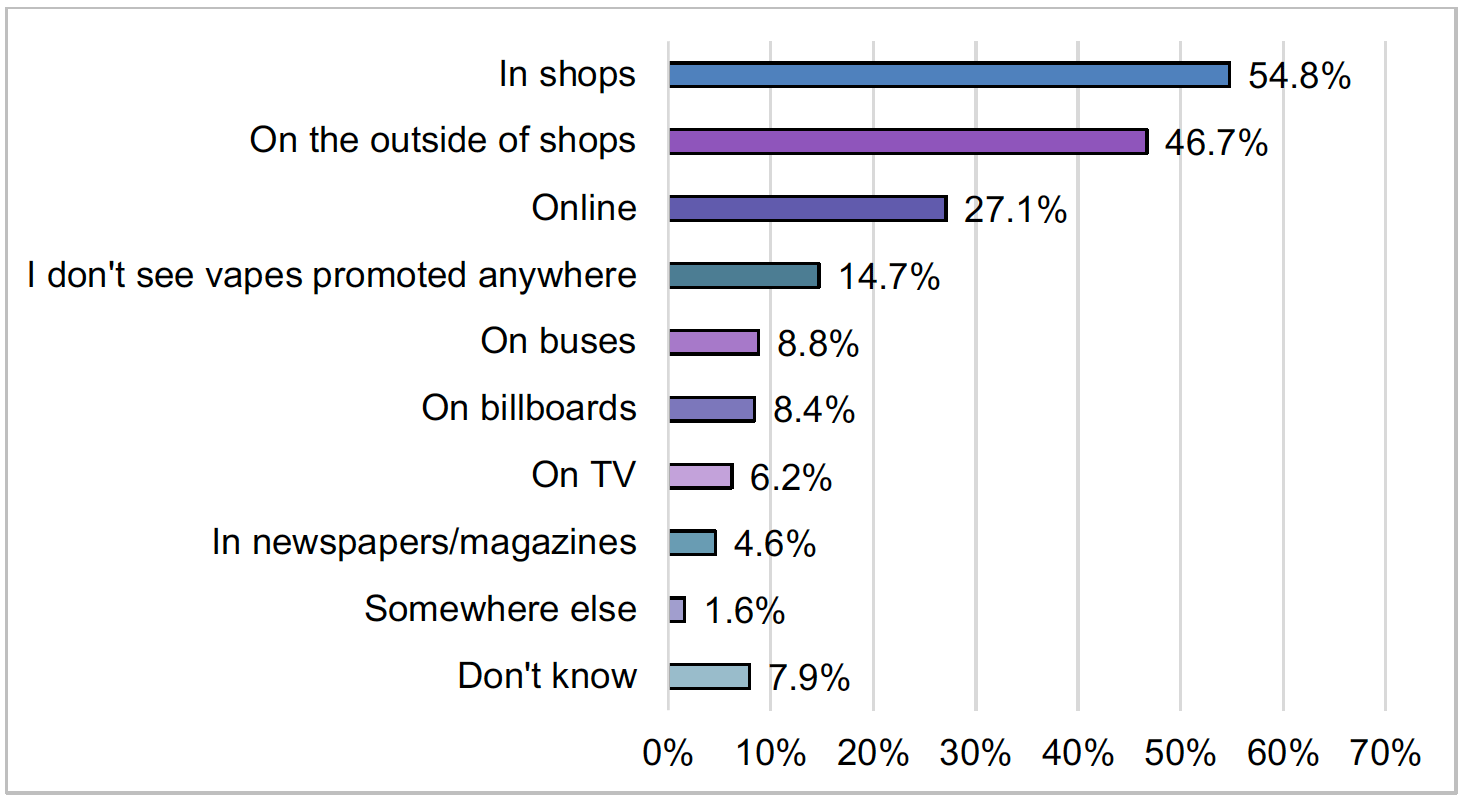
In 2026, among those aware of vapes, shops remained the most common place where adolescents see vape advertising (54.8%). A new response option introduced this year captured exposure to promotions on the outside of shops (e.g. posters and retail signage), reported by 46.7% of respondents. Online was also a common location for exposure (27.1%).
Figure 5 shows the proportion of adolescents exposed to vaping promotions across the full range of locations/types in 2026.
Similar to 2024 and 2025, exposure to vape advertising in shops was higher in corner shops than in supermarkets. Among those aware of vapes and who go into corner shops (N=697), 52.9% said they notice vapes on display every time/most times and 37.8% said they see them sometimes/hardly ever. In comparison, among those aware of vapes and who visit supermarkets (N=714), 27.1% reported noticing displays every time/most times and 53.5% sometimes/hardly ever.
Social media advertising remains the primary channel through which adolescents are exposed to online vape promotion. Among those who reported seeing vapes promoted online (N=211), the majority (43.3%) said they saw them promoted on TikTok, followed by 29.4% on Snapchat, 27.4% on YouTube, and 25.2% on Instagram.
Figure 5: Awareness of vaping promotion (N=741)
Contact
Email: socialresearch@gov.scot