
Trade in Services Report
Examines Scotland’s international trade in services across finance, professional and business services, science, research, creative industries, digital technology and energy. It identifies global growth opportunities and challenges, including market access barriers affecting internationalisation.
Creative Industries
5.1 Sectoral Composition & Overview
- Gross Value Added (GVA) 2022: £1.0bn which constitutes 0.6% of the Scottish Economy. By Comparison, the UK Creative Sector was worth £54.7bn in 2022, which is 2.4% of the UK economy.
- Employment 2024: 17,300 workers which is 0.6% of Scotland’s workforce. In 2022, employment was 20,400 workers which implies a productivity of £50,925.10 per worker in 2022.
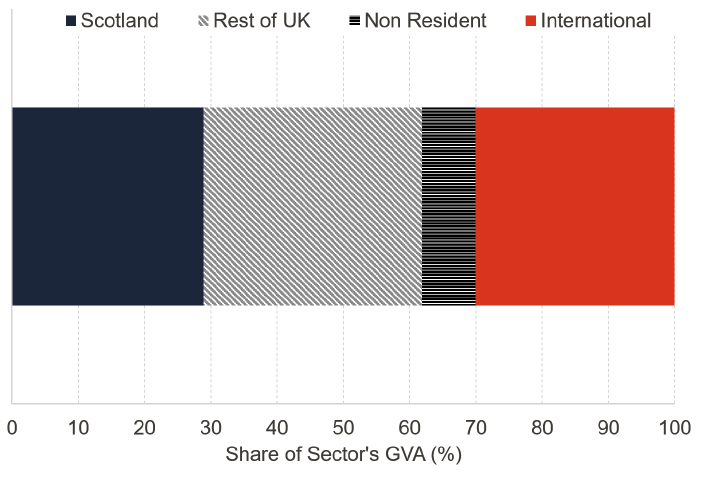
- International Trade (Destination outside the UK) 2022: £313m which is 30.1% of the Creative Industries sector’s total Gross Value Added in Scotland.
- Domestic Trade (Destination in Rest of the UK) 2022: £342m which is 33.0% of the Creative Industries sector’s total Gross Value Added in Scotland.
- Total Exports (Destination not in Scotland) 2022: £739m which is 71.1% of the Creative Industries sector’s total Gross Value Added in Scotland. This includes non-resident spending (i.e. tourism) as well as international and domestic trade.
Source: Scottish National Accounts, UK National Accounts, BRES
The creative sector includes businesses involved in film, TV, music, performing & visual arts, and advertising & marketing. Video game developers also self-selected into the qualitative elements of this sector. However, the rigidity of SIC codes mean they classified as Digital & Tech for quantitative elements. Data analysis of this sector encompasses firms under the following SIC codes:
- 59/60 – Film, Audio, and Broadcasting
- 73 – Advertising and Market Research
- 90 – Creative, Arts, and Entertainment
Scotland’s Creative Sector is very different to its UK counterpart. Advertising & Market research composes 34.9% of the sector’s GVA in Scotland, compared to 43.4% at the UK level.
Creative arts and entertainment activities are approximately 10 percentage points larger in Scotland than the UK.
The Scottish sector is proportionally smaller than the UK, and only 33.0% of GVA is exported to the Rest of the UK. This indicates a degree of distinctiveness present in the Scottish sector, separating it from the UK sector. Tourism (i.e., other) also comprising a notable amount of creative GVA in Scotland.
Source: Scottish National Accounts
Growth in the value of international creative exports slightly outperformed growth in the sector’s value prior to the pandemic (average of 6.2% and 5.2% average annual growth respectively).
Exports to the rest of the UK grew at an average rate of 6.1% annually before the pandemic. In conjunction with the sector’s relatively low proportion of exports to the rest of the UK, this does suggest growth in the Scottish sector having been strongly influenced by the UK sector.
During the pandemic the value of the creative sector and its international exports declined significantly. By 2022, the value of both had recovered, surpassing 2019 values. This is despite the value of exports to the Rest of the UK still lagging behind pre-pandemic levels, further underscoring the distinctiveness between the Scottish and UK sectors.

Source: Scottish National Accounts
| Market | Share of UK Exports |
|---|---|
| United States | 47% |
| European Union | 34% |
| Australia | 5% |
| Switzerland | 3% |
| Turkey | 2% |
| Canada | 1% |
| Saudi Arabia | 1% |
| Japan | 1% |
| Norway | 1% |
| Hong Kong | 1% |
| Top 10 Total | 94% |
Source: OECD, CITP Research
Exports from the UK’s Creatives sector are highly concentrated within the top 10 destination markets for audio services; the European Union and United States dominate the top 10.
Over the past decade, the UK’s Creatives Services trading environment has generally liberalised, positioning the UK as a more open market compared to the EU and the OECD average.
This reflects a broader trend of global openness in the UK’s post-Brexit reality. While the EU maintains free trade internally, it is relatively restrictive toward external partners, particularly for service-based sectors.
Being outside the EU, UK Creative Services now face higher barriers with the EU despite greater access to non-EU markets. The net result is improved access to individually less valuable markets, offsetting some of the challenges posed by newly faced EU restrictions.
Despite this liberalisation, certain domestic barriers remain, primarily related to licensing, qualifications, and operational transparency. Among the UK’s largest trading partners, the US and EU, the most significant restrictions involve temporary movement of service providers and the entry of foreign firms.
| Economy | 2015 | 2024 |
|---|---|---|
| Australia | 1.87 | 1.63 |
| Canada | 2.26 | 2.26 |
| European Union | 1.62 | 1.76 |
| Japan | 1.39 | 1.39 |
| Norway | 2.03 | 2.14 |
| Switzerland | 2.52 | 2.76 |
| Turkey | 2.75 | 3.01 |
| United Kingdom | 1.38 | 1.47 |
| United States | 1.22 | 1.21 |
| OECD Avg. | 1.87 | 1.96 |
| Non-OECD Avg. | 3.16 | 3.13 |
* Score of 0 = Completely Open | Score of 10 = Completely Restricted
Source: OECD, CITP Research
5.2 Current and future global regulatory and non-tariff issues in the Creative Sector
5.2.1 Global regulatory and non-tariff landscape
UNCTAD defines the creative economy as an evolving concept built on creativity, ideas, IP, knowledge, and technology, covering industries from advertising and film to music, games, fashion, software and visual arts.[38]
UNCTAD positions the creative economy as one of the most dynamic and fastest‑growing sectors globally, but also one of the most exposed to fragmented regulation and non‑tariff barriers. Because the Creative Sector depends on intellectual property, digital platforms, and cross‑border digital delivery, the regulatory landscape is shaped by: intangible trade (services rather than goods), rapid technological change (AI, streaming, digital platforms), uneven data, weak measurement systems (especially in developing countries), and wide variation in national oversight systems and absent or partial national strategies (UNCTAD’s 36 country survey).[39]
Non-tariff measures relevant to the creative sector can be broadly categorised into the three types:
(a) Technical and regulatory barriers, such as content classification, censorship, media licensing; broadcasting and audiovisual quotas; and standards for digital services and platforms
(b) Intellectual Property–related non-tariff measures or lack of enforcement (copyright, rights management, digital licensing)
(c) Different types of digital trade and data regulations
Digitalization and AI are emerging regulatory pressure points as both expand and complicate global creative trade. For example, market concentration in digital creative sectors (streaming, audiovisual platforms, app stores) can become a non-tariff barrier for smaller creators, limiting visibility and bargaining power.[40] Also, regulation has not kept pace with digital, platform based, AI driven creative markets. This regulatory lag creates friction, inequity, and new non-tariff barriers. This suggests that future global governance must integrate IP, digital trade, AI, competition policy, and cultural policy.
5.2.2 Subsector mapping
We summarise measures that are identified as non-tariff barriers in the creative subsector by foreign providers in the key reports and programmes.[41]
Film & TV:
- Co production rules — states often impose local partnership requirements; these function as market entry non-tariff barriers.
- Censorship / content approval systems — regulatory procedures act as technical or administrative barriers to distribution.
- Local content quotas — imposed by broadcast or streaming regulators; act as quantitative restrictions.
- Foreign ownership limits — restrictions on media ownership affecting investment and distribution.
- Licensing & classification requirements — a form of regulatory NTMs identified in general NTM literature.
Music:
- Performance and neighbouring rights enforcement — uneven IP regimes function as regulatory barriers.
- Licensing for distribution and streaming — administrative requirements analogous to import licensing.
- Digital platform regulations — data, platform operation, geoblocking and censorship rules affect global distribution.
Gaming/Interactive Media:
- Game classification & ratings requirements — mandatory regulatory approvals function like technical standards non-tariff barriers.
- Content approval regimes (e.g., politically or culturally sensitive rules).
- Cross border data transfer restrictions — critically affect online games
- Licensing for online operations
Performing Arts (theatre, dance, live music)
- Work permit licensing — procedural NTMs hindering international touring.
- Visa & mobility restrictions — administrative procedures equivalent to NTBs; barriers to service exports.
- Restrictions on foreign promoters/production entities — forms of licensing and ownership NTBs.
Advertising / Marketing
- Cross border data flow restrictions —affecting digital advertising and audience targeting.
- Standards for digital ads.
- Content regulations / advertising codes — administrative approval requirements that function as non-tariff barriers.
- Foreign ownership or agency licensing requirements
| Subsector | Type of measures |
|---|---|
| Film/TV | co‑production rules, censorship, local‑content quotas, foreign‑ownership limits |
| Music | performance rights, distribution licensing, digital‑platform restrictions |
| Gaming | classification rules, data‑transfer restrictions, content‑approval systems |
| Performing Arts | visa and mobility barriers, service‑provider licensing |
| Advertising/Marketing | cross‑border data rules, standards for digital ads |
Source: CITP Research
Since UK creative industries are highly services‑ and IP‑intensive, we observe that the type of non-tariff barriers encountered abroad are predominantly regulatory and administrative. These include content approval/censorship, licensing & classification, local‑content quotas, foreign‑ownership limits, cross‑border data restrictions, IP enforcement gaps, visas/work permits, and customs/export permits.
5.3 Creative industries roundtable summary
This roundtable brought together leaders from across Scotland’s creative industries, including architectural and design services, marketing and advertising, the arts, the videogames sector and business development executives for cultural partnerships with higher education. Participants discussed what enables (and inhibits) exporting from Scotland in practice, ranging from specific non‑tariff barriers in the EU to the everyday frictions faced by SMEs and freelancers when accessing trade support, managing payment risk, and navigating cultural expectations in overseas markets.
Many third‑country markets are, on paper, open to Scottish creative services, but firms’ capacity to export is often constrained by: post‑Brexit issues; missing or slow‑moving trade support which is not sufficiently attuned to the needs of firms in the creative industries; intensifying risks around IP and AI; and domestic factors such as the cashflow challenges faced by freelancers.
5.4 SWOT analysis: Creative Industries
5.4.1 Strengths
Soft Power and Global Brand
- Internationally renowned festivals, including those in Edinburgh and major music and cultural events across Scotland, act as export platforms by attracting global audiences and enabling touring and international partnerships. In roundtables, businesses noted that a lot of precursors to actual trade happens at these cultural events.
- Scotland’s cultural visibility reinforces brand recognition and demand for creative outputs overseas.
Diaspora and International Networks
- The global Scottish diaspora strengthens soft power and facilitates export opportunities.
- The GlobalScot network provides market-specific intelligence and trusted connections that support overseas market entry.
Talent and Higher Education Base
- Internationalised higher education networks support cross-border collaboration and reputation building.
- Strong pipeline of creative talent attracts both overseas clients and inward investment.
Regional Clusters and Intellectual Property
- Glasgow, Dundee and Edinburgh serve as hubs for videogames and digital creativity.
- Globally recognised intellectual property, including major titles developed in Scotland, enhances international visibility.
- Creative clusters generate spillovers through innovation, design capability and cross-sector collaboration.
5.4.2 Weaknesses
SME Dominated Structure
- The sector is heavily composed of SMEs, micro-businesses and freelancers with limited administrative and financial capacity to pursue export opportunities. This theme cropped up regularly in roundtables where business lamented inability to access export opportunities due to limited financial capacity despite high willingness.
- Exporting entails navigating regulatory frameworks, compliance requirements and long payment cycles that strain limited resources.
Structural Misalignment in Trade Support Design
- Trade support models focused on high growth firms are not always suited to creative enterprises, where growth pathways differ from traditional scale up models.
- Sole traders and small studios risk falling outside administrative eligibility criteria despite export potential.
Measurement and Classification Gaps
- Outdated statistical classifications obscure the sector’s economic contribution to Scotland.
- Misclassification of videogames and architecture reduces visibility in official data and weakens evidence-based policymaking as well as allocation of potential trade support. For example, video game development sits at the intersection of digital and creative sectors, combining software development with intellectual property creation.
- Under-measurement of supply chain and place based spillovers limits strategic planning.
Acute nature of Cashflow and Payment Risk for individual operators and SMEs
- High exposure to delayed or non-payment in certain export markets. Businesses in roundtables had experienced payment troubles creating a palpable sense of risk aversion to access new markets.
- Upfront project financing requirements create liquidity pressures that most SMEs can find daunting.
- Export insurance mechanisms are often slow or administratively burdensome for small firms.
Inconsistent Trade Support Delivery
- Variable quality and timing of trade missions and sector-specific guidance reduces effectiveness.
- Late notice and limited follow up undermine conversion of introductions into contracts.
5.4.3 Opportunities
Re-engagement with Europe
- A UK–EU reset presents potential for re-engagement with European cultural and funding frameworks.
- Re-joining Creative Europe or developing equivalent partnerships could restore co-production networks and reputational positioning.
Targeted Export Missions
- Designing sector-specific missions around major trade shows, such as the Game Developers Conference, could yield higher returns.
- Greater emphasis on structured post-mission follow-up could improve contract conversion rates.
- Focused targeting of markets such as Japan offers potential for high-value partnerships.
Cluster Led Export Strategy
- Aligning regional strengths, including videogames in Dundee and festivals in Edinburgh, with national export strategy.
- Leveraging regional partners such as local enterprise groups and chambers of commerce to extend reach and build trust.
- Peer networks can act as effective dissemination channels for trade support, especially given the people centric nature of this sector.
AI as Productivity Enhancer
- In marketing and advertising, AI can expand production capacity, enhance international reach and improve cost competitiveness for small teams.
- Adoption of AI tools can allow Scottish firms to compete in global markets more efficiently.
5.4.4 Threats
Post-Brexit Regulatory Frictions
- Loss of automatic mutual recognition of professional qualifications creates barriers for architects operating in the EU. This theme of mutual recognition transcends sectors.
- Insurance and compliance requirements in EU public tenders impose additional costs.
- Visa thresholds limit recruitment of international talent necessary to sustain export delivery.
Market Access Constraints in China
- Restrictions on access to the Chinese videogames market constrain growth prospects.
- Reliance on local Chinese intermediaries increases intellectual property risks. Businesses are forced to chose between either ignoring the growth story of Chinese market or face property theft risks that can lead to diminished market share globally.
Artificial Intelligence Displacement
- Clients shifting to AI generated content has the potential of reducing demand for traditional creative services.
- Entry level roles face displacement risk. This may not show up in economic data but effectively dampen longer term growth prospects.
- Use of scraped creative content to train AI systems raises intellectual property concerns.
Financial Fragility
- Continued exposure to payment risk and insufficient export finance tools could limit willingness to pursue higher-risk markets.
- Weak domestic support mechanisms may increase relocation incentives for high-potential firms.
5.5 Roundtable Feedback and Policy Considerations
5.5.1 Reserved to the UK Government, with a Scottish Government Advocacy Role
The Scottish Government can work proactively with the UK Government to address structural barriers affecting Scotland’s creative exports. Below we list trade policy focused recommendations based on economic data as well as evidence collected from roundtables:
- Secure mutual recognition of professional qualifications for architects with the European Union, restoring more predictable access to EU markets for architectural and design services. Maintain stable and predictable cross border data transfer arrangements, preserving data adequacy decisions and strengthening provisions on data flows in future trade agreements.
- Resolve insurance equivalence barriers that impede cross-border tendering, including requirements in certain EU jurisdictions for locally registered insurance arrangements. While not uniformly raised across all sectors, this reflects the project-based and regulated nature of these services rather than the absence of similar constraints elsewhere.
- Ease mobility and touring restrictions for artists and creators, particularly in the EU, to facilitate short-term performances, exhibitions and collaborative projects.
- Review and reduce salary thresholds for talent visas that currently constrain Scotland-based creative firms’ ability to recruit international staff necessary to deliver export contracts.
- Strengthen international market access for videogames, particularly in China, by advocating for predictable publication routes and drawing lessons from other countries’ trade engagement to reduce regulatory opacity and intellectual property risk.
- Protect intellectual property in the context of artificial intelligence by promoting an opt-in consent model for use of creative works in AI training, ensuring transparent remuneration mechanisms, and embedding strong IP protections within trade dialogues, including safeguards against compelled disclosure of proprietary assets.
5.5.2 Trade Support: Actions for the Scottish Government and Scottish Enterprise, in Partnership with UK Bodies
Given the sector’s structure and export profile, trade support must be tailored keeping SMEs, micro-businesses and freelancers in mind.
- Encourage UK re-engagement with Creative Europe, or equivalent partnership arrangements, to restore networks, co-production opportunities and reputational positioning.
- For SE, reintroduce an account-manager model within trade support services to ensure that creative SMEs receive commercially focused, timely advice aligned to transaction cycles rather than policy timelines.
- Strengthen payment-risk mitigation tools by working with UK Export Finance and relevant bodies to streamline trade credit insurance and export finance processes. Mechanisms should allow pre-approval or rapid activation aligned with contracting deadlines.
- Design trade missions and export showcases with at least six months’ lead time, upfront grant support rather than purely retrospective reimbursement, and structured follow-up over 12–18 months to convert introductions into contracts.
- Restore and expand Scotland’s presence at major international videogames conferences, including the Game Developers Conference, with a particular emphasis on engagement in the United States.
- Leverage Scotland’s own festivals, including those in Edinburgh and events such as Celtic Connections, as export platforms to showcase Scottish creative capability to visiting international buyers.
- Invest in locally engaged expertise in priority overseas markets and continue to mobilise the GlobalScot network to provide market intelligence and connections.
- Improve signposting by creating a clear, single-entry portal for creative SMEs and micro-businesses seeking trade support. Provide clear guidance and practical support for firms navigating data governance and localisation requirements in key markets, particularly where regulatory frameworks are evolving
- Increase sector specificity in guidance and online portals, ensuring sub-sector content, including videogames, architecture and design, is easily accessible and practically oriented.
- Work in partnership with regional and local business networks, including enterprise agencies, chambers of commerce and place-based organisations, to extend the reach of trade support.
- Provide practical market-entry training covering cultural norms, payments practices and partnership models, alongside template agreements to support firms establishing a local presence where required.
- Modernise official measurement of the creative industries by updating classification systems to accurately capture videogames, architecture and related sub-sectors. Improved data will enable more evidence-based policy design and strengthen the sector’s visibility within export strategy.
5.6 Case Study: Lived Experience of a Scottish Creative[42] Services Firm
A typical Scottish creative services SME , employs around 10–25 staff and generates a significant share of its turnover from international clients, continues to export successfully but within a more constrained operating environment than in previous years. International work remains project based and highly reliant on the temporary movement of people, particularly for audiovisual production, music touring, and brand led creative services, yet decisions on whether to pursue opportunities are now shaped at an early stage by uncertainty around short-term work permissions, visa processing times, social security coordination, and the administrative burden associated with operating across multiple jurisdictions. As a result, the firm has become more selective in its international engagement, focusing on a small number of familiar markets where regulatory requirements are well understood. To manage rising fixed costs associated with immigration advice, local tax or payroll representation, and jurisdiction specific contracting, the firm has adjusted its delivery model by deploying smaller Scottish teams overseas, making greater use of local freelancers and intermediaries, and relying more heavily on remote delivery for non-core functions. Although international revenues have remained broadly stable, this adaptation has reduced flexibility, increased overheads, and constrained the firm’s ability to undertake smaller commissions or early-stage creative work, with knock-on effects for the development of new talent and formats. In some cases, maintaining access to international clients has required the use of partners or co-production structures that shift elements of contracting or intellectual property ownership outside Scotland, implying that while exports may persist on paper , the share of creative value and longer-term spillovers retained within Scotland and the wider United Kingdom may be lower than under previous operating conditions.
| Country | Market Size & Growth | Key Drivers | Policy & Support | Barriers / Challenges | Regulatory Barriers (Examples) |
|---|---|---|---|---|---|
| China | Largest global exporter of creative goods; creative industries contribute significantly to GDP | Expanding middle class, rising disposable income, strong government investment | Strong state-led policies, subsidies, infrastructure investment | Regulatory complexity, IP protection concerns, censorship issues | - Strict censorship laws limiting creative content - Weak enforcement of intellectual property rights; widespread piracy - Complicated licensing and approval processes for foreign media - “First-to-file” trademark/IP system leading to bad-faith registrations |
| India | Creative economy valued at ~$30B (2024), employing 8% of workforce; exports $121B (2019) | Large talent pool, digital innovation, AR/VR & animation growth, “Orange Economy” push by the government | Emerging national frameworks, design education expansion, “Create in India” initiatives | Fragmented governance (16 ministries, 28 states), weak IP enforcement | - Fragmented governance: 16 ministries and 28 states oversee creative industries - Weak IP enforcement and high levels of piracy - Proposed AI content labeling rules seen as overreach - Lack of a unified national creative industries policy |
| Brazil | Contributes ~3.6% of GDP (2023), ~$43B annually; strong job creation | Cultural diversity, digital platforms, public programs (Lei Rouanet, Cultura Viva) | Government incentives, IP strengthening, BRICS co-production opportunities | High informality, regional concentration (Rio & São Paulo), economic volatility | -Complex bureaucracy and duplicative regulations - High tariffs and unpredictable tax burdens - Regional concentration of creative industries (Rio & São Paulo), limiting national access - Weak enforcement of artist and cultural professional protections |
| Saudi Arabia | Current value ~$20B, projected to reach $48B by 2030 | Vision 2030 diversification, $155B cultural investment, rapid growth in entertainment | Strong government backing, global partnerships, major cultural investment programs | Conservative cultural norms, evolving IP frameworks, reliance on state-led initiatives | - Strict media rules restricting online expression (e.g., bans on “divisive content”) - Localization and performance requirements for foreign firms - Evolving IP frameworks with gaps in enforcement - Heavy state oversight of cultural and entertainment content |
Contact
Email: Morag.Pavich@gov.scot